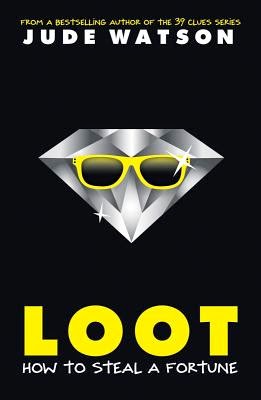
Loot: How to Steal a Fortune

by Jude Watson
First sentence: “No thief likes a full moon.”
Support your local independent bookstore: buy it there!
Content: The only think I can think of is that it’s a bit intense, action-wise. Probably on par with the Percy Jackson books. There’s no swearing, no romance. It’s happily in the middle grade (grades 3-5) section of the bookstore.

This book — combined with The Great Greene Heist (it’s a trend! Does two books make a trend?) — has gotten me thinking about the implausible versus the impossible. It is implausible that Jackson Green could have thrown together a crew to scam less-than-intelligent adults into exposing a blackmailing scheme. It is highly impossible, however, that 12-year-old March McQuin could have gotten together a crew in order to steal back 7 Moonstones that his illustrious thief father, Alfie, stole 12 years before. (Granted, the premise behind the Heist Society books by Ally Carter is also impossible.)

Impossible, however, doesn’t mean “bad”.

In fact, Watson has put together quite a ripping tale. After Alfie’s death during a heist in Amsterdam, March discovers he has a 12-year-old twin sister, Julia, that he didn’t know about. And then, at Alfie’s funeral, March and Julia are confronted by the woman from whom the moonstones were stolen. She’s offered them $7 million in order to steal them back. In a week. They’re up against incredible odds: Alfie’s old partner, who has just recently gotten out of jail, are after the stones as well.

Even though the premise is impossible, Watson does a fantastic job keeping up the pace. The chapters are short, the pacing quick, making it a perfect read for reluctant readers. Plus, it’s action-packed with chases (both in the car and on foot) and rooftop falls as well as planning and executing some pretty amazing heists.

No, it’s not a story that could actually “happen”. But it was still a lot of fun.

Audiobook: Keeping the Castle

by Patricia Kindl
Read by Biana Amato
Support your local independent bookstore: buy it there!
Content: There’s nothing objectionable, but my 8-year-old was quite confused while listening to it. So, it’s probably not for the younger set, just because of intricate plot lines and needing at least a working knowledge of Regency England. It’s in the YA section (grades 6-8) of the bookstore.

Althea Crawley has always known that she needed to marry well. Her father died shortly before her younger brother (and her father’s heir), Alexander, was born. The castle — in the north of England, on a cliff, and their home — her great-grandfather built is slowly falling apart (well, maybe not so slowly). And so when Lord Boring (yes, that really is his name) shows up in the neighborhood, Althea knows what she must do: get him to marry her. Unfortunately, his crass, merchant, cousin, Mr. Fredericks, keeps getting in the way.

The jacket compared this one to I Capture the Castle and Pride and Prejudice. The Capture the Castle part of it is silly: the only things those two books have in common is a young heroine and a castle. However, the book read like a spin on all of Austen’s books. There were elements of Emma and Sense and Sensibility as well as P&P. It’s a more practical Austen, however: Kindl gives us a more confident and curious and modern heroine than Austen ever did. And Kindl gives us more blatant class divisions than Austen did, as well. The love interest is a merchant, and falling in love with a merchant, even a  wealthy one, is something which a landed gentry in Austen’s world just wouldn’t do. In fact, there’s quite a few interesting elements that probably existed in Austen’s time but didn’t overtly make it into her books. As we were listening to it (Hubby quite liked it, too), it occurred to me that this is Jane Austen-lite: an Austenesque books for kids who are curious but can’t quite make it through Pride and Prejudice.

The back did have this right: it is frothy and light as a champagne cocktail. It’s not deep — we were discussing all the ways in which Kindl could have made it more complex and darker than it was — but it sure is fun.

Audiobook: Randi Rhodes Ninja Detective: The Case of the Time Capsule Bandit

by Octavia Spencer
Read by the author.
Support your local independent bookstore: buy it there!
Content: There wasn’t anything objectionable. I don’t know how it’d be reading it, but my 8-year-old followed the story pretty well while listening to it. We did have to stop the audio a few times to explain some things, however. It’s in the middle grade (grades 3-5) section of the bookstore.

I threw this in the audiobook pile mostly because I’ve seen it at the store and wondered if it was any good. (I know: celebrity authors. Ugh. But, sometimes they surprise me. Not often, though.)

Randi Rhodes is a die-hard city girl. She’s grown up in Brooklyn and loved every minute of it. Her family summers in Deer Creek, Tennessee, which is just about the right length of time for a city girl to spend in a boring, dull, small town. But the year after her mother dies (I called that pretty early on; I do get so tired of dead parents), her father, a mystery writer, packs the two of them up to live full-time in Deer Creek. Randi is not happy about this.

But, once there, she falls head-first into a mystery: the 200-year-old time capsule for the town’s Founder’s Day has been stolen. And they have 72 hours to get it back. Much against her over-protective father’s wishes, Randi (and her two new friends, D. C. and Pudge) decide that they are the only ones to solve the mystery.

It’s a pretty run-of-the-mill middle grade mystery book. Nothing too fantastic or brilliant; in fact, as an adult, I’ve seen all the tropes before. The banker is a Bad Guy, as is the power-grabbing Mayor. There’s a grumpy old man with a heart of gold, and a woman sheriff who’s a bit bumbling. (Though — spoiler — this isn’t a true middle grade novel, because by the end, you discover that the sheriff isn’t bumbling at all, but has instead figured out the mystery WAY before the kids ever did.) The best parts of the book are when Randi and her friends are out being detectives; the worst are the angsty tensions between her and her overprotective dad. I got extremely tired of the rants Randi went on about not being “understood.” (But that’s a parent speaking. I did appreciate that Randi was a non-girly girl; she was often ranting about how she wasn’t a princess and didn’t need protection. She’s a black belt in Tae Kwon Do, after all.)

In the end, it wasn’t anything special, though A and K enjoyed listening to it. But, it wasn’t absolutely horrible, either, and Spencer did an admirable job of narrating her book (which I would expect, with her being an actress and all).

Graphic Novel Roundup, June 2014

I discovered that 1) I’m reading more graphic novels than usual right now. Perhaps because I’m picking up a bunch for K at the library due to summer reading. Her goal is to read 36 graphic novels by the end of July. She’s read 15 so far. And 2) I really like these graphic novel roundups. Here’s what I’ve been reading this month.

Will & Whit
by Laura Lee Gulledge
Support your local independent bookstore: buy it there!
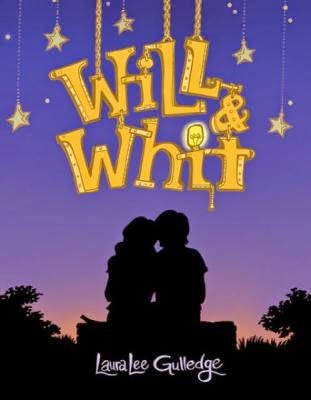
Content: The cover is misleading; it’s not a romance. Not really. Thematically, it’s a little mature — it’s in the teen graphic novel section — but I’d give it to an interested 10- or 11-year-old.

The Will in the title is Wilhelmina Huckstep,  girl whose parents died in an accident recently, the summer before her senior year. She’s living with her aunt, who runs the family antiques store. The Whit in the story is Tropical Storm Whitney which causes the entire town to lose power, thereby creating a situation where everyone has to be unplugged from their technology and interact with each other. It’s delightfully drawn, and balances the dark — Will grieving for her parents and trying not to be a burden — and light — her wonderfully eclectic friends, and the Penny Farthing carnival they put on. There is some romance, with a couple of Will’s friends, but it was very sweet and not at all central to the plot. A delightful summer read.
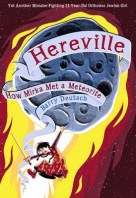
Hereville: How Mirka Met a Meteorite
by Barry Deutsch
Support your local independent bookstore: buy it there!
Others in the series: How Mirka Got her Sword
Content: There’s nothing. I’d let K read this, though she might be a bit confused with the Yiddish words. It’s in the middle reader graphic novel section.

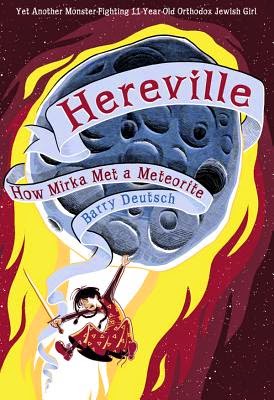
Mirka has her sword, but she longs for more adventures. Instead, she’s stuck at home, knitting berets (its the only thing she can knit) because she’s grounded. Her stepmother, Fruma, just wants her to make reasonable choices. But Mirka is impulsive — something I love about her — and as soon as she could, she went back to the troll for her sword, craving something More. Then the troll sends a meteorite to earth, and the witch changes it into another Mirka. Suddenly, Mirka’s got someone she hast to share her life with. It’s complicated, and Mirka learns that adventures sometimes aren’t all they’re cracked up to be.

Like the first, this one is a delightful mix of Orthodox Judiasm and fantasy. And it works wonderfully. I adore Mirka, I love learning about her life, and I love the adventures Deutsch gives her. Fantastic.

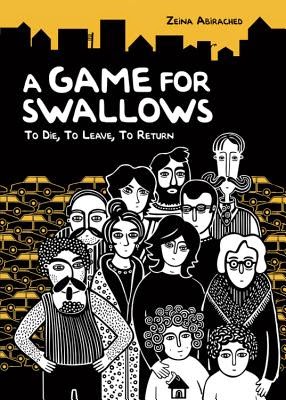
A Game for Swallows
by Zeina Abirached
Support your local independent bookstore: buy it there!
Content: There’s some talk of war and killing, so thematically it’s pretty intense. But, I wouldn’t object to giving it to a 10- or 11-year-old, if they expressed interest. It would been in the teen graphic novel section.

I know absolutely nothing of the Lebanese civil war that happened in from 1975 to 1990. I was a teenager in a small town in America, and it just wasn’t on my radar. But, thanks to Abirached, I have gotten a glimpse into what life was like for those going through it. The book takes place entirely in one night in the foyer of the apartment of two children as they wait for their parents to come back from their grandparents’ house. It shouldn’t be that big of a deal, but in East Beirut, full of shelling and snipers, it is. The foyer is the only safe place in the apartment, and their neighbors — from the young(ish) handyman to the older couple to the former French teacher to the older woman who has been a nanny for a family for 65 years — congregate there in the evenings. The mood ranges from celebratory — they make a cake and enjoy a game of Scrabble — to tense — when they find out that the children’s parents had left an hour earlier and had still not arrived. It’s a picture to how life goes on in the face of war, in the face of uncertainty and in the face of death. Done in very stark black-and-white drawings, it’s a very simple and powerful tale of human resilience.

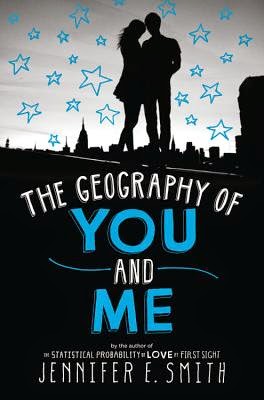
The Geography of You and Me

by Jennifer E. Smith
First sentence: “On the first day of September, the world went dark.”
Support your local independent bookstore: buy it there!
Review copy sent to my boss by the Little, Brown people, and she passed it off to me.
Content: There’s kissing. And a wee bit of swearing. Mostly it’s just sweet. It was in the Teen section (grades 9+) but after finishing it, I moved it to the YA section (grades 6-8) and it fits there just fine.

Lucy is the youngest child of well-off parents, living in an upscale apartment in Manhattan. Owen is the only child of parents who were once drifters, and whose mother recently died in a freak accident. His dad — who isn’t doing so well — is now the superintendent of Lucy’s building. They would have never met, except they were both in the elevator when the power went out. It was a chance meeting, but one that expanded into a night spent wandering a darkened New York City, and then falling asleep on the rooftop.

The next morning, though, Owen is gone when Lucy wakes up, and they never really quite connect again. Lucy’s parents move her to Scotland; Owen’s dad is fired and they’re headed west, looking for jobs. They figure they’ll never see each other again. Except, Owen starts sending her postcards. And so, they start a tentative long-distance relationship. One with its ups and downs.

It’s not a spoiler to say that this one has a hopefully ever after. It’s not happy, per se — Lucy and Owen still live a great distance away — but it’s hopeful that they can make it work. And it’s not a spoiler to say that it’s not a terribly deep book. There’s no issues, really, and no angst. It’s mostly just a sweet journey of two people figuring out they really really like each other.

It’s enjoyable fluff, though. Sweet and charming. And I found that’s exactly what I needed to make me smile.

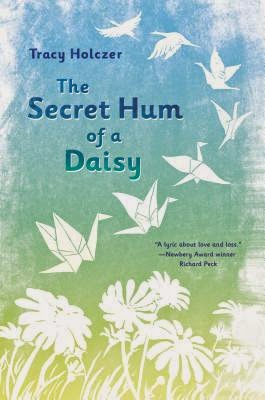
The Secret Hum of a Daisy

by Tracy Holczer
First sentence: “All I had to do was walk up to the coffin.”
Support your local independent bookstore: buy it there!
Review copy downloaded from Edelweiss.
Content: The subject matter — death and forgiveness — is a bit mature, but not so much that I don’t think a fourth-grader could handle it. There is some talk of crushes and bras, but even that is pretty tame.

It has always been just Grace and her mother. For 12 years, they’ve been wandering from city to city, finding work and a place to live here and there, never really settling down. When they finally make it to Sacramento, moving in with another single mom and her daughter, Grace finds she’s had enough of moving. She and her mother argue, and later that night, her mother dies in a tragic accident.

Suddenly, Grace is faced with moving in with her grandmother, whom she’s never met (and has a terrible opinion of, since she kicked Grace’s mom out when she got pregnant). To say it’s not something she wants to do is an understatement. At first, she tries to resist moving in with her grandma; she takes to sleeping in the shed, and tries to pull pranks to get her grandma to send her back to her friends’ house, where she was living. But, slowly, as she gets accustomed to the town, she learns that clues to her mother’s past, and therefore hers, are there, and slowly builds a home for herself.

I’ve read a lot of books with dead parents, so it takes something special to make one stand out of the pack. And I think, in many ways, this one had that something special. First: it was death-by-accident, and Grace was the first one to find her mom. It was realistic in that they argued, it was sudden, and Grace has to live with that. There’s also the non-shiny way everything fit together. Grandma was curt and doesn’t deal with loss well. Grace was petulant and stubborn and doesn’t deal with loss well. People are selfish, and unhappy, and yet…. it all works to make it feel more real than grating (it sounds grating. It isn’t. Well, maybe a little. But that helps give Grace her growth arc.). I also enjoyed the artistic thread that weaved its way through the book; Grace’s mother was an artist, her grandmother a landscape designer, and she’s a writer. The words of Robert Frost also tie this book together, giving it a poetic feel. It’s also a very hopeful book, one that looks past grief and loss to find a new beginning.

And one I found that, in spite of being about death and loss, I thoroughly enjoyed.

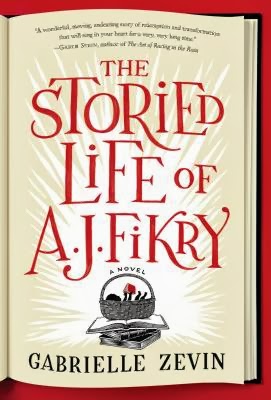
The Storied Life of A. J. Fikry

by Gabrielle Zevin
First sentence: “On the ferry from Hyannis to Alice Island, Amelia Loman paints her nails yellow and, while waiting for them to dry, skims her predecessor’s notes.”
Support your local independent bookstore: buy it there!
Review copy is the one that’s being passed around the bookstore staff.
Content: There’s a lot of language, including a handful of f-bombs. I would give it to a bookish teenager, if they expressed interest.

A.J. Fikry is the owner of Island Books on Alice Island (off the coast of Massachusetts), and it’s not something he’s terribly fond of. In the twenty-one months since his wife’s accidental death after an author event, he’s become increasingly more reclusive and cranky. Then two things happen: someone steals his first edition copy of Tamerlane, by Edgar Allen Poe and someone leaves a two-year-old girl on the doorstep of the bookstore. The first is significant because selling Tamerlane was A. J.’s retirement fund. Without it, he’s stuck on the island, running this bookstore, for the unforeseeable future.  The second is significant because it changes his life.

He is a reluctant father, mostly because his wife was pregnant when she died, and he hasn’t quite gotten over the loss. But his daughter, whom he names Maya Tamerand Fikry when he finally adopts her, gets under his skin and the skin of the community. It’s through concern for her (and for A. J. as her father) that the bookstore finds a second life. As does A. J. Through taking care of Maya and getting involved in the community, he finds that running a bookstore isn’t half bad. Even if you sometimes have to sell pulp fiction in order to carry the literary fiction.

It’s really a love song to community and to bookselling, and the connection between the two. And even though I didn’t find it to be deep or meaningful, I did (as a bookseller) relate to it, finding it charming. It was one of those books where you like everything, wanting to live next door to these quirky characters because they’re so interesting. However, it lacked the emotional punch at the end that I think Zevin was going for; I wasn’t even the tiniest bit sad. (Maybe that’s more me than Zevin. Even though I liked the characters, I didn’t feel emotionally connected enough to be moved.)

In the end, though, it was simply delightful.

Mark of the Dragonfly

by Jaleigh Johnson
First sentence: “Micah brought the music box to her on the night of the meteor storm.”
Support your local independent bookstore: buy it there!
Review copy handed to me by one of my bosses, who told me to “get on it”.
Content: There’s some violence (none of it fatal), and a bit of an innocent crush. But no language. The reading level is probably a confident 3rd grader/4th grade level. It’s happily in the middle grade (3-5th grade) section at the bookstore.

Piper is a scrapper. She lives in a scrap town at the edge of the Meteor Fields, and runs out after storms, looking for salvageable items — things that have come through from other worlds to hers — in order to sell for pennies. She wants more from her life, especially after her father’s death in the Dragonfly Terrritories’ factories, but she doesn’t quite know where to start.

Then, after a particularly violent meteor storm in which her best friend, Micah, is seriously injured, Piper finds a girl. She’s not-quite-dead and bears the Mark of the Dragonfly, which means she’s protected by the king. Piper revives her, and when a sinister man (whom the girl, Anna, calls “the wolf”) comes looking for the girl, she and Piper escape. Only to find themselves on the 401, the main train connecting the northern Marrow kingdom with the southern Dragonfly one.

Once on the train, though, Piper’s and Anna’s problems don’t go away. They meet a whole host of characters and are being chased by slavers and raiders (and the wolf) on their quest to figure out who Anna is, and what Piper’s budding powers can do.

I know I didn’t do the book summary justice. I’m not sure, however, if anyone can. There’s a lot going on in this book. It does have things going for it: Piper is a complex heroine, stubborn and intelligent, a combination of drive and pluck that made her very likable. My only complaint is that Johnson chose to introduce a romance element (however slight) with a boy. I felt it was unnecessary to the whole story, and it didn’t add anything. However, I thought the relationship between Piper and Anna was incredibly well-written. It became a sisterly bond and one that was very realistic and interesting. And the world — from the objects falling from the sky, to the cool train — was fascinating. The book did feel incomplete — is it the first of a series? — and there were many threads left hanging, but it was a good, solid contribution to middle grade fantasy.

The Tyrant’s Daughter

by J. C. Carleson
First sentence: “My brother is the King of Nowhere.”
Support your local independent bookstore: buy it there!
Review copy downloaded from NetGalley
Content: Some mild language, and some indirect violence. It sits in the YA section (grades 6-8) of the bookstore. I don’t know if I’d give it to a 5th grader or not. I think it depends on how news-savvy the kid is.

Laila is the daughter of the ruler of an unnamed Middle Eastern country. She has a good life — trips to Paris with her mother, a private tutor, a resort by the sea. Then one day her world turns upside down when her father is assassinated right before her eyes.

Suddenly Laila, her mother, and her younger brother, Bastian (the “little king”) are exiled, taking refuge in the United States as Laila’s fundamentalist uncle takes over the country. Not only is Laila exiled from her country, she’s thrown into a world that — for all the riches and opulence she was used to — is vastly different from her own. And, on top of that, as she meets other refugees from her country, she discovers that her loving father was actually a brutal dictator.

I think the publishers are billing this as a thriller — J. C. Carleson is a former CIA operative, after all — but it’s not. It’s much more one girl’s story of awakening, and the harsh realities that brings, as well as of the plight of immigrants and how difficult it is to make a new home. Although she makes friends in her Washington D. C. school, Laila never quite belongs here, being uncomfortable with little things: from wearing short skirts to the dance to the seeming nonchalance that the students have to a bomb threat. Laila is constantly a fish out of water, and I think Carleson captures that perfectly.

There are some thriller-esque elements; Laila’s mom is a constant schemer, and there’s a CIA guy hanging around ominously. And I felt the ending was a bit too pat, not quite fitting in with the rest of Laila’s story. But, for the most part, it was a fascinating exploration of one girl’s attempt to come to terms with her family and the outside world.

The Year of Shadows

by Claire Legrand
First sentence: “The year the ghost came started like this:”
Support your local independent bookstore: buy it there!
Review copy provided by the publisher for the Cybils.
Content: There are ghosts and shades and it gets pretty scary. There’s also a lot of pre-teen Angst and a little bit of romance. For those reasons, even though it’s in the middle grade (3-5th grade) section of the bookstore, I’d probably hand it to the older end of the spectrum. But that’s just me.

Olivia hates her life. Her father — whom she less-than-affectionately calls the Maestro — is wholly absorbed with being the conductor of their town’s struggling orchestra. So involved that Olivia’s mother left. So involved that they sold their house and auctioned off their belongings and moved into the back rooms of the concert hall in order to keep the orchestra afloat. And for 13-year-old Olivia, this does not sit well. In fact, she loathes it. (Understatement of the century.)

She’s miserable, she’s basically homeless, and then… she discovers there are ghosts in the concert hall. Not just ghosts, but shades — ghosts that have given up the search for the chance to move on and given into Limbo — as well. And it’s the shades that are Dangerous. And it’s up to Olivia and her new friend Henry to help the ghosts move on and defeat the shades. And, perhaps, in the process maybe they can figure out how to save the concert hall and the orchestra.

I adored this book for lots of reasons. Olivia was dark and grumpy and prickly and perfect for a ghost story. I loved the musical setting for this — the concert hall, the strains of orchestral music (it needs a soundtrack!) running through the story; in the endnote, Legrand talks about choosing pieces to fit the mood of Olivia’s life, and being familiar with many of the pieces, I think she did fabulously. (I don’t know how non-musical readers would react to it, though. Would it make them want to go look up the pieces?) I enjoyed Henry and some of the other minor characters, with their New-Agey feel and their support of Olivia. Because the Maestro? He’s firmly in the bad parent camp. He’s not a “abusive/horrible/evil” dad, but rather the “neglectful/unobservant” dad. And I can understand Olivia’s anger towards him.

There is one quibble: there’s a plot twist near the end of the book that I didn’t feel was absolutely necessary. (And which added to the Maestro’s bad parent-ness.) I think Legrand needed it for plot purposes, but it felt like it was out of left field, and didn’t quite fit with the rest of the book.

Other than that, though, it was highly enjoyable.

(Just for the record: because this is a Cybils nominee, I’ve been asked to make sure y’all know this is my opinion only, and not that of the panel.)