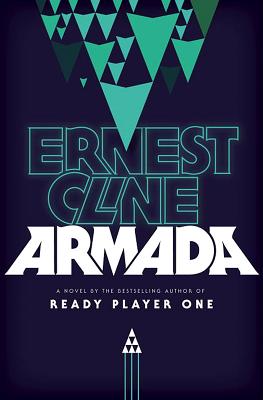
Armada

by Ernest Cline
First sentence: “I was staring out the classroom window and daydreaming of adventure when I spotted the flying saucer.”
Support your local independent bookstore: buy it there!
Release date: July 14, 2015
Review copy pilfered off the ARC shelves at my place of employment.
Content: There’s a lot of swearing, of all sorts. If you have a problem with that, then you probably shouldn’t be reading this. It’ll be in the Science Fiction/Fantasy section of the bookstore.

When I was a kid, one of my favorite movies to quote was The Last Starfighter. (I know: there’s no accounting for taste.) I swear my brothers and I watched it over and over again the summer of 1985 or 1986) and there were lines that incorporated themselves into our everyday lingo (“I’ve always wanted to fight a desperate battle against incredible odds.”). But, when I tried to show it to my kids, I cringed: it’s a pretty bad movie.

So, when I started Armada by Ernest Cline, I cringed: he’s pretty much riffing off the idea behind Last Starfighter (and Ender’s Game): video games, believe it or not, have been training for the impending alien invasion, and since the mid-1970s (it’s set in 2017, as far as I could figure), the top players of the game Armada have been recruited to serve as the Earth’s Defense.

Zack Lightman is one of those players. He’s been obsessed with games, and specifically Armada, since was was old enough to realize that his father — who died when Zack was barely one — was a gamer and Zack wanted to emulate him. Zack’s crawled up the ranks in Armada, until he’s the 6th highest ranked player in the world. And then: he sees a spaceship, one straight from Armada. That’s when his life gets really weird.

Like Ready Player One, this one has a litmus test. If you like/get the following passage, this book is probably for you:

In that moment, I felt like Luke Skywalker surveying a hanger full of A-, Y-, and X-Wing Fighters just before the Battle of Yavin. Or Captain Apollo, climbing into the cockpit of his Viper on the Galactica‘s flight deck. Ender Wigging arriving at Battle School. Or Alex Rogan, clutching his Star League uniform, staring wide-eyed at a hanger full of Gunstars.

I won’t give away too much more of the plot except to say this:  it took a while to get into it, but I was glad I kept with it. I liked the direction that Cline took it in the end.  A good read.

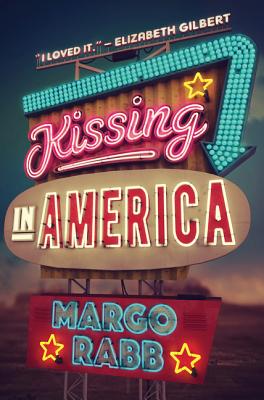
Kissing in America

by Margo Rabb
First sentence: “According to my mother, my first kiss happened on a Saturday in July.”
Support your local independent bookstore: buy it there!
Review copy pilfered off the ARC shelves at my place of employment.
Content: There’s a few mild swear words, s**t being the most prevalent. It’s in the YA section (grades 6-8) of the bookstore.

Eva Roth adores romance novels, much to her feminist mother’s chagrin. Eva loves the sweeping romance, the rugged men (who are ruggedly handsome), the idea of falling in love. She lives in New York City, though; someplace where there aren’t rugged cowboys or Highland Scotsmen to sweep her off her feet.

Then she meets Will: cool, on the swim team, completely inaccessible. Until he is: he’s kissing her on the sidewalk in front of a subway stop, and Eva’s world changes completely.

Enough so that when Will moves to LA  to live with his dad, Eva concocts a way to go see him: she and her best friend, Annie, are going on a cross-country bus trip to be on this Smart Kids game show. Just so she can see Will.

It sounds like a fluffy romance, no? And in many ways it is: Eva falls in love, other people fall in love, there is sweeping kisses and lots of corny romance novel references. But this novel has a darker undercurrent running through it: The reason for the bus trip is that Eva has been afraid to fly, ever since her father died in a freak plane crash.  In fact, the novel turns out less to be about romance than about Eva’s relationship with her mother, grief, and moving on since her father’s death. Which is not what I was expecting.

Even though it wasn’t quite the fluffy romance I was expecting, I did enjoy the story. I liked Eva’s relationship with her best friend, Annie. (Though I wanted to smack her aunt and mother. Seriously overprotective, even if it is understandable.) I liked the road trip part, with Eva getting out of her bubble and routine. (Though it was quite tame compared to, say, the bus trip in Mosquitoland.) And I did like that everything wasn’t “happily ever after”;  it was realistic while being hopeful, and that worked for me.

A good summer read.

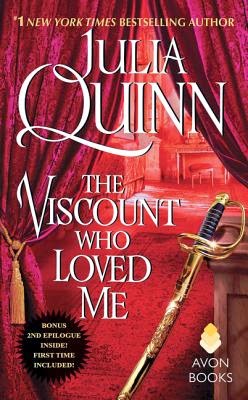
The Viscount Who Loved Me

by Julia Quinn
First sentence: “Anthony Bridgerton had always know he would die young.”
Support your local independent bookstore: buy it there!
Content: Um… yeah…. it’s definitely an Adult book. *blush*

I’ve always said that I prefer plot and character development with my sex (in books). So, I went into this one (a YAckers read, of course) with hopes that it would be, at the very least, entertaining.

And, thankfully, I was rewarded. (Yay!)

The basic plot is was this: Anthony Bridgerton is a rake of the worst sort. It’s 1814, in the height of the Jane Austen era, when chaperones were needed and etiquette was severely structured, and Lord Bridgerton is running around making love to all sorts of women. (Unsavory women, too!) So, of course Kate Sheffield was not going to let him any where near her sister Edwina (seriously: WHAT KIND OF NAME IS EDWINA?), even though she’s the catch of the season and Bridgerton has got it into his head to marry. And everyone knows he gets what he wants.

Except, what he wants turns out to be Kate. *wink wink* *nudge nudge*

And that’s about all the plot there is. There’s a lot (a LOT) of sassy banter between Kate and Anthony and a lot (a LOT) of innuendo and under-the-surface desire before he’s caught with his mouth on her breast, sucking the “venom” out of a bee sting (at which point I was howling with laughter), and they were forced to marry. And then the real fireworks started. Two whole chapters of a sex scene (why was there a chapter break in between?) in which Anthony desires his wife and she lets him have his way with her. (I am SURE there’s a feminist objection here, but honestly, I couldn’t see it for the blatant disregard for the time period.) It was bad. It was so horrible and awful and blush-worthy, I couldn’t stop reading. It was just so bad it turned the corner into good. (Or at least deliciously mock-worthy.) Everyone murmured.   Or had husky voices. It was just too, too delightful.

There were some honestly good bits along the way. I really enjoyed the Bridgerton dynamic as a family: there’s a croquet game that was honestly a lot of fun to read. And Quinn made them a close-knit, loving family which is not something you often see. And there was a bit of depth in both Kate and Anthony; Quinn did manage to give them some fears and insecurities, so they weren’t completely one-dimensional.

Not usually my type of book, but it ended up being a great diversion.

Genuine Sweet

by Faith Harkey
First sentence: “Genuine Sweet.”
Support your local independent bookstore: buy it there!
Review copy sent by the publisher.
Content: There’s a bit too much lovey-dovey stuff than I like for books this age (they kiss a bit and hold hands). Even so, it’s really a middle grade novel, so it’ll be in the middle grade (grades 3-5) section of the bookstore.

I’m a sucker for small town Southern books. (Unlike Ms. Yingling, who loathes them.) I love the small community feel, the quirkyness, and you throw in a bit of magical realism and I’m sold.

Genuine Sweet has all of that. She lives in a small town in Alabama where everyone knows everyone’s business, so that means everyone knows that her daddy is a drunk. Genuine’s (pronounced gen-u-wine) grandma takes care of her, since her mother’s dead, and it turns out that a gift runs in the female side of the family: wish fetching. They don’t grant them, per se, they sing to the stars and fetch the star juice (for lack of a better word) and give it to people who need things. The one cardinal rule: they can’t grant any for themselves.

So, burdened with this knowledge, Genuine sets out to make life a little better for those in the town. But, even as she does so, things get worse at home. No money, no food, no electricity. And as word gets out about her wish fetching Genuine has more and more pressure to fill them ALL. Which takes a toll.

On the one hand, quirky Southern charm. It was very sweet and very Southern, and I liked the way the magic worked: nothing major, nothing huge, just small little helps that fit in with the mood of the book.

But, even with all the quirkyness and the Southerness and the magic, I didn’t absolutely love this book. Partially, because I thought the romance between Genuine and Travis was a bit, well, out of place in a book aimed toward the younger set. And the drunk dad was pretty unnecessary. As was the angry, bitter woman who opposed Geunine’s wish fetching. And all of that added up to make me like, but not thoroughly enjoy this one.

It was a good book, but I think it could have been so much better.

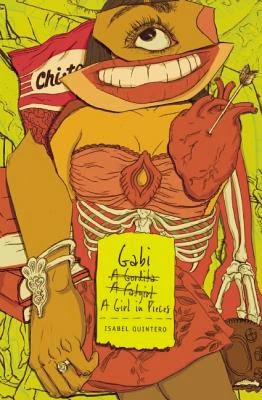
Gabi a Girl in Pieces

by Isabel Quintero
First sentence: “My mother named me Gabriela after my grandmother who — coincidentally — did not want to meet me when I was born because my mother was not married and was therefore living in sin.”
Support your local library: buy it there!
Content: There’s a lot here: talk of drug use, sex (off screen, not graphic), and swearing (including multiple f-bombs). It’d be in the Teen section (grades 9+) of the bookstore.

I didn’t know what to expect when I picked this up. I’d heard good things about it, and it won the Morris Award this year. Even so, I wasn’t prepared for the onslaught of emotions I’d feel while reading it.

It’s Gabi Hernandez’s senior year, and life has gotten more complicated than usual. One of her best friends is pregnant; the other just came out, and has been kicked out of his parents’ house. She’s still struggling with math in school, but she has hopes that she can get into college, the first in her family, since her parents immigrated from Mexico. She wants a boyfriend, but is afraid since she’s a self-proclaimed “fat girl” that she’ll never find love. Then there’s her meth-addicted father, and her punk younger brother. Not to mention a mom who is constantly placing pressure on her to be a “good” girl.

Writing all that down, it both sounds like a lot and not quite enough to hold a book together. One of the things that makes this book shine is the voice. Told in diary form, we get Gabi’s innermost thoughts, her insecurities and feelings, her poems and heartfelt letters to her father (which she never sends). Even though her life is complicated and hard, you can’t help but connect with Gabi on the most elemental level: she’s just a girl trying to live the best she can.

But, it’s also a feminist book, showing us the double standard we have for girls and boys. Which leads me to: oh my gosh, her mom. I wanted to smack her. She was SO hard on Gabi, from nagging her constantly about her weight to lectures about sex (while she tells Gabi’s brother “be sure to use a condom”). I know she was trying and doing the best she could under the circumstances, but I wanted to shake her. Call this another one of those reverse-parenting books, but there is no way I want to have the sort of relationship with my daughter that Gabi had with her mom.

It was Gabi’s awakening to the double standard, and her actively trying to do something about it — which came near the end of the book –which endeared me to the book. There was so much crap going on (if there’s an issue out there that deals with teenagers, it was in the book) going on in Gabi’s life that I found it difficult, initially, to relate. But by the end, I was cheering for Gabi, for her attitude toward her life, and for Quintero’s unflinching portrayal of her.

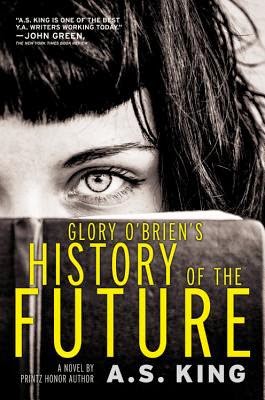
Glory O’Brien’s History of the Future

by A. S. King
First sentence: “So we drank it – the two of us.”
Support your local independent bookstore: buy it there!
Content: There’s some swearing — including multiple f-bombs — plus some frank talk about sex. It’s definitely a more mature book, and is in the teen section (grades 9+) of the bookstore.

Eighteen-year-old Glory O’Brien has had her mother’s suicide hanging over her for practically her whole life. It’s kept her father from doing his art; he stays home, eating, and working as an on-line tech consultant. It’s kept Glory from doing much of anything, really, frozen with the expectation that she, too, will commit suicide eventually.

And it doesn’t help that no one ever talks about It. Or her mom.

Then she and her best friend (by default, since they live across the street from each other), find a dead, mummified bat in the barn. It gets turned to dust, and they mix it with beer and drink it up. And then they start seeing visions.

Glory’s visions are of a horrific patriarchal future, where women’s rights are completely taken away, and the country ends up in another Civil War. This fascinates and terrifies Glory — what’s her role in this future? How does it come to be like this? Will it? — and the act of having these visions pushes her into action.

Trippy doesn’t even begin to cover this book. It’s wild, weird, trippy, odd… King has bitten off a huge piece of cake here, and I’m not sure how well it worked for me. On the one hand, I was thinking it was a Handmaid’s Tale-esque feminist warning about what will happen if we give up the fight and stop questioning the status quo. But the longer the book went, the more I wondered if there was a point to all this, aside from spurring Glory and her dad to action. Maybe there wasn’t. And while I am glad that Glory actually made decisions and started living her life, I kind of wish there were a less trippy way of doing it.

So, in the end, even though I liked the individual elements of the book, I was unsatisfied with it as a whole.

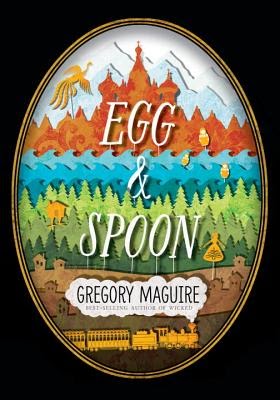
Egg & Spoon

by Gregory Maguire
First sentence: “The heels of military boots, striking marble floors, made a sound like thrown stones.”
Support your local independent bookstore: buy it there!
Review copy provided by the publisher.
Content: There’s nothing objectionable, but it’s a bit long and slow for all but the most advanced middle grade readers. It’s not a Teen book, either, so it’s ended up in the no-man’s land of YA books (grades 6-8) at the bookstore. I’m wondering how it would go as a read-aloud, though.

Elena Rudina is a peasant in pre-Revolution Russia. Her father died in a freak accident, and her mother never quite recovered from that. Her oldest brother is a servant in the baryn’s household and is away in Russia. So when her other brother gets conscripted into the Tsar’s army, Elena decides she needs to do something about that.

Ekaterina is the daughter of semi-noble parents who have dropped her in a London boarding school and gone off gallivanting around the world. The only person who cares about her is her Great-Aunt Sophie, and she’s determined that Ekaterina is going to show up at the Tsar’s party for his godson and be presented as a possible match, which is something Ekaterina does not want.

So, it was quite fortuitous when Elena and Ekaterina meet by accident — the train stops in Elena’s village when the bridge is out — and then (again by accident) switch places. Each get exposure to a different world and are led on the adventure of a lifetime.

I really wanted to like this one. And I did, sometimes. I loved Baba Yaga in all her snarkiness. (In fact, I bookmarked a bunch of her lines. Like: “You’re not going to drink the Kool-Aid?” and “Dumb Doma remodels itself. A nasty habit, like binge shopping.” and “No wonder they call these fairy tales. Tolstoi woudl know better, and a fast train comign into a station would be involved. Blood, tears, regrets. All the fun stuff.”) I sometimes liked the adventure that Elena and Ekaterina were having. (Madame Sophia ended up being a favorite of mine as well.) But, something seemed… off… about this one. Usually I don’t mind intrusive narrators, but this time, he (though I wonder why Maguire chose that particular narrator) was annoying enough that I just wanted him to go away. And that (along with Baba Yaga) got me wondering if this is really a kids’ book, or rather a book for adults who like kids’ books. I found myself hard-pressed to come up with a kid who would enjoy this.

It reminded me most of The Girl Who Circumnavigated Fairyland in tone and style (though it’s much, much longer), And K really liked having that one read aloud to her. So, maybe there is some hope for this one. I just wish I liked it better.

Audiobok: Stiff

by Mary Roach
Read by Shelly Frasier
Support your local independent bookstore: buy it there!
Content: Um, Roach doesn’t mince her words when she talks about scientific stuff, and so some of this is kind of … gross. Fascinating, but gross. There’s a few mild swear words, but if you’re interested in dead bodies, go for it. It’s in the science section of the bookstore.

I picked this one out because I was in between audio books and because I really enjoyed Roach’s writing in Gulp. This time (it’s an earlier book), Roach takes a look into what happens to bodies after people die. From the ones that are donated to science — used in anatomy labs, for surgery practice, for research, etc — to the way the bodies decompose, you have to say that Roach is nothing but thorough.

On the one hand, this wasn’t the best book to listen to. Frasier did a good enough job narrating (though I had to keep reminding myself it wasn’t Roach talking; much of the book is in first person), it’s just that when you read about bodies decomposing, you don’t want to LISTEN to the words. Or at least I don’t. I never got physically ill, but it did make me queasy on a couple of occasions.

On the other hand, though: it was fascinating. Even if the book is 10 years out of date, it’s interesting to think about what can be accomplished through science after one dies. If anything, it got me thinking about what I want done with my body (though Roach pointed out that much of what is done with the body is decided not only by the deceased but by the family members) after I pass on. I think I was most swayed by one of the final chapters where Roach wrote about a woman in Sweden who was advocating for promession, which is a way of composting bodies. For some reason, this really struck a chord with me. I’d much rather be turned into earth and help a tree grow than sit in a graveyard. Shocking, I suppose. But my kids are on board with that (at least right now).

In the end, even though it was gross at times, I really enjoyed this one.

I’ll Give You the Sun

by Jandy Nelson
First sentence: “This is how it all begins.”
Support your local independent bookstore: buy it there!
Content: There is some teen drinking, a (non-graphic) rape scene, and several f-bombs. That, and because of the subject matter, puts it in the Teen section (grades 9+) of the bookstore.

Noah and Jude are twins, separate people but connected in thought and purpose (generally). So much so that they’ve become NoahandJude, pratically inseparable. That is, until the summer they turn 14. Then everything starts to fall apart. Jude becomes “wild”; Noah retreats into his own world until a new boy shows up next door. They end up “dividing” their parents, each vying for the other parent’s attention and love. On top of that, they are fiercely competing to get into the local prestigious art high school. It’s a mess.

Two years later, things aren’t much better. Jude made it into the school; Noah (who was arguably the better artist) did not. They’re still dealing with the aftermath of their mother’s fatal accident. They harbor secrets. And they’re no longer NoahandJude. They’re not even Noah and Jude. They’re two separate planets, who never talk to each other. It’s different from what it was before, but no better.

Did I mention that Jude sees the ghost of her dead grandmother, and senses the presence of her dead mom?

It’s thanks to the two ghosts that Jude searches out Guillermo, sculptor extraordinaire and Latino Mystical Guide, and finds not only salvation but True Love.

Yeah, the book derailed just about there.

For the record: everyone in this book is a Tortured Soul Needing Redemption. And they all find it together. I did enjoy Guillermo — in fact, he was the most interesting character — but that doesn’t change the fact that his role in the book was to cause a change in the white people around him. He was Passionate Lover, he was Father Figure, he was Spiritual Guide. And sometimes he was a living-breathing person, but those times were rare.

And don’t even get me started on the whole Soul Mate thing. Ugh.

What saved this book from being Truly Horrible was the writing — Nelson paints the world vividly, and I do have to admit that there was some good chemistry between Jude and her Soul Mate, even if that’s a trite trope and needs to be done away with. But what I really loved was the art. I loved Guillermo’s giant sculptures and the way Nelson depicted the process of art. I loved Noah’s chapters and the way he’d come up with paintings for everything. I loved how she considered fashion an art.

In the end, I did respect what Nelson was trying to do. But it’s not a perfect book by any means.

A Horse Called Hero

by Sam Angus
First sentence: “Wolfie stopped, distracted by the stacks of sandbags and newly dug trenches.”
Support your local independent bookstore: buy it there!
Review copy provided by the publisher.
Content: There’s really nothing objectionable for the target audience, though there are letters written in cursive, and I know my 3-5 graders would have problems deciphering those. There’s also several intense situations, so if you have a sensitive child, you might want to shy away from that.

Dorothy and Wolfgang Revel — they go by Dodo and Wolfie, however — are children in London the winter of 1940 when the German bombs start dropping. Their father is called up to serve in the army — he was a celebrated commander during World War I — and they are sent off to Northern England to live with strangers. They’re doing okay, until word comes back that their father was arrested for desertion. Then, they are outcasts in this strange place. That is, until they’re taken in by the school teacher. Whereupon Wolfie chances across a horse being born and adopts it for his own.

If you can’t tell my my enthusiastic summary of the first 50 pages (which is really all that is; this book covers an enormous amount of time), I am not a horse person. And, alas, this book did nothing to help with that. I kind of had hopes that this would be Inspiring and Uplifting and help me see what people find in horse books, but… no. I was bored. The basic plot revolves around Wolfie’s love for Hero The Horse and the kids’ concern about their father. There was an incident when Hero saved them after they got trapped in the bog, and another when Hero helped Wolfie get out of a mine after an explosion, but by then, I was so Bored because of the lack of Real Plot (and the extended time; Wolfie was 5 or so when it started, and 14 by the end), I was just skimming.

I am sure that there are kids who would Love this one, but I am not one of them.