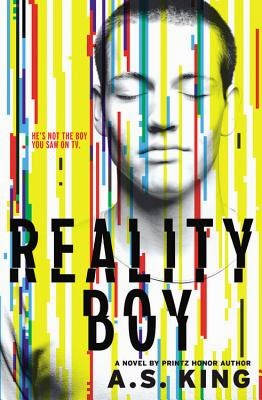
Reality Boy

by A. S. King
First sentence: “I’m the kid you saw on TV.”
Support your local independent bookstore: buy it there!
Content: A lot — a LOT — of language, and to say Tasha isn’t nice is to grossly misunderstand her. There’s also sex, but none of it is graphic. Or even titillating. It’s in the teen section (grades 9 and up) of the bookstore.

I’ve been doing a lot of thinking about this one since I finished it. Like other books I’ve read recently, I’m not sure this one boils down to a “like” or “dislike”. There was just so much going on that was SO horrific that when I was finished I didn’t want to run around saying to everyone that you HAVE to read this book. That said, I finished it basically in one sitting, because I couldn’t tear myself away.

When Gerald was five, his parents (his mother, mostly) decided that he was a Problem Child and wrote to the Network Nanny show to get them to come help Solve the Problem that was Gerald. And so the Network Nanny came, and he was shown crapping on national TV on the table, in his mother’s shoes, in all sorts of places. And, 12 years later, he still hasn’t lived it down. His nickname is “Crapper”. He’s in Special Ed (because someone who craps on the table MUST be developmentally delayed). He’s in therapy for anger management. And he given up all hope of having a future; his only goal is to stay out of jail.

As the book progresses, though, you come to realize that Gerald isn’t a problem child, that he’s just been labeled that way. And that the situation — from his parents who DON’T DO ANYTHING to his teachers who DON’T DO ANYTHING — has rendered Gerald completely helpless. The book is basically his awakening: the realization that it’s HIS life and if he wants to change it, he CAN. That he doesn’t have to be a victim, doesn’t have to conform to his mother’s expectations of him (which are low, to say the least). And that’s empowering.

Its not an easy read.  Gerald’s family is beyond messed up. But King’s writing is not without compassion towards Gerald and his eventual girlfriend, Hannah. There are moments of hope, breaks between the bleakness that make it easier to get through the moments — with his sister Tasha, especially, who is the driving negative force in Gerald’s life — that are hardest to get through. There is hope, in the end, as well. It’s not a happy book, by any means. But it is a powerful one.

And for that reason, it should be read.

Audiobook: The Killer’s Cousin

by Nancy Werlin
Read by: Nick Podehl
Support your local independent bookstore: buy it there!
Content: There’s talk about a murder and a suicide, a lot of mild language, and one f-bomb. Plus a lot of intense situations. It’s in the teen section, (grades 9 and up) of the bookstore, but I’d give it to an 8th grader if they showed interest.

David Yaffe is a killer. Sure, he was acquitted at trial for murdering his girlfriend, but he knows in his heart that he. is. a. killer. So, even though he’s off to Boston to live with his Uncle Vic and Aunt Julia (and their daughter, Lily) and to start over at a new school, he knows — knows — that things will never, ever be the same again.

It doesn’t help that Vic and Julia have waged a cold war with David’s parents for years, and that Julia (at least) is not happy to have David there. It also doesn’t help that their daughter, Kathy, committed suicide in the attic apartment where David’s currently living. And it really doesn’t help that Lily resents David’s presence. Not because he’s a killer — which is the reason most people can’t be around David — but because he’s an intrusion in her perfect little (albeit warped) world.

I don’t know how this is in print form, but listening to Podehl narrate the book, I was completely creeped out. Especially by Lily. It was one of those books where I was yelling at the CD in the car “NO. SHE NEEDS HELP!!” pages (discs) before the characters realized it. And Vic and Julia? I don’t care if it was the mid-1990s (I realized, at one point, that Kathy was my age, which means Vic and Julia were my parents age), they were horrible, horrible, horrible parents. (So were David’s, for that matter.) The epitome of controlling and judgmental. And there was very little growth arc, for them, at least. (Though I’m pretty sure that wasn’t the point of the book.) However, David and Lily, were fascinating characters, and the book is more about their relationship than anything else.

And that had me compelled — even if I thought Podehl’s voice for Lily was a bit on the whiny side — from the first disc to the last.

The Diviners

by Libba Bray
First sentence: “In the town house at a fashionable address on Manhattan’s Upper East Side, every lamp blazes.”
Support your local independent bookstore: buy it there!
Content: There wasn’t any language (at least that I noticed), and there was only illusions to sex. What puts this in the Teen (grades 9 and up) section of the library is the violence. There are 5 gruesome murders, spouse abuse, and other assorted violence. And then there’s the whole occult/creep factor, not to mention the teenage drinking. However, I’d give it to a 12- or 13-year-old if they weren’t overly sensitive.

Evie hates her small-town Ohio life. She’s a modern ’20s woman, and hates being shackled, especially by her Prohibition-supporting mother. So, when Evie makes big blunder with her talent for “reading” objects — she accuses the town’s Golden Boy with knocking up a maid — and she’s shipped off to Manhattan to stay with her admittedly odd uncle, she’s more than happy. She’s thrilled: finally, her life can Begin!

But while Evie makes some good friends, and goes to a couple of thrilling events, things aren’t all coming up roses. There’s a serial killer out there, brutally murdering people and leaving occult signs on the bodies. Her uncle — who runs the Museum of American Folklore, Superstition, and the Occult — has gotten involved with the investigation into the murders, and Evie, being the Modern Woman that she is, weasels her way into that. Which brings a whole mess of problems.

One of the strengths and weaknesses of Bray’s book is that Evie’s isn’t the only story. Bray is weaving a huge tapestry here, with multiple story lines that weave in and out of each other. She’s setting up a huge confrontation, of which the murders only play a small part, but I didn’t mind because the characters themselves were so engaging. To the tortured Ziegfeld star Theta, to the daughter of union supporters Mable, to the charismatic thief Sam, to the tortured Jericho, to the African American bookie runner Memphis, they were all characters I wanted to spend time with and get to know. But in many ways, there was almost too much. The book comes in at nearly 600 pages, and it’s only a first in a series. That’s a lot of set-up going there. And while the overall plot line — the murders — gets resolved, the last 40 pages are spent setting up the next book, which dampened my enthusiasm for it.

But dampened isn’t a dislike. There really is so much to love about this one, from the creepy to the characters.

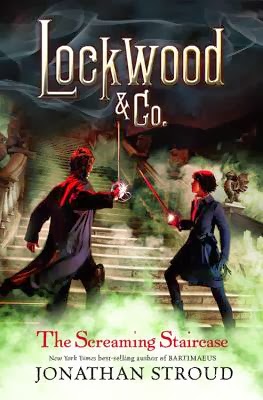
The Screaming Staircase

Lockwood & Co, Book 1
by Jonathan Stroud
First sentence: “
Support your local independent bookstore: buy it there!
Review copy snagged from the ARC shelves at my place of employment.
Content: It’s a ghost story and pretty scary at times, which means, while it’s on a middle grade reading level (and it’s shelved in the middle grade — 3-5th grade — section of my library), I’d be pretty wary about giving this to a Sensitive Child. There’s also a handful of mild swear words.

Even though I saw the rave reviews and the gushing praises, I put off reading this one for much too long. Even though I’ve loved Stroud’s books in the past, I was wary of the rave reviews: it couldn’t be THAT good, could it?

Well, yes. Yes, it was.

Set in a London where there is a Problem with ghosts — they’re everywhere, infesting the buildings and graveyards  — and where only the young can see, and subsequently fight, them. Usually, those with the Talent to see/hear the ghosts, are supervised by adults, but at Lockwood & Co. there’s no such oversight. It’s just Anthony Lockwood, George, and Lucy, teenagers and ghost fighters extraordinaire.

Okay, so it’s not that simple. Lucy and George constantly bicker, and Lockwood is more optimistic about the future of his company than actually capable of running it. But the three of them are talented ghost fighters (hunters? I wasn’t quite sure what to call them), and even though they’re not exactly careful, they get the job done.

Then, on a routine clearing, Lockwood and Lucy stumble on a particularly fierce ghost. It turns out that it was Annabel Ward, a socialite and actress who was murdered and shoved into a chimney. This captures the imagination of our narrator, Lucy, and she ropes the boys into helping her figure out what, exactly, happened to Annabel 50 years ago. One of the best things about this book is the way Stroud handles the mystery: he gives us enough clues as we go along to make a good guess, but it also isn’t the only element to the book. Neither is the ghost Problem. There’s enough layers and depth in this book to keep even the most reluctant of readers interested.

And even though it takes a good 2/3 of the book to get to where the title came from, it all comes together splendidly (fantastically, I might add) at the end.

Additionally, Stroud knows how to do atmosphere. It’s creepy, it’s funny, it’s haunting. It’s eloquent. One passage that stuck out (it’s near the end, but it doesn’t give anything away):

All around us rose the scream, issuing directly from the steps and stones. Its volume was appalling — as painful as repeated blows — but it was the psychic distress it carried that made it so unbearable, that made your gorge rise and your head split and the world spin before your eyes. It was the sound of the terror of
death, drawn out indefinitely, extending on forever. It spiraled around us, clawing at our minds. 

It’s not just good. It’s brilliant.

(Just for the record: because this is a Cybils nominee, I’ve been asked to make sure y’all know this is my opinion only, and not that of the panel.)