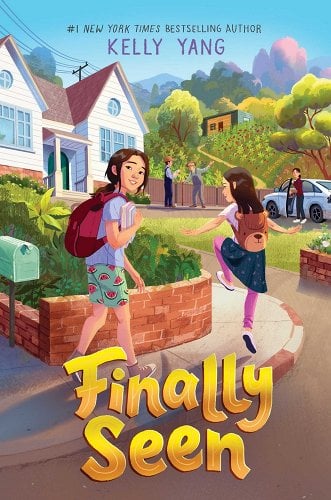
Finally Seen

by Kelly Yang
First sentence: “I listen to the quiet hum of the plane and the not-so-quiet flutter of my heart in my chest.”
Support your local independent bookstore: buy it there!
Content: There is bullying and microaggressions both by other children and adults. It’s in the Middle Grade (grades 3-5) section of the bookstore. I read this book for the Cybils, and this reflects my opinion and not that of the whole panel.

Lina Gao has lived with her grandmother in China for the past five years while her parents and younger sister start a new life in America. She has missed her family but loved her time with her grandmother. But now, her parents have sent for her. She is racked with guilt for leaving her grandmother to go live in a retirement home, but excited to start a new life in America. Unfortunately, it’s not all happiness and roses. She can’t speak English well, so starting a new school is difficult for her. Her parents and sister have a bond that she isn’t part of. And then there’s her parents’ financial situation: back rent from the pandemic is due and her father’s boss at the organic farm is pretty sketchy.

Through the ups and downs of Lina’s life, she gains some friends, helps her parents figure out their finances, and figures out how to navigate her school. And in the end, she feels like maybe she can make a place for herself in her new life.

I liked this one. Reading the author’s note, it seems that some of this reflects Yang’s experience, which makes it that much more interesting. It’s a good immigrant story and a good reminder that everyone wants the best life they can have. Several white adults (mostly men) came off pretty bad in this – they were bullies and racist towards Lina and her family. (One of them – the father of a friend of Lina’s did start to learn and change…) This is a good reminder of how adults tend to use and abuse their power. I like the portrayal of the immigrant story, and I think it’s definitely an important book to have on shelves.

Moning Sun in Wuhan

by Ying Chang Compestine
First sentence: “It feels as though hours have passed since the waitress took my order.”
Support your local independent bookstore: buy it there!
Content: There is talk of the COVID pandemic and the death of a parent. It’s in the Middle Grade (grades 3-5) of the bookstore.

Twelve-year-old Mei and her father are just surviving since her mother died a year ago. They go to work and school, and even though Mei likes to cook, she doesn’t really find any joy in it. Then, in January of 2020, a strange new disease crops up in their town in Wuhan. Suddenly Mei is cut off from her dad and friends. So, she figures out how to put her talent for cooking and organizing to help her neighborhood out in the early days of the lockdown.

So, I wanted to like this one. I appreciate that stories are starting to be told about the pandemic and I appreciate it being told from the perspective of the place where COVID started. But this one was just kind of… blah. It lacked any real conflict, and even the anxiety surrounding those first days of the pandemic. I get that it’s for younger kids, but it just wasn’t great.

That said, it’s good that it’s out there.

The Tao of Pooh

taoofpoohby Benjamin Hoff
First sentence: “‘What’s this you’re writing?’ asked Pooh, climbing onto the writing table.”
Support your local independent bookstore: buy it there!
Content: It’s a primer on philosophy and the Tao Te Ching. If that sounds interesting, then it’s probably your speed. It’s in the Religion/Philosophy section of the bookstore.

Of COURSE one follows up Winnie-the-Pooh with The Tao of Pooh, right?

Right.

I’d read this once, a long time ago (probably after I was first married because the copy we have is Hubby’s), and honestly didn’t remember it much at all.

It’s an interesting hybrid of imitating the Pooh stories, an analysis of the stories and a comparison to the Tao Te Ching. I enjoyed the comparisons of Pooh to the principles of Tao, because it helped explain these admittedly foreign (at least to me) principles in a way I could understand. It reinforced the idea that meditation — the act of actively doing nothing — and being present in the moment are Good Things. And it reinforced the idea that not getting caught up in Ideas and letting your brain run away with itself is not healthy.

The only downside is that while Pooh (and sometimes Piglet) gets all the Praise, he kind of knocks Eeyore, Rabbit, and Owl, and I do have a soft spot for them. So it was kind of sad to see that, at least in the Way, they’re less valued.

Even so, it was a good reminder of helpful practices and good ideas that I needed.

When the Sea Turned to Silver

whentheseaby Grace Lin
First sentence: “When the sea turned to silver and the cold froze the light of the sun, Pinmei knew the Black Tortoise of Winter had arrived with his usual calmness.”
Support your local independent bookstore: buy it there!
Review copy provided by the publisher.
Others in the series: Where the Mountain Meets the Moon, Starry River of the Sky
Content: It’s a slow book, with only a little action, so it’s probably not for those readers who like a fast-paced page-turner. It’s in the middle grade (grades 3-5) section of the bookstore.

I feel I’ve run out of things to say about this sweet series based on Chinese mythology. It’s very much like the other two: an adventure of a main story, interspersed with old legends which blurs the line between “myth” and “reality” It has an element of the fantastical, with gods and magic, but it’s not overbearing, rather fitting seamlessly into the story of a granddaughter searching for her grandmother.

So, really, there isn’t anything more to say except if you haven’t experienced the delight that Lin’s tales are, you are really  missing out.

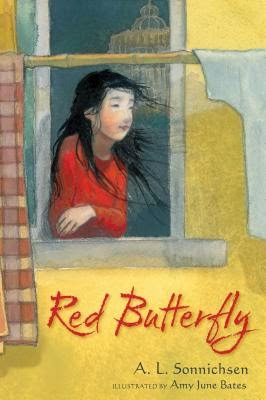
Red Butterfly

by A. L. Sonnichsen
First sentence: “Mama used to have a piano
with an on/off switch
and a dial to make drums beat.”
Support your local independent bookstore: buy it there!
Review copy snagged from the ARC shelves at my place of employment.
Content: It’s pretty long, which will turn some readers off, though it’s in verse, which makes it easier to read (but also might turn readers off). The Chinese words, while spelled phonetically, might also be a deterrent. It’s in the middle grade (grades  3-5) section of the bookstore.

Kara was abandoned at birth, and in China, that generally means certain death. Especially since she is a girl and born with a deformed hand. But a kind, elderly American woman living in Tianjin took Kara in. Now, eleven years later, Kara is wondering why Mama never leaves the house, why she has never gone to school, and why they can’t leave to go join Daddy in Montana.

It takes a while for things to spill out: Mama is always telling Kara to be content with what she has, and not long for something more, but things do eventually come to light. In China, one needs papers to be a legal resident. Kara, because she was abandoned and rescued, has none. And so, they’ve been in hiding all these years.

On the one hand, I enjoyed this peek into China, especially the lives of those children who are neglected and abandoned to the orphanages because of the one-child laws. It’s told in verse, which suits Kara’s contemplative nature and her desire to figure out who she is and where she belongs.  I liked the people Kara met and her interactions in the orphanages.

However, while I got to know Kara and her story, it felt, well… too American. An American pulled her off the streets when she was a baby. She befriended a New Zealander worker in the orphanage (not American, but English-speaking/Western). She ended up in Florida with a second adoptive family. There were Chinese characters, but they were almost afterthoughts in Kara’s life. And while I understood why, I was sad not to get to know China or the Chinese.

It wasn’t bad, overall, but it wasn’t my favorite either.

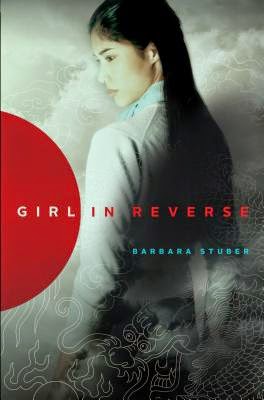
Girl In Reverse

by Barbara Stuber
First sentence: “Say it, Lily.”
Support your local independent bookstore: buy it there!
Content: There’s some mild swearing and kissing. It’s probably a more complicated plot than the Middle Grade section warrants, so it’s in the YA section (grades 6-8) of the bookstore.

Lillian Firestone is an adopted daughter of Chinese heritage. Which makes her a target in Kansas City in 1951, the height of the Korean War. She took the bullying and name-calling when she was younger, but now that she’s 16, she’s taking a stand. Sort of. She walked out of class and school one day, and that act started a domino chain of events that led to the discovery of her birth parents.

There’s art involved and a lot of Chinese culture as Lily goes on this journey.

(I’m tired. Can you tell?)

I wanted to like this book. I love the cover, I love the ideas, the conflict. But I could never connect with Lily. She drove. me. nuts. Completely. And so I started skimming, skipping ahead just to see what happens. And yeah, everything’s tied up in a nice little bow.

It had potential, and I’m sure some readers will really love the art and China elements. But I wasn’t really one of them.