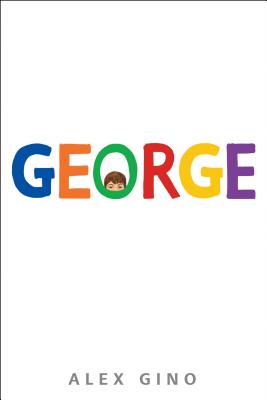
George

by Alex Gino
First sentence: “George pulled a silver house key out of the smallest pocket of a large red backpack.”
Support your local independent bookstore: buy it there!
Review copy provided by the publisher rep.
Content: There’s a lot to talk about and think about here; be prepared for questions. Content-wise, however, it’s simply written,  and so is in the middle grade (grades 3-5) section of the bookstore.

I don’t quite know what I expected from this. It’s got an agenda from the beginning: it’s the first middle grade book about a transgender female child. So, from the start, there’s that underlying the entire book.

There isn’t much plot. George is physically a boy, but identifies as a girl. It’s a secret she keeps from everyone. Except that, as the fourth grade is putting on a play of Charlotte’s Web and George would love to be Charlotte. And she wants to be Charlotte. Which means, in a round about way, being brave and informing people of her true self.

It’s a very open, accepting book; there are bullies, true, but mostly people are accepting once George comes out and confesses her true self. It’s quite liberating.

But, that’s all it is. It’s an important book, true, and an open-minded one. But it’s not really a good book. It’s kind of pedestrian, language-wise, and there’s way too much that’s told and not enough shown. I always felt like I was on the outside, looking in (maybe that was on purpose), and I never quite connected with the story, either. Not that I don’t understand its importance; I do.

I’m just not sure I liked it.
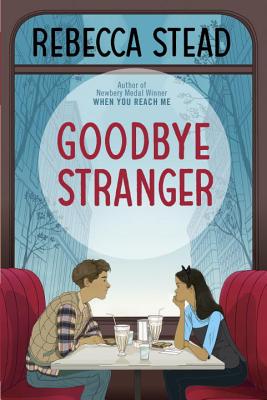
Goodbye Stranger

by Rebecca Stead
First sentence: “When she was eight years old, Bridget Barsamian woke up in a hospital, where a doctor told her she shouldn’t be alive.”
Support your local independent bookstore: buy it there!
Review copy picked up at Children’s Institute
Content: There’s one swear word. And several situations that are more middle school than elementary school. It’s in the YA section (grades 6-8) of the bookstore, but I’d give it to a fifth grader, especially as they’re approaching middle school.

I’ve been thinking about how to start this. It’s not an easy book to categorize: is it a book about friendship? Yes. About growing up? Also yes. About bullying and the shame girls feel about their developing bodies?Again: yes. About first love and that line between friendship and something more? Yep.

But it’s also more: it’s about doing the wrong thing and making it right. About figuring out who you are in the wake of change. And it’s all done with Rebecca Stead’s beautiful writing.

The story is nominally about three friends — Bridge, Em, and Tab — who have been friends since the third grade. They made a pact to always stick together and never to fight, which is easy until seventh grade. Then Em begins attracting the notice of older kids and boys, and, well, likes it. Tab becomes enamored of a feminist teacher and dives headfirst into the world of equality and civil disobedience. And Bridge is kind of stuck in between. She doesn’t really want to grow up (I can relate), and yet she’s kind of interested in it as well. She picks up a pair of cat ears on a headband and wears those through the fall and winter because they felt “right”. She’s not quite sure who she is, or where she fits.

There are plot points, and chapters written in second person by a “mystery” high school freshman narrator (I figured out who it was fairly quickly. Yay me!), but mostly the book is about every day little things as Bridge is trying to figure out where she fits in this weird middle school world.

I loved it, and I think I did for one reason: I saw both myself and my daughters in this book. I saw the awkward 7th grader I was, and realized that Bridge was okay in her journey, because I survived. I saw M and C in the friends, and the ups and downs of their middle school experiences. And I saw A, as she starts middle school next year, and was reminded (again) of all the changes that will come her way. And for that, I loved this. I loved the smallness of it (and the diverseness: Bridge is Armenian and Tab is Indian) and the hopefulness of it. And I loved that the friends did, in fact, make it work out.

I thought it was marvelous. I just hope it finds the kids who will think that too.

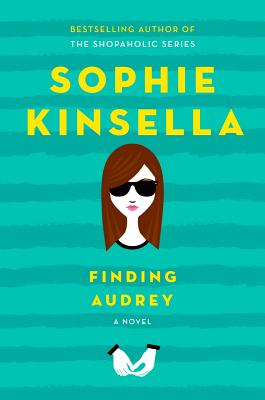
Finding Audrey

by Sophie Kinsella
First sentence: “OMG, Mum’s gone insane.”
Support your local independent bookstore: buy it there
Content: It has six f-bombs, all near the end of the book, and nothing else. So, I’m torn: do I leave it on the YA shelves (grades 6-8), where it thematically belongs? Or do I move it to Teen (grades 9+) where it’s not quite edgy enough, but it fits language-wise? Tough call.

Audrey doesn’t leave the house. Doesn’t talk on the phone. Doesn’t talk to people (outside of her therapist and her family). Doesn’t look people in the eye (in fact, she prefers to wear dark sunglasses all the time). She hasn’t done any of these things since the “incident”. And she prefers to keep it that way.

Before I go much further I have to interject: this is a hilarious book. Perhaps it’s because I love All Things British, but I was thoroughly charmed by Audrey and her family. It is possible to take something serious (like bullying — though you never really find out what happened, and that’s okay) and severe anxiety and to be, well, warm about it.

Maybe I should make a second diversion: I adored Audrey’s family. From her gamer older brother (with his mile-wide sarcastic streak) to her absolutely adorable four-year-old younger brother (adorable!) to her completely clueless dad (probably stereotypical, but it worked), to her over-protective mom (I will stand by my statement that the best way to be a good parent is to read YA books), they were all entertaining. Kinsella definitely wrote this with love.

(It reminded me, in some ways, of the Casson family books. That makes me happy.)

The arc of the novel is Audrey’s “recovery”. It’s aided by Linus, one of her brother’s friends who takes an interest in her. He supports her and pushes her to try new things, to somehow get a grip on her anxiety. I really liked that Audrey was never “cured”: she learned how to handle her fears and her body’s reaction to them, but they were always still around, which was not only realistic but somewhat of a relief.

Yes, things were kind of tied up in a nice bow at the end, but that’s kind of expected and I didn’t mind. In fact, I really quite enjoyed this.

Fish in a Tree

by Lynda Mullaly Hunt
First sentence: “It’s always there.”
Support your local independent bookstore: buy it there!
Content: The chapters are short, and while there are some bigger words, there’s nothing that a 3rd grader couldn’t handle. It’s in the middle grade (grades 3-5) section of the bookstore.

Ally doesn’t like school. Part of that is the result of her moving so much — her dad’s in the military, currently deployed in Iraq/Afghanistan (it didn’t say; I’m assuming this) — of it is because Ally can’t read. It’s a fact she’s hidden by becoming a troublemaker and through her art, but whenever she tries to read, the words swim, her head hurts, and she just. can’t. do. it.

Enter in Mr. Daniels, the permanent sub for her regular sixth-grade teacher who’s off on maternity leave. He picks up on Ally’s defense mechanisms, and realizes that there’s more going on than meets the eye. He espouses the believe that not everyone’s smart in the same way (yay for that!), and draws on Ally’s strength, giving her the confidence to make friends — Albert, the science geek, and Keisha, a baker extraordinaire — and to stand up to the classroom bully, Shay.

There are some nitpicky things that bothered me throughout that kept me from loving this as much as I wanted to. First, why did the teacher have to be male? I’m torn on this one: on the one hand, it’s showing a man doing things that are “normally” reserved for women. He’s concerned about his students, he’s caring, and he reaches out. Not to mention that he’s a man in a female-heavy profession. However, it seems to me in books like this — where a teacher saves a struggling student — the teacher is always male. It’s the men who get to think outside the box, who find ways to connect with the struggling students, who make changes within the system. And that bothered me.

Additionally, there’s a point when Albert comes out of his shell to fight back against his bullies, in order to protect Ally and Keisha from them. Perhaps that was in character for Albert, but it bothered me deeply. Why did he need to protect them? I initially thought it was because they were his friends — maybe he’d do the same for boys who were his friends — but then he says something about “never hitting a girl”and I cringed.

On the other hand, I was glad that Hunt included a broad spectrum of personalities and classes: there are people who are hyper, middle of the road kids, rich kids, kids on free lunches. The usual suspects — drugs, bad parents, etc –aren’t anywhere to be seen. The focus, really, is on celebrating our differences, and recognizing that intelligence isn’t tied to doing well on tests. And that’s worth celebrating.

So, while it’s an uneven book, I’m glad it’s out there.

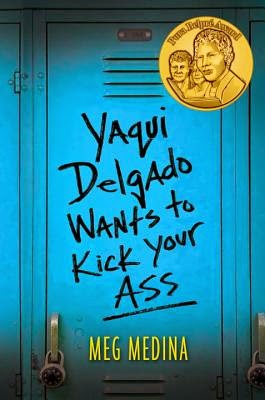
Yaqui Delgado Wants to Kick Your Ass

by Meg Medina
First sentence: “Yaqui Delgado wants to kick your ass.”
Support your local independent bookstore: buy it there!
Content: There’s some mild swearing. The real reason it ended up in the Teen (grads 9+) section is for the bullying and the violence. It’s pretty graphic and the fallout is pretty severe.

Piddy Sanchez is starting a new school. It’s one of those inner city schools in a Hispanic neighborhood in Queens, the kind that justifies every bad stereotype there is. Just a few weeks in, and someone informs Piddy that Yaqui Delgado — whom Piddy has neither seen nor spoken with — is going to kick her ass. Why? Because she thinks Piddy is flirting with her boyfriend. (She’s not.)

It’s this threat, among other things, that begins defining Piddy’s life. She doesn’t feel like she can talk to her mother, who is working extra shifts to try and provide for the both of them. She does turn to her aunt Lila, but even then she keeps the awful details to herself.

It’s a harsh journey, one that I wouldn’t wish on any kid. I did like that there was a range of diverse people in this one; not all white characters were “good” and not all Latin@ ones were “bad”. There was a wide range of personalities, and the color of the skin just happens to be incidental. I also enjoyed how Piddy embraced her culture and loved her neighborhood.

I was glad for the solution to this one, as well. No one really “learned their lesson” and the bully wasn’t reformed and they didn’t become friends and live happily ever after. No, it was much more realistic and messy and showed that sometimes the best option isn’t always the most noble one.

It was a tough read, emotionally raw especially for me (because of the whole daughter thing), but I’m glad I did.

Rhyme Schemer

by K. A. Holt
First sentence: “First day of school.”
Support your local independent bookstore: buy it there!
Review copy snagged off the ARC shelves at work.
Release date: October 14, 2014
Content: Aside from the bullying (which made me uncomfortable), there’s nothing difficult about this book. It’ll be in the middle grade (grades 3-5) section of the bookstore.

Kevin is the youngest of five brothers who are all a lot older than he is. He likes some of his brothers; others, not so much. His parents — both doctors — are gone a lot. So, somehow, he’s become that guy at school who laughs when people fall down. He’s the kind that gets in trouble for tripping a Loser. And he does, often.

But he has a softer side: one that writes free-verse poems (which is the format for this book). He keeps them in a notebook, that he takes with him. He also rips pages out of library books, creating poems by circling words, and sticks them up around the school.

Then his world comes down around him. The kid he usually bullies finds his notebook, and uses it against him, slowly making Kevin into the kid being bullied.

It’s a quiet little book, but one that packs a punch. I appreciated seeing Kevin from both sides: the bully-er and the bullied. It was interesting to see his transition, and to realize that all people are just that: people. And with the backstory — his parents really aren’t the greatest — it was easy to see where the bullying came from.

But what I loved (LOVED!) was the way the librarian (!) saw past everything Kevin was doing and made him feel like a person. Yay for librarians!

Compelling and engrossing and all those other good adjectives.

Fat Boy vs. The Cheerleaders

by Geoff Herbach
First sentence: “Shortly before midnight on June 15, Gabriel Johnson, a sixteen-year-old from Minnekota, MN, was apprehended outside Cub Foods by Officer Rex McCoy.”
Support your local independent bookstore: buy it there!
Review copy pilfered from the ARC shelves at my place of employment.
Content: There’s a lot of swearing, none of it strong. I put it in the Teen (grades 9+) section of the bookstore primarily because I like to keep the YA section toned down. Also, because that’s where all of Herbach’s other books are. I’d say, depending on your kid, it’s good for as young as 7th graders.

In high school, there are two types of people: the jocks and everyone else. Gabe is everyone else.  Actually, Gabe is a band geek, and a mostly friend-less loser. He’s been going downhill since his mom ran off with a Japanese guy a few years back, and his grandpa moved in. It’s not just that he has only two friends, it’s that he’s overweight. Massively so. In fact, everyone (including his friends) call him Chunk. And he’s okay with that.

Gabe spends his days chugging Code Red, primarily because the money in the school’s soda vending machine goes to support the band that is Gabe’s lifeline. He figures he can chug 5 bottles of the stuff, if the money goes to fund his program. Then he finds out that a Super Sekrit school board meeting took away the vending machine money from the band and gave it to the Brand Spanking New dance team. Which makes Gabe mad. Eventually.

There’s more to the plot, of course, but it’s more about Gabe gaining self-respect than any eventual result. You know from the start — the whole book is his confession; a one-sided conversation with a Mr. Rodriguez — that he’s gotten arrested for doing something. You assume it’s for stealing money out of the vending machine. But, things are more complex than that.

Part of the charm of this book is the format; I was entertained by hearing only one side of the conversation, and imagining what Mr. Rodriguez’s side was. But, it was also Gabe. He was such a loser to start with, and it’s empowering to see how he regains control over his life, in spite of the people — from his friends to his father — who are trying to hold him back. Everyone needs a summer in which they find their best selves, and this story of Gabe’s was a truly fun one.

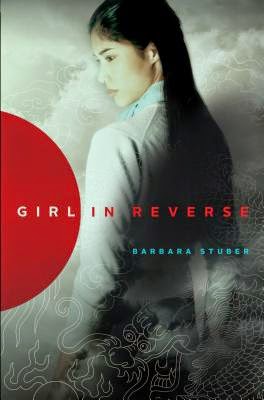
Girl In Reverse

by Barbara Stuber
First sentence: “Say it, Lily.”
Support your local independent bookstore: buy it there!
Content: There’s some mild swearing and kissing. It’s probably a more complicated plot than the Middle Grade section warrants, so it’s in the YA section (grades 6-8) of the bookstore.

Lillian Firestone is an adopted daughter of Chinese heritage. Which makes her a target in Kansas City in 1951, the height of the Korean War. She took the bullying and name-calling when she was younger, but now that she’s 16, she’s taking a stand. Sort of. She walked out of class and school one day, and that act started a domino chain of events that led to the discovery of her birth parents.

There’s art involved and a lot of Chinese culture as Lily goes on this journey.

(I’m tired. Can you tell?)

I wanted to like this book. I love the cover, I love the ideas, the conflict. But I could never connect with Lily. She drove. me. nuts. Completely. And so I started skimming, skipping ahead just to see what happens. And yeah, everything’s tied up in a nice little bow.

It had potential, and I’m sure some readers will really love the art and China elements. But I wasn’t really one of them.

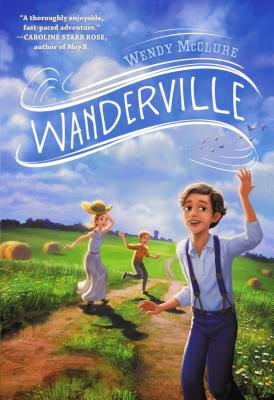
Wanderville

by Wendy McClure
First sentence: “Jack didn’t notice the smoke until there was far too much of it.”
Support your local independent bookstore: buy it there!
Content: There’s a some bullying and a fire that kills a family member of a main character, but that’s about it. It’s short enough to be a beginning chapter book, but it might be too challenging for most 1st and 2nd graders. Definitely belongs in the middle grade (3-5th grade) section of the bookstore.

Jack lives in a walk up in New York City in 1904. Their family is poor, but making it. That is, until a fire takes both their building and the life of Jack’s older brother. Frances and her younger brother Harold are orphans and living off the charity of one of the many orphanages in the city. Both find themselves on a train headed west, as part of the efforts of the Society for Children’s Aid and Relief Office. But, as all three find out, the best intentions of adults don’t always translate into good things for kids.

Faced with being separated from her brother, and looking forced labor in the eye, Frances, Harold and Jack decide to jump off the train before they reach their final destination. They’re wandering the Kansas prairie when they find Alexander, another orphan train escapee. He’s decided to start his own town, called Wanderville, and while it doesn’t look like much (or anything, really) it’s not his own. Unfortunately they way they get supplies is by “liberating” them from the nearby town. Which, obviously, is going to lead to trouble.

I wanted to like this one. It’s got a good idea — exploring the world of the orphans from the orphan train — and it’s set here in Kansas. I was hoping that it’d be a good contribution to historical/Kansas middle grade fiction. But it’s not. Perhaps it was me, but I didn’t like the characters, and felt the text itself was too condescending and predictable. I felt that if I had a checklist I would have ticked every single cliche off.  Bully on the train? Check. Evil man exploiting the system for his own gain? Check. Rugged and slow cop? Check. Sisterly figure who always knows better than the boys? Check. Adorable 7-year-old who is Wiser Than His Years? Check.) That’s not to say that kids won’t like it. I’m sure many will.

I just didn’t.

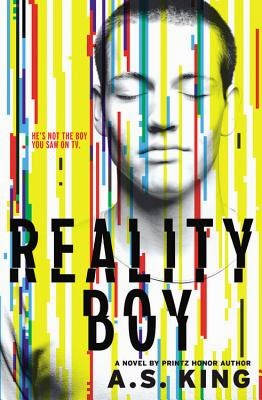
Reality Boy

by A. S. King
First sentence: “I’m the kid you saw on TV.”
Support your local independent bookstore: buy it there!
Content: A lot — a LOT — of language, and to say Tasha isn’t nice is to grossly misunderstand her. There’s also sex, but none of it is graphic. Or even titillating. It’s in the teen section (grades 9 and up) of the bookstore.

I’ve been doing a lot of thinking about this one since I finished it. Like other books I’ve read recently, I’m not sure this one boils down to a “like” or “dislike”. There was just so much going on that was SO horrific that when I was finished I didn’t want to run around saying to everyone that you HAVE to read this book. That said, I finished it basically in one sitting, because I couldn’t tear myself away.

When Gerald was five, his parents (his mother, mostly) decided that he was a Problem Child and wrote to the Network Nanny show to get them to come help Solve the Problem that was Gerald. And so the Network Nanny came, and he was shown crapping on national TV on the table, in his mother’s shoes, in all sorts of places. And, 12 years later, he still hasn’t lived it down. His nickname is “Crapper”. He’s in Special Ed (because someone who craps on the table MUST be developmentally delayed). He’s in therapy for anger management. And he given up all hope of having a future; his only goal is to stay out of jail.

As the book progresses, though, you come to realize that Gerald isn’t a problem child, that he’s just been labeled that way. And that the situation — from his parents who DON’T DO ANYTHING to his teachers who DON’T DO ANYTHING — has rendered Gerald completely helpless. The book is basically his awakening: the realization that it’s HIS life and if he wants to change it, he CAN. That he doesn’t have to be a victim, doesn’t have to conform to his mother’s expectations of him (which are low, to say the least). And that’s empowering.

Its not an easy read.  Gerald’s family is beyond messed up. But King’s writing is not without compassion towards Gerald and his eventual girlfriend, Hannah. There are moments of hope, breaks between the bleakness that make it easier to get through the moments — with his sister Tasha, especially, who is the driving negative force in Gerald’s life — that are hardest to get through. There is hope, in the end, as well. It’s not a happy book, by any means. But it is a powerful one.

And for that reason, it should be read.