Belzhar

by Meg Wolitzer
First sentence: “I was sent here because of a boy.”
Support your local independent bookstore: buy it there!
Release date: September 30, 2014
Review copy downloaded from Edelweiss
Content: There’s some talk of teen drinking and pot smoking, and some swearing (including a few f-bombs; I didn’t count). But, because of the nature of the book — it’s just has a very “adult” feel to it, it will be in the Teen section (grades 9+) of the bookstore. I don’t think, however, it’s beyond the reach of an interested 7th- or 8th grader, though.

Jam — short for Jamaica — is falling to pieces. Her boyfriend, Reese, died, and so she has no real reason for living. After trying everything — pleading, therapy — her parents decide to send her away to a special boarding school for those with issues called The Wooden Barn. Jam is expecting to behave much the same way at this school as she has before: detached, uninvolved, not caring. But then she’s signed up for Special Topics in English and everything changes.

Special Topics is a teacher-selected class of only five students. They only study one author, and this semester it’s Sylvia Plath. They’re required to come to class, to discuss the works, and to write in their journals. But what Jam and the other students don’t realize is this: their lives are about to change.

At first, I loved this book. I like the idea of studying one author in depth, and even though I don’t know much about Sylvia Plath (I really ought to read her stuff), I was enjoying Wolitzer’s writing about it. I didn’t even mind the slight magical aspect of it: whenever the students write in their journals, they enter an alternate reality, a place where the worst thing hasn’t happened. I thought it was a little weird, particularly since I was expecting a realistic fiction book, but it worked for me.

However, the book fell apart for me at the end. Especially with the twist. (I’m not going to tell you what that is.) I do think, though, that it’ll hit the spot with it’s intended audience; I think a lot of my reluctance to go along with it is just age and experience showing.

And the writing is gorgeous. Wolitzer really does know how to turn a phrase. And much like Katherine Howe, I found myself thinking that I really ought to read some of Wolitzer’s adult stuff.

Not bad, in the end.

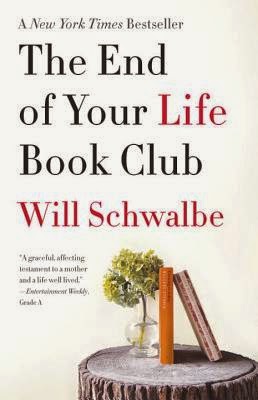
The End of Your Life Book Club

by Will Schwalbe
First sentence: “WE were nuts about the mocha in the waiting room at Memorial Sloan-Kittering’s outpatient care center.”
Support your local independent bookstore: buy it there!
Content: There’s really nothing. It’s a very adult book in its sensibilities, but there’s no reason a teenager — especially a bookish one — couldn’t read this.

This book has been on my radar for a little while; it made the rounds at the bookstore when it came out and many of the staff and regulars loved it. But I didn’t get around to reading it until a good friend of mine suggested it for our book group.

If you haven’t heard about this one, it’s basically the story of Will’s mother as she goes from diagnosis for pancreatic cancer through her final days. The two of them are both avid readers, and they formed their own small book group during her chemotherapy sessions. It’s one part book-lovers book, and one part death and dying story.

I liked the book-lover part better, mostly because it was something I could grasp. I hadn’t read (or even heard of) a good number of the books they talked about, but Schwalbe was enthusiastic and thoughtful about enough of them that I’m interested in checking several of the books and authors out. I highlighted quite a few quotes about books and reading, ones that resonated with me.

As for the death and dying part, I was touched by Schwalbe and his mother’s story. She was a remarkable woman, who did remarkable things in her own small way. I had one of those “if I could only be as awesome as she was” moments. And you could tell the affection that Schwalbe had for his mother. I know that sometimes in these sorts of books the dead person gets “sainted”, but I never felt that his mother was. By framing the book around the books they read, Schwalbe gave this book a grounding — and a broader audience — that you don’t usually find in cancer books, something which I appreciated quite a bit.

I don’t think it was my favorite book ever, but I am glad I finally got to read it.

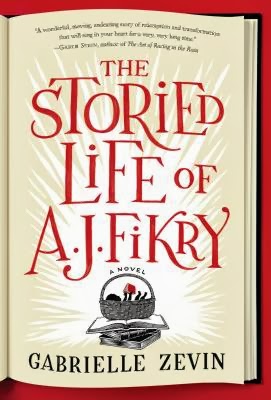
The Storied Life of A. J. Fikry

by Gabrielle Zevin
First sentence: “On the ferry from Hyannis to Alice Island, Amelia Loman paints her nails yellow and, while waiting for them to dry, skims her predecessor’s notes.”
Support your local independent bookstore: buy it there!
Review copy is the one that’s being passed around the bookstore staff.
Content: There’s a lot of language, including a handful of f-bombs. I would give it to a bookish teenager, if they expressed interest.

A.J. Fikry is the owner of Island Books on Alice Island (off the coast of Massachusetts), and it’s not something he’s terribly fond of. In the twenty-one months since his wife’s accidental death after an author event, he’s become increasingly more reclusive and cranky. Then two things happen: someone steals his first edition copy of Tamerlane, by Edgar Allen Poe and someone leaves a two-year-old girl on the doorstep of the bookstore. The first is significant because selling Tamerlane was A. J.’s retirement fund. Without it, he’s stuck on the island, running this bookstore, for the unforeseeable future.  The second is significant because it changes his life.

He is a reluctant father, mostly because his wife was pregnant when she died, and he hasn’t quite gotten over the loss. But his daughter, whom he names Maya Tamerand Fikry when he finally adopts her, gets under his skin and the skin of the community. It’s through concern for her (and for A. J. as her father) that the bookstore finds a second life. As does A. J. Through taking care of Maya and getting involved in the community, he finds that running a bookstore isn’t half bad. Even if you sometimes have to sell pulp fiction in order to carry the literary fiction.

It’s really a love song to community and to bookselling, and the connection between the two. And even though I didn’t find it to be deep or meaningful, I did (as a bookseller) relate to it, finding it charming. It was one of those books where you like everything, wanting to live next door to these quirky characters because they’re so interesting. However, it lacked the emotional punch at the end that I think Zevin was going for; I wasn’t even the tiniest bit sad. (Maybe that’s more me than Zevin. Even though I liked the characters, I didn’t feel emotionally connected enough to be moved.)

In the end, though, it was simply delightful.