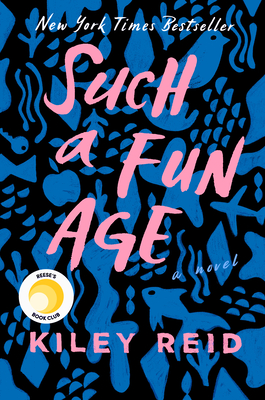
Audio book: Such a Fun Age

by Kiley Reid
Read by Nicole Lewis
Support your local independent bookstore: buy it there!
Or listen at Libro.fm
Content: There is a lot of swearing, including multiple f-bombs. There is also talk of sex, but none actual. It’s in the Fiction section of the bookstore.

Emira is a 25-year-old Black woman who is kind of aimless. All her friends seem to have “real” jobs, but she’s working as a temporary typist for the Green Party in Philadelphia and as a babysitter for Alix and Peter Chamberlin. The thing is, Emira adores Briar, the girl she sits, and doesn’t really feel much of a need to change things up. Then she meets Kelly — at a grocery store after Emira had a run-in with a security cop. And they begin to date, which sets up a run-in with Alix.

It doesn’t sound like a whole lot happens in this book from the description, but it’s more thoughtful and intricate than that. It’s a meditation on relationships — can a wealthy White woman really have a “friendship” with her Black babysitter? Is a White man who sees himself as an ally because he has Black friends and dates Black or biracial women, really an ally? — but it’s also a meditation on how we perceive ourselves. Reid did a fabulous job making no one out to be the “villain” here. Everyone had reasonable motivations (or at least presented reasonable motivations) and I could see they were all operating from a place they thought was reasonable. But, I could also see how the decisions were self-interested. Everyone said they were trying to help Emira, but were their decisions really helping? There’s a lot to talk and think about, especially about the way White people center themselves, even when they’re trying to help.

On top of that, the narrator was fabulous. I loved the way she portrayed each character (especially 3-year-old Briar; she was perfect!) and the way she made them distinctive and intriguing. She kept me coming back (though I think this one would have worked for me in print form, as well) and wanting to see what was going on next with Emira and Alix.

Definitely worth the buzz it’s been getting.

Giovanni’s Room

by James Baldwin
First sentence: “I stand at the window of this great house in the south of France as night falls, the night which is leading me to the most terrible morning of my life.”
Support your local independent bookstore: buy it there!
Content: There is some talk of sex and some mild swearing. It’s in the adult fiction section of the bookstore.

I’m at a loss wit this one. The basic plot is this: it’s the 1950s (the book was first published in 1956, which surprised me) and David is a gay man. Except he doesn’t want to believe it. He believes he is sick, he is dirty. And, in Paris, he’s found a girl — Hella — who he mostly likes and asks her to marry him. Except she’s not sure, so she darts off to Spain, and David meets Giovanni. And falls in love. Head-over-heels, living together love. Until Hella comes back, and David completely dumps Giovanni who ends up going into depressive spiral.

On the one hand, good on Baldwin for writing about LGBTQ characters in the 1950s (I haven’t read much classic lit from that time period, so I really don’t know how common or uncommon it was). Also, it surprised me that all of his characters were White (except Giovanni who was Italian, but that’s basically White). Not saying he shouldn’t have written it, just that it surprised me. But, the thing was: this was so full of gay self-loathing. I understand why: it was, culturally (especially for Americans) taboo, and so those who are gay must have felt absolutely awful about it. I appreciate that insight. But it was so hard to take. Maybe because I’m looking at it through 21st-century eyes, but I felt bad for David. He didn’t need to mess up his life so much because he was gay. But, then, it was the 1950s, so maybe he did.

Also: I had a hard time stomaching the sexism. At one point, Hella’s like “I totally need a man to complete me” (not those exact words; Baldwin likes going in for long eloquent sentences), which so eye-rollingly, well, 1950s. I guess it’s really just a reflection of its time.

That said, it was short, and it was interesting (even if it was impossibly sad) and I’m glad I read it. Not my favorite Baldwin book though.

Audio book: The Color of Compromise

by Jemar Tisby
Read by the author
Support your local independent bookstore: buy it there!
Or listen at Libro.fm
Content: There is descriptions of violence done to Black people and use of the n-word. It would be in either the Sociology section or Religion section if the bookstore carried it.

This book is the history of chattel slavery in the United States, but as seen through the lens of Christianity. So, on the one hand: there wasn’t much new for me to learn about slavery that I hadn’t already learned from Stamped from the Beginning. But the part about Christianity was fascinating. See, white Christians have always bee complicit in slavery, in Jim Crow laws, in racism. There’s no way around it. If we consider the United States a Christian nation, if there were God-fearing people who owned slaves; who owned people; who discriminated against Blacks; who, say, in the example of my own church, refused to give them equal standing as white men and women; then, Christians have always been complicit in the oppression of Black people.

And that’s a hard realization. It’s so easy to think of the oppressors as “other”, but as Tisby points out, even if Christians were not actively acting as slave-owners or KKK members (and some were) the Silence of the church as a whole (and many, many members) gave tacit approval to the systemic oppression. By not speaking out against it, by not working to fight against it, they were, by default, for it.

Although Tisby gives suggestions on how to fix the problem of Christianity’s complicit behavior in anti-Black racism, I’m not sure what I can do systemically. I do know I am working on the racism – both implicit and explicit — in my life, working to enlarge my circle and my point of view. And to remember that we are all God’s children, even if the system doesn’t behave like we are.

Juliet Takes a Breath

by Gabby Rivera
First sentence: “There was always train traffic ahead of us and that Saturday was no different.”
Support your local independent bookstore: buy it there!
Review copy provided by publisher.
Content: There are a ton of f-bombs, some tasteful on-screen sex, and pot use. It’s in the Teen section (grades 9+) of the bookstore.

So, while doing some Googling and looking when I finished this, I discovered that it was published four years ago by a small press, but picked up by Dial Press and re-published last year. Which explains 1) how I got an ARC from our Penguin rep and 2) why I missed it the first time around.

Because this a a spectacular piece of feminist LGBT writing.

The premise is this: Juliet has grown up in the Bronx, but gone away to a liberal arts college in Baltimore. Once there, she began discovering her sexuality, and read “Raging Flower” a seminal feminist book by Harlowe Brisbane. On a whim, Juliet decides to write Harlowe and ask if she needs an intern, which Harlowe readily agrees to. So, Juliet takes off across the country to Portland, hoping to be inspired and discover out more about herself.

What she discovers is that Harlowe doesn’t have all the answers, but the experiences — both good and bad — are immensely worth having.

The book was not kind to Portland; the people there were VERY hippie. So much hippie. And maybe that’s the way Portland really is, but I kind of felt like it was overkill. That said, I think Rivera did an amazing job exploring the space between adoring someone and being hurt by them and questioning their motivations. I also loved Juliet’s exploration of her sexuality and her relationship with her mother. But mostly I adored her cousin Ava.

It’s a good feminist book, encouraging girls (and women) to stand up and question not just patriarchy but their own individual responses. It was also a good exploration of intersectionality, and how if we don’t welcome everyone to the table, there’s not a lot of good that can be done. It’s all about taking ownership, and I can get behind that.

And it wasn’t a bad story either.

Black is the Body

by Emily Bernard
First sentence: “This book was conceived in a hospital.”
Support your local independent bookstore: buy it there!
Content: There is swearing, including a few f-bombs. Also, an entire chapter is devoted to teaching and talking about the n-word. It’s in the biography section of the bookstore.

This has been on my radar for a while; everyone — well, all my coworkers — said it was a really good exploration of one person’s experience as a Black woman moving through White spaces.

And it was that. Bernard grew up in Nashville, but went to college at Yale, and teaches in Vermont, so she is often the only (or one of the only) Black people in a space. In this series of essays, she explores what that means. She talks about an act of violence she experienced, the adoption of her daughters, her relationship with her White husband, and tells the stories of her mother and grandmother’s lives.

It’s an interesting book, one that is very personal to Bernarnd’s own experience. She doesn’t pretend to have answers, but does ask a lot of questions about how White people treat and react to Blacks. It was worth a read if only to think about how I am reacting to others.

That, and it’s a series of personal stories, which I always enjoy. So while this was not my favorite book about race, it was a good book. Because everyone’s perspective is worth hearing.

The Murmur of Bees

by Sofia Segovia
Translated by Simon Bruni
First sentence: “That early morning in October, the baby’s wails mingled with the cool wind that blew through the trees, with the birdsong, and with the night’s insects saying their farewell.”
Support your local independent bookstore: buy it there!
Content: There is some violence, but none on-screen, and some mild swearing. (There may have been one or two f-bombs, but honestly? I’m not remembering any.)

This is a sweeping family saga, set in Linares, Mexico, and following the Morales family over the course of many decades. It’s not exactly linear, though it nominally follows the life of Simonopio, an abandoned baby that was found covered in bees, and how his life affected that of the Morales family. It’s told through reminiscences by the youngest of the Morales children, Francisco, as he heads back to Linares after many many years away.

It has a loose plot, but mostly it’s just small stories connected together to tell the tale of a family and a time — the late 19th century and early 20th — in their history.

And all of this makes it sound less than it was. Segovia’s writing is gorgeous, and even the magical realism elements — Simonopio talks to his bees, and has an uncanny ability to sense and predict things — added to the overall sense of wonder this book created. Maybe because it was nominally told as a series of flashbacks, with Francisco interrupting to explain and comment upon his family that it all worked together seamlessly.

It truly was a delight to read, and I’m glad I did.

Americanah

by Chimamanda Ngozi Adichie
First sentence: “Princeton, in the summer, smelled of nothing, and although Ifemelu liked the tranquil greenness of the many trees, the clean streets and stately homes, the delicately overpriced shops, and the quiet, abiding air of earned grace, it was this, the lack of smell, that most appealed to her, perhaps because the other American cities she knew well had all smelled distinctly.”
Support your local independent bookstore: buy it there!
Content: There is some on-screen sex, including a rape scene, as well as swearing, including f-bombs. It’s in the adult fiction section of the bookstore.

It’s hard to know where to start on the plot of this one. It’s basically the story of two Nigerians — Ifemelu and Obinze — who met in high school and fell in love, and their distinct paths. They attended college together, but in a political uprising in Nigeria, their education got interrupted. Ifemelu — whose aunt had moved to America years before — got into a college in the US and went there. Obinze was denied a visa to the US and so ended up as an illegal immigrant in the UK. Most of the book is about their experiences — told in flashback, mostly — as immigrants in Western countries.

That part of the book was fascinating, though I found Ifemelu’s story more interesting. Obinze only spent a few years in the UK, working underground, trying to become legal, before he was caught and deported back to Nigeria, where he actually ended up becoming very wealthy. Ifemelu spent a long time in the US — 15 years — and had a myriad of experiences from the terrible to the banal to the good. She ended up writing a blog about being a non-American Black in the US and about race relations. All of which I found a fascinating perspective. Ifemelu had some interesting observations about race in the US and the role immigrants — especially Black immigrants — play in the discussion about race.

In the end, though, this is a story about relationships, how they work and change over time. Not just romantic ones, though it is that, but all interpersonal relationships. There is an ebb and flow to relationships, people who come in and go out of our lives, and I think Adichie captured that quite eloquently. In fact, Adichie is a gorgeous writer, balancing beautiful words with characterization and enough plot to keep me turning pages.

Recommended.

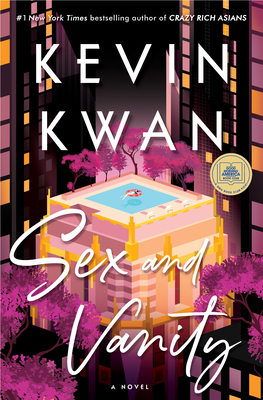
Sex and Vanity

by Kevin Kwan
First sentence: “The trail was lit by tall flickering torches, but Charlotte Barclay still felt like she could have fallen a thousand times on the pathway.”
Support your local independent bookstore: buy it there!
Content: There’s a lot of swearing, including multiple f-bombs, plus a tasteful sex scene, a very awkward sex scene, and some talk of oral sex. It’s in the adult fiction section of the bookstore.

First off, you’re going to want to compare this to Crazy Rich Asians, and it’s not. Sure, it’s crazy rich people and there are the same comparisons of old vs. new money that cropped up in Crazy Rich Asians, as well as the subtle racism that BIPOC — in this case, very wealthy BIPOC — get when running around white circles — in this case, very rich, white circles. But, this is so much more than that.

Kwan has taken E. M. Forester’s book, A Room with a View and thoroughly updated while keeping all the charm from both the book and the Merchant Ivory film, both of which I have loved for ages. (Seriously: he changed details, but the beats of the plot were exactly the same. It felt familiar and new all at the same time.) And he did it so seamlessly. The characters were their own individual characters, and yet I could see the original Charlotte, Lucy, George, and Cecil laid on top of them. I adored the modernization, I adored the homage to Italy and New York. I adored Kwan’s obsession with fashion and food and how new money can be both crass and understandable. It really was the perfect retelling of a classic story, and a perfect book to read on a hot summer day.

Absolutely recommended.

Stand Up, Yumi Chung!

by Jessica Kim
First sentence: “I should have known better than to think anyone would listen to me at the Korean beauty salon.”
Support your local independent bookstore: buy it there!
Review copy provided by the publisher
Content: There are some awkward moments and second-hand embarrassment. It’s in the middle grade (grades 3-5) section of the bookstore.

Yumi Chung is the youngest of two daughters of Korean immigrants. Her parents run a Korean barbecue restaurant in LA, and they expect Yumi — like her older sister, Yuri — to be excellent. The problem is that Yumi wants to be a stand-up comedian, which is something her parents neither understand or respect. Instead, they send her to hagwon — a Korean summer tutoring program — that will help her get a scholarship to the best private school in LA. Yumi is miserable until she discovers a new comedy club is running a summer camp for kids, and the person teaching it is Yumi’s favorite YouTube comedian! She ends up going — pretending to be Kay Nakamura (which gives some interesting, if subtle, insight into how white people lump all East Asians together) — until things all fall apart, including her parent’s restaurant being on the verge of closing. Can Yumi fix the mess she’s made for herself?

Oh, this was so very delightful. It addressed so many things — from not living up to your older sibling’s achievements, to finding your own space int the world, to owning your mistakes — without ever being heavy-handed. Yumi was a totally believable character with completely understandable parents. The conflict came from not just the immigrant to first-generation divide, but their honest desires that their kids wouldn’t have to slave away in a restaurant to make their living. I liked how Kim never made the parents out to be villains, and how Yumi (and Yuri) was able to figure out how to balance her parents’ wishes with her desire to follow her own path.

And excellent middle grade book.

Audio book: You Should See Me in a Crown

by Leah Johnson
Read by Alaska Jackson
Support your local independent bookstore: buy it there!
Or listen at Libro.fm
Content: There’s some bullying, a race and homophobic-centered hate crime, and one f-bomb. It’s in the YA section (grades 6-8) of the bookstore.

Liz Lighty has kept her head down through all of high school, avoiding crowds, avoiding any sort of drama. Which isn’t easy in Campbell, Indiana because she is one of only a handful of black kids in the school (and town). But when she doesn’t get a scholarship to the college of her choice, she decides to enter the competition for Prom Queen, since winning that comes with a scholarship. And then, all of a sudden, she’s thrust into the limelight, where she isn’t comfortable.

But there are good things that come out of running for prom queen, too. Like re-kindling her friendship with Jordan, whom she fell out with their freshman year. And the new girl, Mack, who is smart and funny, and whom Liz might just have more than a little crush on.

Oh, this was such a delight to listen to! The narrator is perfect for the book, pulling me in with Liz’s voice and just keeping me there. And Johnson balanced some heavy topics: like a mom who died from sickle cell anemia, as well as the idea of popularity, and overt and covert racism and homophobia. But it’s never an “issue” book. It’s centered in Black joy and excellence, and is just a delight every step of the way. Plus the love story is super super cute. So much cute.

It was exactly the thing I needed and I’m so happy I listened to it.