I’d like to place an order please

I love catalogs.

(This feels like a confessional. Is there a support group for those of us addicted to ordering-by-mail?)

It’s not that I order a lot of stuff, though I have been known to place an order for something not completely unnecessary just because I love receiving stuff in the mail, much to my husband’s (and our pocketbook’s) chagrin. Mostly I like getting the catalogs in the mail. I know you can order all the stuff over the Internet, but where is the fun in that? It’s convenient when I know exactly what I want, but to just browse (which is what catalogs are for, aren’t they?), it’s not as exciting. I once read someone saying that he (of course) loved to get the Victoria’s Secret catalog — it was, for him, kind of like a secret feminine world that he invented stories about. I can relate (well, not to the Victoria’s Secret thing): every time I get a catalog, it’s like opening a whole new shopping world of fantastically overpriced (usually) but wonderful things.

There are four catalogs that if I had all the money in the world, I’d order everything in: Chinaberry (for the books), Lands End (for the clothes, though I think I like Lands End Kids better), Baker’s Catalog (great cooking supplies), and Pottery Barn/Pottery Barn Kids (mostly for decorating ideas). Every time one of them comes, I drop everything else and spend twenty heavenly minutes looking at all the things I can’t order. Then I spend the next day or so obsessing over said items and fighting the urge to just pick up the phone and order something.

I am not the catalog queen, though. The woman who lived in our house before us was. Over the past four months, catalogs that I’ve never heard of have come in the mail. Along with some forgotten ones, too. And that’s reignited my love of catalogs. I haven’t seen Williams Sonoma for a long time, and I’ve missed it. I enjoyed browsing through the Gaiam catalog, and I’ve been amused at the overpriced clothes at Title Nine (along with the “life stories” of “real women”). There have been others: Sundance, some Hawaiian shirt catalog, and a few wine and cooking ones that weren’t especially memorable. I’ve been good, though, and I haven’t ordered anything.

But it made my week when Femail Creations showed up in the mail. I died laughing — this catalog was filled with some hokey, some fun and some incredibly pointless things. Still, I was hooked when I saw this:
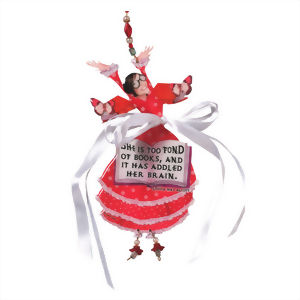
The text says: “She is too fond of books, and it has addled her brain.” Louisa May Alcott was supposed to have said it. She may not have. At any rate, I need this. No, really.

I don’t need this, but I really laughed:

And then there’s this:

But not for me. For a friend.

I’d like to place an order, please.

Inkspell

I really wanted to like this one. And… I did. But, I really wanted to like it. And… I just couldn’t.

The second in what I guess is supposed to be at least a trilogy, Inkspell has many problems that either didn’t exist for me in Inkheart, or that I was willing to forgive. This time around, I couldn’t. The story went from being a charming, fun idea — which is what I really loved about Inkheart — to being an adventure story, and a complicated and slow-moving one at that. I should have been suspicious when I opened the book and there was a list of characters with descriptions. Any book with that has the potential to be overly complicated. And it was. At least four major plot lines, too many major characters — with none taking the lead (except perhaps Dustfinger, but not even him, really) — not enough active conflict (though it was lurking in the background), and, in my book the crime of all crimes, no resolution at the end. Okay, I can forgive the last one (do I have to read the NEXT book to find out what happens?!) — it is in a series after all. But, that doesn’t mean the story has to just… stop. It can come to its own resolution, right? Rowling has done it — each HP book has its own ending while keeping the series alive. You don’t have to read book 5 to understand book 6. Not really. But, Inkspell can’t stand alone. There is no ending.

I think the hardest thing was keeping myself interested in the story for most of the book. It took until I was 2/3 of the way through to get interested in it. But, that’s 300 or so pages of writing to wade through to get to the interesting part. Not exactly fun.

Still. I don’t wish for the time back. I think I just wish I could have gotten through it faster.

The Cuckoo Tree

I picked this book up because Julie mentioned Joan Aiken in a post last month, and honsestly, she’s another author I’ve never even heard of. I missed a lot as a child. Surprisingly, our little library had several books by her (perhaps because she was writing in the 60s and 70s?). I checked out a couple. One — Midnight is a Place — I just couldn’t get into. At all. Fell flat after about 20 pages. So, I tried The Cuckoo Tree, and had more success. It wasn’t one of those couldn’t-put-it-down books, but it was enjoyable. Except she wrote in dialect, which is maddening for me as a reader. “Eye thankee for awl yee downe fur mee.” Eek. I know it lends atmosphere, but it’s terribly difficult to get through. At least, for me.

Anyway. I don’t know if I’m going to rush out and get any more of her novels — unless someone highly recommends another one — but I’m glad I at least know who Joan Aiken is now.

Observations on a Writers’ Group

Being an “aspiring” writer (I’m not entirely willing to take on the implications of declaring myself a “writer” yet), I started going to a local writers’ group. I’ve known about it for months (it’s run by the mom of our babysitter), but hadn’t made the time (gotten up the courage?) to go. But, yesterday, I figured it’s a new year, why not give it a try.

There were five of us there (not including my daughter) — four women and one man. Three stay-home-moms, two university professors. Interesting mix.

Observation #1: I hate being the newcomer (excuse why I never go), even though the others made me feel welcome. It’s still intimidating. Everyone already knows each other, and has a history together. I’ve got… a two-year-old who needs to eat lunch (which I brought). Thankfully, my dear sweet daughter wasn’t terribly disruptive (other than displacing the group from the comfortable living room to the not-so-comfortable dining room). If she’d only been less obsessive about the dog and going potty…

Observation #2: What’s it with science fiction writers? The only other person (aside from me; intimidation aside, I brought something to share) who read what they’d written was a sci-fi writer. He’d been working on this story for 2 years or so, and was getting ready to submit it to some contest or another. I don’t want to be cruel, and I have to admit that I was managing my daughter much of the time, but… I thought his story was lame (I obviously didn’t tell him this, not wanting to offend on my first day). There was way too much exposition in my view and not enough action. And when you boil it all down, after 7 single-line spaced typed pages and 45 minutes of reading, there wasn’t much story there. The basic plot: A guy is mad at his neighbor’s wife (because she implicated his daughter in some theft that his daughter didn’t do; the writer had to explain that after), and wants to kill her, but doesn’t but then she dies via breast implant explosion (gross!) and he feels guilty.

Why is it that sci-fi writers feel they can devote all their time to world creation (that’s what most of the exposition was about: wry and slightly humorous observations of his future world) and none to the story? I know, much of science fiction/fantasty is like that. But it seems to me that they would be better served by coming up with a good story — or two or three good world ideas (Card talks about this in his intro to Speaker fo the Dead; how it took two different ideas — that of a speaker and that of an alien race — to make a compelling story) — and then create a world to fit it.

Observation #3: I’m not dealing with people who read children’s fiction. I read my stories — two versions of the same one — and I got comparisons to Barney and illusions to Dr. Seuss. Not that I’m complaining; they did make some valid observations, and some helpful suggstions. But I do have to admit that I was disappointed that their points of reference were so limited. Then again, it’s not like I can give constructive criticism on poetry, so I really have no reason to complain here.

I’m going to go back, in spite of the bad science fiction and lack of children’s writing refrences. I need something to motivate me to write… and there’s nothing like an audience, right? Maybe I’ll even get into the habit of posting observations on our weekly (mostly) meetings here. Could make it even more interesting.

Possession

Admittedly, I am not a huge fan of crictics’ darlings, or even “English Lit” books. I keep trying, though, to broaden my horizons, guilting myself into checking out and reading various classics or critically acclaimed books. And every once in a while, I surprise myself by actually liking the book.

This was one of those times. I hadn’t even ever heard of A.S. Byatt (male or female?) or the book (hey, wasn’t that a movie with Gwyneth Paltrow?) until Laura recommended this one to me. It was slow going at first — I mean, really how much do I want to know about English PhDs in the late 1980s — but as the story progressed, I found myself more and more intrigued and involved in the story. I admit that I skipped most of the poetry (and probably missed out on some plot points, but I survived), but I read and enjoyed the letters, and honestly loved the feeling of discovery and chase. (Look: it’s a thriller for English Lit geeks! My husband commented one night, “Didn’t she kind of make English PhDs look cool?” Well, um, yeah.) Maybe it’s the journalist in me; maybe it’s a buried family historian. I don’t know. But I loved that Roland and Maud were discovering hidden secrets and stories. And I didn’t even mind the twist ending, or the three flashback chapters, though perhaps I would have preferred it all be discovered through the letters.

Granted, it’s not a perfect book in my opinion: too long, too many poems, too many minor characters (that really didn’t DO anything in the end). But, I’d say it was worth the time spent reading it.

Books on my Doorstep

My husband’s brother and his wife gave us gift certificates to Barnes and Noble for Christmas… they must know us well. The package didn’t come until after, but better late than never! We had fun ordering books (since there’s no B&N around here — our town is much too small for that — we used B&N.com) and half arrived yesterday. What fun!

My order came yesterday, and in it was: Inkheart, Dragonsong, Dragonsinger, and Eats, Shoots & Leaves (you can tell where my interests lie!)

What’s still to come (hubby’s order): Speaker for the Dead, Dooms Day Book, and What are People For? (that’s not exactly his interests; if left to his own wishes, there’d be some political and/or philosophy books there… granted, they’re also more expensive…)

The only one we haven’t previously read is the Wendell Berry book, and he’s got a decent enough track record with us that we felt comfortable buying that one new.

See, although I love books, I hate buying them unless I know I’m going to like the book. (Which is why we have more picture books than anything around the house; they’re so much easier to judge the worth of than a fiction or non-fiction book.) I just can’t justify spending money on a book, then not absolutely loving it. In my opinion, that’s what libraries are for: to weed out all the “bad” books. I feel much less guilty about not finishing a book I’ve checked out than one that I’ve bought. So, instead of buying new books, we focused on filling in the gaps to our little collection. No matter: I still can’t wait to re-read them!

Snow

My friend Amira finished and reviewed Tales of a Female Nomad, which I raved about, a couple days ago. While she didn’t hate the book, she didn’t particularly like it either. But, her review got me thinking. See, I’m the quintessential American non-tourist. The most exotic places I’ve been are the Caribbean (on a cruise), Canada and Germany. And even though we spent three months in Germany, we really didn’t get out and “experience” the local culture the way we could have. Amira, on the other hand, is currently living in Kyrgyzstan, and is having a totally wonderful and unique experience, something which (for many reasons, the first among them is that I would never even have considered going to Kyrgyzstan) I couldn’t have ever done. She’s well-traveled (or at least better traveled than I am) and has spent the time and energy to devote herself to the culture in which she is living.

So, Melissa, what does this have to do with Snow (which is by Orhan Pamuk, by the way)? Well, what I realized when I read Amira’s review, and what I’ve realized since finishing Snow (and have probably realized before), is that much of what we get out of books depends on what we bring to it. I got a different experience reading Nomad than Amira did, mostly because I’ve had different travel experiences than she has. I didn’t like Snow, but I think if I were a different person, I may have. Let me explain (no, that would take too long. Let me sum up…):

Strike one: This book was written in Turkish (translated, of course) for a Turkish audience and is about the struggle in Turkey between secularists and Muslim fundamentalists. I am, obviously, neither Turkish or Muslim. And I only have a passing interest, and no real knowlege, of Muslims or Islam.

Strike two: This book is very lyrical and poetical. The main character is a poet, and often talks about how poems come to him, almost like inspiration. The author spent pages and pages and pages setting the mood, and evoking images of cold, snowy, winter days in Turkey (and thereby lonliness, desperation, God?). Me: I was trained in college as a journalist, and I am a lover of children’s fiction. Excessive words usually don’t move me.

Strike three: Halfway through the book, the narrator tells about the main character’s murder. Huh? Okay, what’s the point in finishing the book? Why bother telling us that the main character dies (no foreshadowing here) halfway through? What’s the literary point? Why should I, as a reader, even bother to go on? I didn’t, really. I struggled through a bit more, then skimmed the rest. Enough to get the gist of what plot there was. And I still don’t get it.

Granted, it will make for good discussion at the book group (is a book worth reading only for the discussion it creates?): was Pamuk making fun of believers or non-believers? What was the whole deal with Ka’s obsessions about Kars and religiosity anyway? And why was Ka so confused and indecisive? …

Anyway. On to other things.

Happy Christmas

It was a good day…

My parents-in-law gave me cards with this on it:


It’s so totally perfect! The text on the back I’ve chosen to put in the sidebar.

My parents gave me a wonderful, beautiful bamboo cutting board, which I have longed for. YAY!

And my husband gave me time for a much-needed nap. We also got loads of books, though not as many as in past years. Still, any new reading material is great. And my oldest loves Dragon Rider so far. I guess it was a good choice. 🙂

Hope your holiays were happy!

Sorcery and Cecelia (Or, The Enchanted Chocolate Pot)

Remember back a few weeks (or so) when I was looking for something light?? Well, this is pretty much what I was looking for. It was not deep, or particularly specatacular, but it was involving, diverting (I tend to think and talk in Victorian English after reading a book like this) and a whole lot of fun. I think part of what made it fun for me was the method in which it was written. The basic premise: two girls in early-19th Century England (with magic) are writing back and forth to each other and get into a series of adventures (and fall in love, of course). See? Nothing special. But, it was written by Patricia Wrede (writer of the Enchanted Forest, which my oldest loves) and Caroline Stevermer (of whom, I admit, I’ve never heard before). What they did (and it sounds like fun) is essentially become the two characters (Wrede was Cecelia; Stevermer was the cousin Kate) and let the plot develop by writing letters back and forth to each other. Then, of course, they got back together and did some revising and editing for the book. But still… to experience the development of the book in such a way… wow. And it showed in the writing. There were really two disctinct voices (which is hard to achieve if there’s only one writer), and you could tell that things were simoltaneously developing individually and in response to what the other writer had written. Makes me want to try it. Oh, and it makes me want to read the sequel, The Grand Tour: Being a Revelation of Matters of High Confidentiality and Greatest Importance, Including Extracts from the Intimate Diary of a Noblewoman and the Sworn Testimony of a Lady of Quality. How can you not want to read a book with a title like that?

The Miracle Life of Edgar Mint

I really tried to read this book. Honestly. But… I got 30 pages into this somewhat depressing tale of a boy who gets run over by a mail truck (I know there’s more to it than that) and how he came about, and it was really well written, but just not… engaging. Besides the temptation to read The Dark is Rising with Julie and Laura was much to great. And, as my husband commented, I’m just not a critically-acclaimed, New York Times Bestseller type of book lover. So, good bye meaty adult fiction; hello Midwinter kids fare. I’m much happier. (Maybe I’ll try Edgar Mint again someday… It would probably make a good book group book.)