Unfinished Angel

by Sharon Creech
ages: 8+
First sentence: “Peoples are strange!”
Support your local independent bookstore: buy it there!

Some books stick in your mind because they have a brilliant plot. Some because they have created a fabulous world. Others because they have great characters, ones that you want to take home to your mother.

And others, still, because the voice — the way the narrator speaks to you, as a reader — is so unique, so endearing, that you can’t help but love the book.

The voice of Angel, the title character in this sweet little book, is wonderful. It’s not just the word choices that Creech uses, though that is a lot of it. Some of the words that just endeared me to Angel: peoplealities, surprisements, mishmaseroni, glompsing (I really love this one!), struddles. How can you not love a character who uses words like that? But if it was just a sprinkling of fun words throughout the book, it probably would have been more annoying than endearing. No, it was everything about Angel: from his/her irritation with yet love for the people in her (I’m not sure if it was a his or a her, but it felt like a her to me…) Swiss/Italian village, to Angel’s gradual acceptance of the crazy American girl — Zola, who is just extramarkable — and the village’s slow awakening to the sense of community.

Sure, I got all of that out of this as an adult, but I think what kids will see, and probably come to love, is Angel. It’s such an endearing character, and a captivating voice that it will keep practically anyone turning pages. The rest is just frosting.

My Most Excellent Year

A Novel of Love, Mary Poppins & Fenway Park
by Steve Kluger
ages: 12+
First sentence: “Since you’d never guess it from looking at me, nobody can tell that words like because, fart, there, and banana come out sounding like “becazz,” “faht,” “they-a,” and “bananer” when I say them out loud.”
Support your local independent bookstore: buy it there!

There are many things in my life that make me smile. Like:

Seeing these on the road:

Eating these:

Watching him:

And this book. This book made me unavoidably, undeniably, unabashedly happy.

It’s the simple story of a year in the lives of three high school freshmen: Bostonian and die-hard Red Sox fan (is there any other kind?) T. C. Keller (also known as Tony C and Tick but never, ever Anthony); his brother (in all ways except biology since age six) and diva extraordinaire (can you recite All About Eve word-for-word? I thought not.) Augie Hwong; and newbie Alejandra Perez, daughter of the former ambassador to Mexico and closet singer/dancer (who just doesn’t know how brilliant she is). It’s not like there’s a big crisis or a huge plot arc; this book is full of little things. Little things — like T.C. and Augie being brothers; or the discovery of Hucky, a six year old deaf kid that T.C. befriends; or the talent show and subsequent Kiss Me Kate production; or the three love stories, where there were no burst of passion, no sparkles, no in love at first sight, but instead just honest-to-goodness learning how to love and forgive and compromise. (Yeah, I know, I generally have a problem with lasting high school love, but this was just so darn adorable, that I forgave them the high school part.)

Sure, it’s unrealistic, but I plain didn’t care. I wanted to move in next door to T.C. and Augie and Ale. Shoot, I wanted to be a part of their crazy, wonderful, lovable extended family. (Much like the Cassons; I want to be a part of their family, too.) And I didn’t want this book to end. Which, really, is the best thing I can say.

Library Loot 2010-3

Both K and I are cranky today, so all we did was go in, find books (not many movies, much to our displeasure), pick up our holds, and get out.

It must be January.

This week’s loot:

Picture books:
Puffling, by Margaret Wild and Julie Vivas
How Do You Wokka-Wokka?, by Elizabeth Blueme/Illus. by Randy Cecil
I Will Surprise My Friend! (An Elephant and Piggie Book), by Mo Willems
Dear Vampa, by Ross Collins
Never Smile at a Monkey: And 17 Other Important Things to Remember, by Steve Jenkins
Waiting for Winter, by Sebastian Meschenmoser
Emmet, by Leo Politi
Magic Box, by Kate Cleminson
Catfish Kate and the Sweet Swamp Band, by Sarah Weeks/Illus. by Elwood H. Smith

Middle Grade books:
Where the Mountain Meets the Moon, by Grace Lin

YA books:
The Hollow Kingdom: Book I — The Hollow Kingdom Trilogy, by Clare B. Dunkle
Close Kin: Book II — The Hollow Kingdom Trilogy, by Clare B. Dunkle
Leviathan, by Scott Westerfield (M is in the mood for it now.)
The Singing: The Fourth Book of Pellinor (Pellinor Series), by Alison Croggon
Darkhenge, by Catherine Fisher

Non-Fiction:
Eats, Shoots & Leaves: The Zero Tolerance Approach to Punctuation, by Lynne Truss
Charles and Emma: The Darwins’ Leap of Faith, by Deborah Heiligman

The roundup is either at Reading Adventures or A Striped Armchair. Obligatory FTC note: the links are provided through my Amazon Associates account. If you click through and actually purchase one of these books, I’ll get a teeny, tiny payment. But, since no one ever does, and it’s SO much easier using the associates account to put up these links, I’m going to keep doing it.

10 Questions for Rosanne Parry

I was completely captivated when I read Heart of a Shepherd last month, and was more than happy when the book made the Cybils shortlist for Middle Grade fiction. I totally agree with what Sherry at Semicolon wrote when she called it “a treat to be savored.” It very much is. And because I wasn’t willing to let the book go just yet, I thought I’d contact the author herself, and she graciously consented to be interviewed. There really isn’t much more to say, other than if you haven’t read the book, you should.

MF: Heart of a Shepherd is your first published novel! Congrats! It’s not your first book, though, is it? Can you tell us a bit about the process of writing a picture book versus a novel?

RP: I think picture book writing has more in common with writing poetry than writing novels. You have to make every single word rich and precise and useful. Which I think, in the long run, helps me write what I hope are richer novels.

In my picture book, Daddy’s Home, we ended up changing the order of events so that the action was spread out through the child’s house, which is visually more interesting. In a novel, my words carry the weight of bringing the setting to life. I think picture books work best when some of the character and setting decisions can be made by the illustrator. For example, in Daddy’s Home the text does not mention the gender of the main character, the ages of the siblings, the race or economic situation of the family or the presence of a Mommy. All of that I left to my illustrator. David Leonard did such a lovely job conveying the warmth and exuberance of the preschool reader. I love what his art added to the book.

MF: What was your initial inspiration for Heart of a Shepherd?

RP: Ten years ago, I wrote a sonnet for poetry month as I try to do every year. At the time, my son was six and my dad was teaching him to play chess, so I wrote a practice piece about that. A few years later, I got an idea for a short story about grandfather and grandson playing a game of chess which eventually became the first chapter of Heart of a Shepherd. I set that story on a ranch in Eastern Oregon because I had recently visited a friend in Malhuer County.

MF: Heart of a Shepherd is an interesting combination of things one wouldn’t think would “go” together: religion, East Oregon ranching and the Iraq war. How/why did that combination come about?

RP: I began writing about a boy and a grandpa on a ranch but there wasn’t enough energy in the two of them to sustain a whole novel, so I added the military family element and the two seemed to compliment each other well. I’ve found both the army officers and the ranchers I know to be surprisingly philosophical and to have a strong sense of stewardship for the people and animals in their care.

As for the inclusion of religion, that was a matter of being true to my characters and setting. Ranching and soldiering are not professions that attract atheists. These families are far more likely to be church-going than the general population. Malhuer County, where the story takes place, was settled primarily by Irish and Basques. These are people for whom Catholicism is not just their faith, but an important part of their cultural identification. Many stories don’t need to mention their character’s spiritual lives, but leaving that element out of this story was just unthinkable. Some people’s lives only make sense in the light of their faith and HEART was just that kind of story.

MF: I read that it took you seven years from idea to finished book. Can you tell us a bit about that process?

RP: Seven years is a tad misleading. I wrote a poem from which the initial scene of the book was drawn about ten years ago. I set the poem aside and did nothing with it for ages because I was working on another story at the time. A few years later I wrote the short story, which eventually became the opening scene of Heart of a Shepherd. I liked the story very much, but since I was in the middle of writing a different book, I set it aside once again.

Eventually, I wrote three more stories with Brother and his grandpa, but then I got completely stuck. Fortunately, Random House editor Wendy Lamb critiqued the stories at an Oregon SCBWI conference and was warmly encouraging of my efforts. She didn’t say what I needed to fix so much as what sparked her interest. The setting was one she seldom saw in submissions, and she enjoyed the warm and loving rivalry among the five brothers.

So I went back to the story, adding the military family element. All together, it took me two years of intensive study, research and writing to come up with a draft of Heart of a Shepherd I was satisfied with. From there I sent it to Jim Thomas at Random House and he made an offer on the manuscript in September of 2006, which was about seven and a half years from the starting point. Once the book was under contract it took another two and a half years to get it in print. It was a surprise to me that it would take so long, but I’ve since learned that it is a typical time frame. In fact, I’m very grateful to have an editor willing to give me the time I need to make my book just right.

MF: Do you have a favorite character or scene in the book?

RP: When I ask students what they want me to read out loud, they almost always choose the “boys against the girls” part. It’s a very fun scene to read aloud, especially to a group of kids. It was one of my editor’s favorites, and I can imagine that he was once a lot like Brother in this particular part of the story. For my part, I often feel like throwing things at him, so it’s a favorite for me as well.

MF: I found the book to be deeply religious, though that could be what I brought to the book. Is there anything you hope, in particular, readers will get out of your novel?

RP: I think that part of what makes reading such a rich experience and writing such a surprising profession is that people bring their whole life to every book they read so that it is a different experience for each reader. I got a lovely note from a teenager who said HEART helped her think of her family’s all-consuming ethnic restaurant business in a whole new way. Wow! I’d have never made that connection but family businesses whether it’s a farm or a store or a restaurant share some of the same stresses and benefits. It’s kind of cool to see what different readers bring to the experience.

If I have an agenda at all, it’s literacy. Young readers, and particularly those who struggle to read, need characters that speak to their life experience. Military families and ranching families are seldom depicted in children’s fiction. One of the most moving things that happened to me this year was the day I spent addressing an adult English language class at a local college. Mine was the first novel any of them had read in English, which felt like such a huge honor and responsibility. I was very proud of the team at Random House who packaged the book with a page lay out that is very inviting for a struggling reader and a cover that an adult can read on the city bus with dignity. Those details matter and I’m thrilled to have a publisher who is so attentive to them.

MF: Is being a writer something you’ve “always” wanted to do, or is it something you discovered later in life? Do you have any specific writing influences?

RP: I hated writing when I was a child, and I was not especially good at it, but I’ve always loved making up stories. When I was home full time with a house full of toddlers and preschoolers, I finally had the time to work at writing stories and I spent the next ten years learning to write like a storyteller.

MF: Who or what inspires you?

RP: The need to put four kids through college is pretty much all the inspiration I need.

MF: That certainly is inspiration! Do you have five books that you think everyone should read?

RP: Here are some books I’ve read recently which I really enjoyed.

  • When the Whistle Blows, by Fran Cannon Slayton
  • Marcello in the Real World, by Francisco X. Stork
  • The King of Attolia, by Megan Whalen Turner
  • Krik Krak , by Edwidge Danticat
  • Crash Into Me, by Albert Boris
  • poetry by ee cummings
  • Our Town, by Thornton Wilder
  • The Wee Free Men, by Terry Pratchet

MF: That’s an impressive list! if you don’t mind telling us, what’s up next for you?

RP: Yesterday, I sent my next novel SECOND FIDDLE off to the copy editor. It will be out in the spring of 2011. It’s a story about three girl musicians living in Berlin at the end of the Cold War. They find a Soviet soldier who is being murdered by his own officers. They rescue him and run away to Paris. It has been great fun to write. I was in Paris myself almost exactly twenty years ago so it has been fun to revisit my memories of that trip.

MF: That sounds interesting; I can’t wait to read it. Thank you so much for your time!!
RP: Thanks again for the interview.

A Wrinkle in Time

by Madeline L’Engle
ages: 9+
First sentence: “It was a dark and stormy night.”
Support your local independent bookstore: buy it there!

I thought, as I started this deceptively small novel, what was it that captivated me about this book when I was a child? See, I have the copy I originally got — was it a gift? did I buy it with my own money? — and it’s well-loved. I remember reading it over and over again, though I stopped sometime in high school, and honestly haven’t picked it up (or thought much about it) before I cracked it open last week.

When I finished, though, I knew exactly what I loved about it. See, I was Meg. I was geeky, awkward, kind of smart (but not in everything), and felt I was unable to quite fit in. The idea that someone like me — that Meg, of all the characters — would be the one to save the day, would be the one with the answers, and (most importantly to my 11 year old self) would be the one to find love, gave me immense hope.

Going back to this book as an adult, one thing really surprised me: it’s an incredibly religious work. Not in the same way that, say, Narnia is — it’s more blatant than that. There’s the good-versus-evil element, of course, though L’Engle’s vision of evil is more subtle than I remembered (Evil is sameness? I can see that…), but it’s also the the references to Mrs. Whatsit, Mrs. Who and Mrs. Which as Guardian Angels. It’s sometimes small little things throughout, but it’s also the big things, like this quote from Mrs. Who:

The foolishness of God is wiser than men; and the weakness of God is stronger than men. For ye see your calling, brethren, how that not many wise men after the flesh, not many mighty, not many noble, are called, but God hath chosen the foolish things of the world to confound the wise; and God has chosen the weak things of the world to confound the things which are mighty. And base things of the world, and things which are despised, hath God chosen, yea, and things which are not, to bring naught things that are.

Religious aspects aside, I still love the story. It’s Meg’s story, of course, and her growth and coming into her own. That still captivated me. I loved the Mrs.es, adored Charles Wallace, and enjoyed the story, though it wasn’t as unputdownable as I remember it being when I was a child. Still, I’m glad I took the time to revisit the world and the Murrys.

Sunday Salon: Writer’s Block

I have found, since probably sometime in January, that writing reviews aren’t coming as easily as they have in the past. (Or at least I remember them coming in the past.) I can safely exclude the idea of blog burnout in this problem; I’m still like blogging, and I want to write the reviews. It’s just that when I sit down to type up my thoughts, I find that I either 1) can’t gather them up sufficiently (maybe they’re on hiatus?) or 2) find myself typing the same old limpid platitudes (Oh, I have wanted to use that phrase for a while now. Who’d of thunk it’d be in reference to my own reviews?!) over and over again. Yes, we all know the book was compelling, engaging, thrilling, exciting, fantastic, fabulous, boring, . Find some new words, Melissa.

So, I ask you, my fellow book bloggy friends, what do you do when you have writer’s/reviewer’s block? Keep writing, even if the reviews come out sounding blah (at least to you)? Give up? Go on hiatus? Use the thesaurus more?

An an additional question: how do you go about writing your reviews? Is there something you do to make sure they end up sounding as good as they possibly can?

The Year My Son and I Were Born

A Story of Down Syndrome, Motherhood, and Self-Discovery
by Kathryn Lynard Soper
ages: adult
First sentence: “No. Oh, no.”
Review copy sent to me by the author.
Support your local independent bookstore, buy it there!

Some books can just be summed up in a few words. The words for this one: Honest. Brave. Beautiful.

I’ve been working on this review for two days now, and I am still at a loss how to adequately sum up this book. It’s a story of a mother learning to accept her newborn son’s diagnosis of Down Syndrome. It’s a story of a woman who’s dealing with depression. It’s a story of a person who has been dealt an unexpected set of cards trying to come to terms with her faith and her community.

It’s not the story that makes this book compelling, though it’s a compelling story. What drew me in, and kept me there even though I thought I couldn’t relate, was the writing. There’s always a self-indulgent aspect to memoirs: one has to think they’re unique or important enough to write a memoir in the first place. But Soper takes an incredibly unflinching, honest tone, and uses spare, beautiful writing. Both of these combine to give the book an emotional wallop, making Soper’s journey not only captivating, but accessible and understandable to those who haven’t had the same journey. We come to care about Soper and her family. We become emotionally invested in them and their lives.

It’s also an unexpected story, which gives it a raw edge. Soper doesn’t take everything just fine. There are ups and downs, both emotionally and medically. It’s a hopeful ending — I almost wished for an epilogue; how is her son, Thomas now? — but it’s not a pat ending. There will be bumps down the road; Thomas will have medical problems, there will be discrimination, there will be trials. But, by the end, Soper (and the reader) have come to a new enlightened state, where everything is, if not happy, then at peace.

I do have one more word: remarkable.

Book to Movie Friday: Stranger than Fiction

I haven’t done one of these in a while (again); blame it on the Cybils. I’ve hardly watched any movies for a while. But, last weekend, one of my favorite movies of all time (I know: I’m not especially picky) came up on my Netflix queue, and I figured I’d write about it, even if though it’s not based on a book.

Adore it.

It makes me undeniably happy, mostly because it’s a very literary movie. Sure, it’s terrifically funny, and Will Farrell is amazing as the down-and-out Harold Crick, as is Emma Thompson as the weird-but-brilliant author, Karen Eiffel. (Not to mention Dustin Hoffman’s and Queen Latifah’s supporting characters.) But, you boil down this well-written, well-acted movie to is bare bones, and it’s all about how fiction intersects with and affects our real life.

And I find that both amazing and wonderfully life-affirming.

I’m not sure exactly why, except that I love the idea of our lives being stories. I love that, while there may (or may not, depending on your beliefs) be an ultimate narrator and writer to our lives, that we have the opportunity to change the story, to convince that person otherwise. I love how each of our stories intersect with one another, and — this has been a theme with me, personally for a while now — how they affect each other for good or ill.

Throw all that in a movie that makes me think, makes me smile, and makes me want to go out and live, and you’ve got a perfect little movie.

Verdict: if you haven’t seen it, you really should.


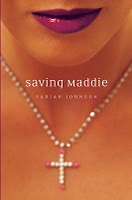
Saving Maddie

by Varian Johnson

ages: 14+
First sentence: “‘Hurry up,’ she yelled, dust blowing in her wake as she ran down the dirt trail.”
Review copy given to me by the author.
Support your local independent bookstore: buy it there!
Release date: March 9, 2010

Joshua Wynn is a good guy. He doesn’t drink, he doesn’t smoke, he doesn’t party, he doesn’t have sex. He chooses leading his church’s youth group over playing on the school basketball team. Granted, he’s the preacher’s kid, and there’s an enormous amount of pressure on Joshua to be good. And Joshua’s mostly okay with that.

That is, until Maddie Smith — his best childhood friend who moved away when she was 13 — moves back into town. She’s 18 now, and she’s not what Joshua remembers. For starters, she’s not a believer any more, and Joshua (sort-of) decides that it’s up to him to “save” her. Except, he’s falling for her as well.

This is an incredibly thoughtful novel; Johnson maintains a fine balance between those who take their faith incredibly seriously, and those who don’t, managing (for the most part) never to take sides as to which is better. He also avoids making Joshua a caricature, someone who is easily dismissed. Joshua is a complex character — desires, insecurities, hangups, and all.

Which brings me to something else I found admirable about Saving Maggie: Johnson doesn’t write down to teens (it reminded me a lot of John Green’s books, and that’s a compliment!). It’s a strikingly honest book: honest about belief, faith and following. Honest about the conflict between desire and duty. And all this makes Joshua’s struggle to find his own way — as opposed to the way he’s always just gone because that’s what he was taught — more powerful.

I also appreciated the ending (and you know how important endings are!) because it’s not the traditional happy ending and because there’s hope. It’s an immensely hopeful book, one that asks the reader to look beyond appearances to the person inside.

But, most of all, it’s a book that will make you think, about belief, about decisions and about others. And a book like that is always worth reading.

LIbrary Loot 2010-02

Storytime started today. I’m such a kid: I LOVE storytime. And not just because I get to spend time with K… no… I love the stories and the finger plays and the songs.

Good thing I get to go once a week, huh?

This week’s loot:

Picture books:
Patricia Von Pleasantsquirrel, by James Proimos
Prudence and Moxie: A Tale of Mismatched Friends, by Debroah Noyes/Illus. by AnnaLaura Cantone
Freckleface Strawberry and the Dodgeball Bully, by Julianne Moore/Illus. by LeUyen Pham (eek! How did this get here?!)
Love That Puppy!: The Story of a Boy Who Wanted to be a Dog, by Jeff Jarka
I Can Do It Myself!, by Diane Adams/Illus. by Nancy Hayashi
The Tiptoe Guide to Tracking Fairies, by Ammi-Joan Paquette/Illus. by Christa Unzer

Middle Grade books:
Day of the Scarab: Book Three of The Oracle Prophecies, by Catherine Fisher
Troll Fell, by Katherine Langrish
Troll Mill, by Katherine Langrish
Troll Bell, by Katherine Langrish
The Stoneheart Trilogy, Book One: Stoneheart , by Charlie Fletcher
The Stoneheart Trilogy, Book Two: Ironhand, by Charlie Fletcher
11 Birthdays, by Wendy Mass
Max Quigley, Technically Not a Bully, by James Roy
Westmark, by Lloyd Alexander
The Illyrian Adventure, by Lloyd Alexander

YA books:
Carter Finally Gets It, by Brent Crawford

The roundup is either at Reading Adventures or A Striped Armchair. Obligatory FTC note: the links are provided through my Amazon Associates account. If you click through and actually purchase one of these books, I’ll get a teeny, tiny payment. But, since no one ever does, and it’s SO much easier using the associates account to put up these links, I’m going to keep doing it.