Spring = Once Upon a Time

Here I was, reveling in the fact that it’s spring (and 71 degrees here!), and it completely slipped my mind until I saw the post… It’s time for Carl’s Once Upon a Time Challenge! Whee!

I can’t let this one go by without joining in.

I am, as per my usual fare, signing up for Quest the Second:
1. Fantasy: Exile, by Anne Osterlund
2. Folklore: Runemarks, Joanne Harris
3. Fairy Tale: The Fairy Godmother, by Mercedes Lackey
4. Mythology: Zeus: King of the Gods and Athena: Grey-eyed Goddess, by George O’Connor

My Unfair Godmother, by Jannette Rallison
Enchanted Ivy, by Sarah Beth Durst
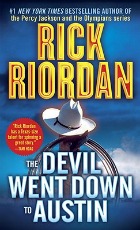
The Throne of Fire, by Rick Riordan
Reckless, by Cornelia Funke
Mad Love, by Suzanne Selfors
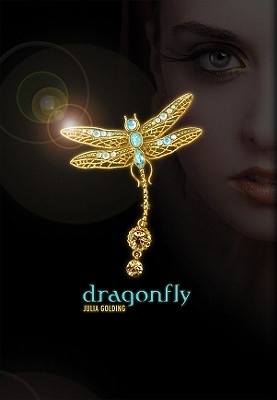
Dragonfly, by Julia Golding
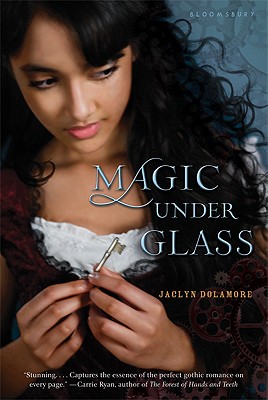
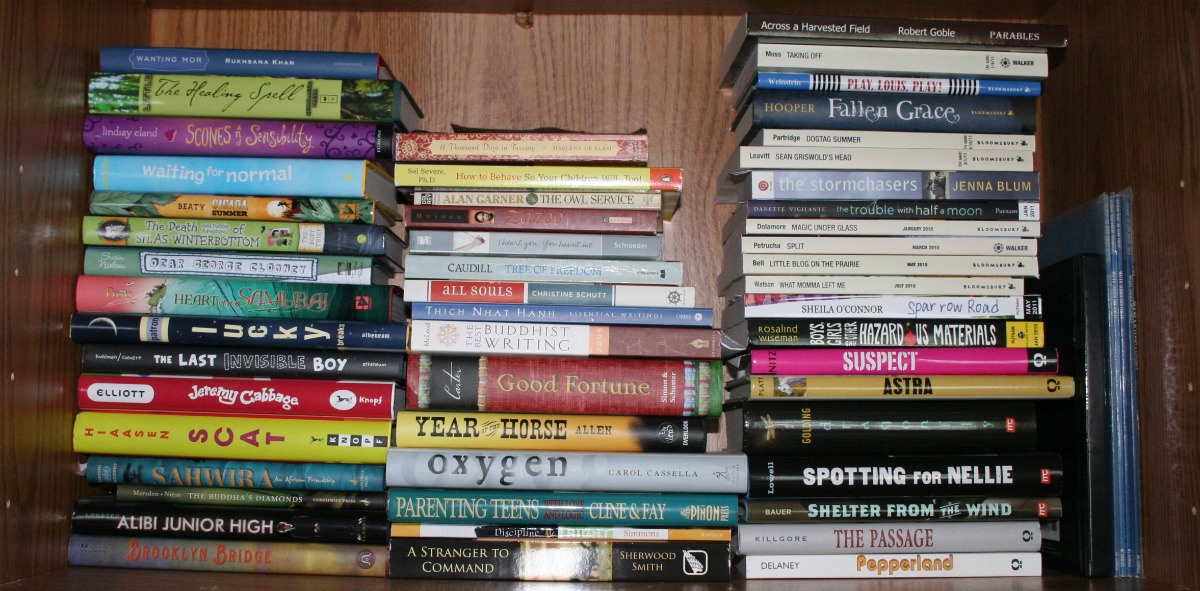
Magic Under Glass, by Jaclyn Dolamore
Gods Behaving Badly, by Marie Phillips

Can’t wait to get started! Won’t you join us, too?

Sunday Salon: Battle of the Kids’ Books Round 1 Commentary

I meant, last week, to put up a post with my predictions for the School Library Journal’s Battle of the Kids’ Books. But, it was C’s birthday, and I spent my morning decorating a cake and doing birthday stuff, and predictions — which I’m horrible at, anyway — took a back seat.

But I can’t pass up the opportunity to comment on the matches so far.

Match 1 As Easy as Falling Off the Face of the Earth vs. The Cardturner: As Liz B. points out the best thing about this match was the way Francisco X. Stork wrote the decision. Brilliant bit of blog writing/reviewing. But then, that’s why he’s the writer and I’m the reader. Right? I haven’t read Lynne Rae Perkins’ book (I may, though, after reading something about it), but I’m not quibbling with the result of the match: I loved The Cardturner.

Match 2 A Conspiracy of Kings vs. Countdown: I adored one, got annoyed with the other. And being solidly on Team Gen (though I’m also on Team Bartimaeus), I really wanted Kings to move on. But judge Dana Reinhardt doesn’t do fantasy though I thought this was telling:

while the journey one takes reading Megan Whalen Turner’s A Conspiracy of Kings is to a world of the writer’s ingenious imagination that feels so real I’m embarrassed to admit I began to question my own knowledge of ancient history. I found myself dusting off the cobwebs, trying to remember if I’d ever studied Sounis, Eddis and Attolia in school.

Truly, the Thief novels are fantasy books for non-fantasy people. She does have another valid point: while it can stand alone, it really does help if you’ve read the other books in the series. And given that, the true historical fiction moves on.

Shall I put in a hope here? I do hope that The Cardturner wins the next round; I found Countdown to be that annoying, and am still scratching my head as to why everyone else seems to like it. But a book that makes bridge sound interesting? That’s worth rooting for.

Match 3 The Dreamer vs. The Good, The Bad, The Barbie: I haven’t read Barbie, though I’ve been curious about it for a while. (It’s on my list.) Anyway, judge Barry Lyga’s decision is a blast to read (being one who often has conversations with myself), and I liked his reasoning throughout. Granted, I was predisposed to Barbie, having read The Dreamer and thinking, while beautiful and lyrical it really wasn’t very interesting. So, no complaints from me.

Match 4 Hereville: How Mirka Got Her Sword vs. Keeper: This one, if you knew anything about the judge Susan Patron, was a no brainer. No matter how fun and clever and interesting Mirka is, the lyricalness (and it was a good story) of Keeper was going to pull the judge. As commentator Jonathan Hunt said, “Hey, wait! Didn’t this happen before: where an author tried to judge her own book? Oh, yeah. Kristin Cashore wrote Graceling—not Tamora Pierce. And Susan didn’t write Keeper; Kathi Appelt did.” Still, this one was obvious.

I do wonder how Keeper will fare against Barbie? I might have to go with Keeper here, if only because it’s the one I’ve read, though Barbie does sound intriguing.

Match 5 The Odyssey vs. One Crazy Summer: Just when I was thinking graphic novels weren’t going very far this year, judge Karen Hesse goes and pulls an upset on me. The question is, though: is One Crazy Summer the likely candidate for the undead poll winner? (I’m keeping my fingers crossed for my vote: A Conspiracy of Kings.)

As for this week’s battles? I’m crossing my fingers for Bartimaeus, Will Grayson and the Grimm book (which I just finished; it’s quite fabulous). But we’ll see how they fare against the judges’ opinions. (Ah, that’s half the fun, isn’t it?)

Hereville: How Mirka Got Her Sword

by Barry Deutsch
ages: 11+
First sentence: “Mirka liked her stepmother, Fruma, well enough.”
Support your local independent bookstore: buy it there!

This book, hands down, has the best tagline: “Yet another troll-fighting 11-year-old Orthodox Jewish girl.” How can you resist that?

Hereville is a town, the where is not really important, that is pretty much secluded from the outside world. Mirka lives there with her father, stepmother, and brothers and sisters (both blood and step). Life is pretty ordinary: she goes to school, her stepmother tries to teach her how to knit, her sisters worry about getting married, her brother deals with the neighborhood bullies. But, Mirka is a bit different than the others: she sneaks in non-Jewish books (how she gets them, I don’t know) which are banned, pouring over the ones about swordfighting and killing dragons, especially. Her dream? To get a sword and fight dragons.

This is not exactly feasible for an 11 year old Orthodox Jewish girl. That is, until Mirka finds a witch in the forest and has a run-in with the witch’s pig. In a brilliant bit of art and storytelling, Mirka goes through the trial, beating the pig. In the end, she’s rewarded by the witch with the location of a troll who has a sword. Even though, when she asks Fruma about how to defeat trolls, Mirka’s forbidden from seeking the troll, she goes, she confronts everything, and — no secret since it’s in the title — gets her sword. But there’s a cost; there always is.

You wouldn’t think it could be done, but the book deftly combines fantasy with a peek into the world of Orthodox Judaism. The book is littered with Yiddish words, and the section on Shabbos was poetic. It’s a good start to a series — hopefully it is a series, since I’m quite curious to know what Mirka’s going to do with her sword now she’s got it — with a unique premise. And you can’t get much better than that.

Audiobook: Hattie Big Sky

by Kirby Larson
Read by: Kirsten Potter
ages 12+
Support your local independent bookstore: buy it there!

Hattie is an orphan who, for most of her life, has been shuffled around to distant relatives to live. She’s never felt she’s belonged anywhere, never felt like she had a family. Then, the winter she’s 16, she gets a letter from an estranged uncle leaving her his 320 acre homestead claim in Montana. All she has to do is finish proving up on it, and it’s hers.

So, trying to escape the feeling of being unwanted, Hattie ventures out to the land, three miles northwest of Vida, Montana, and attempts to fill the terms of the claim. In doing so, she discovers things about herself, about people in general, and manages to find a family in the diverse bunch of people out there on the northern prairie.

It is very much a coming of age book: it’s all about Hattie growing and learning and finding a place in her own skin as well as learning that family doesn’t always mean blood relations. But beyond that, it’s an excellent historical novel: Larson manages to give us a picture of homesteading life — shades of Laura Ingalls Wilder — set in the early 20th century, against the backdrop of World War I. The themes that ran through the book, of wartime racism and sacrifice, are (as she mentioned in the author’s note) applicable today. The characters rang true, and the book avoided being too cliche or overly saccharine in the end, which I appreciated.

And the audiobook was quite lovely. Kirsten Potter does a grand job reading the book, capturing the subtleties of the characters. It was a grand way to experience this wonderful little book.

Heat Wave

by Richard Castle
ages: adult
First sentence: “It was always the same for her when she arrived to meet the body.”
Support your local independent bookstore: buy it there!

“Oh, Melissa,” you say. “We know that you are really eclectic in your reading. But, a book written by the main character of a TV show. Really? Isn’t that a bit meta for your tastes?”

Yes. Yes, it is. And yet, it sat out there in cyberspace, it’s sultry cover calling to me, piquing my interest. Eventually, I had to cave in.

“Yes, but it can’t have been a good book. It’s written by a fictional person!”

Well, it wasn’t fine literature, that’s true. And I’m not sure it wasn’t even a good mystery, since I called it about halfway through. It did feel pretty pedestrian as far as books go. But, it was fun, and that’s all I was expecting. I’m guessing the screenwriters wrote it, by the way.

“What makes you say that? Nathan Fillion’s headshot’s on the back cover… they went pretty far keeping the illusion that Richard Castle ‘wrote’ the book.”

I know! And that’s one of the things I liked (besides Nathan Fillion’s headshot on the back cover). It really was an in-joke kind of things for fans of the series. Scenes in the book that were lifted straight from episodes; in many ways it was a mash-up of Castle, season one. Aside from Nikki Heat thoroughly beating up a bad guy while buck naked, of course. (Though honestly, I wouldn’t mind seeing Stana Katic pull that off…)

“So, if it’s just a bunch of scenes from episodes thrown together by the screenwriters, is there even a plot?”

Yes, it does have a plot. Nikki Heat is a NYPD detective and the latest murder is millionaire developer Matthew Starr. Jameson Rook is a celebrity journalist following Nikki around to get background for an article he’s writing. As they investigate Starr’s murder, things unravel about his background, his wife, and his business, centering in on the $60 million art collection in his house. Of course, lives are put on the line, banter is had, and sparks fly. It’s not as fun as the show, and I got annoyed with a few things — like calling Detectives Raley and Ochoa “Roach” — but mostly, it’s was just fluffy fun.

“Even if it is fun, why should we, who don’t really watch Castle or follow Nathan Fillion obsessively on Twitter, read it?”

My response: Why aren’t you? It’s quite fun as TV goes. Great writing, pretty good stories, it’s some serious fun. Seriously, though, if you’re not a fan of the show, I really don’t know why you’d pick up the book. Unless you really, really like mysteries and will read just about anything. But, if you’re a fan (or even if you only just watch the show), it’s a quick, fun, fluffy read.

“*sigh* That means you’re going to read the sequel, doesn’t it?”

Yep. It does.

India Calling

by Anand Giridharadas
ages: adult
First sentence: “As my flight swooped down toward Bombay, an elderly Indian man leaned over and asked for help with his landing card.”
Support your local independent bookstore: buy it there!

M, actually, is responsible for choosing this book. I introduced her (mostly by accident) to the joy that are Hindi language movies, and she fell head-over-heels in love with them. As a result, she’s been requesting books on India for the past few weeks, trying to learn as much about the country as she can. This one just happened to catch my eye. And I’m glad it did.

Anand Giridharadas is the son of NRIs (Non-Resident Indians). His parents came to American in the 1970s, mostly because India wasn’t offering his father the kind of opportunities that he wanted. Anand, raised as a good Indian-American, with only brief trips back to India as a child, felt the siren call of India and shortly after college headed there to live and work. This book is his observations of the “new” India, the way India is reinventing itself, and the consequences — both good and bad — of that.

The book is divided into chapters exploring different emotions and hopes: dreams, ambition, pride, anger, love, freedom. Giridharadas explores how each one has had an impact on the India of his parents and grandparents, and through his observations, travels, experiences in the country, and interviews, he explores how each things are changing — because of capitalism and consumerism — and not changing — because India is an old country, and one with a billion attitudes to change. The book weaves history, culture and religion together, leaving, it seemed to me, no stone unturned. As an Indian himself, he was able to go places a Westerner couldn’t have, and yet as an outsider, he was able to make observations and ask questions that wouldn’t occur to someone who hadn’t been raised outside of India. It was the best of both worlds, that melded into a very thought-provoking book.

It was fascinating, to say the least, even for someone who has had very little exposure to the world that is India.

Serenity: The Graphic Novel

by Joss Whedon, Brett Matthews, Will Conrad
ages: adult
vol 1: Those Left Behind
First sentence: “And so I say to you on this fine day, citizens of Constance, that your lives are not defined by that with which you enter this world, but rather with what you leave behind on it.”
Support your local independent bookstore, buy it there!

vol 2: Better Times
First sentence: “I don’t like speeches.”
Support your local independent bookstore: buy it there!

I saw these over at The Written World, and since I was feeling a bit on a Nathan Fillion kick, I picked them up. (Yes, I do like the show because of him. Or maybe I like him because of the show?) I am shameless sometimes. (Yes, I have also caved into curiosity and am reading Heat Wave.)

The graphic novels pick up the world in the time period after the series ended but before the movie Serenity. (That will only make sense to fans.) They’re basically episodes in graphic novel form, something which I simultaneously found entertaining and irritating. Entertaining, because it’s always nice to visit with old “friends”, characters one loves. Irritating because I wasn’ really sure what was going on the whole time; it was a bit confusing in its storytelling. Oh, sure, I think I caught the general arc, but I’m just not a skilled enough graphics novel reader to really capture the whole essence of it all. And, in spite of the drawings looking amazingly like the actors, I missed the actors. You didn’t get Jayne’s sardonic inflection, Mal’s snarky smile. Little things — like intonation and inflection — that make acting a storyline out so much better.

That said, I adored the introduction in the first one by Nathan Fillion. (The second’s introduction was written by Adam Baldwin, and was highly entertaining as well.) Anyway, Nathan wrote about his love of comic books as a kid and how Mal was his favorite role, thanking Joss Whedon for making him, and all of them really, a superhero. That, at least, was very cool stuff.

How to Survive a Garden Gnome Attack

Defend Yourself When the Lawn Warriors Strike (and They Will)
by Chuck Sambuchino
ages: adult
First sentence: “Keep reading if you want to live.”
Support your local independent bookstore: buy it there!

You know you have that zombie invasion handbook sitting on your bookshelf. (Or maybe it’s hidden in your personal safe?) But really, zombie invasion? That’s so not happening. The real threat? Those stupid garden gnomes you have in your yard (or if not you, your neighbors). (Yes, I do have one in my backyard, thankyouverymuch.) Thankfully, Chuck Sambuchino has done the research necessary to help you protect yourself (and your friends and neighbors, should you choose to share).

I found this one through Whimpulsive, and knew I had to find a copy for myself. It sounded so hilarious. And in many ways– mostly because it reads like a 1950s bomb shelter advert — it was hilariously funny. There are instructions, illustrated with pictures of gnomes in various attack modes (too funny!), on how to asses the risk of attack and protect and defend oneself against the homicidal maniacs. It’s too far-fetched to even remotely be realistic, but, it also takes itself seriously enough that I could sense myself almost being convinced: yes, I do need to fortify my house! Then I’d do a double-take: it’s only silliness. Ah, the power of propaganda.

At the very least, it’s a fun way to spend an hour. I think I’m going to go check my garden gnome now, though. Just in case.

A Tree Grows in Brooklyn

by Betty Smith
ages: adult
First sentence: “Serene was a word you can put to Brooklyn, New York.”
Support your local independent bookstore: buy it there!

I’ve heard about this book for years, mostly from people who absolutely love it. So, while I knew next to nothing about this going in, I did know it was beloved by many, many people whose opinions I respect.

Happily, it lived up to my expectations. As the Anna Quindlen pointed out in the forward, this book is both about nothing and about everything. It’s so hard to summarize: how do you take a childhood and distill it down into a few pithy sentences? It’s semi-autobiographical, Betty Smith’s childhood was probably not unlike that of her main character, Francie Nolan. It’s a childhood in Brooklyn, New York; but it’s not a glorified childhood: Smith holds nothing back. There’s poverty, discrimination, abuse, drunkenness, attempted rape, murder, death. It’s life, in all its griminess, for all to see. And yet, for all that, it’s not depressing.

In fact, while I hesitate to call it lyrical, it is thoughtful and very evocative, of both a life and a place and a time. There were parts to make me laugh, parts to make me think, and while I think it kind of petered out at the end, it petered out in a hopeful note (I was actually very happy there wasn’t an epilogue; that would have killed the book entirely). I found it to be a very touching portrait of a life, and now I understand what everyone is talking about.

The Cloud Searchers

Amulet, vol. 3
by Kazu Kibuishi
ages: 10+
First sentence: “Luger.”
Support your local independent bookstore: buy it there!

Picking up where we left off, our fearless crew, including Emily, her brother, mother, and assorted robots and guards are off to find the lost city of Cielis, in order to find the Guardian Council to help them overthrow the Elf king. Along the way, they pick up two elf renegades: one just happens to be the elf prince. Emily (and the rest) don’t really trust them, but they also don’t have a choice. And when darker forces come calling, it’s probably a good thing to have all the help you can get.

This book is still just as lovely and as exciting as the first two, but I’m starting to forget the train of the story from one book to the next. Which really isn’t Kibushi’s fault; I’m terrible at remembering things. But, that said, I’m wondering if it wouldn’t be wise to put off reading the rest of this (albeit great) series until the whole story is completed. Because, especially with this one, each book isn’t telling it’s own individual story, being rather a piece in the whole puzzle. And while the puzzle itself is intriguing, it’s not going forward fast enough for my brain to retain the pieces.

Which means I’ll have to get back to the series later.