Boys, Girls, and Other Hazardous Materials

by Rosalind Wiseman
ages: 13+
First sentence: “Here’s the deal.”
Support your local independent bookstore: buy it there!
Review copy provided by the publisher.

Sure, this book was written by the author whose book inspired Mean Girls. Sure, it’s got a quote from Tina Fey (whom I find to be incredibly funny) on the cover. Sure, it’s got a fun title.

But…. Meh.

Charlotte (otherwise known as Charley) Healey is excited to start a new High School, getting away from her mean girl frenemies of 8th grade. It’s a fresh start, away from all the crap of middle school. Of course, high school isn’t that easy: of course she makes new friends (who are “true friends”, of course), puts some of her past to rest, but also deals with some crap with the guys.

What really bothered me was that it felt so… preachy. And goody-goody. It felt like Wiseman was trying too hard to hit all the “issues” that “teens face” — from back-biting friends, to trust, to teen drinking, to hazing on sports teams — and as a result didn’t do any of them justice. The characters were cardboard, the dialogue stilted. And while it wasn’t bad enough for me to toss across the room, it wasn’t great either. There are better teen issue books out there. Ones where you connect with the character and don’t feel like the author is trying really hard to get across a message to those poor, disturbed, confused teens.

*sigh*

Unwind

by Neal Shusterman
ages: 14+
First sentence: “‘There are places you can go,’ Ariana tells him, ‘and a guys as smart as you has a decent chance of surviving to eighteen.'”
Support your local independent bookstore: buy it there!

This is, up front, a disturbing — if a bit unrealistic — premise for a book. Shusterman imagines a world in which unwanted (for whatever reason) children and teens are harvested for their body parts (no part is left to go to waste; it’s the law). All their parents or guardians have to do is sign an unwind order, and the child is carted off to a “harvest camp” to… die.

Except: are they really dead if their body parts are scattered all over the country?

Obviously, it’s not something that the kids do willingly, and some even have the wits to escape. The story follows three: Connor, whose parents signed the order because he couldn’t control his temper; Risa, who was a ward of the state and subject to budget cutbacks; and Levi (and his is the creepiest), who was raised as a “tithe”, in a religion where they believe that giving a human up for unwinding is an act of religious devotion.

It’s horrifying.

It’s also highly implausible; supposedly this all came about because the Pro-Life and Pro-Choice factions stopped trying to negotiate and went to war against each other. The unwind law (with it’s companion, the storking law — enabling unwanted babies to be left on doorsteps, giving legal rights to the people who find them) being introduced as a “compromise” that “satisfied” all sides. It’s a miserable world that Shusterman created, one in which human life is devalued to such a great degree it’s sickening.

I think that was the point. (And at one point, I did get physically ill; it was near the end when he actually described the harvesting process. It gave me nightmares.) To make people think about life, existence and souls, and the meaning of all three. I’m not sure how effective it was; in many ways, it was preaching “LIFE IS GOOD, ANY SORT OF KILLING IS BAD” quite obviously, but it would make a good jumping point for discussion about life and choice.

And any sort of discussion (reasonable, with respect) is a good thing these days.

One Day and One Amazing Morning on Orange Street

by Joanne Rocklin
ages: 9+
First sentence: “It was a hot summer day on Orange Street, one of those days that seem ordinary until you look back on it.”
Support your local independent bookstore: buy it there!

In many ways, that first sentence sums this entire book up. It a simple book: what happens is very small, very simple, and yet, somehow, also very important. It’s the story of a tree, a neighborhood, of friendship.

It’s also really hard to sum up. There’s the girls: Ali, whose 2 1/2-year-old brother has cancer and has stopped talking; Leandra, who is bossy sometimes, but is dealing with her own problems; and Bunny, who deals with anxiety and feels like she doesn’t live up to the ancestor whose name she bears. Then there’s the boys: Robert, who is shy and insecure, especially since his parents divorced; and Manny, the nanny (or manny!), who takes care of Ali’s brother during the day and serves as adviser to the kids. There’s also Ms. Snoops, whose real name is Ethel Finneymaker, who knows a lot about the past but is having problems remembering the present. And then there’s the mysterious stranger.

I know it sounds disjointed, and kind of simplistic. But, honestly: it works. It works because Rocklin’s writing is so charming, so well put together, that it can’t help but work. Everything is exactly where it needs to be, every word, every flashback, every story fits together in a whole. And, while it’s not an adventuresome whole, or even a greatly climatic one, it’s a sweet whole. And kind of tart. Kind of like an orange.

My only drawback is that, in spite of it’s lovely cover, I don’t think kids will read this one. It’s slow. It’s lazy. It’s unexciting. Which is too bad. Because it’s a very, very good little book.

Inside Out & Back Again

by Thanhha Lai
ages: 8+
First sentence: “Today is Tet, the first day of the lunar calendar.”
Support your local independent bookstore: buy it there!

It’s 1975, in South Vietnam, and Ha is 10. She’s the youngest of four children, the only girl after three boys, a fact which kind of bothers her. Her father is missing; he left on a Navy mission and never returned. The rest of the family is surviving, but with the Americans pulling out, and the Communists advancing, the family decides to flee to America.

This novel in verse tells the story of Ha and her family over the course of a year; from their life in Vietnam, through their flight and all that entails, and finally their adjustment to life in Alabama. It’s simplicity is deceptive: sure there’s not many words on the page, which makes it read fast, but this novel packs a punch. Immigrant stories are all the rage these days, some more dramatic than others. This one is low on the drama scale, thankfully skirting the edge of the Vietnam War instead of delving into the mess that it was. That leaves room for the longing for the home, the missing of family, the desperation of adjusting to a new life, and Ha’s personal issues of being a girl in a heavily-male family. It reaches out to kids on all levels: a story that’s both foreign (no, I could not pronounce the Vietnamese) and familiar.

Excellent.

July Jacket Flap-a-thon

Guys. It’s hot here. Which is an understatement. On the upside, since it’s too hot to exist outside of an air conditioned bubble, I did get a lot of reading done. On the downside, we’ve also watched way too many movies and TV shows….

The best of the flap copy this month:

The Last Little Blue Envelope (HarperTeen): “Ginny Blackstone thought that the biggest adventure of her life was behind her. She spent last summer traveling around Europe, following the tasks her aunt Peg laid out in a series of letters before she died. When someone stole Ginny’s backpack—and the last little blue envelope inside—she resigned herself to never knowing how it was supposed to end. Months later, a mysterious boy contacts Ginny from London, saying he’s found her bag. Finally, Ginny can finish what she started. But instead of ending her journey, the last letter starts a new adventure—one filled with old friends, new loves, and once-in-a-lifetime experiences. Ginny finds she must hold on to her wits . . . and her heart. This time, there are no instructions. “

Tight, references the first book, and just hints at what’s going to happen in this one. Perfect.

How Lamar’s Bad Prank Won a Bubba-Sized Trophy (Balzar & Bray): “Thirteen-year-old Lamar Washington is the maddest, baddest, most spectacular bowler at Striker’s Bowling Paradise. But while Lamar’s a whiz at rolling strikes, he always strikes out with girls. And his brother, Xavier the Basketball Savior, is no help. Xavier earns trophy after trophy on the basketball court and soaks up Dad’s attention, leaving no room for Lamar’s problems. Until bad boy Billy Jenks convinces Lamar that hustling at the alley will help him win his dream girl, plus earn him enough money to buy an expensive pro ball and impress celebrity bowler Bubba Sanders. But when Billy’s scheme goes awry, Lamar ends up ruining his brother’s shot at college and every relationship in his life. Can Lamar figure out how to mend his broken ties, no matter what the cost? From debut author Crystal Allen comes an unforgettable story of one boy’s struggle to win his family’s respect and get the girl of his dreams while playing the sport he loves.”

It sounded a lot better than I thought it was in the end. But the copy does it’s job: it draws you in.

The Dressmaker of Khair Khana (Harper): “The life Kamila Sidiqi had known changed overnight when the Taliban seized control of the city of Kabul. After receiving a teaching degree during the civil war—a rare achievement for any Afghan woman—Kamila was subsequently banned from school and confined to her home. When her father and brother were forced to flee the city, Kamila became the sole breadwinner for her five siblings. Armed only with grit and determination, she picked up a needle and thread and created a thriving business of her own. The Dressmaker of Khair Khana tells the incredible true story of this unlikely entrepreneur who mobilized her community under the Taliban. Former ABC News reporter Gayle Tzemach Lemmon spent years on the ground reporting Kamila’s story, and the result is an unusually intimate and unsanitized look at the daily lives of women in Afghanistan. These women are not victims; they are the glue that holds families together; they are the backbone and the heart of their nation. Afghanistan’s future remains uncertain as debates over withdrawal timelines dominate the news. The Dressmaker of Khair Khana moves beyond the headlines to transport you to an Afghanistan you have never seen before. This is a story of war, but it is also a story of sisterhood and resilience in the face of despair. Kamila Sidiqi’s journey will inspire you, but it will also change the way you think about one of the most important political and humanitarian issues of our time.”

I’m doing this as a favor for you. This flap copy basically tells you what’s in the book, and how you’re supposed to react to it. Now you don’t have to spend the time reading it.

Other Books Read:
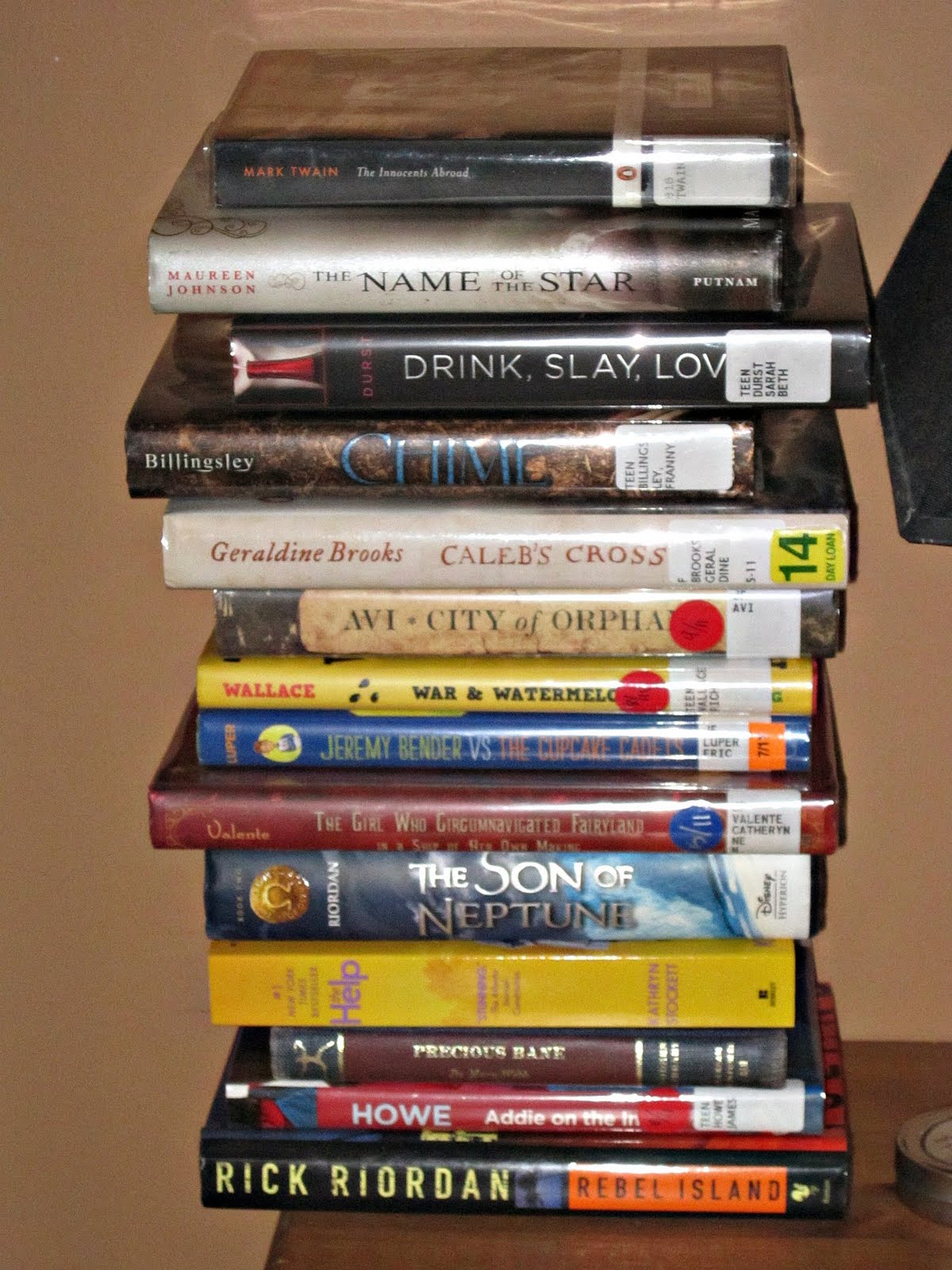
Penderwicks at Point Mouette
Wildwood Dancing (reread)
The Lion, the Witch and the Wardrobe (audio)
The Wee Free Men (audio; reread)
Close to Famous
What Momma Left Me
A Stranger to Command (DNF)
The Great Gatsby
Anna and the French Kiss
Mission Road

Anna and the French Kiss

by Stephanie Perkins
ages: 14+
First sentence: “Here is everything I know about France: Madeline and Amélie and Moulin Rouge.”
Support your local independent bookstore: buy it there!
Copy given to me by the lovely Vasilly

So, this one has been getting a lot of hype, all of it saying how wonderful, how great, how supremely perfect this was.

M, when she finished it said, “Well, that was cheesetastic. Good cheese, but so cheesy.”

The basic story: Anna Oliphant is the daughter of a Nicholas Sparks-type author, who, not wanting to be outdone by all his Posh Hollywood Friends, ships Anna off to a Posh boarding school in Paris. (Oh noes.) She doesn’t know a lick of French, doesn’t want to leave her comfortable life in Atlanta, doesn’t want to leave her blossoming almost-relationship with Toph. But, to Paris she goes.

Where she bumps into — literally — Étienne St. Clair.

(cue dreamboat music)

What ensues is a lot of romantic push-and-pull. Anna obviously St. Clair, but she has a double problem to deal with: he’s got a girlfriend though she’s kind of out of the picture, and Anna’s friend Mer likes him as well. Then there’s the question of whether or not St. Clair likes her? Sure, they’re friends, and they hang out all the time. But does he like her?

(Because, you know, we ALL want to know that.)

That’s not to say this is a bad book: it’s predictable, sure. But I did enjoy the relationship between Anna and St. Clair, it’s heights and valleys, and it’s inevitable, swoon-worthy resolution. It’s not a simple book, and much like Maureen Johnson’s work, Perkins knows how to write a romance that deals with more even while putting the relationship front-and-center.

Update, 2018: I can see how I thought it was cheesy, but for whatever reason (time, place, etc.), I found it to have a lot more depth this time. There were themes about communication and assumptions that touched me, and a reminder that while my children are my responsibility, they are also their own people with their own dreams, and it’s not up to me to control their lives. Also: I missed the subtext that Americans really can be awful (en masse) the first time around. Still a very good book.

Not perfect, b I ut delightful.

Mission Road

by Rick Riordan
ages: adult
First sentence: “Ana had to get the baby out of the house.”
Support your local independent bookstore: buy it there!

Even after my failed attempt to read Southtown, I wanted to finish out Tres Navarre’s story. Mission Road didn’t sound like such the gritty story, and so I picked it up, hoping for the same sort of thrilling mystery that Riordan had delivered before.

Tres Navarre has settled into a bit of a routine: visit his girlfriend Maia up in Austin, take care of his resident ex-FBI housemate, take a PI job here and there, try not to get killed in the process. But when his old friend Ralph Arguello shows up at Tres’s back door shaking, covered in blood, and accused of being his wife’s, Sargeant Ana DeLeon, shooter, there’s only one thing Tres can do: help him.

That makes Tres a fugitive from the law: he and Ralph have 48 hours to figure out who shot Ana, and solve a cold case from 1987. Because the two are inevitably connected. This, of course, involves getting the help of a notorious San Antonio mob boss, who also happens to be the father of the murder victim in the 1987 case.

Interestingly enough, Tres is more of a pawn in this book than an actual participant. It’s Maia who does all the legwork, getting the information, and actually is the one who solved both crimes. She’s the one who had the intense face-down with the suspect, who put the puzzle pieces together while Tres and Ralph were running around creating a nice diversion while trying to save their necks. I didn’t mind this at all; I like Tres, but I’ve decided that I like Maia more. She’s a tough, intelligent, interesting woman; full of power and vulnerability in all the right ways. It also helped that Tres and Ralph hooked up with another intriguing, complicated woman — Madeline White, daughter of the mob boss — which spiced up their run for their lives.

Even with these two women, the book is populated with less-than-lovely characters. There’s an interesting division between bad and truly evil, between skirting the law and doing unspeakable crimes. Riordan handles something that could be really disturbing — the rape and murder of multiple young women — with sensitivity; the book never crosses over into the truly graphic, which makes it go down easier. First and foremost is saving Tres and Ralph, and by extension, Ralph’s wife and year-old daughter.

As for the mystery: I kind of figured it out halfway through, but only one part of it. There’s a really nice twist in the very last chapter, one that was surprising, but made sense given the characters and the plot.

Very satisfying.

The Great Gatsby

by F. Scott Fitzgerald
ages: adult
First sentence: “In my younger and more vulnerable years my father gave me some advice that I’ve been turning over in my mind ever since.”
Support your local independent bookstore: buy it there!

Ah Gatsby.

I fell for this book sometime in high school during my jazz phase. I don’t remember what it was about the book that captured my fancy; I just remember loving it. However, after using it as a basis for a paper in my class on the history of jazz my freshman year of college, I haven’t opened the book.

Enter John Green and the Nerdfighters. They’re doing a read-along of the book this summer, and while I may not actively participate in the discussion (though I did enjoy John’s first video on the book), I decided I would at least give The Great Gatsby another try to see if it held up over the years.

And it did. I’m not sure I was as enamored over it as I was in high school. Upon rereading, I think what I liked was the feel of the book. It captures the feel of the jazz age — the aimlessness, loneliness after the first World War, and yet the desire to distance oneself from anything destructive — so perfectly. I was caught up again in their mediocre lives of desperation, indulging in the reminder that being rich does not solve any problems, and may only serve to create more. It was also a reminder, this time around, that the past should stay in the past, that any desire to relive it will just end in pain for everyone.

I find the writing lyrical, and the story beautiful in it’s desperation. A true American classic.

A Stranger to Command

by Sherwood Smith
ages: 13+
First sentence: “You’re a new one.”
Review copy won from Charlotte’s Library

First off: this has the ugliest. cover. ever. After I got it in the mail, I took a look at it and thought: man, they’re not doing much to promote what hopefully will be an awesome story inside.

Then I stuck it on my shelf. Every time I looked at it, I just thought: ugh.

Eventually, I did crack it open. Partially because I loved Crown Duel and this is billed as the “exciting prequel”. Partially because I was looking for some good sweeping fantasy, and hoping this would fit the bill.

Unfortunately, I bailed halfway through. The book wasn’t doing it for me. It’s the story of Vidanric as a 15 year old, sent off to a military school in a far-away kingdom because his king is killing off all the heirs in his kingdom. He has to adjust, to learn, to fight homesickness… blah, blah, blah.

It was glacially slow; I made it through Vidanric’s (now known as Shevraeth) first year and about halfway into his second when I just got bored. I put it down, and now, two weeks later, have no desire to learn any more about Marloven’s military tactics, their boy-king, the prophecy, or the unseen force that’s rising in the north. (Or wherever.)

I wanted this one to be so much more. Disappointing.

Sunday Salon: Why I Go To KidLitCon

I’ve been meaning to write this post for weeks, but with vacation and summertime computer usage by my children (we really need another computer around here!) I’ve hardly been on the blog at all. Just enough to whip off yet another review (at least I can read while everyone else is hogging the computer!), but not enough to spread news.

The 5th Annual KidlitCon is set for September 16-17 in Seattle this year. Registration is open through August 31, but after August 1, the price bumps up $5. And — this is beyond cool, I think — Scott Westerfeld is the keynote speaker.

This will be the third KidLitCon I’ve gone to. Why do I choose this one above everything else bookish out there I could go to, like BEA? (Though I’m tossing around the idea of going to the Texas Book Festival this year. That is, if there’s going to be any authors I’m interested in. They haven’t put up the list yet… I may go, regardless; I’ve always kind of wanted to do a big book festival, and the one in DC is on a bad weekend.) I’d like to be able to go to more, but time and money won’t allow it.

I go to KidLitCon because it’s small. I’m an introvert, and honestly? While BEA appeals to me (as does ALA), the idea of so many people and me being there by myself thoroughly intimidates (and terrifies) me. KidLitCon is the right size: there’s usually around 100 participants, so there’s enough people there to have a diversity, but not so many that there’s a mob. Just perfect.

I go to KidLitCon because it helps me be a better blogger. Or at least I’d like to think that. Sure, a lot of the panels are directed toward helping authors navigate the world of social media, but there are ones about blogging and reviewing and connecting with said authors and publishers. I find it engaging and thrilling to be talking to like-minded people; ones who are just as passionate about not only reading but about children’s books (and not just what’s hip in YA) as I am.

Speaking of which: I go to KidLitCon because of the people. This seriously may be the biggest reason for me. By the time I started going, I’d been following blogs for years, and I wanted to meet the people whose writing I enjoyed. I figured if they were as lovely in person as the were on the web, then I’d be in good company. (I was right.) The thing I think I like most about this group of people is that they are some of the kindest, most inclusive people I’ve ever met. Sure, I’m not a librarian, or a literacy advocate, or an author, or even that good of a writer, but they don’t seem to mind. (Or if they do mind me crashing their party, no one’s ever said so.) I feel as much a part of the group as Carol Rasco (who, by the way, has a delightful Arkansan accent and is a pleasure to talk to).

Those are my reasons for going. If you go, what are yours? And if not, consider joining us. You won’t regret it. I promise.