The Fire Horse Girl

by: Kay Honeyman
ages: 11+
First sentence: “There one was a girl, a fire horse girl.”
Support your local independent bookstore: buy it there!

It’s China in the early 1920s, and while some progress has been made for women — our 17-year-old protagonist Jade Moon never had her feet bound — there is still are a lot of restrictions. Once that Jade Moon struggles with. And there’s an added layer of stress: Jade Moon is a Fire Horse girl — one that was born in the Chinese zodiac year of the horse that matched up with an element of fire. As is often Chinese way, that means she’s labeled as cursed: she’s stubborn, she’s head strong, she’s outspoken. She’s everything the Chinese don’t want in a daughter (at least at that time).

So, when a stranger proclaiming to be a lost uncle’s adopted son shows up, offering her father a trip to the United States, Jade Moon begs to go along. She figures there will be more opportunity for her in the U.S., less restrictions, and more room for her to be who she really is.

Of course things aren’t as rosy as Jade Moon thought they would be; there wouldn’t be a book if there were. While I didn’t find myself entranced by this book, I was interested in all the historical detail Honeyman included. The portrait of Angel Island was less than rosy; there was a immense dislike and distrust of the Chinese during that time period, and officials would do anything they could to keep the Chinese from entering the U. S. Then, there’s the references to both the gangs that ran Chinatown and the brothels the women were kept in. Nothing explicit, but Honeyman did an excellent job making this book feel like the 1920s. As for Jade Moon herself, while I liked her, I found that I couldn’t quite connect with her.

In the end, it was a good book, but not a fabulous one. Which isn’t bad. 

Audiobook: The Castle of Otranto

by HoraceWalpole
Read by Tony Jay
ages: adult
Support your local independent bookstore: buy it there!

 It starts out on as a happy day for Manfred, the lord of the Castle Otranto. His only son, Conrad, is going to be married to Isabella. However, right before the wedding, Conrad is mysteriously killed by falling helmet. Weird, right? That’s only the beginning: Manfred, distraught, does the only thing possible (huh??) and decides that, to insure his lineage will go on, he will marry Isabella. (Yeah, Manfred does have a living wife. And a daughter.) Isabella (rightfully) escapes (go girl!) with the help of a peasant, Theodore. Whom Manfred locks in the tower. Theodore’s rescued by Matilda, Manfred’s daughter (you’ve gotta love the pluck of these girls. The novel was published in 1764), and sent off to help Isabella. After almost nearly killing her father (who appeared out of nowhere, really), they head back to the castle to confront Manfred and the ghosts that have been haunting him.

It’s a melodramatic, over-the-top novel. But, I really had a great time with it. The best part of this one was the narrator. Jay was fabulous. I found myself gripped in the thralls of what I would have otherwise  found to be a boring, hard to understand novel. I found myself listening in the car because Jay was so captivating.

And that made all the difference for me.

Eleanor & Park

by Rainbow Rowell
ages: 14+
First sentence: “He’d stopped trying to bring her back.”
Support your local independent bookstore: buy it there!

Eleanor is the new girl on the bus. She’s not noticeable because she’s attractive. Rather, it’s because she stands out: she has flaming red hair, she’s not the thinnest person on the boat, and she dresses like a hobo. The last thing Park wants is for her to sit next to him.

Park is not exactly someone who blends in all-white Omaha, Nebraska in late 1986. He’s short. He’s half-Korean. He likes alternative music. He reads comic books. He’s spent his life trying to lay low. And so, having the “taint” of Eleanor isn’t exactly the attention-getter he wants in his life.

Except, slowly, he realizes what a gem she is. It starts with comic books: she begins by reading over his shoulder, and that leads to actively sharing them with her. And as their relationship develops, Park realizes things about Eleanor — why she is who she is — and falls head over heels in love.

The most beautiful thing about this book, I think, is the slow development of Eleanor & Park’s relationship. It’s not instalove, it’s not all sparks and romance. It’s a friendship that develops into something more. And it’s complicated. Not the least reason because Eleanor’s stepfather is a real piece of work. Seriously. He’s one of those guys who is all about power and control, and yes, he abuses Eleanor’s mother. I loathed the man. It’s because of her stepfather (and her father, really, who isn’t much better) that she’s anxious about men, tries to fly low on the radar, and dresses the way she does. And Park, because of his innate decent-ness, is able to get through all of Eleanor’s defenses.

I’ve decided that what I need to do is man-up and realize that my high school years are really historical fiction. This is the third book this  year set in the mid-1980s, and honestly, I think it’s the best. It actually felt like the 1980s — not only because of the music and vague pop culture references, but I think Rowell really got the way things were — but she also used the 80s as a way to connect her characters. And I was caught up in it all, not just for nostalgic reasons, but because the characters were caught up in it.

And the ending? Shall I just say it was perfect. Not “happily ever after”, but hopeful. Amazingly, wonderfully, perfectly hopeful. I appreciated that.

As Bill and Ted would say: it was excellent.

Eoin Colfer is Actually a Stand-Up Comedian

I could have titled this something normal like “Eoin Colfer Author  Event” (which is what it was), but this went so far beyond “author event” that I had to tell it like it is. I was warned by a co-worker going in that he 1) had the Irish storytelling gene and 2) was a leprechaun but I still wasn’t prepared for the absolute hilarity that the evening was.

I’m not even going to try to recount his stories except for one. He was telling us about his teenager, Finn, and how he never tells Eoin that he loves him anymore. Then Eoin got sick on a plane once and decided to play it up like he was dying, thinking he’d get Finn to say those dreaded words. He drew it out for a while, but eventually Finn came over saying, “Dad, I need to tell you something.” Eoin thought that it’d be “I love you” but it turned out to be: “My headphones are broken.” Everyone laughed and he moved on. Eventually, he started taking questions and A (all of 9 1/2) stuck her hand up. He called on her, and she asked, “So: did you ever fix Finn’s headphones??” Everyone cracked up, and she rendered Eoin speechless. I think he said something like “Are you a plant from J. K. Rowling??” (to which A nodded; of course she is!) But then he proceeded to tease her the rest of the evening.  It was pretty funny.

Traveling with Eoin was a magician (who was pretty funny — and good — in his own right). But afterward, he sought A out and told her that he’s been traveling with Eoin for 9 days and had never seen anyone call him out on one of his stories. He gave her a high five, did a couple of tricks just for her, and became her friend for life.

Kindred spirits

I do have to mention that A took Eoin’s teasing pretty hard — she was convinced he hated her. But (especially after the magician cheered her up) she stood in line to talk to him after. He gave her a wink and a smile and shook her hand and cracked jokes right before the camera went off.

It amuses me that he’s the only one not smiling.

I had him sign Airman, which is my favorite of his books.

And we decided on our way home that out of all the events we’ve been to, this one was the best. Period.

Aristotle and Dante Discover the Secrets of the Universe

by Benjamin Alire Saenz
ages: 14+
First sentence: “One summer night I fell asleep, hoping the world would be different when I woke.”
Support your local independent bookstore: buy it there!

It’s the summer of 1987, and 15-year-old Aristotle — Ari; he hates his given name — is a bit lost. He’s the caboose in a Mexican-American family; he was born after his father returned from a tour in Vietnam. He’s got older twin sisters and an older brother, but since he’s in prison, no one talks about him. Ari’s got a whole lot of bottled up angsty feelings, and is quite directionless with his life.

Then he meets Dante, who is everything Ari is not: vibrant, interesting, talkative. They become friends — best friends — and slowly over the course of the year, that friendship blossoms into something more.

I think I need to just come to terms with the idea that the 1980s are historical fiction now. Though, I’m still at a loss as to why this couldn’t have been contemporary. It’s set in El Paso, and the world that they inhabited didn’t feel like it needed to be in the 80s. Their parents were incredibly accepting of Dante’s homosexuality, and the experimentation with drugs and alcohol could have happened just as well today as it did back then. There side plot that involves violence against Dante for being gay, but again: not necessarily something that needed to be in the 1980s. In fact, even with the violence, it seemed… tame. We have come a long way in the last 30 years.

Though — and maybe it was me — I never really found myself connecting with this book. I think part of it was that I don’t do 15-year-old boy angst well at all. I just found it hard to relate to Ari, to all his angst and his non-communication. And I’m not sure that the spare prose — as lovely as it was, sometimes — helped the situation much. While I understood Ari, and what he was going through, I found I couldn’t sympathize with him. And I do have to say that while I didn’t have a problem with the end, I didn’t think it was terribly convincing, either.

In short, it wasn’t a bad novel, just one that I don’t think was for me.

The Reluctant Assassin (W.A.R.P. 1)

by Eoin Colfer
ages: 12+
First sentence: “There were two smudges in the shadows between the grandfather clock and the velvet drapes.”
Support your local independent bookstore: buy it there!
Review copy provided by the publisher through the bookstore.

Chevron Savano is a 17-year-old FBI junior agent, stuck in London as a reassignment after an undercover debacle in Los Angeles. She’s basically babysitting this weird pod with an agent who calls himself Agent Orange. It’s all very odd and extremely boring. That is, until one day the pod shakes and shivers and a boy from the past comes through. It turns out that the pod is actually a time machine with a link to Victorian London (as part of an experimental FBI witness relocation program) and the scientist who invented it was just murdered.

Riley is the assistant to former magician and current assassin for hire Albert Garrick. He’s not a willing assistant: he owes Garrick his life, but is becoming increasingly disillusioned about Garrick and his, well, we’ll call them sensibilities. Riley lives his live in constant terror: Garrick is evil at his core and he has a sense of ownership for Riley that is positively creepy. And so, when Riley activates the wormhole (with the death of the scientist) and slides through., Garrick does the only thing possible: kills the FBI cleanup team, and heads through the wormhole. With one addition: his consciousness merges with that of Agent Orange, effectively making Garrick a supervillian. Riley and Chevron are both on the run from Garrick and determined to stop him from completely destroying the fabric of time.

On the one hand, Colfer –whose work has been hit-and-miss for me over the years — really knows how to pile on the action. It’s non-stop! It’s one thing after another, but I never felt it was too over the top. It all made sense to me. Also: I thoroughly enjoyed both Chevie and Riley as characters. They complimented each other — which could have been a tricky thing considering they are from two different centuries — and Colfer played each to his or her strength. Additionally, Garrick is a great villain: creepy and evil to the core.

In fact, my only real complaint is the same as Ms. Yingling: for a book the publishers are marketing for 10+, there is an awfully high body count. Garrick has absolutely no qualms about murdering anyone and everyone, which means that there is someone being offed (and sometimes more than one) quite often. I know there are other dark middle grade books out there (the Harry Potter series and Graveyard Book are two that come to mind), but there is a casualness about the killing in this one that is a little, well, creepy.

Aside from that, however, it’s a gripping read. Oh, and Eoin Colfer’s going to be at Watermark on Wednesday! If you’re in town, stop by. It should be fun!

State of the TBR Pile 16: May 2013

To all those out there celebrating: Happy Mother’s Day! I’m not getting books, mostly because I already have too large a pile. But isn’t that the way it always is?

Oh, one more thing. I need to write a post on PopCircle (especially in the wake of Amazon buying Goodreads), but I don’t think that’s going to happen until my life settles down a bit. I will say this: I’m impressed. It’s a great way to organize books (and music and movies), and it’s incredibly easy to use. It’s fun, but I think it’ll be even more fun when more people use it, mostly because it merges social networking and organization. Go check it out here. And tell me what you think.

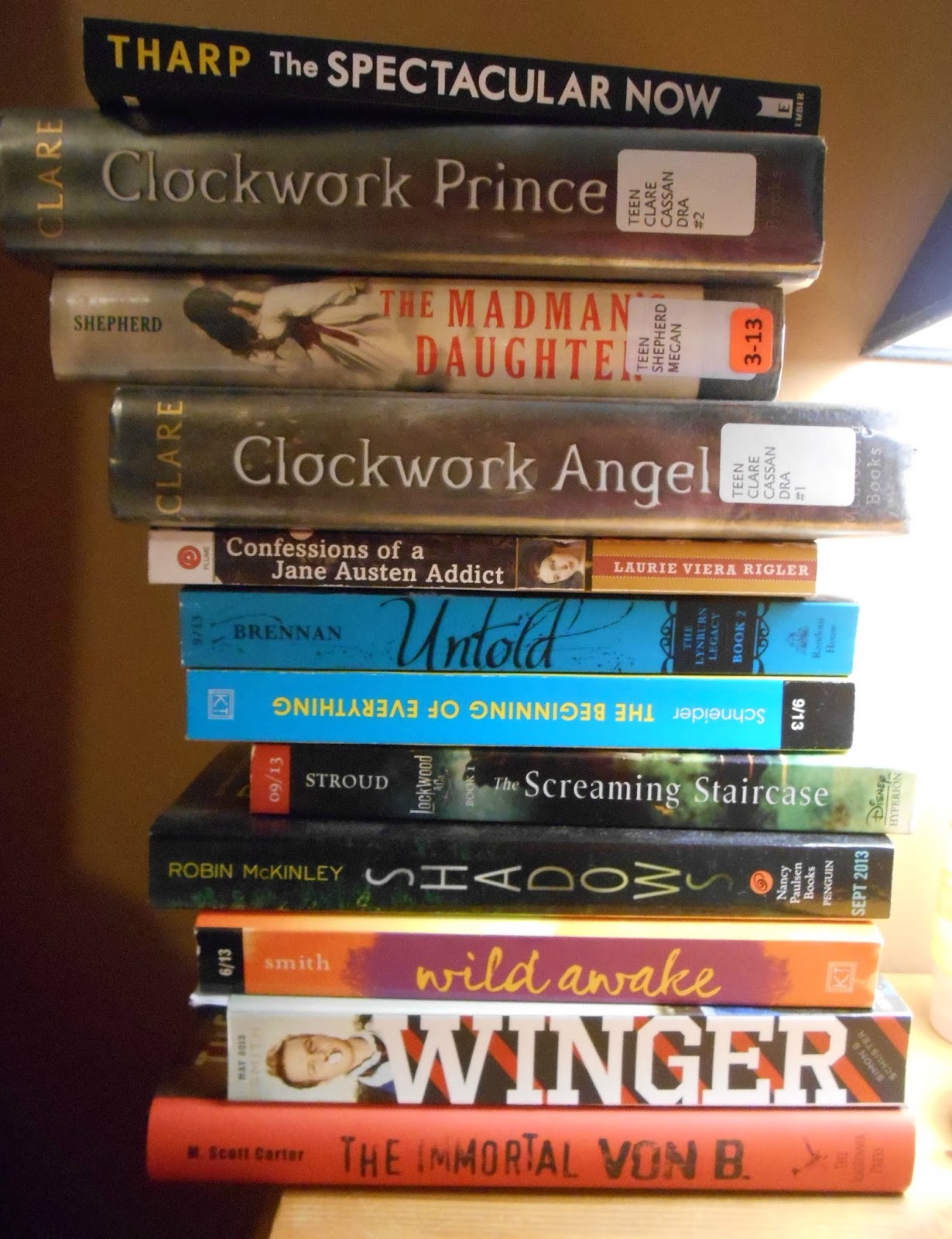
Confessions of a Jane Austen Addict, by Laurie Viera Regler (my friend Wendy gave me this when I visited her last fall. I’m in the mood for it now.)
Icons, by Margaret Stohl (because Shannon Hale tweeted that it was good.)
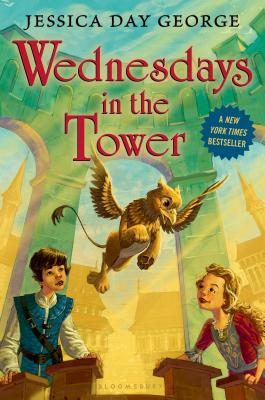
Wednesdays in the Tower, by Jessica Day George (because I loved Tuesdays at the Castle)
Apothecary, by Maile Meloy (for my work 3-5th Grade book club June selection)
The Key and the Flame, Claire M. Caterer (because she’s coming to the store in June)
Rebel Spirits, by Lois Ruby (ditto)
OCD, the Dude, and Me, by Lauren Roedy Vaughn
 Hold Fast, by Blue Balliet
The Little Way of Ruthie Lemming, by Rod Dreher (my husband knows him, read this, and says I need to read it so I  know why he wants a cow)
Cooked, by Michael Pollan (do I need a reason? It’s food and it’s Michael Pollan. Of COURSE I’m reading it.)
Bone 1: Out from Boneville and Bone 2: The Great Cow Race by Jeff Smith (because it’s about time I read Bone.)

What are you looking forward to on your pile?

Here Where the Sunbeams Are Green

by Helen Phillips
ages: 10+
First sentence: “So here we are in this shaky little airplane high above the jungle which is kind of (very) scary.”
Support your local independent bookstore: buy it there!

Madeline (only her family and close friends call her Mad) and Ruby (Roo, to her older sister) are sisters whose father is the Bird Guy: he will go anywhere to study birds. So, when he gets invited to Central America to track a bird that has supposedly been extinct, he jumps at the chance.

He was only supposed to be gone a month. But 10 months later, he still hasn’t returned, and there’s this guy, Ken, from the corporation La Lava, who keeps hanging around. And there are what Mad calls “the Creepies”: feelings that they’re being watched. And, finally, the Very Weird Letter from their dad to Roo. All of this prompts the girls and their mother to head down to La Lava in search of their father. But little do they realize the complicated mess they’re walking into, or their role in helping their dad escape.

I have mixed feelings on this one. On the one hand, the present tense bugged me (it always does), but there also felt like there was something off. Perhaps it was because it was written in present tense, and the reader figures things out along with Mad and Roo. Perhaps it was because our main character (in my opinion) is the least interesting person in the book. Perhaps it was this weird mix between science and “magic” (anything magical was explained away by science, yet sometimes the coincidences were a bit… much).  It was never enough for me to want to put the book down, but it was enough for me to not entirely embrace it, either.

That said, by the end, Phillips had won me over (albeit tentatively) to her world, and I wasn’t sorry I put in the effort to get there.

The Different Girl

by Gordon Dahlquist
ages: 11+
First sentence: “My name is Veronika.”
Support your local independent bookstore: buy it there!

On this island there are four girls — Veronika, Isobel, Eleanor, and Caroline — who are exactly alike. Same size, same weight, same temperament. They tell each other apart by their hair: Isobel’s is yellow, Caroline’s is brown, Eleanor’s is black, and Veronika’s is red. They’ve been on this island as long as they can remember with their teachers Irene and Robbert.

I’m going to make an aside here and mention that one of the things that truly fascinated me about this book was the puzzle that it presented. Dahlquist doesn’t come out and say that these four girls are some sort of robot. Or that this world is some sort of dystopian place. Rather, he put clues — a click behind the ear when the girls go to sleep; an aversion to water; how their hair has to be in the sun — throughout the book in order to give us a sense of how these girls view themselves.

Especially once May — a real, live girl — is shipwrecked on their island. She brings with her questions, ones that Veronika, our narrator, can’t answer. And when an outside ship comes to the island, it’s up to May and the four girls to figure out how to keep safe.

It takes a really unique premise to get me hooked these days, especially when it’s a dystopian/apocalyptic world. And this one did it. I loved the robot narrator, I loved the questions that the book presented, I loved that the world was implied but never fully explained. I loved the science fiction elements of the story, but also how very human it was. I don’t know if kids would “get” it the way I did; there’s a lot of room for confusion, but also a lot for discussion.

I think this is one that will stay with me for a while.

Audiobook: An Abundance of Katherines

by John Green
read by Jeff Woodman
ages: 14+
Support your local independent bookstore: buy it there!

I picked this up on a whim,  partially because Laura (all my good ideas come from her!) suggested the YAckers read another John Green book, and partially because I’ve been trying to get this guy at work to read John Green, and I suggested this one. I figured it was due for a reread. Or listen in this case.

After going back and reading my initial review, I realize I don’t have much to add. It’s still a great mix of nerdiness, humor, and Deep Thoughts, though I think John (I can call him that, right? Being a Nerdfighter and all?) has gotten better at meshing the Deep Thoughts into his books  and they come off less as Deep Thoughts and more as, well, just thoughts. I didn’t remember the bit about the footnotes; I’m assuming Woodman read them, but they just came off more as asides, which I didn’t mind at all.  Speaking of Woodman, I thoroughly enjoyed his narration; he got the voices just right, and the girls — always an issue with me with male readers — weren’t simpery. Hassan was still my favorite character, hands down; it was nice to have a religious character — an Islamic one at that — who wasn’t preachy. Not to mention the fact that he was overweight but not obsessive about it.

I do think, in the end, that although this is John’s funniest book (all the fugs made me laugh), it’s not my favorite anymore. (I’ve remembered it that way for the longest time.) It’s charming, it’s sweet, it’s fun, but it lack the depth that he has in his other novels. Perhaps I should try pushing Paper Towns on the guy at work (he’s one of those literary fiction sorts). He might like that one better.