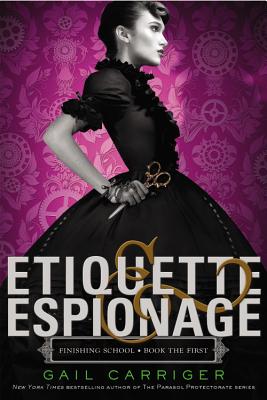
Etiquette & Espionage

by Gail Carriger
ages: 12+
First sentence: “Sophronia intended to pull the dumbwaiter up from the kitchen to outside the front parlor on the ground floor, where Mrs. Barnaclegose was taking tea.”
Support your local independent bookstore: buy it there!

I’m going to say this up front: I was drawn in by the cover and by the back, which has a very catchy and kind of awesome blurb on it:

It’s one thing to curtsey properly
It’s quite another to learn to curtsey & throw a knife at the same time.
Welcome to Finishing School.

But I couldn’t finish it. In fact, after about the first paragraph, I was questioning my desire to read it at all.

From what I can gather, Sophronia (Really? REALLY? What a terrible name. Then again, all the names are terrible) is a 14-year-old tomboy in 1850-something.  It’s a steampunkish world, with machinery and robots, but there’s also paranormal beasties (you know: werewolves, vampires and the like). Because she’s such a handful, her mother’s neighbor (I think that’s who Mrs. Barnaclegoose is; I was never really quite clear on this), takes it upon herself to enroll Sophronia in Mademoiselle Geraldine’s Finishing School. Which, as it turns out, has a lot more to do with finishing than Finishing. (Ha.)

I never really got the rest of the plot, because after the attack of the flywayman (double ha) and the revelation that Mademoiselle Geraldine is actually a 17-year-old student named Monique (who has an Agenda), I lost interest. I wanted this to be awesome in the over the top but way cool sort of way,  but instead it ended up just being convoluted.

Orson Scot Card said once (I think it was him) (and I’m obviously paraphrasing here) that a good story needs more than one good idea. But that’s the problem with this one: a Finishing school for assassins is a good idea. A fellow student who has an Agenda is a good idea. A steampunk world is a good idea. Werewolves and vampires are good ideas. But all of them  together? Not so much. The book felt — and granted I only got about 70 pages in — cluttered.  Crowded. It made me feel claustrophobic.

And the writing? Sure, it’s the 1850s, but this is just banal:

“Your mother is occupied in an important private audience. I was going to await her leisure. But for this, I shall disturb her. It is 1851 and I believe we lived in a civilized world! Yet you are as bad a a rampaging werewolf, young miss, and someone must take action.” (3)

Dimity sidled up to Sophronia and whispered, “Isn’t he simply scrumptious?”
Sophronia pretended obtuseness. “The coachman?”
“No, silly. Him!” Dimity tilted her head toward their new escort.
“He’s a little old, don’t you feel?” (47)

(Much talk like Yoda, hmmm?)

“Oh yes, lead on, do. To the Squeak deck.”
“What-ho.” (73)

And that sound you hear? It’s the sound of my hopes being dashed.

Pity.

Paper Valentine

by Brenna Yovanoff
ages: 13+
First sentence: “My sister, Ariel, is sprawled upside down on the couch, pointing with the TV remote.”
Support your local independent bookstore: buy it there!

Hannah’s friend Lillian slowly killed herself through anorexia, finally dying about six months ago. And ever since then, she’s been haunting Hannah, hanging out, commenting on her life, not really allowing Hannah to let go and move on.

But things are changing this summer: Hannah’s become interested in Finny Boone, one of the social un-elite, whom she’s known forever but never really paid attention to. And young girls are being murdered, which means the whole town is on edge. Somehow, all three of those things — Finny, Lillian, and the killer — are connected, and maybe by figuring out how, Hannah will be able to deal with her grief and move on.

On the surface, this is a hodgepodge of things: a murder mystery, a ghost story, a Teen Issue story, a grief and loss story. But, for some reasons, in Yovanoff’s hands, most of those elements work really well together. I say most, because I had the most issues with the serial killer part of the story. I’m not going to give away any spoilers, but while I didn’t really see the ending coming, it wasn’t a satisfying conclusion to the whole mystery. That, and the bad guy monologues. I hate it when they monologue. It’s so… pat. Like the information should have been out there already, and we didn’t really need to hear it all from the bad guy’s mouth. Except in this case, it wasn’t.

That, and I found the characters incredibly difficult to connect to. Hannah was mopey, Lillian pushed Hannah around, and her other “friends” weren’t so nice (my favorite scene? When Hannah confronted the Clique and told them off. You go girl.) Finney was the Strong Silent Guy, and Ariel was the Cute Younger Sister. While I found the book to be intense, it was in spite of the characters and unlike Lauren Oliver’s Before I Fall or Laurie Halse Anderson’s Wintergirls, I didn’t buy Hannah’s growth arc.

Still, there were some pretty creepy moments, and I have to give Yovanoff credit for that. I just wish it worked better as a whole.

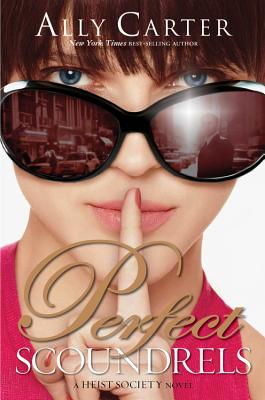
Perfect Scoundrels

by Ally Carter
ages: 12+
First sentence: “Of all the people who knew about the big house in the middle of Wyndham Woods, very few had ever been inside.”
Support your local independent bookstore: buy it there!
Others in the series: Heist Society, Uncommon Criminals

I have decided (only took me three books, too), that one of the things I like best about this series is that it’s not really a “series”. You don’t have to read the first two to get the third (though they’re fun and you should read them). Each one is a separate con/heist while building upon the characters we’ve come to know and love (and, in my case, swoon over).

This one is all about Hale. (*swoon* You should have seen me at the store when these came in. I was a complete fangirl. HALE!) The short version is that we learn a lot about his family, his past, and his life. Which, to tell the truth, doesn’t really bode well for Kat. Hale’s beloved grandma Hazel has just passed away,  and it turns out that Hale is the sole inheritor of the business, with the family lawyer named as trustee until Hale turns 25. And fortune. Except, Marcus (ever-trusty chauffeur/butler/guy) believes there’s something wrong: his sister, Marianne, who was Hazel’s companion and friend, was completely cut out. He asserts that the will read is fake, and hires Kat to find and steal the real one back.

Of course, that’s not the whole story. But to tell you it would be to ruin your fun. I will tell you this: out of the three, this one has the tightest con. I didn’t figure it out until it was nearly over, and then I just sat back, reveling in the brilliance of it all. And while Hale wasn’t perfectly charming the whole book, it was still Hale. I know I shouldn’t have crushes on 17-year-old fictional men, but honestly: *swoon*

Plus the whole gang is back, and there are some brilliantly funny moments as they set up the long con. We get to meet more of Kat’s family, with all their brilliance and weirdness. Though I have to say that my new favorite minor character is Silas. Please: more of him!

All the other fun elements that I’ve come to expect from these books are there: jetting around the world, rappelling down buildings, breaking into banks, and just a little bit of kissing (in closets). I hope Ally Carter has a few more of these up her sleeves, because, heaven knows I can always find time to read them.

If only because I *swoon* over Hale.

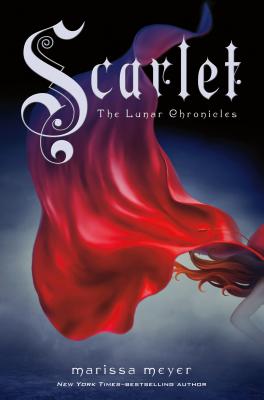
Scarlet

by Marissa Meyer
ages: 12+
First sentence: “Scarlet was descending toward the alley behind the Rieux Tavern when her portscreen chimed from the passenger seat, followed by an automated voice: “Comm received for Mademoiselle Scarlet Benoit from the Toulouse Law Enforcement Department of Missing Persons.
Support your local independent bookstore: buy it there!
Others in the series: Cinder
Review copy handed to me by the publishing representative.

I wasn’t going to read this one. Really. After my issues with Cinder, I was going to let the whole series slide. But the Macmillian rep who comes by the store once a quarter handed this to me back in November with the words: this is a LOT better than the first.  So, I took a chance.

And was completely blown away.

I’m not going to say this is the Best Book Evah, but honestly? Meyer took what was kind of a weird thing in Cinder, and delivered something intense. (Obviously, spoilers for Cinder will follow.)

Scarlet Benoit’s grand-mere has been missing for two weeks, and she’s getting annoyed at the lack of leads in the case. It’s not a suicide, like the authorities have ruled: Scarlet knows her grandmother well enough to know that. But she has no idea where to start looking for her. Then a strange man called Wolf falls into her life, claiming to have knowledge — though he’s reluctant to share it — about where her grandmother is. They head to Paris to get some answers.

Meanwhile, Cinder escapes from prison and teams up with an American to try and process all the information that’s been given her in the last 24 hours. Turns out that Scarlet’s grandmother may have information that Cinder needs as well.

All that against the backdrop of an impending invasion from the very creepy Lunar queen Levana.

The thing I liked best about this one, I think, is that Meyer gives us more of this fascinating futuristic world that she’s created. Sure, Scarlet is loosely based on Little Red Riding Hood, but it’s not so much a fairy tale as a story of what people will do for those that they care for. Which makes it sound deeper than it is. Really? It’s just a lot of fun, a great second novel in a series. (You don’t often hear that.) Which leaves me begging for the next installment.

Just One Day

by Gayle Forman
ages: 14+
First sentence: “What if Shakespeare had it wrong?
Support your local independent bookstore: buy it there!
Review copy provided by my place of employment.

Allyson and her best friend Melanie have just recently graduated high school, and are off on a tour of Europe. You know the type: scheduled, regimented, seeing all the highlights tour. If it’s Wednesday, we must be in Rome type of thing. Allyson, being the structured-type girl herself, is enjoying it okay, in spite of Melanie’s attempts at a re-do. She keeps saying that in college they can reinvent themselves, but at the same time, loves that Allyson is so reliably… Allyson.

Then, they meet Willem. It was a fluke: when they were in Stratford-upon-Avon, they passed up the chance to see the Royal Shakespeare Company do Hamlet in favor of seeing a company called Guerrilla Will do Twelfth Night. And it was… something. Willem, 20 and Dutch, was charming, and Allyson fell, well, in like. And the next day when they met again on the train, she decided it was kismet, and decided on a whim to go to Paris with him. For the day.

Forman really works this implausibility. (Especially for me, as a mother of four girls, I was conflicted. Part of me was: YES, PARIS!! How romantic! And it was, really. The other part of me was screaming: NOOOOOOOO!!!!) It makes sense for Allyson in that moment to make that choice, to experiment with living a life that was something other than her same structured existence. And what better place to do it than Paris? She has a marvelous day, and then… Willem’s gone. She’s alone. “It” didn’t work.

So she packs off home and heads up to college, where she tries to move on with her life. Or rather, move on with the life that her mother has assigned to her. I realized while reading this one that a lot of my ideas on parenting teens have come from reading teen novels because I could totally see where things were going to go. Helicopter mom = disastrous first semester. It wasn’t until her second semester that Allyson began to figure out how to stand up for what she wanted, how to make friends, how to find her own path instead of the one her parents made for her.

And the end? Well, let’s just say it’s a hopeful one. I’m not sure how plausible it is, but by that point, I didn’t care. I was fully invested in Allyson’s story, in her trials and her hopes and dreams. Which Foreman made come alive for me.

Besides, it’s Paris. You can’t get any better than that.

Level 2

by Lenore Applehans
ages: 12+
First sentence: “I’ll sleep when I’m dead.”
Support your local independent bookstore: buy it there!
Review copy provided by my place of employment.
Additional disclaimer: while I wouldn’t claim to “know” Lenore, I have met her on several occasions when she stops in town, and enjoy her company.

Felicia is dead. (That’s not a spoiler.)

She’s been lounging around in her hive in Level 2, revisiting her memories — only the pleasant ones, please; specifically of Neil, her boyfriend at the time of her death — talking to her friends Beckah and Virginia, trying to stave off the ever-increasing boredom. Then, one day, something Exciting happens: the system malfunctions, and Beckah disappears.

Oh, and Julian — an old, not-so-beloved flame of Felicia’s — reappears. And it seems that Level 2 isn’t the happy, peaceful, resting place Felicia thought it was. In fact, it’s a place where a group called the Morati — angels who weren’t quite, well, angelic — are siphoning humans’ energy in order to invade heaven. And they need Felicia’s power.

What the what?

At first take, this is an interesting glance into the afterlife. I liked the use of Felicia’s memories to give us backstory, without having to set up everything first. (Yes, we do eventually learn how she died.) It serves to help us get to know Felicia, to understand her interior motivations.

But, unfortunately, it also allows us to keep our distance.  Which is the first of my problems with this one. I go back and forth between whether I’m a character-driven reader or a plot-driven reader, and I think I’m both. If the plot is slow, I will forgive it if there are fascinating characters. And I’ll forgive wooden or stereotpyical characters if the plot keeps my interest. The problem with Level 2 is that I didn’t have either.

I think we’re supposed to like Felicia, with all her guilt and complexities (not to mention her fixation on Neil). But I just… didn’t. I thought she was whiny privileged, and not at all the Heroine she was made out to be. (Maybe that was on purpose? And there will be More in the next book?) I did like Julian (whom I don’t think we were supposed to), but I felt let-down by his character arc. I wanted more from him. And Neil? Well, lets just say he was arm candy.

The second of my problems is that I felt the plot was uneven: perhaps it was because the memories broke up the flow of the plot, but I felt it came in fits and starts. It was too slow at the beginning, took too long to get rolling, and then ended up going too fast at the end. In fact, I finished the book with a “WHAT? HUH?” expression: I had no clue, really, what just happened. Perhaps that was my fault: I’m not exactly the most careful of readers all the time, so I probably missed something. Either way, the Twist and the Big Reveal did not work for me.

Now, to be fair, I may be being a bit hyper critical. It’s not every day that someone I “know” gets a book published, and advance buzz for this was quite good. I’m always more critical of books with a lot of advance buzz, so I tend to avoid them.  This book reminded me a lot of the Matched series, so I know there will be readers for it. And I’m not sorry I spent the time immersed in this world.

I just wish I had liked it more.

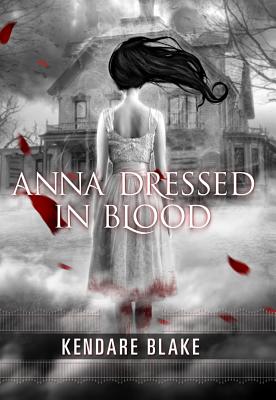
Anna Dressed in Blood

by Kendare Blake
ages: 14+
First sentence: “The grease-slicked hair is a dead giveaway — no pun intended.”
Support your local independent bookstore: buy it there!
For the YAckers book group.

Cas is a ghost killer.

How can that be, you ask, since they’re already dead?

Well… some ghosts don’t want to stay dead. And some ghosts start acting out against humans, harming them. And it’s those ghosts that Cas, with his family heritage — his father was a ghost killer before him — and his athame — the knife that does the killing, tackles.

That doesn’t mean everything is coming up roses. In fact, quite the contrary. Cas’s father was brutally  murdered by a ghost outside of Baton Rouge, Louisiana, and Cas has been spending the last several years working to get good enough to go back and face whatever it is. And so, when he gets word of an especially violent ghost in Thunder Bay, Ontario, he knows he has to go get it. Her.

Anna Dressed in Blood.

A bit of an aside here: I don’t do horror. Period. Never have, never will. And yet: I found myself attracted to this book. From the ink the color of dried blood, to the violence that Anna does (and she does some violence), to the intense (for me!) climax at the end (they got the ghost with a hundred pages left to go, and I was wondering what Drake was going to do with them; worry not: they’re incredible), I couldn’t put this one down.

Another quick aside: the over quote from Cassandra Clare is “Spellbinding and romantic.” Um. NOT. This is not a romantic book. This is a violent, bloody, intense book. Sure, there’s a bit of love-falling-into, but honestly: don’t let the girl in the dress on the cover throw you off. It’s an episode (or three) of Supernatural. It’s a ghost Buffy (the comparison is aptly made in the book, actually). It’s a ramped-up, less funny Ghostbusters. It’s awesome. Perhaps it’s spellbinding. But it’s not romantic. Unless, of course, you find grappling with a deadly ghost romantic. Then, yeah. It’s romantic.

Either way, it’s worth the read.

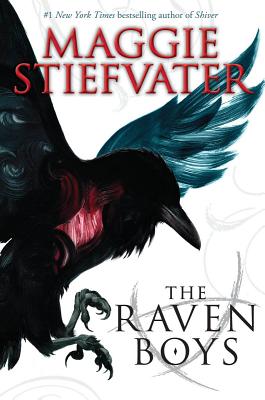
The Raven Boys

by Maggie Stiefvater
ages: 13+
First sentence: “Blue Sargent had forgotten how many times she’d been told that she would kill her true love.”
Support your local independent bookstore: buy it there!

It would be a lie to say I am a longtime fan of Maggie Stiefvater’s. I’m not. I made it through Shiver and Linger, but gave up on the wolves after that. Even after hearing her speak at KidlitCon 2010 I wasn’t all gungho about her writing. Then, I read The Scorpio Races, and my mind began to be changed. After this one, though, I have to admit: I’m a fan.

There’s just something eloquent in this book: it’s not that its prose is beautiful; I can’t thing of a single passage that stood out. But rather, Stiefvater is eloquent in her simplicity. There’s nothing outstanding about any of the characters individually, and yet as a whole they become remarkable.

The girl is Blue, the daughter of a psychic, who aspires to be “eccentric” but really is only “sensible.” She has been told since she was little that she would kill her true love with her kiss. Because of that, Blue has two rules: 1) don’t kiss anyone, and 2) don’t get involved with the Raven Boys. They’re the upper crust blue bloods that populate the pre-Ivy League boarding school in this small mountain Virginia town. Except rule number two changes after Blue gets involved with Gansey’s — one of those blue bloods with an affinity for a 1973 Camaro — quest to find a mysterious Welsh king he believes to be buried nearby. Gansey doesn’t come alone, but rather in a pack: there is Ronan, a hot-blooded Irish boy who has gone off the deep end since his father’s mysterious murder; Noah, who lurks around the outskirts of everything, but still is somehow part of it all; and Adam — the one Blue falls for — who has his pride and not much else. Their quest starts out innocently enough, but becomes increasingly darker as the book goes on. It’s this slow descent into the strange, supernatural, and eerie that kept me reading, not wanting to put it down.

It was pointed out in the YAckers that it’s a good gender-neutral book: the love bits aren’t all smushy, and the male characters are pretty amazing. As is everyone else.

I’m blathering. Just go read it (if you already haven’t).

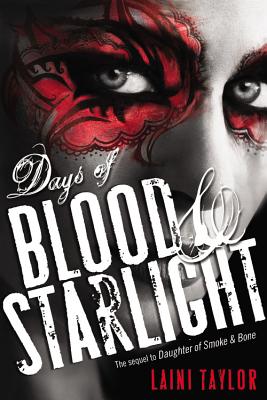
Days of Blood & Starlight

by Laini Taylor
ages: 14+
First sentence: “Prague, early May.”
Support your local independent bookstore: buy it there!
Others in the series: Daughter of Smoke and Bone

First off: if you haven’t read Daughter yet, you need to. Unlike other books, even though Taylor (thankfully) includes information to remind you of what went on in the first book, to really, fully understand what’s going on in this one, you have to have read the first. (Not that it’s a chore to do that.) (And you should probably do so before continuing on here because there will be spoilers.)

We last left Karou and her angel love Akiva, they weren’t on good terms. Karou discovered that she was formerly Madrigal — a chimera, an enemy to the seraphim — and that while she was Akiva’s lover, that didn’t end well. And Akiva didn’t bounce back happily; being the Beast’s Bane for the seraphim emperor, he waged war on the chimera, killing off everyone Karou loved.

That’s something you don’t forgive easily.

So, Karou has thrown herself in with the chimera, becoming the resurrectionist — the person who brings souls back to live in new bodies — for the rebellion army, headed up by the White Wolf, Thiago. Getting it out of the way here: there are some despicable male characters in this book. Horrible isn’t a strong enough word. And the things they do to innocent people are, well, contemptible. Taylor doesn’t hold back on the horrors of war, the terrible things power-hungry men (always men; though there’s a couple of — I’m running out of adjectives — loathsome women, too) will do to gain their power. And the pitiable state of their victims. It’s one of the reasons why this book is so dark and, as a result, so powerful.

Akiva, on the other hand, is trying to reconcile the horrible things he’s done with his feelings for Karou, searching for some way to get her forgiveness. He starts saving chimera from the angel attacks, which leads him — and by extension, his brother Hazael and sister Liraz — directly on a path of conflict with their father, the emperor Joram, and their uncle Jael.

I’ll leave the plot summary there, because there’s so much more going on. Zuzana and Mik show up (happily) and not everyone gets out of this one alive. It’s a trilogy, so don’t expect a conclusion — much like the first one, it comes to a stopping point, but there’s so much left unresolved, and so much happens in the last quarter that I’m anxious for the next one. (A year is so long to wait!)

But, I do have to  mention this: as far as second in a series books go, this one is phenomenal. Taylor’s such a gifted writer and storyteller, that she was able to take a middle book that’s mostly about revenge and war and make it into something grander. Every character was fully dimensional — even the horrid ones — and I was fully invested, emotionally as well as intellectually, in where the story was going.

I’m starting to think, however, that I’m going to be sad when this series ends. It really is that good.

Under My Hat

Tales from the Cauldron
edited by Jonathan Strahan
ages: 11+
First sentence: “The stories all start with a hat, specifically a tall, black, pointy hat.”
Support your local independent bookstore: buy it there!

I know it’s bad form to start a review with “I never read x” but in this case it’s true. I don’t do short stories and I’m not a big fan of witches. (Tiffany Aching aside.) But, in this case, I’m glad for the Cybils: I thoroughly enjoyed this collection of short stories about witches.

The stories themselves were good, taking in a wide breadth of witch lore. It went from modern Wiccan (Holly Black’s “Little Gods,” which — since this is a book aimed at the upper-middle grade audience, I feel compelled to add — contains the book’s only f-bomb), to traditional fairy tale (Jane Yolen’s fabulous “Andersen’s Witch”) and everything in between. There are some fantasy  heavyweights here as well: aside from Black and Yolen, Neil Gaiman weighs in with a quirky poem; Patricia McKillip has a story about a witch band fighting evil (way cool); Frances Hardinge was her elegant self in the smart, funny “Payment Due”; Charles De Lint explores the idea of a Hispanic witch in “Barrio Girls”, and Garth Nix offers up a creepy boarding school witch story.

Obviously, there were some that I liked more than others, but hands-down my favorite was from an author I’d not heard of before: Tim Pratt. I guess he’s solely a short story writer, which is why I haven’t read his stuff, but his story “The Carved Forest” was amazing. It’s basically the story of a girl who is having conflicts with her family, so she runs away to the witch’s house. Her brother comes to get her, and discovers that the witch has an entire forest of carved trees. They’re of people in his town, and the witch’s job is to keep them rooted, never leaving her care. It works on several levels: as a brother-sister story, as a creepy witch story, and as an allegory for letting people follow their own path. Perhaps it’s what I wanted to read right then, but it really affected me.

Overall, it’s a great collection of stories, perfect for anyone who is into witches (or just wants to explore the topic a bit).

(Just for the record: because this is a Cybils nominee, I’ve been asked to make sure y’all know this is my opinion only, and not that of the panel.)