Totto-Chan: The Little Girl at the Window

My friend Sarah recommended this one for our in-person book group; we’ve been passing her two copies around since the library doesn’t have one. And it was my turn to have the great pleasure of reading Tetsuko Kuroyangai’s wonderful little memoir.

It’s the most unusual memoir I’ve read recently. It’s in the third person and reads more like a work of fiction than a collection of personal recollections. That, and it’s so simply, so cheerfully written that it’s not just an easy read, but an entertaining one as well.

The story is about Totto-Chan, Kuroyanagi’s childhood name, and her experiences at the Tomoe (to-mo-e) Gakuen school, an alternative elementary school outside of Tokyo designed and run by Sosaku Kobayashi from 1937 to 1945. He believed in a whole education — and this book is as much a portrait of an ideal school as it is a memoir — and letting the child determine his or her place in school. He taught music, believed in exploring nature, used everyday experiences (like lunch) as teaching tool, and created a wholesome environment so that the children attending developed confidence and self-esteem. It was truly remarkable to read about.

I’m sure much could be said about the educational value of the book, and the critique it indirectly gives of modern education. I, however, preferred enjoying it on a simpler level: as a series of sweet reflections of a woman about her idyllic childhood. Either way, it’s a wonderful little book.

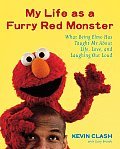
My Life as Furry Red Monster

This little book, by puppeteer Kevin Clash (with Gary Brozek, in very small print), is one-part memoir, one-part glimpse into the world of Sesame Street and one-part life-affirming-self-help-ish-type book. I liked two-thirds of it.

The memoir part was fascinating. Have you ever wondered how a 45-year-old, tall black guy ends up playing a 3 1/2-year-old furry red monster? I have. Ever since I found out that the same guy played both Hoots the Owl and Elmo (as well as Natasha the baby monster), I’ve wondered about him. How did he get into puppetry? How did he end up being Elmo, of all muppets… This book answers some of those questions. He had a poor, but loving, and nearly idyllic (if you believe everything he writes) childhood. His parents were awesome — how many parents would take their child’s love of puppets and wholeheartedly support it? And his evolution as a puppeteer and a performer is fascinating, too.

I loved the parts about Sesame Street, too. Jim Henson was probably the world’s best boss, and Clash gives you a little insight into that world. I appreciated the logic and the insider dope on some of the global spin-offs, as well as the Sesame Street’s evolution here. (Especially since I stopped watching the show with my kids sometime in 2002. C was the last one who really watched it. A didn’t have much interest in it, and since we don’t have cable now and the local PBS station’s signal is weak, we don’t even get it anymore.) I haven’t always liked what they’ve done with the show, but I understand the reasoning behind it. Clash took us through the whole process from curriculum design through to rehearsals and test audiences. It was pretty interesting, too.

But when he tried to sum the whole thing up into little bits of advice (good advice: love, joy, creativity, tolerance courage, friendship, cooperation, learning, optimism), it just felt forced. I would have rather read a book about Clash’s life, his experiences with being a master puppeteer, and left the whole life affirming stuff off. Even so, it wasn’t too obnoxious and overbearing. And it was worth it to read about his life and work.

The Year of Living Biblically

I’ve had my eye on this for a little while; I know it’s been making the blog rounds where it’s been getting overwhelmingly positive reviews. So, when Hubby’s colleague loaned it to us a month ago, I jumped at the chance to skip the hold line at the library and actually read the book.

A. J. Jacobs is a man with a mission, crazy though it might be (especially for an agnostic, secular Jew): to live the teachings of the Bible — all of them — as literally as possible for an entire year. He grows a huge beard, he wears white, he dances with joy, he sacrifices an animal (well, pays to have one sacrificed), he prays… the list goes on.

It’s an ambitious project, as Jacobs soon finds out; he’s attempting to do in one year what most people don’t accomplish in a lifetime. But he’s game, almost naively so, to give it a try. And the result is a funny, fascinating, enlightening book.

Jacobs spends eight months of the year exploring the Old Testament/Hebrew Bible, partially because he’s Jewish (at least by heritage) and partially because so much of the Bible (comparatively speaking) is made up of the Old Testament. It’s an interesting journey, full of bumps and starts and failures and revelations. I thoroughly enjoyed his journey with prayer; being reminded, in the process, of things that I could be doing better. I enjoyed his experiences with the weirder aspects of the Bible (like not wearing mixed fibers), and his
ultimate realization that sometimes you do things just because God asked you. I liked the New Testament part less, mostly because — and Jacobs admits that this is a problem — without believing in Jesus as the Savior, the New Testament isn’t as easy to follow. Still, he makes a go at it, exploring many facets of Christianity (including snake handlers… go figure) with an open mind.

It helps that Jacobs is a witty, engaging writer, as well as an honest and forthright one (well that is one of the commandments, after all). It’s an excellent read.

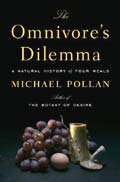
Omnivore’s Dilemma

First, some history. Back in 2001 Hubby brought home a New York Times Magazine article by Michael Pollan had written about corn and the effect it is havingAmerican diets. I read it, was sufficiently shocked, and started reading ingredient labels. A anti-corn syrup activist was born. I have changed my diet (and my family’s) significantly in the past 7 1/2 years: I make my own bread, we limit the cereal and snack intake, we only have soda rarely. Aside from that article, the other motivators for food change over the years have been Fast Food Nation (which Hubby read; he said I probably couldn’t stomach the slaughtering chapters) and Crunchy Cons. We rarely eat at fast food (not never, though I do loathe McDonalds these days), and we try our best to buy local, especially when it comes to food. (Warning: this is one LONG review. Sorry.)

So this book, for me, was not so much a revelation as a confirmation. I can — and should — take the next step, take our food awareness to a slightly higher level (even if that means, much to C’s distress, getting rid of chicken nuggets and hot dogs and mac-and-cheese in a box).

The book is divided up in to three parts: Industrial, Organic, and Foraging, where he follows four meals from the beginning through to eating them. In industrial, he follows corn through corn-fed steers being “processed” to eating at McDonalds. If you read nothing else out of this book, read this section. Please. The only way we’ll even remotely begin to change the hold of industrial agribusiness has on this country is if more people know. (At one point, Pollan writes that the best way to change things would be to require glass walls on all slaughterhouses. Then, the public would be forced to acknowledge what goes on in those places in the name of cheap beef.)

The organic section was the one that I found most interesting. Pollan’s ultimate conclusion is that big organic (Whole Foods, Trader Joes, what you get at the supermarket) isn’t a whole lot better than industrial agriculture. I found this somewhat surprising. But, he visited farms and feedlots, and was unimpressed with the organicness of it all. Sure, they didn’t use pesticides or antibiotics, but the vegetables were still being picked by immigrant workers and the animals were still living in overcrowded conditions. Not exactly environmentally healthy, even if there is an “organic” stamp on it. (He also spends a lot of time talking about USDA regulations. If you can read this book and not end up angry at the USDA, I’ll be impressed.)

The second part of the organic section is Pollan’s ultimate ideal. He spent a week at Polyface farm, run by Joel Salatin. This man is an impressive farmer. He considers himself a”grass farmer“, rethinking how he raises cows, chickens, pigs, and rabbits. Everything is eco-friendly, local and interconnected. It’s an amazing place (it almost sounds too good to be true), and it made me wish for such a place closer to me (either that, or that I still lived in the DC area so I could pop down for a visit). It also made me realize that even though I buy local, I haven’t visited the farms where I get my meat. How are the animals living? How are they slaughtered and processed? I should be more proactive.

The final section is his attempt to recreate the hunter-gatherer. He hunts for wild boar. He forages for mushrooms, and serves a meal, in the end, that cost him practically nothing (except for time). He also visits vegetarianism, and the implications that has for modern eating. It’s all very fascinating (and well-written).

But, in the end, it leaves me slightly depressed. How many people are going to pick up this book? How many people can it change? Sure, organics and farmers markets are growing, but (as we’ve found out), it’s expensive. We spend a good chunk of our monthly paycheck on food, and it’s not because we’re buying more. I liked this quote (from Joel Salatin):

“Whenever I hear people say clean food is expensive, I tell them it’s actually the cheapest food you can buy… [W]ith our food all of the cost are figured into the price. Society is not bearing the cost of water pollution, of antibiotic resistance, of food-borne illnesses, of crop subsidies, of subsidized oil and water — of all the hidden costs to the environment and the taxpayer that make cheap food seem cheap. No thinking person will tell you they don’t care about all that. I tell them the choice is simple: You can buy honestly priced food or you can buy irresponsibly priced food.”

It just seems like a huge, uphill battle. But one in which I’m more than willing to do my part.

The Royal Road to Romance

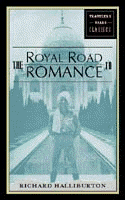
I decided a while ago to abandon my original list for The Armchair Challenge. After reading, and loving, The Embarrassment of Mangoes, I knew there was no returning. So, I hunted for the suggestions that my friend, Amira, gave in the comments of one of my other posts. No luck; I guess my library just isn’t as versed in Central Asia as hers is. But, they did have my Nook friend Cami’s suggestion (well, actually Cami’s mother’s): Richard Halliburton’s The Royal Road to Romance. And I’m so glad I picked it up.

I’ve gotten into BBC’s Jeeves and Wooster (based on the P.G. Wodehouse books, which I really must read). I’ve not only enjoyed the silly (very silly!) story lines, but I’ve loved the whole 1920s aura; the dress, the attitude, the language. So, what does Bertie Wooster have to do with The Royal Road? Well, imagine Bertie as an American tramping about the world, and you’ve basically got the feel of the book. It’s really a whole lotta 1920s fun.

First, a couple of laments: I lamented the lack of a map. I had an idea where many of the places were, but there were several stops I had no clue about. I wanted to know where Andorra was, and whether or not it was still a country. Same with Ladakh. I wanted to know where in India all these cities he popped in and out of were. There was a map in the original publication; Halliburton made reference to it. But, my edition lacked one and there were times when I really missed it. But the greater lament was the lack of photographs. Halliburton’s tromping all over the world with his trusty camera (even getting thrown in jail for taking pictures in Gibraltar) and the only evidence we have is the cover photo of him in front of the Taj Mahal. So sad.

My laments aside — and they really are paltry — I thoroughly enjoyed seeing the world through Halliburton’s eyes. The world was so different then; Halliburton literally bummed around the world, hitching rides on steamers, stealing trips on trains (avoiding train conductors was a common pastime of his: “All day long, it was necessary to fight off collectors, as the news of my default spread by telegram up and down the line. Not only conductors were on hand to hound me, but inspectors, police and station-masters. I was diving out of windows, changing compartments and haggling from morning till night. One particularly obnoxious collector would have pushed me bodily off the train had I not pushed him off first.”), biking, walking… things that very few people these days would even think of doing. Sure, he comes from a certain class of people — for who else, when graduating from college, would shun a career for 600 days of “horizon chasing” — and that affects his view on the world. But, there’s also the fact that so much of the British Empire was still intact, so there was a feeling of compatriotism from the ex-pats he met, people who were more-than-willing to help him on his adventures.

And what adventures he had! He climbed the Matterhorn, without any previous climbing experience (and was mildly disgusted at his friend Irvine’s response: “At last,” he continued in a far-away voice, “after talking about it and dreaming about it all these years, at last, I can actually SPIT A MILE!”). He met the president of Andorra, and bummed around Spain with a fellow American (an architect student; the funniest part was their “contest” in Seville where they tried to get as many girls as they could to smile/flirt with them). He went south to Gibraltar, snuck (sneaked?) into the fort at night, and then got jailed for taking pictures a couple of days later. (I liked this quote: “That same afternoon we approached the Bay of Algeciras, and there before me, rising abruptly across the water, I saw the majestic Rock, entirely devoid, to my great disappointment, of the Prudential Life Insurance advertisement I had always seen emblazoned upon it in picture.” Hubby said, “Wow. Even back then.”) He got out by sheer pluck, and with a fine of 10 pounds, which he did not have, but the guards (for whatever reason; because Halliburton was plucky?) and friends paid the fine for him.

From Gibraltar, he headed to Monte Carlo, where he and another American, Pauline, lost $200 gambling. I really liked this passage:

Finding diamonds very boring, we sat on a bench in the Casino Gardens overlooking the sea, and there surrounded by great banks of flowers we finished our inadequate box of candy, realizing how much better it was to drown our desolation in this form of narcotic than to do the commonplace thing of shooting bullets into our skulls.

And then on to Egypt, where he spent the night on top of one of the pyramids, Kheops, and got caught naked in the Nile (that was a funny adventure!). He decided instead of heading to Greece, that he’d go on to India, spent the night in the Taj Mahal (yes, he snuck — sneaked — in there, too), and bummed around various other places. He climbed the Kyber Pass, visited Kashmir, and was one of only 12 whites to see Ladakh that year. From there, he decided to continue east:

[I] turned my attention to maps, upon which I saw that in my aimless peregrinations I had wandered half-way round the world. It was now as near home eastward as westward so I resolved to return to America via Japan, despite the fact that this move would make me eligible for the dreadful epithet “globe-trotter”.

He saw a cremation festival in Bali, partied in Hong Kong, got robbed by pirates off of Macao, met Russian exiles in Harbin, Bolsheviks in Vladivostok and then managed to secure passage across to Japan (as an “official” mail courier) and climbed Mt. Fuji (in January, in the ice and snow, taking the first-ever picture of the crater in the snowy season) before working his way back home.

It really is a grand adventure, a royal road to romance. And one that’s really worth the time to read. I’ll end with my favorite quote of the book, from after the pirate incident:

As our little ship moved painfully toward her dock I was standing on deck in my shirt-sleeves beside the unfortunate American tourist who had lost most of his two hundred dollars.
“Lord, I’m hungry!” he growled at me.
“Oh, everybody’s hungry,” I replied unsympathetically. “But it’s worth it having such a jolly adventure. “
“Jolly adventure!” he gasped.
“Why, of course. I’ve never had such a good time.”
“Idiot!” he burst out.
“Fossil!” I retorted.

Eight Feet in the Andes

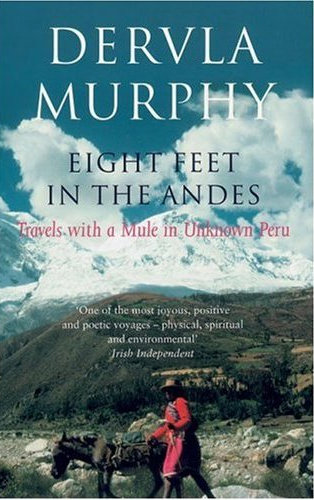
I think, perhaps, several years ago I would have been more inclined to like this book by Dervla Murphy. I think I would have admired her, thought her ambitious and adventuresome for climbing the Andes mountains with no companions except her 9-year-old daughter and a mule, living on the land and the generosity of the Peruvians. I think I would have found her feminist observations — why can’t a woman do this by herself, anyway? — inspiring.

Now… I just think she’s crazy. Crazy for even thinking about hiking through the Andes. Crazy for taking her daughter along. Crazy because… well… let’s just say it’s not something I even remotely related to. (Not that I have to, but it didn’t amuse or inspire me, either.)

It took me a while to get into the book — it’s a diary, and those are hit and miss with me. This time, it was more misses than hits. There’s really no story here. They hike from place to place. They have food sometimes; they sleep in various places. They almost freeze, rescued by a native family who didn’t speak a word of Spanish or English. And, by the entries in mid-October I was tired. Tired of her whining about modern civilization (though early on I thought it had Wendell Berry-esque overtones), tired of the paces she put her child through. Tired of Peru.

So, I abandoned them. Sure, I checked the back: whew, they made it to the end of the trail safe by Christmas Day. Yee-haw.

That’s the third book for the Armchair Challenge. Not one memorable one yet. Maybe I ought to re-think my list….

Reviving Ophelia

Number one book finished on vacation. I didn’t pick light and fluffy books. I did, however, read everyone’s reviews of Eclipse, and am very happy that it’s now waiting for me at the library. Unfortunately (maybe), I have two Austen-sequels to get through before Saturday, so Bella and Jacob and Edward will have to wait (as well Pretties…). I do promise to put pictures of Amira and booklogged up, if it’s okay with them. 🙂

On to the review…

After reading Girls Gone Mild, and since M is due to start Middle School any day now, I figured it was about time I got around to reading Mary Pipher’s book. My mom sent me this one a year or so ago; she had read it a while back when my sister was going through some tough times at home. Mom figured it could help me — you know, the whole four girls thing and all.

I found this book — it’s the 1994 version — to be both incredibly helpful and completely out of date. Well, mostly out of date. I think we’ve come a long ways in the 13 years since this book was written. I’m not sure the teenagers of today are nearly the demure, confused girls that Pipher was interviewing. There is greater equality in education (in fact, I read a report that quoted statistics that said more girls than boys are likely to graduate high school and go to college.) At the same time, I completely buy what Shalit was writing about: we are still an incredibly sexist, lookist and misogynistic society and that the incidences of eating disorders and other self-abusive practices are actually up, rather than down.

It was really a lot of personal stories, many of them disturbing and sad. But, there were a couple of places where Pipher gives some much-needed advice. (Unfortunately, they were at the end of the book.) She has a chapter on “What I Learned from Listening”, which is essentially a primer on how to listen to your teenager, and how to guide her through the process of discovering her own opinions, thoughts, and belief systems. Invaluable. And the final chapter, “A Fence At the Top of the Hill”, she gave suggestions on how to keep your girl from being swept away by the storm that is teenage years. I found it to be encouraging and helpful.

It’s not a perfect book, but I am glad I read it. Maybe I will survive my girls being teenagers. It’s like everything else: hard work, perseverance, mistakes, crying, and joy. Either that, or just cross my fingers and hope. Right?

The Redemption of Love

For all you non-Christians, this book isn’t for you. It’s basic premise — Rescuing Marriage and Sexuality from the Economics of a Fallen World — rests upon a belief in the Bible and in the words of Jesus. Without that, there really isn’t any point in reading this book. Oh, and this is going to be a long post because there’s a lot to say. Feel free to skip it. 🙂
For the rest of us, this book, by Carrie A. Miles, is an interesting look into the history of male-female relationships, marriage, and th expectations laid out in the Bible for both. Her basic assertion is that God never intended marriage to be “man rules and works and woman stays at home”, but rather God created male and female to be complete in each other.

The reason given in Genesis 2 for woman’s existence in no way implies her inferiority, but neither does it support the notion that she is complete in herself. Woman is not creation’s all in all any more than the man is. … Rather, sexuality in creation belongs not to the individual but to the relationship. Female and male exist only for the sake of the other. Power has nothing to do with it.

It’s only because of the Fall that the historical pattern of marriage emerged.

Miles spends a lot of time on the economic history of marriage. She asserts that it’s because man had to work for his bread that what we’ve come to view as “traditional” marriage emerged. And then, only because the woman had an asset that man didn’t: the ability to give birth. Because she could do that, and because children were essential to the economy of the pre-industrial world, she was by necessity tied to the house. If she worked hard in the fields, she ran the chance of miscarrying. Having given birth, she was tied to the house to nurse and then raise the child. Miles writes, “Eve was told that she would bring forth children in sorrow– sorrow because they would be valued not for their individuality or for their relationship with God but for what they could produce.”

Miles goes on to write that Jesus (and even Paul) asserted that this was not the way relationships between man and women were supposed to be.

Jesus opened the door not only to female discipleship but to the possibility of men and women interacting without reference to sex. Further, in shifting the blame for lust from the woman to the man, Jesus removed the assumption of sinfulness that adhered to women’s very existence as female.

(There’s even a chapter on the Song of Songs — or the Song of Solomon, as I know it — and how it’s a blueprint for a true and lasting relationship. Very interesting.)

She goes on to assert that what Christians believe is a decline in morals in today’s society is a result of the Industrial Revolution. Marriage, in the last 100 years, has essentially become a luxury, not a necessity. We marry for love, for sexual attraction, not because we need someone to bear our children so that we have people to work the farm. “Feminism,” she writes, “did not cause the breakdown of the family; rather, the breakdown of the historic functions of the family caused feminism.”

She goes on to write:

With the forces sustaining the sexual cartel gone, young women in the 1960s discovered that they had little restraint on their sexual behavior. Casting away the old morality once inculcated through shame and obligation, young women began asking themselves the same question that importunate young men had been askig forever: Why not? Why not enjoy the same “sexual prerogatives” that men enjoyed? Economically dependent on neither man nor child, tehy armed themselves with reliable birth control, the right to abortion should birth control prove not to be so reliable, and, if all else failed, the knowledge that a good job, welfare, or child support would sustain them. While far from every woman personally embraced the sexual revolution, middle-class women increasingly took it as their right to join the wealthy in behaving as they pleased.

So, what do we, as Christians, do with this? If what has been historically the traditional marriage relationship is not supported by the Bible, then what? Unfortunately, here is where the book breaks down. It’s not that she doesn’t make the book relevant to 21st-century relationships; she does. But she doesn’t do it with the same passion and assertion that she talks about the historical relationships and Biblical expectations. I’m not sure what I was expecting; this isn’t a marriage-help book. But, I think I was expecting some sort of light: Ah, THIS is how I can make my marriage work better. Or, THIS is what I can do to survive in this world. There is a lot of talk about “in the world of thorns”, and I suppose the assumption is that if we didn’t want to live in the world of thorns, we wouldn’t do that. Perhaps, I may have been expecting something Miles felt wasn’t necessary. In fact, her last paragraph reads:

The Bible offers a single, simple ideal for marriage: a union of two souls that is romantic, poetic, and by worldly standards completely impractical. But God did not create sexuality and marriage to be practical. Practicality is for those who live outside the garden. redeemed as Christians and as lovers, we keep the fruit of our own vineyards.

In the end, then I figure this book is just an extended study on how the Bible interprets marriage. Whether or not anyone gets anything out of it is completely up to them.Which, I guess, is a lot like religion and our relationship with God. We can learn all we can but if we don’t do anything about it, there’s really no point to the knowledge we have. We need to be constantly progressing and changing, and if that means reconsidering our relationship to our spouse (and children) then this book can be a good catalyst for doing that.

The Art of the Common place: The Agrarian Essays of Wendell Berry

Ah, Wendell Berry. The last time I attempted to read him, I, um, didn’t succeed. But then, I wasn’t getting much sleep either. And one thing I’ve learned about Berry is that you really have to focus on what he’s saying. I re-realized that with this book; I found I got the most out of the essays when it was quiet.

So, about the essays — the book is a collection of some of Berry’s essays on from the last thirty years, though I think the most recent was written in 1999. They touch on typical Berry subjects: the environment, place, community, conservation, farming. It wasn’t as extremist as I remember being Sex, Freedom, Economy & Community being (though there are several essays from that book here), but there was still food for thought.

And, as an interesting aside, I felt less guilty than usual while reading this book. I guess I have to back up a bit here: Berry makes me feel guilty. I guess it’s because I actually am persuaded by many of his arguments, and feel bad that I’m not doing more in my life. And since we’ve actually started making changes in our lives (read hubby’s post about that here) to conserve and to treat the world we live in better, I was able to read this book without the huge dose of guilt that has come along with reading Berry in the past.

Some other thoughts. I loved the first essay: “A Native Hill”. They called it a geobiography, and it was just beautifully written. Berry is such an evocative writer.

Perhaps it is to prepare to hear someday the music of the spheres that I am always turning my ears to the music of streams. There is indeed a music in streams, but it is not for the hurried. It has to be loitered by and imagined. Or imagined toward, for it is hardly for men at all. Nature has a patient ear. To her the slowest funeral march sounds like a jig. She is satisfied to have the notes drawn out to the lengths of days or weeks or months. Small variations are acceptable to her, modulations as leisurely as the opening of a flower.

There is one essay that hurt (I really can’t think of how else to put it). I was having a really bad day, as a mother, and I sat down to read “The Body and the Earth” and I got to a section entitled “Sexual Division”. And I read this:

This determinations that nurturing should become exclusively a concern of women served to signify to both sexes that neither nurture nor womanhood was very important. But the assignment to woman of a kind of work that was thought both onerous and trivial was the beginning of their exploitation… Women had become customers, a fact not long wasted on the salesmen, who saw that in these women they had customers of a new and most promising kind. The modern housewife was isolated from her husband, from her school-age children, and from other women. She was saddled with work from which much of the skill, hence much of the dignity, had been withdrawn, and which she herself was less and less able to consider important.

That’s exactly how I was feeling. Isolated. Like my life was a drudgery. It was emotional to see my feelings there on the page.

It was a good read. It is good to be reminded that nature is there and it is good, and an integral part of our lives, whether or not we live on a farm. That the real things in life: community, the growing season, nature, are what really matter. That technology and business isn’t the total sum of existence (and in fact, it just might do more harm than good). And if it takes an old crank from Kentucky to remind us of that, so be it.

The Life and Times of the Thunderbolt Kid

I love Bill Bryson. Really. He usually makes me laugh out loud.

But I have absolutely no interest in finishing this book.

I’m about 3/4 of the way through (well, I’ve got 3 1/2 chapters left), and I’m looking at it, and looking at all the other books I’ve got to read and thinking to myself, “Nah. Not interested enough.”

It was pretty funny; he’s one of the few authors that can make me laugh out loud. But, with that said, I have two problems with the book.

Point number one. Saying he grew up in the 50s is kind of like saying I grew up in the 70s. I didn’t, not really. I was 8 in 1980, and I consider myself a child of the 80s. I can remember the 80s (pretty vividly), while the 70s are pretty much a haze. He was born in 1951. He was 9 in 1960. Yes, he was a child in the 1950s (mostly), but “growing up”? Not so much. It bugged me that he spoke with such authority about a time period when he was just a little kid. I don’t know why. It just did.

Which leads me to point number two.

2) I’m amazed anyone can remember in vivid detail anything before they’re 8 years old. It seems to me that this book was just an excuse to harp on and explore the 1950s. I would have rather something more memoir-ish. He’s become (at least with the last couple of books) more of a “trivia guy” rather than a story teller. The book was littered with little bits of trivia about the 1950s, some of which was interesting, but most of which was just distracting and annoying.

I’m sure there’s more wrong with the book. There’s more right with it, too. It reminds me of Bryson’s book The Lost Continent which I couldn’t get through either (he crossed the line from being funny to being mean, in my opnion). It’s too bad; he’s written some of my favorite books. This just isn’t going to be one of them.