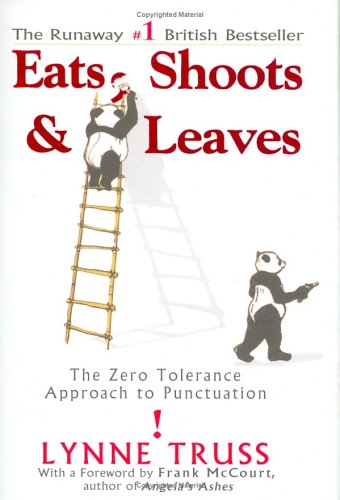
Eats, Shoots & Leaves

by Lynn Truss
ages: adult (but it’s not inappropriate for anyone really interested in punctuation)
First sentence: “To be clear from the beginning: no one involved in the production of Eats, Shoots & Leaves expected the words “runaway” and “bestseller” would ever be associated with it, let alone upon the cover of an American edition.”
Support your local independent bookstore: buy it there!

I am just geeky enough to truly love this book.

I loved it when it came out — Hubby bought it for me in hardback (and its sequel) — and, even though I haven’t picked it up in years, I found that I still laugh hysterically at the examples, and I find myself still being a complete and total stickler when it comes to punctuation. (Am I the only one who edits my friends’ Facebook statuses, if only in my head?)

So this is not quite a review. More of a love letter to Truss and her oh-so-funny look at punctuation. (And yes, I’ve gone back and checked and double-checked to make sure it’s all right. And it’s probably not.)

I think what I loved most was her examples. Sure, she pulled examples from literature, but she also would just throw things in as she went along. Like this (it’s my favorite):

Assuming a sentence rises into the air with the initial capital letter and lands with a soft-ish bump at the full stop, the humble comma can keep the sentence aloft all right, like this, UP, for hours if necessary, UP, like this, UP, sort-of bouncing, and then falling down, and then UP it goes again, assuming you have enough additional things to say, although in the end you may run out of ideas and then you have to roll along the ground with no commas at all until some sort of surface resistance takes over and you run out of steam anyway and then eventually with the help of three dots … you stop.

How can you not love that? Or this:

So it is true that we must keep an eye on the dash — and also the ellipsis (…), which is turning up increasingly in emails as shorthand for “more to come, actually … it might be related to what I’ve just written … but the main thing is I haven’t finished … let’s just wait and see … I could go on like this for hours …”

I also loved that, while it’s funny and accessible, you actually learn things. Or, at the very least, you’re reminded of things. Like the uses of apostrophes (or not). Or when to use the dash versus when to use parentheses. Or exclamation points! Or… (yeah, those things, too.)

Most famously of all, the apostrophe of omission creates the word “it’s”:
It’s your turn (it is your turn)
It’s got very gold (it has got very cold)
It’s a braw bricht moonlicht nicht the nicht (no idea)

But, learning aside, the best part of the book is really the geeky part. Truss is persnickety about punctuation, and it makes me laugh.

Now there are no laws against iprisioning apostrophes and making them look daft. Cruelty to punctuation is quite unlegislated: you can get away with pulling the legs off semicolons; shrivelling question marks on the garden path under a powerful magnifying glass; you name it.

Sticklers, unite!

The Year My Son and I Were Born

A Story of Down Syndrome, Motherhood, and Self-Discovery
by Kathryn Lynard Soper
ages: adult
First sentence: “No. Oh, no.”
Review copy sent to me by the author.
Support your local independent bookstore, buy it there!

Some books can just be summed up in a few words. The words for this one: Honest. Brave. Beautiful.

I’ve been working on this review for two days now, and I am still at a loss how to adequately sum up this book. It’s a story of a mother learning to accept her newborn son’s diagnosis of Down Syndrome. It’s a story of a woman who’s dealing with depression. It’s a story of a person who has been dealt an unexpected set of cards trying to come to terms with her faith and her community.

It’s not the story that makes this book compelling, though it’s a compelling story. What drew me in, and kept me there even though I thought I couldn’t relate, was the writing. There’s always a self-indulgent aspect to memoirs: one has to think they’re unique or important enough to write a memoir in the first place. But Soper takes an incredibly unflinching, honest tone, and uses spare, beautiful writing. Both of these combine to give the book an emotional wallop, making Soper’s journey not only captivating, but accessible and understandable to those who haven’t had the same journey. We come to care about Soper and her family. We become emotionally invested in them and their lives.

It’s also an unexpected story, which gives it a raw edge. Soper doesn’t take everything just fine. There are ups and downs, both emotionally and medically. It’s a hopeful ending — I almost wished for an epilogue; how is her son, Thomas now? — but it’s not a pat ending. There will be bumps down the road; Thomas will have medical problems, there will be discrimination, there will be trials. But, by the end, Soper (and the reader) have come to a new enlightened state, where everything is, if not happy, then at peace.

I do have one more word: remarkable.

Perfect Girls, Starving Daughters

The Frightening New Normalcy of Hating Your Body
by Courtney E. Martin
ages: adult
First sentence: “I have carried this book around inside of me for years.”
Support your local independent bookstore, buy it there!

I was conflicted while reading this book. On the one hand, it’s chock full of useful and relevant insights — my library copy is fairly dog-eared, and at times I thought that this would be one that I’d like to own. On the other hand, I felt like a foreigner in a strange land. Martin kept talking about “my generation” and “my parents generation”, and I’m sandwiched between the two. I can relate to some of the issues with the body that Martin pointed out as “common” among women — either in myself or in my friends — but, either I/we are in a much better place than “most” women, or maybe it’s just with the women Martin knows and younger that these issues of hating ones body are prevalent.

That said, this book did scare the hell out of me when it comes to raising my girls. There’s SO much that can go wrong with raising girls, and much of it is placed on the shoulders of the mother. (Though, much to my satisfaction, there’s a chapter on the influence fathers have in the lives of their daughters. Which I made Hubby read.) And so, while I was reading it, I was hyper sensitive to everything my girls did. (I even asked them straight up what they thought of their bodies; both M and C looked at me funny and asked if I was feeling okay.) I have to give Martin credit for tackling all the tough subjects: not just the out-and-out eating disorders, but all the gray area in between. Porn, guys expectations, pressure we women give each other, the drive for perfectionism, exercise, college, high school, sex, faith (or lack thereof). It’s all out there, candid and honest, and Martin discusses how all of it relates to how we look at our bodies.

This book is imminently accessible, which is both a positive and a negative. Positive, because it’s mostly a series of personal essays, vignettes about Martin, her friends, and the girls (and men) she talks to. This approach makes a tough subject interesting, or at least not-boring, and she keeps you turning pages. However, the drawbacks are that Martin lacks authority, which makes the book easier to brush off. Sure, she quotes psychologists and scientists, but the book lacks weight. It’s easy to feel as I did: these are other people. These are people she knows; it isn’t my world.

I’ll leave you with a little taste of the book, a few quotes from the many pages I turned down:

Our bodies, our needs, our cravings, our sadness, our weakness, our stillness inevitably become our own worst enemies. It is the starving daughter within who must be shut down, muted, ignored… eventually killed off.

Being thing may get you noticed, but it will not get you seen, and it will never get you truly, fiercely loved. Only all four dimensions of your beauty — spirit, soul, mind, and, yes, body — will get you that. Both men and women are trapped in this maze of self-scrutiny, weight or shape preoccupation, preening and primping, searching and spending. But love doesn’t dwell at the end of this maze, even if you do find your way through…. There is no one-size-fits-all beauty, no perfect girl, no ideal guy. There is only a fit, plain and simple and miraculous.

True health is “the middle path,” along which control is sometimes lost, sometimes won, without much fanfare. There are unexpected and delightful detours along the way. There is no “good” or “bad”, only “right now” — tastes, moods, the occasional craving, like different kinds of weather, all welcomed and satisfied without judgment,. True health is balance. Balance is freedom.

You know what is really, powerfully sexy? A sense of humor. A taste for adventure. A healthy glow. Hips to grab on to. Openness. Confidence. Humility. Appetite. Intuition. A girl who makes the world seem bigger and more interesting. A girl who can rap. A loud laugh that comes from her belly. Smart-ass comebacks. Presence. A quick wit. Dirty jokes told by an innocent-looking lady. Hooded sweatshirts. Breakfast in bed. A girl with boundaries. Grace. Clumsiness. A runny-nosed crier. A partner who knows what turns her on. Sassy waitresses. Pretty scientists. Any and all librarians (okay, maybe this is my issue). Truth. Vulnerability. Strength. Naivete. Big breasts. Small breasts. Doesn’t matter the size, they all fascinate. A girl who can play the blues harp. A girl who calls you on your bullshit but isn’t afraid to love you inspite of it. A storyteller. A genius. A doctor. A new mother. A woman who realizes how beautiful she is.

Here’s to accepting our bodies.

Oracle Bones

A Journey Between China’s Past and Present
by Peter Hessler
ages: adult
First sentence: “From Beijing to Anyang — from the modern capital to the city known as the cradle of ancient Chinese civilization — it takes six hours by train.”
Support your local independent bookstore: buy it there!

I picked this one up because I thought it was a travel book. I think I first saw it in Powell’s, in the travel section, and upon reading the blurb, I thought it sounded interesting. I know little about China, and have a passing interest in the country, and this sounded like a good overview.

And in may ways, it was. A series of essays and vignettes about Peter Hessler’s experiences in China, initially as a teacher and then as a foreign correspondent, spotlighting the people he met and their experiences in modern-day China, interspersed with histories of various artifacts from the oracle bones of the title to the development of Chinese language.

It was an uneven book for me: some sections — his stories about his friend Polat, an Uighur who eventually sought refuge in America, or the chapter about Hu Xiaomei, a radio talk show host in Shenzhen — were incredibly fascinating. The intersection between history, Communism and progress in China is a vibrant, conflicted, exciting thing, and there were times when Hessler caught that just perfectly.

Unfortunately — and it may just be me — there were many times in which what Hessler was trying to do just fell flat. I ended up skipping most of the Artifact sections; they were long, they were boring (to me), they didn’t add to the arc of the narrative. And then there was the fact that I wanted a travel book. Yes, the people he met were fascinating enough, but I didn’t come away with an overall picture of his experiences, his time in the country. Which disappointed me, in the end.

But, I’d be interested to hear the opinions of those who are actually interested in the area (Amira and Jennie, I’m thinking you…) to see if it was just me.

Mission Control, This is Apollo

by Anderw Chaikin/paintings by Alan Bean
ages: 8-12
First sentence: “Until 1961, space travel was something that only dreamers and science fiction writers thought about seriously.”

This is an absolutely gorgeous book. Oversized, glossy pages, beautiful paintings by former astronaut Alan Bean — it’s a book that I want to own just so I can page through over and over again, looking at it all.

And the text supports the beauty of the book. Chronicling the Apollo moon missions (Apollo One, and then Seven through Fourteen), Chaikin details the work, the amazement, the passion that the astronauts had for exploring the moon. It’s not a book that’s done in great detail — it is for younger kids after all — but there are some interesting facts in it. Instead of delving into the details of the missions, Chaikin chose to highlight the enthusiasm for space and the moon, the drive to get men there, and the dangerous job they had to do. There were also pages throughout about the practical side of space travel — from going to the bathroom to adjusting to zero G, to the explanation of why astronauts were held in quarantine — fascinating tidbits that made this surreal experience (especially for those of us who weren’t alive when this was happening) more real.

It’s a fabulous book, one that hopefully will inspire people to study space, to want to return to the moon. Or, at the very least, you’ll react like me, and want to watch movies and drag the family to NASA in Houston, just to get another glimpse at this remarkable time in history.

From Cover to Cover

Evaluating and Reviewing Children’s books
by Kathleen T. Horning
ages: adult (I’m sure teens could read it, if they’re interested).
Support your local independent bookstore: buy it there!

I think it was Liz who mentioned this book in passing, though the title immediately intrigued me. Lucky me: the library had a copy, so I stuck it on hold.

I never intended to read the whole thing: much of the book is on evaluating and understanding picture books and easy readers, neither of which (while I enjoy reading them) I’m interested in learning how to review better. So, I skipped ahead to the last two chapters: on reading and reviewing fiction.

And, while (as Liz pointed out) this book is a bit outdated (being published in 1997, before the Harry Potter phenomenon) and I’d be curious to see what she thinks about the book blogging communities, it is an interesting book. I learned that what I write (and I probably knew this) is less of a proper review and more of a reaction, and I found that I’m okay with that. I don’t take notes as I read the book — though sometimes I’ve thought I should; I would be able to remember things about the book more when I’m finished — and I don’t really think about themes or style or impact. My approach is to enjoy the book (or try to, anyway), and then blog about that. I am interested in trying to stretch myself, so maybe I’ll pick up a notebook, and start taking notes on the books I read. We’ll see….

Anyway. Not a bad little primer on “proper” book reviewing.

Intuitive Eating

A Revolutionary Program that Works
by Evelyn Tribole and Elise Resch
ages: adult
First sentence: “If you could cash in every diet like a frequent flier program, most of us would have earned a trip to the moon and back.”
Support your local independent bookstore: buy it there!

My mom sent me this book a month or so ago after I was complaining that I couldn’t stop eating, that whatever I’d been doing to control what I stuck in my mouth (especially when I was sad or stressed) wasn’t working.

The basic premise is really very simple: basically it’s to listen to your body and what your body wants to eat, and how much. I was suspicious at first: no “diet”, no eating plan can really be that simple. Right?

Well, it’s simple because it’s not a diet. It’s a re-thinking of one’s attitude towards food, which is something I sorely needed. I say that because I think I was relying on external factors to control my eating habits, rather than internal ones.

The book helps people like me — though I’m not the chronic dieter that they specifically target as their audience, I do teeter on that precipice — work through the process (and it is a process) of getting in touch with the body’s hunger and fullness, as well as balancing health and pleasure when eating. The authors are quite specific and detailed in the steps of the process, from giving up the diet mentality to addressing exercise and healthy eating near the end. It’s obvious that they expect the reader to participate in the program, and not just read the book — there’s spaces for notes, and I photocopied a couple of the charts and hung them up.

That said, my brother-in-law had complaints about their approach: it seemed too lackadaisical, too unscientific for his tastes. And, yes, it is at first glance a fairly unrigorous approach, mostly because every body is different and every approach to this way of thinking about food will be slightly different. However, my BIL’s objections aside, it seems to be “working” for me: I stress eat much less, the feelings of resentment about food (and my self-imposed restrictions on them) are gone, and I’m tending not to over-eat.

While this book probably isn’t for everyone, it actually helped me quite a bit. Which makes it a good book in my mind.

The Prince

by Niccolo Machavelli
ages: adult
First sentence: “All states, all dominions that have had and continue to have power over men were and still are either republics or principalities.”

My husband, bless his heart, has been trying to get me to read this book (and the Communist Manifesto) for years, since he discovered that I managed to get out of college without reading it (either one, really).

I had begged him to join my online book group, mostly because there was only one lone man and all us women, and I thought Russell would help balance out the testosterone. Unfortunately, that meant when it was his turn to host a book, he picked ones that he was interested in… which meant I would actually have to crack open the cover of a work of political theory. (I could have skipped, I know, but I live with the guy: do you think I’d live it down if I did?)

So… I got through it.

It wasn’t easy; the language was dense and I found that my usual reading situation (during the kids TV time) didn’t work: I had to actually focus on the words. Which meant reading later at night, which meant that I tended to doze off while reading the book. Not exactly ideal.

That said, I can see why this is one of Hubby’s favorite books to teach: there’s a lot to discuss in it. Machiavelli was a brilliant mind, and his ideas, although ruthless by modern standards, are quite, well, practical for the time period. I’m sure, though, that I didn’t get everything I could have out of it (though, when talking to Hubby, I realized I absorbed more than I thought I did!). Which means that maybe someday, I’ll actually have to sit in a class of Hubby’s and listen to him lecture on it.

That would be fascinating.

My Life in France

by Julia Child with Alex Prud’homme
ages: adult
First sentence: “This is a book about some of the things I have loved most in my life: my husband, Paul Child; la belle France; and the many pleasures of cooking and eating.”
Support your local independent bookstore! Buy it there.

Julia Child is an awesome woman.

Okay, yeah, I like food books and French books — and this book is both of those things — but mostly it’s the force of Julia Child’s personality that carries this book.

A forceful, entertaining, incredible personality.

It’s the story of Julia’s introduction to France, her discovery of her passion for French food, and the birth of Mastering the Art of French Cooking. It’s a fascinating journey, and it’s made all the more interesting by the way Julia writes about it. She’s full of joie de la vie, especially for all things French. She’s no-nonsense, methodical, and passionate. And, most of all, she writes like you’re sitting down next to her, sipping a cup of whatever, and she’s just rattling off memory after memory of her fascinating life, holding you spellbound.

Some basic highlights: She moved to France in 1946 — she was 36 — with her husband, Paul, who was stationed there with the USIS. She had never been there, and was totally ignorant in the ways of cooking and food in general. She shortly became passionate about the food, and decided about six months into their stay to study at Le Cordon Bleu.

While she appreciated the basic education that Le Cordon Bleu gave her, she was ultimately dissatisfied with the school. She did graduate, but only after having to go through some bureaucratic hoop-jumping. She had discovered that she was passionate about cooking, especially cooking French food, and so even though the school didn’t work out the way she wanted it to, she kept up with teaching herself.

One of the things that really impressed me was how methodical she was in her learning. She took the time to research everything, especially when she started working on the cook book (or “cookery-bookery” as she called it), and was more than willing to listen and learn from the experts. It took her — she collaborated with a couple of French women — 10 years to get the first Mastering book done and into the hands of a publisher, and another 9 on Volume 2. I found that immensely impressive.

On top of all that, she was as gifted linguist: she picked up French, German and Norwegian during her husband’s years in the service, before settling down in Cambridge, Massachusetts. She does get into how her TV show came to be, and dealing with the effects of celebrity, but I felt it was all almost an afterthought. The heart of the book, and the most interesting parts, are in Paris. Which is probably as it should be.

I loved the last paragraph, though:

In all the years since that succulent meal, I have yet to lose the feelings of wonder and excitement that it inspired in me. I can still almost taste it. And thinking back on it now reminds me that the pleasures of the table, and of life, are infinitetoujours bon appetit!

Bon appetit, indeed.

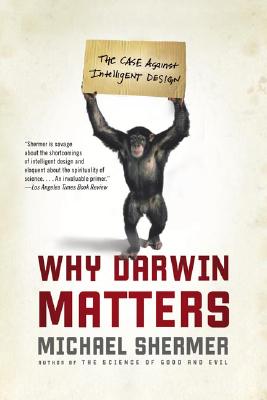
Why Darwin Matters

The Case Against Intelligent Design
by Michael Shermer
ages: adult (though anyone interested in this debate could read this)
First sentence: “In June 2004, the science historian Frank Sulloway and I began a month-long expedition to retrace Charles Darwin’s footsteps in the Galapagos Islands.”

Delivery, people, delivery.

When writing a book, SO much depends on the delivery, the tone, the way in which you present the information, characters, narrative, story.

In short: this book would have been much better if the author hadn’t constantly come off as a pompous ass.

It’s not that I disagree with his premise: that Intelligent Design is NOT science, that evolution is a fact and not a belief, that one can believe in God and accept evolution and not have it in conflict. But, I just don’t know who this man was trying to convince. He kept implying — and in some cases, he says it pretty explicitly — that the ID people are morons (which they might be, but that’s no way to present an argument), that they are crusaders (ditto), and that Science is Right and if you are a reasonable person, then you will accept that ID is bunk and Evolution is right.

Right.

Really, it’s no way to endear your reader to your position. And it’s no way to convince those who believe in ID, or are even on the fence, that you’re right and they’re wrong (even if you are).

Grrr.