A Natural History of the Senses

by Diane Ackerman

ages: adult
First sentence: “Nothing is more memorable than a smell.”
Support your local independent bookstore: buy it there!

Going into this book, I didn’t quite know what I’d be getting from a “natural history” of the senses. It’s such a broad term; and how does one actually provide a history of something that’s been part of the human experience since the beginning of time?

What I got was one part history, one part science, and one part poetry. Ackerman divided the book into five sections, one for each of the senses. She started with smell, then worked through touch, taste, hearing and vision. I had a hard time at first, getting used to the style of the book, which seemed haphazard and disorganized. It seemed like it was a series of short essays cobbled together without much sense and flow. But, after the smell section — which was the worst for the disjointedness — it settled into a rhythm, a little bit of poetic description, a bit of science (most of which I wondered if still was “correct”, since the book was written in 1990), a bit of social history. Much of it was fascinating. Her descriptions (passages of which I would love to copy down, but are much, much too long), especially about how the senses work in relationships, were elegant and poetic. But, in the end, it wasn’t enough. I wanted something less thrown together, something that flowed more, something that was less disjointed.

Because when it was good, it was very good. I just wanted more goodness.

India Calling

by Anand Giridharadas
ages: adult
First sentence: “As my flight swooped down toward Bombay, an elderly Indian man leaned over and asked for help with his landing card.”
Support your local independent bookstore: buy it there!

M, actually, is responsible for choosing this book. I introduced her (mostly by accident) to the joy that are Hindi language movies, and she fell head-over-heels in love with them. As a result, she’s been requesting books on India for the past few weeks, trying to learn as much about the country as she can. This one just happened to catch my eye. And I’m glad it did.

Anand Giridharadas is the son of NRIs (Non-Resident Indians). His parents came to American in the 1970s, mostly because India wasn’t offering his father the kind of opportunities that he wanted. Anand, raised as a good Indian-American, with only brief trips back to India as a child, felt the siren call of India and shortly after college headed there to live and work. This book is his observations of the “new” India, the way India is reinventing itself, and the consequences — both good and bad — of that.

The book is divided into chapters exploring different emotions and hopes: dreams, ambition, pride, anger, love, freedom. Giridharadas explores how each one has had an impact on the India of his parents and grandparents, and through his observations, travels, experiences in the country, and interviews, he explores how each things are changing — because of capitalism and consumerism — and not changing — because India is an old country, and one with a billion attitudes to change. The book weaves history, culture and religion together, leaving, it seemed to me, no stone unturned. As an Indian himself, he was able to go places a Westerner couldn’t have, and yet as an outsider, he was able to make observations and ask questions that wouldn’t occur to someone who hadn’t been raised outside of India. It was the best of both worlds, that melded into a very thought-provoking book.

It was fascinating, to say the least, even for someone who has had very little exposure to the world that is India.

King of Bollywood

Shah Rukh Khan and the Seductive World of Indian Cinema
by Anupama Chopra
ages: adult
First sentence: “Dreams come true in Dalton.”
Support your local independent bookstore: buy it there!

First off, a disclaimer: four years ago, when I saw this on the shelves, I took a look and said, “Hmm… could be interesting.” But, since my older two girls and I have been on an Indian Cinema bender lately (don’t ask how many movies we’ve watched in the last month…), I put a hold on this one. M read it in one sitting, devouring information about Shah Rukh. I took it a bit slower.

It’s basically one of those Hollywood tell-all biographies; Chopra did sit down an interview Shah Rukh and those closest to him, so it’s an “authorized” version. Reading it reminded me why I prefer memoirs over biographies: I like hearing the stories by the person themselves, rather than being interpreted through someone else. That, and questions I had (like: why is his name Shah Rukh Khan when his dad’s last name was Mohammed? Why did he change it? When did he change it?) weren’t really answered.

That said, even with the meandering and slightly clunky writing style, it was a fascinating look into Indian cinema. To explain how Shah Rukh became the massive superstar he is, Chopra felt it necessary to explain the history of Hindi film, and with that, a bit of Indian history as well. Some really interesting stuff. That’s not to say that Shah Rukh isn’t fascinating: the amount of naked ambition he has is boggling. And yet, he’s an incredibly down-to-earth individual (or at least Chopra made him seem so). Additionally, he’s a halfway decent actor, if a bit on the goofy side. Other than that, there isn’t much to say about this book.

Good for those who are slightly obsessed with Indian cinema.

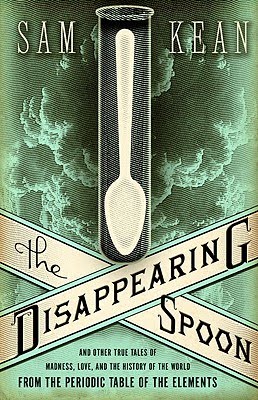
The Disappearing Spoon

Madness, Love, and the HIstory of the World from the Periodic Table of the Elements
by Sam Kean
ages: adult
First sentence: “As a child in teh early 1980s, I tended to talk with things in my mouth — food dentist’s tubes, balloons that would fly away, whatever — and if no one else was around, I’d talk anyway.”
Support your local independent bookstore: buy it there!

Me and science aren’t exactly friends. (Or is it science and I? Bad grammar day.) I’ve taken a few science classes, and while I think I liked chemistry the best (who doesn’t like blowing things up in a beaker?), I really haven’t given science (or it’s application) much thought over the years. In fact, save visits to hands-on science museums (my favorite), I haven’t given it any thought.

Enter Sam Kean and this book. It’s perfect for people like me: those who kind of like science (especially chemistry) in a passing sort of way, but aren’t scientists by any stretch of the imagination. It’s a sweeping book, one that explains basic chemistry as well as looking at the history of how different elements were discovered, the periodic table was put together, and about the scientists behind both. All the famous people are there: Einstein, Pierre and Marie Curie, and… that’s all I can think of off the top of my head. But, he goes beyond the famous people, and delves into the all the stories. One I loved was how x-rays were discovered. Or about the kid who decided he needed to help the world break its oil addiction and built a nuclear reactor in his mother’s backyard. Or how elements influenced pen making. Or the politics of Nobel Prizes and naming elements. Or this throw-away line: “Still, chefs and chemists tended to distrust one another, chemists seeing cooks as undisciplined and unscientific, cooks seeing chemists as sterile killjoys.”

It’s got everything, and yet, it’s an incredibly balanced book. It’s amazingly accessible (a must), and even though I think I only understood maybe a third of what Kean was explaining, I found I was never bored. Kean knows how to talk science to unsciency people, so that even if we didn’t understand all the technicalities, we still can thoroughly enjoyed the book.

And that’s a feat unto itself.

The Lincolns

A Scrapbook Look at Abraham and Mary
by Candace Fleming
ages: 10+
First sentence: “I’m an Illinois girl, raised in the very heart of the ‘land of Lincoln.'”
Support your local independent bookstore: buy it there!

Everyone knows the story of Abraham and Mary Lincoln. We learn about it in school, all the stories and events that made up their lives. So, really, why do we need yet another biography of them?

That’s the question I asked when I opened this book. And, surprisingly, while I didn’t learn much new information — and most of what I learned was about Mary Lincoln and not Abraham — I did thoroughly enjoy this book.

The book is laid out like old newspapers, complete with photos and different type faces. The stories themselves are short, just snippets and overviews of events. There’s very little that is in-depth here, but then it’s not aiming to be anything more than what it is: an introduction for elementary-age kids. It’s engaging reading, even if the stories aren’t in-depth or new: Fleming has a accessible and engaging writing style. It’s simple without being simplistic.

What I did learn was all about Mary; she seems to have gotten a bad rap in the history books (unsurprisingly). Fleming did much to paint Mary as human (she did much to paint Abraham as human, too; he was not a larger-than-life figure), with faults, yes, but also with many virtues as well. She was a spitfire, someone who was a good companion to her husband. I was amazed at their child-raising habits (very modern, and thus were looked down upon back then), and at the amount of tragedy that Mary had in her life. Sobering, to say the least. It made me curious to read a good biography (if there is one) solely about Mary.

I’m glad I read the book, even if it wasn’t in-depth or enlightening. It’s definitely something I’d recommend to anyone looking for a good overview of the Lincolns.

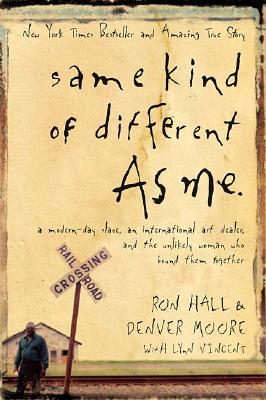
Same Kind of Different as Me

by Ron Hall and Denver Moore (with Lynn Vincent)
ages: adult

First sentence: “Until Miss Debbie, I’d never spoke to no white woman before.”

Support your local independent bookstore: buy it there!

I would have never, in a million years, have picked this up if it weren’t for my in-person book group. I don’t to religious books, I especially don’t do evangelical books. It’s not that I have anything against religion or even evangelicalism, it’s just that I prefer to escape when I read.

I’d love to say that I loved the book, in spite of my hesitations. But, I didn’t. I liked it. I thought the story was interesting. But I wasn’t moved by it, or even motivated by it.

It’s the story of two men: Ron Hall, who came from a lower-middle-class Texas upbringing and turned himself, by luck and the grace of God into a millionaire art dealer; and Denver Moore, the product of Jim Crow laws and a Louisiana sharecropping upbringing, who was homeless in Fort Worth when Ron and his wife Debbie first met him. Debbie insisted that Ron reach out to Denver, and it eventually turned into a friendship. One that helped Ron make it through his wife’s cancer and eventual death (yep: it’s one of those cancer books). It’s basically their witness and testimony: look what God wrought in their lives.

The most inspiring person (obviously, since it’s their story about her and because she’s passed on) is Debbie: how she took the money Ron made and put it to better use. How she got involved in her community and worked to make it a better place. But, even that wasn’t enough to salvage the book for me.

Now, I suppose this is me being all hyper-critical: just because the writing wasn’t the most elegant, just because the story was a bit cliche, should I take apart these men’s beliefs? Because I do believe that they believe they were doing good by writing this book. No. That wouldn’t be fair. I guess my fundamental problem was that I just never got what I was supposed to get out of their story. (There’s class issues here as well, I discovered: I have a problem with wealthy people throwing their money at good causes and saying “Look at me doing good! Aren’t I wonderful?” And I felt like I got a lot of that.) In the end, though, I felt like I feel in those tear-jerker movies: manipulated. And that rankled me.

That said, there is good in this book. There’s a good story. There’s redemption and forgiveness and grace. I just didn’t feel it. But maybe you will.

Guests of the Sheik

An Ethnography of an Iraqi Village
by Elizabeth Warnock Fernea
ages: adult
First sentence: “The night train from Baghdad to Basra was already hissing and creaking in its tracks when Bob and I arrived at the platform.”
Support your local independent bookstore: buy it there!

I’m perfectly sure, even with Amira’s high recommendation, that I would have never picked up this book without it being chosen as a book group selection. I am also perfectly sure that, even though it took me a lot longer to read than I wanted it to (for various reasons), it’s a fascinating look at a specific segment of of the Iraqi women population in a specific time in history.

Our author, amazing woman that she is, was brave enough to spend the first years of her marriage in a backwater tribal village in southern Iraq in 1957 and 1958. Her husband, Bob, was there to do some research, and she went along for the ride. It was good, as well, since Bob had no access to half the population: the women. Through trial and error, Elizabeth (or Beeja as they referred to her) made her way through the intricacies of daily life for a Shiite Muslim woman in that particular tribe. It was an interesting insight to the Islamic faith, to the traditions and strictures and customs of both the faith as well as the tribe.

That’s one of the things I had to keep reminding myself: this ethnography (so hard to spell!) is of a particular village in a particular time, and while it’s fascinating, it really can’t be applied broadly. I kept wondering how things have changed, not just for the village, but for women in Iraq in general.

Given that, it was an interesting story. I kept admiring Beeja for her gumption: I’m not sure, newly married, if I would have been that adventuresome. (Yes, I want to travel, but generally “travel” for me includes flushing toilets and mattresses.) But, she did what any sensible person would do: she threw herself into her situation and made the best of it. Can’t ask for more than that. It was interesting to read about her ups and downs of adapting, and how her relationships with the women in the village evolved and flourished in spite of the cultural (and, initially, linguistic) barriers.

But it wasn’t until the end of the book that I found something that truly resonated with me:

How many years would it take, I wondered, before the two worlds began to understand each other’s attitudes towards women? For the West, too, had a blind spot in this area. I could tell my friends in America again and again that the veiling and seclusion of Eastern women did not mean necessarily that they were forced against their will to live lives of submission and near-serfdom. I could tell Haji again and again that the low-cut gowns and brandished freedom of Western women did necessarily mean that these women were promiscuous and cared nothing for home and family. Neither would have understood, for each group, in its turn, was bound by custom and background to misinterpret appearances in its own way.

For better or for worse, this still is the case. And, at the very least, helping bridge that misinterpretation is something good that this book, even out-of-date as it is, can do.

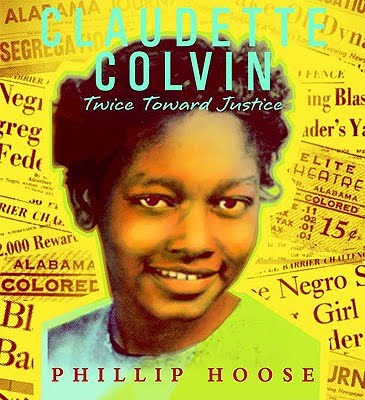
Claudette Colvin: Twice Toward Justice

by Phillip Hoose
ages: 11+
First sentence: “Claudette Colvin: I was about four years old the first time I ever saw what happened when you acted up to whites.”
Support your local independent bookstore: buy it there!

When I came across a brief mention of Claudette Colvin in Mare’s War, I knew I needed to (finally) read this book, if only to find out a little bit more about who this girl was.

Told in a combination of narration and quoted memories from Claudette herself, the covers a broad range of history in Alabama, though it focuses specifically on Claudette, following her from early childhood through the late 1950s. It’s a turbulent time in Alabama, and the book doesn’t sugar coat much of anything: the treatment of blacks during the Jim Crow years, the conditions that they lived, worked and went to school in. Claudette had hopes of rising above all that, and she had a remarkable support system. She was opinionated, and curious, and willing to stand up for what she believed in. Which is why, one day, she just decided that she’d had enough of Montgomery’s stupid backward bus laws/customs, and refused to get off her seat. Nine months before Rosa Parks did the same thing.

What surprised me most about this book — and perhaps it shouldn’t have — was how much class came into play during the civil rights movement. I guess I kind of figured that all the blacks were fed up, that all the blacks would support whatever stand against segregation whomever it was that made them. According to the book and Claudette’s memory, that wasn’t so. She made a stand, but she wasn’t the right class, wasn’t the right person, it wasn’t the right time… all among the reasons she wouldn’t made a good poster girl for the cause. I suppose it’s cynical to think so, but everything dealing with government is political, everything needs PR and the right spin, and the civil rights movement wasn’t exempt.

That’s not to say that it wasn’t a worthy cause, just because it was politicized. It was. I just felt bad for Claudette. In many ways, she was courageous, and deserved to be honored for that. But, instead she was shunned and pushed to the side. No wonder she never made it into history books, even though she was the star witness on the lawsuit — Browder v. Gayle — that actually got the city of Montgomery to integrate the bus system. It’s a portrait of an unsung hero, yes, but it’s also a look into the politics of a movement.

Fascinating stuff.

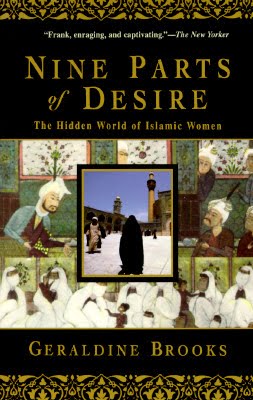
Nine Parts of Desire

The Hidden World of Islamic Women
by Geraldine Brooks
ages: adult
First sentence: “The hotel receptionist held my reservation card in his hand.”
Support your local independent books: buy it there!

When I read this back in 1995, when it first came out, I remembered being floored by it. It was fascinating, powerful, interesting, moving. It’s what put Geraldine Brooks on the map for me (I loved her husband’s, Tony Horwitz, writing, too), which is not something I regret.

Before I go on, this book is Brooks’ investigation into the lives of women in Islamic countries. It’s something only she can do — obviously, being a woman — and she tries to cover all aspects of how Islam, and the laws in majority-Islamic countries, affect the lives of the women in those countries. It runs the gamut: from veiling, to polygamy, to clitoridectomies, to travel, to politics and education. It focuses mostly on the Middle East: Egypt, Iran, Jordan, Saudi Arabia and a little bit of Iraq and Kuwait. She does dip into Pakistan and Africa, but only incidentally.

The thing that struck me most, this time around, was how much I wish that there was an updated version of all this. How did the Taliban change things in Afghanistan? Or the second Iraq war? How is the situation now, thirty years on, in Iran? The whole book — while still interesting — just felt dated.

Part of that was me, obviously: I think this was the first book I’d ever read on Islam, and while I’m not as well-read as some (like Amira), I do have a basic idea of the religion these days. And so I noticed things this time around that I didn’t last time. Like, while Brooks has respect for the basic tenets of the religion, she really doesn’t have much respect for those who try and interpret the religion. She’s very critical of most Islamic governments, and many of the individual men. It’s firey feminism at its finest, and while it’s justified in many ways (genital mutilation is just wrong, period.), it’s also heavy-handed. It’s not that it’s a bad thing, but (especially for a convert to Judaism, and someone who grew up Catholic; or maybe it’s because of those things), it’s almost like she willfully doesn’t understand someone who could actually submit to the things these women submit to. Or why they would do it happily. It’s like she’s thinking: doesn’t everyone want what a Western secularist wants? And if not, why?

I’m not sure I liked it as much this time around. Then again, I’m not sure how much it matters anymore. Brooks has written better books, and there are more interesting ones on Islam. Though sometimes it’s nice to revisit old books just to see how well they hold up. Even if it’s not all that well.

Ugly as Sin

The Truth About How We Look and Finding Freedom from Self-Hatred
by Toni Raiten-D’Antonio
ages: adult
First sentence: “I am ugly.”
Support your local independent bookstore: buy it there!
Review copy provided by TLC Book Tours

We’ve all seen, and probably read, those image books. How we’re supposed to accept the way we are (or help our daughters do so). How we can be our best selves by doing X or Y or Z. How we can embrace ourselves and stop loathing ourselves.

And yet, none of them really get to the root of the problem: we all fear, on some level, rejection because we don’t measure up to some (unattainable) standard of beauty. Because we are, gasp, ugly. Which is exactly what D’Antonio tackles head-on.

The basic thesis is that we — especially as women, but really everyone — spend so much of our time being afraid of getting/being ugly that it affects everything we do. In the way we relate to people, in the way we treat ourselves. She asserts that it’s the root cause of eating disorders, that it may (not necessarily, but quite probably) be the reason we spend so much time exercising, or on hair dye or fashion. We have taken what should be natural — aging, especially, but also just the way we naturally look — and have transformed it into something unreal.

It’s a comprehensive, if abbreviated, look at the role of beauty through the ages, especially in Western culture. D’Antonio covers everything from the origins of ugliphobia through it’s place in culture, relationships, and self awareness. It’s a bit to glossed over to be truly thorough, and many of the ideas have been written about elsewhere using different language: be true to yourself, improve your character not your appearance. But one has to give D’Antonio some credit: she is blunt and forthright not only about being ugly, but about her own experience with it. This book is almost a memoir: it’s her personal experience with accepting herself the way nature made her and her determination to disregard what society wants her to be. And, hopefully, reach others like her.

And the solution? It’s simplistic, and one I have heard many times before, but possibly could work: give in to your better self, and stop looking at the outside. Improve the inside. And if you do give into the beauty regimen, make sure it’s something you want to do, not one that you feel you have to do. It’s not something that will change the beauty-obsessed culture overnight, but perhaps, one person at a time, we can all become more at peace with who we are.

Thought-provoking, to say the least.