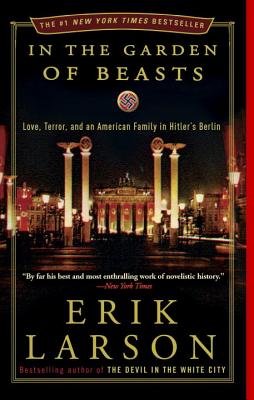
Audiobook: In the Garden of the Beasts

Love, Terror, and an American Family in Hitler’s Berlin
by Erik Larson
Read by Stephen Hoye
ages: adult
Support your local independent bookstore: buy it there !

I’ve not read any of Erik Larson’s work before, even though he (and this book) have been on my radar for a while now. So, when it came up as the November book at the Nook, I was more than happy to read it. (Or in my case, listen to it, since I didn’t really have the time to sit and read it.)

If you don’t know: it’s the story of William Dodd, the U. S. Ambassador to Berlin in 1933, just as Hitler was rising to power, and all that entails. And, it entailed a lot. First off, Dodd wasn’t that popular with the “Pretty Good Club”: the insiders (mostly Harvard grads) at the State Department who didn’t like Dodd’s conservation-minded ways. (He wanted to live within his salary? Shocking!) They undercut all of Dodd’s attempts at, well, diplomacy, and leaked things to the press whenever it served them to make him look bad. All they really wanted him to do — infuriatingly, to the reader, knowing what Hitler was capable of — is get Germany to make good on their debt to America.

The other part of the story (the “love” part) was about Dodd’s daughter, Martha, who was a bit of a manizer. (If a man can be a womanizer, then…) She was naive, silly, and very much in love with falling in love. So, as a result, she was married twice, divorced once, and had strings of lovers on her chain all at the same time. Can you tell yet that she really bothered me? Actually, what bothered me most was not all of that, but that she would play one lover off another. Or pine for their attention, only to push them away. It was most infuriating.

But, this book was fascinating. It did spawn a lot of thought and discussion: about the nature of evil, about relationships, about what could have been done, about politics.  And for that, reading (well listening to it — a side note: the audio was just fine. Maybe Hoye’s voice was a bit grating by the end, but not enough to turn me off) this is well worth the time.
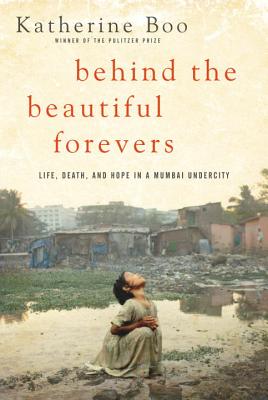
Behind the Beautiful Forevers

by Katherine Boo
ages: adult
First sentence: “Midnight was closing in, the one-legged woman was grievously burned, and the Mumbai police were coming for Abdul and his father.”
Support your local independent bookstore: buy it there!

I don’t know if I’m the last person to read this one, but I do know that it was its nomination for the 2012 National Book Award that finally spurred me into picking it up. (You would think it was M’s desire to go to India for a year. But, no.)

For the twelve of us who haven’t read the book yet, this is Pulitzer Prize-winning journalist Boo’s foray into the world of Mumbai’s underbelly. She spent several years (from November 2007 to March 2011) in the Annawadi slum, near the Mumbai airport, getting to know the residents. She followed their ups and downs, painting a portrait of people who were desperately poor, and their attempts to do something about it, whether for good or ill.

It’s a desperate story, gritty and harsh, and yet it’s an incredible work of journalism. Boo’s affection for these people come through, and she manages to get them — individuals who have no qualms in lying to each other as well as police and the government — to tell an honest story. It’s one that made me think: about class, about globalism, about corruption, about India as a country.

Several quotes that struck me:

An aside in a larger discussion about the sections in Annawadi (yes, even the poor in India have classes): “In the Indian caste system, the most artfully oppressive division of labor ever devised, Dalits — once termed untouchables — were at the bottom of the heap.” (p. 42)

The parliamentarian who would represent Annawadians was hardly in doubt. It would be the incumbent from the Congress Party, Priya Dutt, a kind, unassuming woman who personified two historical weaknesses of the Indian electorate: for flimi people and for legacies.” (p. 230)

And what I think is at the heart of this book:

What was unfolding in Mumbai was unfolding elsewhere, too. In the age of global market capitalism, hopes and grievances were narrowly conceived, which blunted a sense of common predicament. Poor people didn’t unite; they competed ferociously amongst themselves for gains as slender as they were provisional. And this undercity strife created only the faintest ripple in the fabric of the society at large. The gates of the rich, occasionally rattled, remained unbreached, The politicians held forth on the middle class. The poor took down one another, and the world’s great, unequal cities soldiered on in relative peace.

Fascinating and thought-provoking.

Audiobook: Home

by Julie Andrews
read by the author
ages: adult
Support your local independent bookstore: buy it there!

I picked this one up for my commute audio book mostly because I like Julie Andrews. I’m not a huge fan or anything, but I like her well enough. She’s, well, nice and she’s aged so beautifully, and I have tons of respect for her, that I figured: why not read her memoir of her childhood.

And for the most part, it’s not a bad book. I especially enjoyed the audio form, listening to Julie (we’re on a first-name basis now that I’ve finished the book) tell stories about her parents (you can tell she adores her dad); her step-father, whose name she ended up with (he was quite creepy); her life in vaudeville (she ended up supporting her family for quite some time); her leap into Broadway (a bit of a fluke and a lucky chance); and her time with My Fair Lady and Camelot.

But, I didn’t love the book. I don’t think it was because her life lacked conflict; there was all sorts of ups and downs as she was trying to figure out who she was (other than that cute girl with the freakish voice) and how to make her way in the world. I also don’t think it was because she ended the book just as I though it was getting really interesting. No, it was because Julie Andrews can’t ever say anything truly bad about anyone or anything. Even her step-father, who really was quite creepy to her a couple of times (he gave her her first kiss, tongue and everything. Ew!), whom she was never really close to, she was unwilling to actually speak harshly about.

The other unintended side effect of that was that she tended to gush about everything. It was always “lovely” or “marvelous” or “exquisite” or “grand” or “delightful”, and sometimes all at once. I did get to the point in the book where I swore if she gushed about one. more. thing., I was going to toss it out the window. (I didn’t, even though she didn’t stop gushing.)

So, there you have it: Julie Andrew’s virtue of being nice to everyone is actually a fault when it comes down to it. At least in memoir writing.

Which is just too bad.

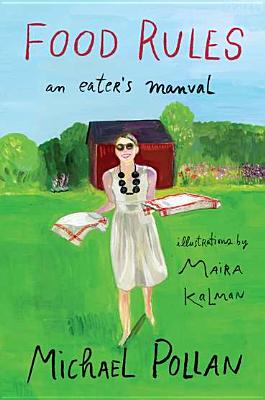
Food Rules: An Eater’s Manual

by Michael Pollan, illustrated by Maira Kalman
ages: adult
First sentence: “Eating in our time has gotten complicated — needlessly so, in my opinion.”
Support your local independent bookstore: buy it there!

I suppose this is kind of an unusual pick for me, since I’ve been on board with Michael Pollan’s philosophy (more or less) for years now. And so, in many ways, this little “eater’s manual” is kind of superfluous, at least for me.

But, since I picked it for my in-person book group (I’d wanted to pick Kitchen Counter Cooking School, but the library only has one copy, and I needed something more accessible), I figured I needed to read it.

And while I don’t think I learned anything new, this lovely illustrated, slim book was simply a joy to read. Pollan’s taken his whole philosophy and boiled it down to seven words — Eat food. Not too much. Mostly plants — and has 83 rules to help you follow that philosophy. In other words: he makes the complicated and long Omnivore’s Dilemma accessible for, well, ordinary people.

Which means that I hope people will read it, and we can have some good discussion. Because there are some good ideas in this book.

Oh, and as as aside: my favorite rule? I have three: #22, It’s Not Food if It Arrived Through the Window of Your Car; #57, If You’re Not Hungry Enough to Eat an Apple, Then You’re Probably Not Hungry; and #76, Place a Boquet of Flowers on the Table and Everything Will Taste Twice as Good.

Worth reading.

Dearie

by Bob Spitz
ages: adult
First sentence: “‘Now, dearie, I will require a hot plate for my appearance on Professor Duhamel’s program.'”
Support your local independent bookstore: buy it there!

I have to admit that I didn’t grow up as a Julia Child groupie. Oh, I knew who she was, but I wasn’t that into food (I was more into sports) or cooking, and what she did didn’t interest me. My parents may have watched her French Chef show — I don’t know — but it’s not like she was an influence in my upbringing.

Then I read Julie and Julia and, later, My Life in France, and I became an unabashed Julia Child fan. So, of course, when the new biography came out (on August 15, her 100th birthday), I had to read it. (Granted, I wasn’t going to read it just yet, but a friend thrust it in my hands and said it was due back at the library in 2 weeks, so, really, what else was I going to do?)

Spitz admits, in the acknowledgements, that he is not really an unbiased reporter of Julia’s life. He met her in 1992 and developed a bit of a crush on her through their interaction. So, when the opportunity fell into his lap to write a biography of her, he, of course, jumped at the chance.

This really is a comprehensive (and by default, huge, coming in at 530 pages) biography: from her early upbringing in Pasadena, California, through her stint with the OSS (which really is much less glamorous than it seems), through her marriage to Paul Child and their years in France (which Spitz kind of glossed over, but I didn’t mind, since I’d read about that already), and through all her various incarnations in television, up through Paul’s, and her own, death.

But Spitz is an excellent writer, and his enthusiasm for Julia shows. He really delves into her life, drawing her both in broad strokes (she really WAS manic, full of energy; at one point, I pointed out to Hubby that she must have been exhausting to know), and small details (the amount of work this woman did, basically up until she died, was simply amazing; also she LOVED men. Not like affairs, or anything: she was devoted to Paul; she just loved having men around.), which gave a more thorough picture of the real person behind the persona. (By the way, she adored the Dan Ackroyd Saturday Night Live skit.) Additionally, there was enough foodiness, especially later on, to keep the foody side of me happy.

It was the combination of my admiration for Julia (I admire her more the older I get; she started a completely new career at age 50, and made it work) and Spitz’s writing that made this book such a delight to read.

A must for any Julia Child fan. 

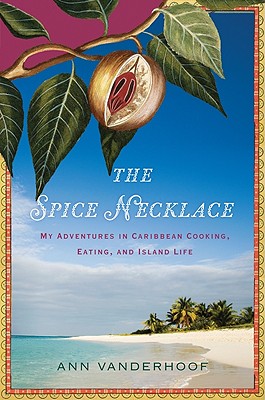
The Spice Necklace

by Ann Vanderhoof
ages: adult
First sentence: “This time, I bring my rolling pin to the Caribbean.”
Support your local independent bookstore: buy it there!

I read, and fell in love with Vanderhoof’s book of her first trip to the Caribbean,
Embarrassment of Mangoes, nearly five years ago. I didn’t even know there was a book about a second trip until a few months back, when someone pointed it out to me. Of course, I had to read it! And, unsurprisingly, I had much the same experience with this one that I had with the first book.

Ann and Steve returned to Toronto, to their “land-based” life, but after a couple of years, they realized that they missed the easy-going, food-saturated life they had in the Caribbean. So they did what they could to put things in order, got out their boat, Receta, and headed south again.

In many ways, this one covers much of the same territory as the first one did: there is food and friends and sunshine. But, knowing that, Vanderhoof was smart: the book (as evidenced by the title), is mostly about the spices native to the islands, and the many, many uses they have in everyday life. And because I don’t know much about the spices I eat, I learned a whole lot. Like how nutmeg is grown, and the fact that mace and nutmeg comes from the same plant. And that the islanders (especially on Trinidad) love their peppah HOT. I also learned a whole lot about rum (I had to turn to a friend to explain proof, just so I could understand why the 151 proof Saba Spice was so difficult to get down), and the ways in which rum really does permeate island culture.

My favorite island this time was Trinidad; Vanderhoof made it come alive, and made me curious about the African/Indian blend of cultures and cuisine they have there.  They also spent a lot of time in the Dominican Republic and Dominica, both islands would be fascinating to visit. Mostly, though, I envied their approach to seeing the world: parking in one spot for months at a time, soaking up the culture and the cuisine, meeting people, and learning about a place rather than just seeing it. I would (still) love to travel that way.

But the next best thing to a vacation is a well-written, food-heavy, travel book about an area. And this one is just the ticket.

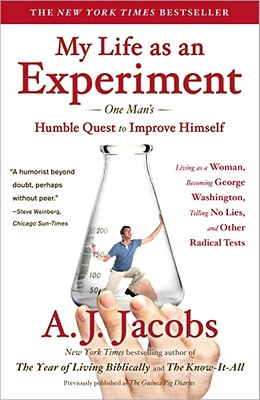
My Life as an Experiment

by A. J. Jacobs
age: adult
First sentence: “Over the years, I’ve gotten a lot of suggestions.”
Support your local independent bookstore: buy it there!

It’s no secret that I really like A. J. Jacobs. Even so, I somehow missed this book when it came out. Unlike his other three books, this is a series of short vignettes, one month projects ranging all over the place from a month of trying to be like George Washington, to a month of outsourcing his life to India, to a month practicing being radically honest.

While it’s a fascinating and fun little jaunt — my favorite chapter was the rationality project — it lacked the depth that his longer books have. See: he’s really not all about the gimmick, at least not in his big books. Sure, they’re gimmicky, and they’re silly, but there’s a profoundness (profundity??) to them that was missing from these experiments. And because of that, they weren’t nearly as interesting as they could have been.

That said, I’m not sure I’d want to read a whole book about him outsourcing his life, or even being George Washington (though I didn’t learn a thing from that chapter, since Hubby’s a pretty big GW fan). They worked as vignettes, even if the depth and reflection isn’t there. They are funny (the naked one was pretty hilarious), and his wife is still amazingly tolerant (though he gives her a month of whatever she wants, and she quite abuses the power). It has all the elements of his books, just not to the extent that I have come to enjoy.

Upon reflection, this would be a really good introduction to the weird world that is A. J. Jacobs.

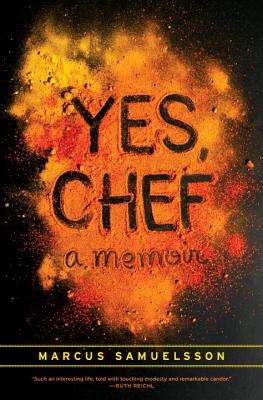
Yes, Chef

by Marcus Samuelsson
ages: adult
First sentence: “I have never seen a picture of my mother.”
Support your local independent bookstore: buy it there!
Release date: June 26, 2012
Review copy provided by my place of employment.

I am not really into the whole food “scene”. I love reading books about good food, I like cooking (but I’m a cook, not a chef, even though I worked in a restaurant for a year when I was a teenager), and I like the idea of good food, but when it comes to names of chefs, I’m pretty much limited to the really popular Food Network people.

So, before a Random House rep came into the store pitching hot books this summer, I  had never heard of Marcus Samuelsson. I think that was a good thing, however, because I was able to come to his story free of biases, open to whatever journey he was willing to take me on.

And it’s quite the journey: Born in Ethiopia, he, his mother and his sister contracted tuberculosis when Marcus was 2. His mother walked for days to get to a hospital, dying soon after reaching there, leaving the children orphaned. Luckily, there was an older couple in Sweden who were desperate for children, not caring what color or nationality they were, and they adopted both Marcus and his sister.

Samuelsson spends quite a bit of the book on his childhood and upbringing in Sweden, primarily because he firmly believes that this was the foundation for all his successes. His mother’s mother taught him to cook, in the classic Swedish style. His parents taught him the work ethic that made Samuelsson what he his today, and supported his journeys around the world, as well as his choice of career. These parts of the book are fascinating: from his stages (I guess that’s what they’re called) in Sweden, Switzerland, Austria, and New York before the ultimate stage in France and then back to America where he became — almost by accident — the executive chef of Aquavit. He is liberal with praise for the people who helped him, candid about the people who were jerks, he muses about the idea of race in the restaurant and food world. But always, always these reflections are centered around his food journey and his chasing the flavor around the world.

The latter third of the book, his time at Aquavit, his stint on Top Chef masters (and winning that competition), to his finding his birth family in Ethiopia and opening his current restaurant, Red Rooster, in Harlem are not as compelling as the first part, though they still hold interest. The time line gets a little fuzzy, and I felt like he was rushing through things, when I wanted him to linger, especially on the flavors and the tastes of the food he was creating.

Even with that slight drawback, it’s a marvelous foody memoir. Enough that I would love to step into his world, just to taste the dishes he made sound so delicious. Anyone up for a trip to Harlem?

Audiobook: Sports From Hell

by Rick Reilly
read by Mike Chamberlain
ages: adult
Support your local independent bookstore: buy it there!

Not content with being a writer for Sports Illustrated or ESPN — or perhaps it was bored with being a writer of normal sports — Rick Reilly decided to go on a quest: over the course of three years, he (and his lovely researcher/girlfriend, TLC) searched the world over for the World’s Dumbest Sport.

And because he’s a journalist, he felt the need to share it with the world, as well.

The sports range from the pretty cool (women’s football), to the retro (the Jart; remember those? If not, you didn’t grow up in the 70s and 80s), to the weird (ferret legging; that’s what he’s doing in the picture up there) to the “I wanna try” (Zorbing; seriously looks like fun), to the eye-rolling (his chapter-long rant on baseball), to the certifiably insane (bull poker). Not to be outdone, there’s a chapter on drinking games (did you know there’s a world series of beer pong?), on the world championship Rock, Paper, Scissors tournament, and the Finnish “sport” of Saunaing (or whatever they call it).

It’s a completely useless book — there’s really nothing of value in here, unless you want to impress people with your synonyms for vomit — but it’s entertaining. Or, at least, it tries very hard to be.

See, Reilly’s use of similes drove me completely batty. Literally. I laughed at them at first, but as the book wore on, I grimaced and eventually rolled my eyes. I wish I had the actual book in front of me, so I could write a few of them down; they were literally that bad. And all over the place. Which I found highly distracting.

The second distracting thing was Mike Chamberlain as a reader. He only had two
“voices”, and he would alternate between the two of them. And I have to admit that his inflection grated on me after a while; it was nice and chatty at first, but eventually, I kind of wanted to smack him.

Still, it wasn’t enough for me to give up the rubber-neck value of the book: the sports were so bad, I had to see what Reilly would find out next.

Oh, and for the record, the dumbest sport: chess boxing.

Drop Dead Healthy

by A. J. Jacobs
ages: adult
First sentence: “For the last few months, I’ve been assembling a list of things I need to do to improve my health.”
Support your local independent bookstore: buy it there!
Review copy provided by my place of employment.

The thing I love best about A. J. Jacobs is that he’s insane enough to try things that normal human beings don’t even consider. I mean, really: who would read the entire Encyclopedia Brittanica? Or spend a year living the Bible to the letter? Or going undercover as woman? (Actually, I haven’t read that one. Yet.)

Or how about spending two years becoming the healthiest man alive?

If anyone can go from intellectual, indoor-loving couch potato, to a lean, mean machine, it has to be A. J. Jacobs.

He organizes this one roughly chronological — giving us check-up updates from month 1 to month 25 — but also by body part. He spends a month on his eyes, his ears, his brain, his fingers, his stomach, his heart, his testicles (yes, you read that right), and right on down to his feet. He’s game to try just about everything — from cave man exercise (and diets!) to going OCD on toxins to BluePrintCleanse, though he didn’t go as far as plastic surgery — there really is no stone he leaves unturned. It’s a fascinating way to approach health, but also a trivia-inducing one. If I have become insufferable with “Did you know…” and “I read in Drop Dead Healthy…” statements, it’s only because this book is packed with so. much. information. And all of it interesting. It helps, I think, that his books are so readable: he’s self-deprecating, but not to the point where it’s annoying. He’s funny. And his wonderful, long-suffering wife (and adorable boys) play a role as well; he really is devoted to them, and they really are wonderfully tolerant of his insanity.

So, did I learn anything? Yes. There was possibly too much information thrown at me, but some did sink in. Will I incorporate anything I learned in my life? I don’t know. Perhaps. Was it an enjoyable way to spend my time? Most definitely.

Oh, and for the record: I think A. J. would be proud that I read this book entirely while on the elliptical at the gym. I hope so, anyway.