Audio book: Mobituaries

by Mo Rocca
Read by the author.
Support your local independent bookstore: buy it there!
Or listen at Libro.fm
Content: There may be some mild swearing. And sometimes the topics are kind of gross. It’s in the biography section of the bookstore.

I picked this one up because I like Mo Rocca on Wait Wait Don’t Tell Me. Which is also the reason I picked to listen to it rather than read it. I enjoyed listening to Mo tell these stories — some of which I knew, most of which I didn’t — about people and ideas that have passed on. The problem? In audio, while it was going, I was interested and entertained. Afterward, though, I couldn’t tell you a single thing about what I heard. Maybe it’s just how I retain knowledge, maybe it was a bit the way the book was structured (it was more a trivia book than anything else), but I didn’t retain a single thing. It’s very much a bathroom book: read a story while you go to the bathroom, and then put it down.

That does’t mean it was bad. Mo is very entertaining, both as a writer and a reader, and some of these stories were quite fascinating. But it just didn’t stick with me in the long run.

So: entertaining, but not really informative.
Stamped From the Beginning

by Ibram X. Kendi
First sentence: “Every historian writes in — and is impacted by — a precise historical moment.”
Support your local independent bookstore: buy it there!
Content: There is some swearing, including a few instances of the f-bomb and many of the n-word. It’s in the history section of the bookstore.

I picked this one up after listening to Stamped, which is a remix for younger readers of this history. I didn’t know what to expigect, but what I got was a book that made me rethink my perceptions of race, race relations, and class, and rethink what I was taught in history classes.

The basic idea that Kendi sets out to demonstrate is this: racial discrimination leads to racist ideas which lead to ignorance and hate. It’s the reverse of everything I had been taught which is: ignorance and hate lead to racist ideas which lead to discrimination. It’s a lot to wrap a (racist) brain around at first, but over the course of the 500 pages, Kendi does an excellent job showing how, throughout history, racism starts with racist people being self-interested and creating racist policies. I learned a ton.

I don’t know if there are any solutions to be found in the book. Except for the conclusion that self-sacrifice (of Blacks) and uplift suasion (Black people being “more like White people”, which is a racist idea), and educational persuasion (if white people just had “all the facts” about racism they wouldn’t be racist) don’t work. It will take a concerted effort of White people and Black and Brown people to realize that it’s in the best interest of ALL people to do away with racist policies.

I don’t know what the political and economic solution for this is (except maybe tax the wealthy and refund all the social programs that have been axed over the years). But I do know that it is important for corporate media (!) and White people to stop generalizing and stereotyping Black people.

As for me, this book made me rethink ideas I’ve had in the past, rethink the way I interact with the media and politics, and perhaps made me a little more antiracist. I can only hope.

Audiobook: Catch and Kill

by Ronan Farrow
Read by the author
Support your local independent bookstore: buy it there!
Or listen at Libro.fm
Content: This book is about sexual predators, and Farrow doesn’t pull back from descriptions of sexual harassment, assault, and rape. It’s not prurient and it’s not graphic, but it may be triggering. There is also swearing, including multiple f-bombs. It’s in the True Crime section of the bookstore.

I heard a story about this book somewhere, in a report about the Harvey Weinstein trial. The report said that they were having trouble finding neutral jurors, mostly because so many of them had read this book and had already made up their minds about Weinstein.

And they’re right. You come out of this book knowing that not only is Weinstein and evil man, every single person, corporation, or entity that protected him and enabled him (and other predators, like Matt Lauer) are also completely and totally corrupt.

This book is Farrow’s story about getting his 2017 New Yorker article about Harvey Weinstein published. See, it didn’t start out as a New Yorker article; Farrow was an on-air reporter at NBC news when he first started looking at leads and conducting interviews about Weinstein’s history of sexual predation. Farrow interviewed several women, corroborated their stories, and was set to put something on air, when NBC pulled it. It goes deeper than that: Weinstein had private investigators tailing Farrow, looking for dirt that he could use to kill the story. NBC has its own history of talent and others harassing, abusing, and raping women in vulnerable positions. It all adds up to not only a toxic male culture, but one in which I end up mistrusting corporate journalism. I don’t blame the journalists — Farrow (and others) did his job to the best of his ability. But, at many points, his bosses were telling him to cancel interviews and tried incredibly hard to kill the story, and if Farrow hadn’t 1) been a male and 2) he hadn’t had a couple people on his side urging him to keep going. It’s so easy for corporations and advertisers and powerful individuals to kill stories they don’t like.

It wasn’t an easy book to listen to because of the subject matter, but Farrow was a compelling writer and an excellent narrator. I know it sounds odd to say I enjoyed every minute of this, but I really did. I kept wanting to know what happened next, and Farrow’s narration kept me engaged.

It’s not only an important book, it’s a good one.

Recollections of My Nonexistence

by Rebecca Solnit
First sentence: “One day long ago, I looked at myself as I faced a full-length mirror and saw my image darken and soften and then seem to retreat, as though I was vanishing from the world rather than that my mind was shutting it out.”
Support your local independent bookstore: buy it there!
Review copy provided by the publisher.
Content: There is some mild swearing and talk of rape, but nothing graphic. It’s in the biography section of the bookstore.

I had no idea what to expect from this book. I’ve never read any Solnit before, though she’s been writing for decades. I only picked this up because we have this Pick of the List program at the bookstore, and this was one of our picks (booksellers more sophisticated than me picked it!). What I got was a beautifully written, lyrical, loosely chronological memoir of a woman’s professional life. It’s not a strict memoir, per se: Solnit only briefly touches on her childhood, and it tends to jump around in time. “Recollections” is really the best word for it, as it feels as though she’s sitting with you just kind of musing about the paths her life has taken. It is a feminist work: the “Nonexistence” part is about how men have often tried to diminish her thoughts, her work, herself and her perseverance in the face of that.

It is so beautifully written though. A couple passages that struck me: “I believe in the irreducible and in invocation and evocation, and I am fond of sentences less like superhighways than winding paths, with the occasional scenic detour or pause to take in the view, since a footpath can traverse steep and twisting terrain that a paved road cannot.” I feel like this could be the book’s thesis statement. And yet, the paths she takes us down are both lyrical and interesting and I found myself wanting to take the time to wander with her.

A second passage: “I was arguing that the wars of the future and the past were overlapping in the present, and that they were largely unrecognized because of how we thought about things like war, and the West, and nature, and culture, and Native people.” Even with her musings, she is political and radical, and reminded me so very strongly of some of the Western writers I’ve read, like Terry Tempest Williams. I’m not hugely drawn to the West or the Southwest in writing (or in nature, preferring my lush green trees and water — and yes, humidity — of the East and South), but I admire writers like Solnit for their passion for wide open spaces and their understanding of how Native peoples fit into the larger picture.

I’m actually curious about some of Solnit’s other books now. And perhaps I will actually read them. I’m glad I read this one.

Audiobook: Stop Missing Your Life

by Cory Muscara
Read by the author
Support your local independent bookstore: buy it there!
Or listen at libro.fm
Content: There were two f-bombs and some mild swearing, which seemed odd and out of place. It’s in the mindfulness section of the bookstore.

I’m not entirely sure why I picked this up, other than to satisfy a category in the #ReadICT challenge, but I’m kind of glad I did. It’s a how-to and a why book on meditation, something I tried for a while (about a year, I think) and then dismissed as something “too hard” (sitting still is quite hard for me). I do yoga kind of regularly, once or twice a week, but meditation? Not so much.

But, in this crazy world (and especially after the insanity surrounding COVID), I really kind of needed this. Yeah, it’s another Buddhist mindfulness book, but I liked that Muscara is practical about the whole thing. He does impart Buddhist philosophy: that the idea to “happiness” is to be able to sit with emotion and situations as they are, whether “good” or “bad”, and be able to interact with them without trying to control them. That’s not how I usually think of “mindfulness”, and I appreciated thinking differently. He also gives a huge variety of meditation practices, from what you traditionally think of “meditation” to a practice with your phone (or any technology) in order to interact with it in a more present and mindful matter. I think, for me, the simple question of asking why am I doing things has made the most difference. Why am I scrolling through Facebook? Why am I eating the cake? Why do I feel anxious? It’s helped. That, and doing a body scan practice, which, yes, is a form of meditation, every night.

And I highly recommend it on audio. Cory is a good reader, and it’s beneficial to be able to go through some of the practices as he reads them. It’s a very conversational book, which works well in audio form.

It’s probably not drastically changed my life, but I do have a wider perspective on things, and maybe that will, in the long run, be a good thing.

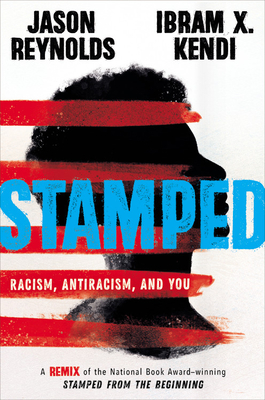
Audio book: Stamped: Racism, Anti-racism, and You

by Jason Reynolds and Ibram X. Kendi
Read by Jason Reynolds
Support your local independent bookstore: buy it there!
Or listen at Libro.fm
Content: There is frank talk of slavery and rape and they use the n-word a couple of times. It will be in the Middle Grade History section of the bookstore.

The publishers — and Reynolds himself — are calling this a “remix” of the National Book Award- winning Stamped, by Kendi, and a brilliant remix it is. Reynolds takes the ideas in Kendi’s book — which is a look at racism from the first recorded instance in the 14th century to the present day — and distills them down so that kids == it’s aimed at the 10 and up crowd — can easily grasp the ideas and the history.

And Reynolds makes it fun. It’s a “not history history book”, one where Reynolds talks about IDEAS and how they fit into the grander scope of history. It’s incredibly engaging to listen to (and read!) — Reynolds is a fabulous narrator — and it made me look at history in a new light. It’s an important book — I’ve checked the original out from the library because I’m interested in what Kendi’s research — especially in this day and age. It’s incredibly helpful as a white person to understand that racism is systemic and built into the framework of our society. And maybe by understanding that, we can all become a bit more aware.

Excellent and highly recommended.

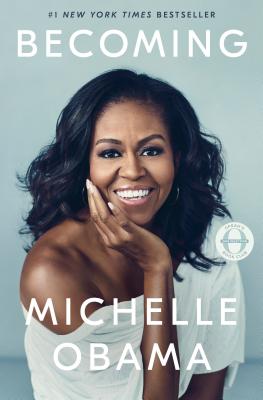
Audio book: Becoming

by Michelle Obama
Read by the author.
Support your local independent bookstore: buy it there!
Or listen at Libro.fm
Content: There’s some mild swearing. It’s in the Biography section of the bookstore.

This is your basic memoir: the life of Michelle Robinson Obama, from growing up in the South Side of Chicago to going to college at Princeton and law school at Harvard, to how she met and married Barak Obama, her challenges and successes as a professional woman with two children, and then dealing with a husband who wanted to become (and then became!) president and all the challenges and success with being the first lady of the United States.

First off: yes, it does live up to the hype, especially on audio. Obama is a delightful narrator, and listening to her tell her insightful, funny, interesting story is a treat (whether or not you agree with her husband’s politics, I think). She is a delightful, smart, good human being and I’m glad she chose to tell her story. I do hope it does what I think she hopes it does, and inspires young girls and young women to get involved.

Mostly what it made me do, in the end, was desperately miss having someone in the White House (whether or not you agree with their politics) who took the idea of governing seriously, who did their best to be ethical and honest, and who actually was Presidential. You could argue that Barak Obama wasn’t a great president, but what you can’t say is that he didn’t take the role seriously. Same for Michelle: she took the idea of being First Lady seriously, harnessing her influence for something good, and I miss that terribly.

At any rate, this was an excellent book.

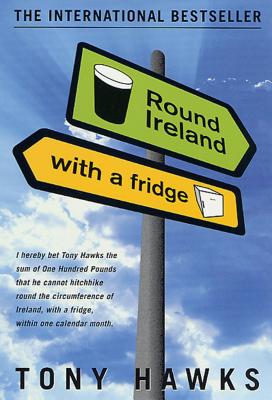
Round Ireland with a Fridge

by Tony Hawks
First sentence: “I’m not, by nature, a betting man.”
Support your local independent bookstore: buy it there!
Content: It’s sweary, both in English and Iris, and there’s a ton of drinking. It’d be in the creative non-fiction section of the bookstore if we had it.

A while back, I happened to be watching vlogbrothers, and John recommended this one, and I thought to myself “That is the sort of book I need to get me through some dull winter days.”

I was right.

The basic premise is this: Tony got super drunk one night and his friend bet him 100 pounds that Tony couldn’t hitchhike the circumference of Ireland carrying a fridge. (There are Reasons this got bet, but that’s really unimportant.) Tony, for whatever reason that I can’t remember now, decided that it was a good bet to try and accomplish. So, he set out to Ireland, picked himself up a small, white, minifridge and a dolly, and started hitchhiking.

The boon came from when someone (again, I’m not sure who) got him in contact with the Gerry Ryan Show, which was broadcast throughout Ireland on the radio. They were all so mystified by why Tony would do this, so Gerry decided to put out calls to help Tony out. I’m pretty sure without that support, this would have been an entirely different book.

As it is, it’s a delightful (if often stupid) read about a delightful (if often stupid) trip. Tony met lots and lots of people, had a good sense of humor about it all, and in the end realized that humanity (at least humanity 22 years ago) isn’t all that bad. It’s a ridiculous book about a ridiculous endeavor.

Which is to say: I really enjoyed it. Tony had me laughing out loud at parts, and it’s a truly delightful book to tell people about (“No seriously: the fridge went surfing!”). It does have a nice travel element to it, though it’s less about the landscape of Ireland and more about the people Tony meets. At any rate, it was a delightful romp to the Emerald Isle in the middle of a cold winter.

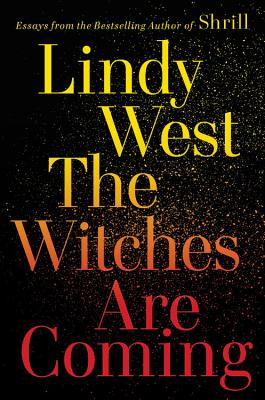
Audio Book: The Witches are Coming

by Lindy West
Read by the author.
Support your local independent bookstore: buy it there!
Or listen at Libro.fm
Content: There’s swearing, including lots of f-bombs, plus frank talk about sex. It’s in the Sociology section of the bookstore.

This book of essays, written in past couple of years and spurred on by the election of Donald Trump, is not just a feminist skewering of the alt-right and those attacking progress in all its forms. It’s also a reminder — especially for me, as a white, middle class, educated woman — that there are causes worth fighting for, that all sides (at least on the national scale) are not equal, and that it’s okay to be outspoken on things you believe in (and, to be fair: believing in things is a Good Thing).

It’s a reminder that “political correctness” is really just respecting other people and their identities and boundaries. A call that fat people deserve respect too, especially in this thin- and diet-obsessed culture. And maybe West is a White Woman, but (I thought, but I’m no BIPOC) she made sure she was trying to be inclusive and reminding those of us who are White Women that there are people out there who are marginalized and disadvantaged. And that there are people suffering while we’re sitting in our nice suburban households.

No, she’s not kind to the alt-right (but should she be?) or to the men who have abused their power for their own personal profit. And that’s part of what I liked about this. It was unapologetic and brazen and I loved that. It’s not going to resonate with all readers, but I think West knows that but she’s not trying to be palatable to all readers. She has Beliefs and she stands by them, and I can respect that.

And West is a good reader as well. She was entertaining and one of those readers I’d happily listen to for a long time.

Audio Book: North Korea Journal

by Michael Palin
Read by the author
Support your local independent bookstore: buy it there!
Or listen at Libro.fm
Content: It’s a journal travelogue, so it’s probably only interesting to people who like Palin or are interested in North Korea. It’s in the Current Events section at the bookstore.

I haven’t seen the BBC special this journal is based on, but I don’t think it’s really necessary. Palin is an incredible diarist, and this is based on his experience gaining access to North Korea to film a travelogue and then his experiences during the two weeks he was in North Korea.

It’s a fascinating story: I don’t know much about the DPRK (Democratic People’s Republic of Korea, which is its official name) besides what we hear through the media, which (to be honest) isn’t much. Palin didn’t get a whole lot of access to the “common” people and when he tried to strike up political conversations, he was immediately shut down. What he did wasn’t often edited, but sometimes — like in the instance when he wanted to be filmed sending an anti-American postcard to Terry Gilliam — they preempted things from happening. The “minders”, as Palin called them, wanted to show North Korea at its best, so he wasn’t really allowed free access to the country. There’s an interesting postscript on the book written by one of the directors (I think; I can’t quite remember now) about the negotiating that needed to happen before they could even start filming, and how it was difficult to get across that they wanted to see “everyday” life, not just the Best of the Best.

It’s a fascinating book (and a short one!) and Palin’s delightful to listen to.

Highly recommended. (Now, to go see if I can find the show somewhere.)