Kidnapped!

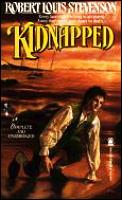
This isn’t the edition I read (my cover was quite boring), but I liked this one because it illustrates one of my main problems with this book by Robert Louis Stevenson: the age of the main character, David Balfour.

I pictured David as a 14- or 15-year-old kid, maybe slightly older than Jim in Treasure Island. Sure, that gives David the role of the “wise and noble youth”, which drives me nuts, but I figured I could deal with it. David’s adventures start when he receives a letter saying that, with the death of his father, he’s come into an inheritance that he never knew he had. He goes in search of it, and finds a crabby, miserly old uncle, who tries to kill David. That not succeeding (David — oh, wise and noble youth — was too smart for that), he arranges to have a captain of a merchant ship headed for the Carolinas (it’s 1751) kidnap David in order to sell him into indentured servantship.

That works, and David sets off. However, as fate would have it, the weather is against the ship, and they don’t get far before ramming into another boat, killing everyone on board except for Alan Breck Stewart (who, as I found out through Wikepedia, is a real historical person). Alan and David fall in, take over the ship (well, there’s a murderer on board, and, as you know, Right always wins, especially when paired with Might), but end up separated and David is abandoned on an island (off the coast of Scotland. They didn’t get far.). David spends four days starving himself on the island, before he realizes that he could walk across the reef to the mainland (maybe he’s not so wise and noble?). He sets out in search of Alan again, and on his way runs into Alan’s old arch enemy, the Red Fox. Someone kills said fox while David’s standing there, and they determine that David’s an accomplice, so he sets off (bumping into, and joining in said flight with, Alan along the way), running for his life.

It sounds okay in a plot summary, but actually it was pretty dry and boring. Punctuated with the insufferable David’s moralizing. He eventually falls out with Alan because … I don’t even care why. I think it was because Alan was in more danger than David and David thought he’d fare better on his own. Or maybe it’s because Alan lived by his sword, which offended David. My favorite bit was when David challenged Alan to a duel, thinking he’d win. As if.

At any rate, David (of course: he’s the wise and noble youth) got his inheritance back because he got Alan to trick David’s uncle into admitting that he’d paid twenty pounds to have David kidnapped (but not killed). I didn’t really care by that point. (Though it was interesting to find out that David was 20 years old. I don’t know why I cared, but it seemed to make a bit of a difference. Not much, though.)

Long and short of it: if you want to read a Robert Louis Stevenson book, stick with Treasure Island. This one just isn’t worth it.

Candyfloss

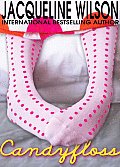
I have to admit (and this is one of those really embarrassing moments) that when I first heard the buzz about this book, I thought “Jacqueline Wilson; I’ve read a book by her. It was all right, but I’m not really that interested in reading another one.” Then I read more about Candyfloss, and how Jacqueline Wilson was one of the top British writers, and how her books have a “cheerful integrity and lack of sentimentality” (Slate.com) and I started thinking that this wasn’t the same person I was thinking of.

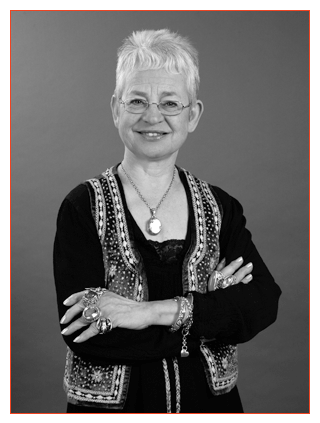
Then it hit me: I was mixing her up with Jacqueline Woodson. So, for the record:

Jacqueline Woodson:

and Jacqueline Wilson:.

Not the same person. Not even close.

So, when I saw Candyfloss at the library, I threw it in the pile, figuring M would like reading it. Which she did. And so, because I had some spare time, I picked it up, too. And I thought it was incredibly cute. I know that’s an overused word, and not exactly a positive one, but I think it really describes Candyfloss well. I think that it’s because it’s cute, and accessible, that the deeper themes — of separation, dealing with divorce, and making and keeping friends — come across that much better.

Floss has a problem: her step-dad, Steve, has gotten a promotion and is relocating (for six months) to Sydney. In Australia. Initially, Floss was really excited, but then she got to thinking: what about her dad? He’s not exactly well-off; he runs a run-down cafe making chip butties (they are these, in case you were wondering. I was.). Floss decides, after much thinking, that what she really wants to do is stay with her dad. And the book is the story of that decision.

I think one of the reasons this was so cute was that that the characters were so down-to-earth. I loved Floss and her father; sure he’s a flake and she’s kind of odd, but they’re good people. And normal. I liked the differences between Floss’s friend Rhiannon and her other friend Susan. I liked Rose — the candyfloss lady that Floss and her dad meet at the fair — and the whole fair atmosphere. I loved the British slang that was littered throughout the book. (I liked the semi-snide comment in the glossary at the back: “slowcoach — slowpoke. Margot tries to talk with an American accent, but she’s not very good at it. I wonder if you guys ever try to talk with a British accent?”) I won’t say that this book is perfect, but I will say that it was very good.

And I’ll probably check out Jacqueline Wilson’s other work sometime.

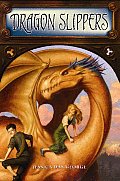
Dragon Slippers

I’ve heard the buzz on this for a while (as with many of my books), though I’m not quite sure what made it go from the TBR list, to the active “I’ve put a hold and am just waiting for it” pile. It’s been a while in coming; there’s a lot of Jessica Day George fans out there, and I’ve had to wait my turn.

I’m glad I finally got to bring it home.

It’s a lovely cross between Patricia Wrede’s Enchanted Chronicles series — spunky anti-heroine, who doesn’t need any rescuing and is more than willing to make friends with dragons, not to mention the plucky younger son of the king — and an Anne McCaffrey-like world creation. Dragons and humans are at odds, though not violent odds, due to a long-ago king using the dragons (against their will) to fight (and win) a war against a neighboring country. Throw in some Robin McKinley-esqe home-spun elegance (our anti-heroine, Creel, has a beautiful talent for embroidery), and you’ve pretty much got Dragon Slippers in a nutshell.

It’s not a deep or heavy book, though there are some tense moments, as well as a few ethical quandaries. Creel’s “enemies” were twits rather than malicious until near the end, so it was difficult to actually feel anything other than annoyance for them. Even when they betray Creel’s trusts. I think the reason I liked this book was for the world creation. I loved the dragons, their personalities (they don’t hoard gold — at least not all of them. They all have their individual “collections”), and the way they came to like and respect Creel. It wouldn’t have been enough to make a book work for me, though, if that’s all I liked. Creel was — like Cimorene in Enchanted Forest and Menolly in the Harper Hall triology — spunky enough and sympathetic enough to carry the book.

Which makes it a delightful way to spend an afternoon.

The Sisters Grimm: The Fairy-Tale Detectives

After finishing Matilda, C — being swayed by M’s recent discovery of and enthusiasm for these books — begged to start the Sisters Grimm, by Michael Buckley. And we’re both glad we did; it was a whole lot of clever fun.

Sabrina, age 11, and Daphne, age 7, were orphaned a year and a half ago and have been bumping around foster homes ever since. Until they get sent to Ferryport Landing to live with their supposed grandmother, Relda Grimm. It’s there that they learn the truth: the Grimms are not collectors of tales, but rather historians of the true events that people call “fairy tales”. The characters are real. The events are real. Daphne buys into it right away, but it takes Granny Relda (and her companion, Mr. Canis) being kidnapped by a giant to convince Sabrina. There’s a daring rescue, betrayal, and a bunch of fairy-tale insider jokes along the way.

C ate this one up. She was actually reminding me — begging me! — to read every night. She didn’t want me to stop, especially if the chapter ended with a cliff-hanger (which they often did). She made me swear that I wouldn’t read ahead (I was good), and then asked questions about how it was going to turn out. She begged information off of M (who would listen in and make cryptic comments now and again — she’s read all 5 and knows more of the story than we do), who was pretty good about not giving C too much. It was exciting and fun to read (more accents!) and very well-written, too.

We’ve got the second one on hold… and are waiting eagerly to see what happens next with Sabrina and Daphne.

Kira-Kira

I’m behind on my own challenge! I meant to read more in January, but it just didn’t happen. I have been enjoying reading the reviews of books others have been reading, and expanding my to-be-read list (among other things).

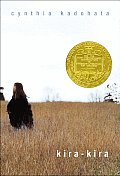
So… Kira-Kira, by Cynthia Kadohata, and 2005 Newbery winner.

I’m not sure what I think of this one. It’s one of those books that’s not really about anything. I’m not sure I could sum up the plot: it’s a young Japanese girl growing up in Georgia and her family surviving. It doesn’t sound terribly interesting. (I’m not sure how many kids would be taken in by the cover, either.)

And yet, it’s a lovely book, word-wise; very evocative of place and mood. You easily get a sense of Katie’s wonder at the world, at her love for her sister (and eventually her younger brother). And because of the language, it becomes a beautiful tribute to sisters and to growing up. Katie would do anything for Lynn, even when the going gets difficult. Lynn loves Katie, even when she’s being a teenager and thinks Katie’s too immature. It’s a testament to family and to how pulling together family can get someone through just about everything.

It’s heartbreaking at the end, when Lynn becomes ill and eventually dies. Katie not only helps nurse her through her illness, but has to help her family pick up the pieces and move on. It’s not easy; there are times when everyone loses it. But, they do move on, remembering Lynn yet not ending their lives for her.

It was a good book. Much better than I was expecting, and I’m glad I finally got around to reading it.

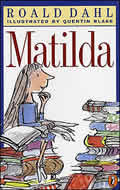
Matilda

I debated for a while if I should write this one up, since it was another read-aloud to C. But I remembered that I wrote about The Secret Garden, and I decided if I haven’t written anything about the books I’ve read aloud to her (we read Ella Enchanted, but I’ve already got that one floating around here somewhere), then I’ll write about it.

This is one of those books that I’ve known the story of forever, but I’m not actually sure I’ve ever read the book before. Maybe I have; elements of it seemed familiar, but perhaps that’s from other Roald Dahl books I’ve read. He does have a very distinct writing style. And one that’s completely over-the-top and captivating at the same time.

The book had both me and C completely captivated, the entire time. She was sitting on the floor, or the ottoman, inching, leaning closer to me as if that would help her absorb the words better. She loved the story; the idea of this uber-mean woman who had power over all dominion, and the little girl who defeated her. She loved Matilda’s pranks, though she said, “She probably shouldn’t have done them. Just because her parents were mean, doesn’t really make them right.” (Ah, conscience.) She loved the words, asking me to re-read things.

And I loved reading it out loud. It’s one of those books that while it reads fine on the page, reading it out loud really brings out the brilliance of it all. I loved reading Trunchbull’s name-calling: “vile, repulsive, repellent, malicious little brute” or “You ignorant little slug! You witless weed! You empty-headed hamster! You stupid glob of glue!” I even found myself doing voices; there’s something about the Wormwoods and Trunchbull that begs to be read in a certain way.

In short, it was a lot of fun. That leaves us with a problem, though: What to read next?

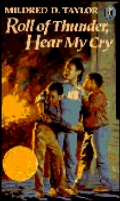
Roll of Thunder, Hear My Cry

For me, this book falls into the “important but very painful to read” category. It was depressing, disheartening, and yet an important look at race relations in the south in the 1930s.

The basic story is a year in the life of the Logans, as told from 9-year-old Cassie Logan’s point of view. She and her family live in Mississippi, north of Vicksburg, on a former plantation. Her family is different than the other tenant farmers in their area: they own 400 acres of their own land. It was a fluke: a Yankee had bought some after the Civil War and ended up selling some to Cassie’s grandfather. Yet, it’s the land — and owning it — that allows Cassie’s family a measure of freedom that the other families don’t have.

The interesting thing (to me) is that the other black families don’t hold it against the Logans do what they can to help out their neighbors and work hard at making ends meet. It’s the white people that claim the Logan’s are putting on airs, getting uppity and the like. In the end, it’s the land that both dooms them and saves them. (Which sounds ominous, I know, but really that’s the way it happens.)

Mildred Taylor doesn’t spare any one or anything. When Cassie disobeys, she gets whipped. She gets humiliated for just being black, and manages to get her “revenge”. It’s very much a world of get and try and give back. The children get splattered every morning on their way to school by the white bus going by (on purpose), and they take their revenge. Which sets off a chain of events. I think more than race relations, this book is about consequences. The consequences of choices, of decisions, of being black (or white) in Mississippi. There’s a strong sense of family, too. The Logans deeply care for their children, wanting what’s best for them. They are also concerned for their safety, navigating the difficult path of what’s right versus what’s best.

It was a very powerful book, one that I’m sure will stay with me for quite a while.

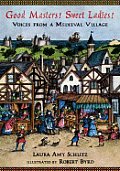
Good Masters! Sweet Ladies!

In a word: delightful.

Other words to describe this: gem, fascinating, funny, captivating, beautiful.

Amazing.

It’s amazing how much information Laura Amy Schlitz packed into 81 pages. There are 22 captivating characters, each one with their own story, separate, yet interconnected. It’s a well-researched (but never dull) peek back in to Medieval times, the harshness of it, as well as the simple little joys. I liked that Schlitz didn’t glamorize the lives of these children, but I liked that she kept it accessible to kids of today. I liked that much of it was poetry: beautiful, simple, powerful. (And this is from someone who isn’t necessarily a fan of poetry.)

I want to own this book. I have a feeling that M and C will enjoy it, too. I can even see them putting on one or two of the plays themselves. It’s a treasure, and well worth the Newbery it won this year.

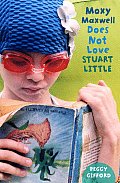
Moxy Maxwell Does Not Love Stuart Little

I’m really reading The Omnivore’s Dilemma (and enjoying it), but last night after all the girls were in bed, it really wasn’t what I wanted to curl up with.

So, it’s a good thing — on a recommendation from Becky — that I picked up this book, the first by Peggy Gifford, at the library the other day. It hit the spot: short, cute, and very funny. Just right for the evening of a stressful day. In fact, I think you could safely call this book adorable. (Though I’m not sure Moxy would like being called that all that much.)

Moxy Maxwell, 9-year-old, almost-fourth grader has had all summer to read Stuart Little. But there never seemed to be enough time. Until it’s come down to this: the last day before school starts, the day of the “Goodbye to Summer Splash” show where she’s 1/8th of a swimming daisy, and an ultimatum: read the book or don’t go.

Simple. And it works. Moxy is an amusing main character, coming up with all sorts of ways to get out of reading the book. But when she finally does, it’s — like many things we are “forced to do” — love. But that’s another story. This story is her adventures in getting out of reading the book. And it’s a winner. (I’m passing it on to C, who I’m sure, will just love it as much as I did.)

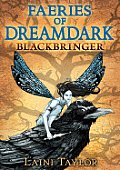
Faeries of Dreamdark: Blackbringer

I have come to a conclusion: I have to stop reading. I’ve made up a best-of list, and I’ve been putting off publishing it, mostly because I’m a completest, and the year’s not technically over. [Update: but then I accidentally went and published my list today. Bleh. That’s what I get for blogging with a 20-month-old on my lap.] But, I’ve stumbled on to one of those blessed runs where every book I read is so good, my list keeps changing. Take this book, for example. It’s the first novel from the woman who made this (which I still covet):

But aside from that (which I think is pretty cool), Blackbringer is a fabulous fantasy book. The world which Laini Taylor has created is intricate and magical, and completely sucked me in. I could not put this book down.

Magpie is a faerie, but an unusual one. She’s the granddaughter of the West Wind. Her clan is a group of crows. She’s a devil hunter, capturing the ones that humans (mannies) accidentally let out of their bottles. But when she comes across one that leaves nothing in its wake — swallowing its victims whole — she knows she’s a bit out of her league. She heads back to the place of her birth, Dreamdark, to find and wake up the Magruwen — the head djinn, the creator of this world — in hopes of saving the world from the evil that is hunting the faeries.

Usually, when a world is so developed as this one is, the rest of the book suffers. But in this case, Taylor has developed a strong and remarkable heroine in Magpie. She’s feisty and determined, at time fragile, yet there’s no doubt that she won’t succeed in what she does. And Magpie makes the book work. That, and there’s myriads of secondary characters, who captured my imagination: Talon, the Prince of the faerie guardian band; Poppy Manygreen, who can speak to plants; Vesper, the impostor queen; Bellatrix, the heroine of old; and various imps and other faeries that are too numerous to name. It also helps that Taylor has a knack for writing adventure. There was more than one time when I was biting my nails, wondering how Magpie was going to get out of the mess she’d gotten herself into. And because of all this, the world of faeries and mannies and the history Taylor infuses into the book comes together almost seamlessly. It’s a perfect meld between world-creating and plot and characterization.

I can’t ask for anything better from a fantasy novel.