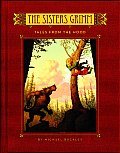
The Sisters Grimm: Magic and Other Misdemeanors

First thing: that’s a terrible reproduction of a pretty good cover. Sorry.

I’ve been slowly reading this series to C, and while I thought the idea was original and interesting in the beginning, my interest has waned over the last three books. The fourth one kind of perked it up, but I admit I wasn’t more interested in the story than I actually needed to be in order to read to C.

All that changed with this one, though.

This time, I found myself interested enough in the story to want to read ahead (and did, much to C’s chagrin). It’ s not because Buckley’s writing has changed — he’s still an overly long-winded writer, including scenes that really don’t have a whole heck of a lot to do with the plot (but for some reason M and C really enjoy) — but rather because this time there was an interesting enough story.

Prince Charming’s lost the mayoral election and the new mayor, Mayor Heart (as in Queen of Hearts) has decided to tax the humans out of town. On top of that, magical items around the town — specifically the Wand of Merlin, the Wonder Clock and water from the Fountain of Youth — are disappearing. And to make things more challenging, rips in the fabric of time are occurring randomly, spending people, animals, and even the Grimm sisters forward and backward through time. And then, of course, there’s still the pesky little Scarlet Hand problem, in addition to trying to figure out how to wake up their parents.

The things I liked: Charming was a winner in this book. He’s been annoying throughout the series, but I really liked him here. Not only does he prove to be a decent fellow, but a good action hero on top of that. I liked the future sequences, too… Daphne and Sabrina meet their older selves, which makes for some interesting situations.

Things I didn’t like: The end. Doesn’t Buckley know how to wrap up a book?! The one thing I hate the most is a book that ends with “to be continued…” Don’t slip in a cliff-hanger (and this one’s a doozy) two pages before the end of the book. Sure, it’ll get people to buy the next one, but it’s bad form.

I’ve just discovered that our library has the sixth one, so I get to read that one to C. Though I really liked this one, I still find myself asking: When will this ever end? That’s probably not a good sign. Even so, C adores them, talks about them, and wants to keep going, so we will…

Out of the Wild

After I raved about Into the Wild, I got an email in the mailbox from Sarah Beth Durst (when that happens, I have to admit that I get all fan-girly: an author’s reading my blog!) offering me an ARC for the sequel. I would have been stupid to say no…

M got to it first, and raved about it. And so, in between review books and challenge books I decided to see what Julie, Rapunzel and all the rest of the fairy-tale characters were up to.

I couldn’t put the book down.

While Into the Wild is a wonderful, brilliant idea in it’s own right, Out of the Wild takes everything to a more complex, deeper, more fascinating (and scarier) level. It seems not everyone has been happy with Rapunzel’s decision to escape the Wild — that in itself is a complex issue, even the escape wasn’t a happily-ever-after for everyone — and the Wild’s development in the first book was just a step. Six weeks later, the Wild spits out Julie’s dad — Rapunzel’s prince — who has a hard time accepting that his role as a hero is not to be his fate in this world. As soon as he senses a quest, he’s off. And Julie — who knows the danger of the Wild — is off to stop him. There’s some fascinating stuff going on here: parent-child relationships, the value of choice, the problems of freedom and of making decisions… The real enjoyment here is that it can be enjoyed on more than one level: there’s some great adventure going on here (chasing a fire-breathing dragon on a flying bathmat, or being eaten by a wolf to name a couple) in addition to all the thought- and discussion-provoking issues. It’s a perfect mix.

Julie’s still a great heroine — spunky, thoughtful, daring, yet still imperfect. I love that she makes mistakes, yet is able to deal with them and work with them. And I still love what Durst does with fairy tale characters. I like how she uses the fairy tales, working not only with characters but with the individual elements in the tales, and, ultimately, the telling of the tales. And this book, like the first, has an absolutely perfect ending.

The only sad part is that you have to wait until June 19th to read it.

Airman

This is another one (among many) that I see positive reviews of (this time at Fuse and ShelfElf), think Hmmm, that sounds interesting, and promptly forget about until it shows up on the new books shelf at the library, when I snatch it up (probably giggling maniacally) and check it out. It then sits on my nightstand for three weeks, and it’s only when I realize that it’s DUE that I finally get around to reading it.

And promptly kick myself for not reading it sooner.

(That seems to happen quite a bit, doesn’t it?)

Airman is by Eion Colfer, whom I think I’ve read exactly three books by. Two of them were Artemis Fowl ones (I lost interest in the series halfway through the second book), the other was a little book I remember very little about. (Not surprisingly.) But all three are blown out of the water with this one. This one (as ShelfElf said) is the real deal: an adventuresome, flying, dark, humorous, swashbuckling, alternative history filled with dark prisons, romance, science and great characters.

A basic plotline: Conor was born on a balloon in Paris, 1878, and ever since (perhaps because of?) has longed to fly. He lives on the island Great Saltee, off the coast of Ireland, and has an idyllic childhood with his French tutor Victor, learning to fight and fly, and his best friend, Princess Isabella. I liked these chapters, though I thought they were a bit jumpy. There were some interesting passages (like how Conor rescued Isabella and himself from a burning tower on the castle), but mostly it was just set-up.

Then, one day after he turned 14, Conor is framed (of sorts) for the murder of the king and thrown into prison on Little Saltee. Little Saltee is not a nice place, and this is where I found that Colfer excelled. He writes depressing, dank, and misery really well. It was very intense, Conor’s years in the prison, and Colfer threw an awful lot in Conor’s way in order to help Conor succeed. Friendless, hopeless, Conor uses his wits and his observations to get through the tough, unforgiving place that is the prison and diamond mines of Little Saltee. By this point, we’re only halfway through the book, and I began wondering what Colfer had in store to fill out the pages… and he didn’t disappoint. I’ll not tell you — it’ll ruin some of the surprises that are in store. But, know this: it lives up to its name and its very cool cover. I don’t know if it’s the best book ever, but it’s definitely my favorite by Eoin Colfer.

The Sisters Grimm: Once Upon a Crime

I didn’t particularly want to continue reading this series out loud to C, especially since the second and third books weren’t all that thrilling. But, she desperately wants to read on (spurred by tantalizing hints from M, who’s read the series), and me, being the loving mother that I am, checked the fourth book out from the library. And amazingly enough, enjoyed it.

There was less exposition in the book, but (aside from the fact that you might wonder how Puck ended up desperately wounded) you could probably pick up the series here and not miss a thing. In fact, I’d probably recommend it. This one is easily the best of the bunch (that I’ve read so far).

Because of Puck’s injury, the Grimm sisters (along with Granny Relda, Mr. Canis, and Mr. Hamstead) need to leave Ferryport Landing and take Puck back to his fairy family in New York City. In a brilliant turn of events, King Oberon gets killed and the Fairytale Detectives are asked to find the killer. Of course there are hilarious characters along the way (love Scrooge and Tiny Tim), some fun twists, and some interesting revelations. They aren’t any closer, really, to knowing why their parents were kidnapped and are asleep, or how to wake them up, but they do know who did it by the end of the book. It had tighter writing, some pretty good action scenes, and you realize by the end of the book that while Puck’s annoying, he does add some good comic balance and relief to Sabrina’s annoying personality. (Man, she gets on my nerves.)

And we’re on to the next book. Hopefully, it’ll continue to be good. (I am harboring the secret belief — secret from my girls — that this series is going on a bit too long…. when’s it going to end??)

The Battle of the Labyrinth

Ohmanohmanohmanohman.

I wasn’t planning on reading this so soon, but I managed to “have” a reason to go to the bookstore on Tuesday, and picked it up for M who was DYING to read it. She (of course) devoured it after school, even forgetting dinner and even taking it to the church mother-daughter activity (I understood, though I think everyone else was a bit frustrated that she sat in the corner, reading…). When she finished it, she plunked it down on the table next to me and said, “I’m mad at Rick Riordan.” “Why?” I asked. She kind of sighed and said, “I just wish he’d write faster.”

Amen to that.

This one — if you haven’t read the previous three, then you’re just missing out — begins the summer after Titan’s Curse. It’s supposed to be a “normal” summer for Percy (ha!), but everything gets off on the wrong foot. He sets fire to the school he’s trying to get in to, meets up with an acquaintance from Titan’s Curse (wasn’t expecting that, but I’m glad), and (good news!) Annabeth is back, and leading a quest into the labyrinth, in order to save Camp Half-Blood. (The rest of the plot you’ll just have to find out by reading the book. Though I will tell you that my favorite chapter titles are “The Underworld Sends Me a Prank Call” and “We Play the Game Show of Death”.)

While it’s not as funny as Titan’s Curse, it does have its moments. And, like all the books, it’s incredibly action-filled. While there’s a lot of walking and talking and trying to figure out girls (poor Percy!), Riordan manages to include just enough action to make it fun. It’s not suspenseful in the way some books are, but Riordan does have a gift for writing action sequences that actually manage to actually convey action vividly, something I appreciate. That, and (I know I’ve said this before, but it’s the one thing that awes me every time) he really knows his Greek myths, and is incredibly creative in his uses of them. I love all the mythical characters, monsters and situations that Percy and his friends find himself in. And no matter how like Harry Potter it is (and while we were talking to Hubby — who hasn’t read any of the books — about it last night, I realized that it is very like the Harry Potter books), it has a fresh, exciting, gripping feel to it.

I wish Riordan could write faster, too… I’m anxious to know how the series ends!

Into the Wild

Fairy tales are supposed to have a beginning, a middle and a happily ever after for the heroes and a bad ending for the witches, step-family, and other assorted “evil” characters. And that’s the way it’s always been, and no one’s really thought much about it.

Except for Sarah Beth Durst. The Wild, in her first book, is a living thing, a place where fairy tale characters are caught, trapped, forced, into living their stories over and over again. Until they escape, and Rapunzel becomes the guard of the wild. For five hundred years, everything is fine, and Rapunzel even has a child, Julie. Then one day, someone wishes the Wild free, and it begins taking over their town, trapping the characters (and other people) into endings and beginnings and it’s up to Julie to rescue her mom and save everyone from the Wild.

This was a fabulous book. I think I knew it would be; so many people have absolutely loved it. But it’s hard to convey in a review how wonderfully clever it is, how enjoyable it is to read. Durst takes every single fairy tale character and uses them in new and unexpected ways, making the old stories come alive again. I loved the struggle for free will and how the Wild uses character’s choices; I loved how Julie used the Wild against itself, in order to make it through her story; and I loved how endings and beginnings were used.

And the ending was so perfect. It was both unexpected (though I had an inkling) and made perfect sense.
I can’t wait to read the sequel. I hear it’s just as good (if not better).

So B. It

I liked this book by Sarah Weeks. It’s a slight book, well-written, and at first glance, not that interesting or profound. Yet, it gets under your skin, and you feel for the characters in unexpected ways. Perhaps that’s why, a day after I finished it, I’m still thinking about it.

Heidi is a 13-year-old girl, living in Reno, whose past is a mystery. Her mom is mentally disabled, and can only say about 23 words. She calls herself So Be It. And 13 years previously, she shows up mysteriously with Heidi at Bernadette’s door. Bernadette is an interesting character, too: an older woman, who has agoraphobia, and therefore can’t leave their apartment. Heidi’s been home schooled by Bernadette, comfortable with her mother and her family, until… until she gets old enough to realize that she should have some sort of past. And to be curious about a word her mother only says: soof.

It’s a journey book — Heidi goes across the country to New York in search of answers. It’s a finding book — Heidi finding her past, and some answers anyway. It’s a loss book — there isn’t anyone in this book who hasn’t lost something. It’s powerful, in its own, slight, way. It’s one that stays with you for its humanity, for it’s love and for the journey that Heidi goes on.

Sisters Grimm: The Problem Child

I have to admit: this series is losing a bit of its charm for me. Sure, C’s still enjoying it (and Hubby’s even been listening in), but I’m feeling like it’s getting a bit stale: the same jokes, the same cuteness, the same story. It’s suffering from the “series syndrome”: Buckley’s trying to give someone who picks up this book enough back story so the book makes sense, but in the process completely bores those of us who’ve read books one and two. I skipped paragraphs, pages even, of information that we already knew (C would say, “We know that, already. Skip it.”).

But… the story picked up about two-thirds of the way through. When Sabrina and their newly “found” Uncle Jake finally (mostly) give up whining and complaining and actually start doing something: finding the pieces of the Vorpal Blade so they can kill the Jabberwocky, but more importantly, cut a hole in the barrier so they can take Puck to the faeries because he got his wings ripped off by the Jabberwocky while he was trying to save the Grimm sisters. (Whew.) The taking Puck to the faeries is the fourth book, but the adventures they had to put the Vorpal Blade together (okay, I did like the way Buckley utilized Lewis Carrol in this book) were fun. We met the not-so-Little Mermaid, Baba Yaga and figured out who The Blue Fairy is (from Pinocchio; she’s the most powerful Everafter because she has the power to give life). The ending was even okay, mostly because while it was a bit of a cliff-hanger, it wasn’t nearly as suspenseful or hate-inducing as the last two books.

So, we’re going to keep plugging on with the series (can’t give up in the middle). And I’m hoping that the next two books make me like the series as much as I did in the beginning.

The Willoughbys

This is one book, I think, that you’ll either really really love… or just not get. It’s by Lois Lowry, known more for her thought-provoking Newbery winners, and I think many people just won’t know what to do with it. However, I am solidly in the former category: I grinned the whole way through, gratefully in on the joke (or parody), eating up the snide remarks and sarcasm. It’s like Lemony Snicket’s books, but better. Much better.

I’d write a long review myself, but Fuse #8 and Sarah Miller both wrote such eloquent reviews (and I can’t think of anything else to say that would add much), I think I’ll send you over there instead. Read them, be entertained, pick up the book. You won’t be sorry.

Oh, and I’m thinking that this one would make a fabulous read-aloud. I’m going to foist it upon C right after we finish our latest Sisters Grimm. Hopefully, she’ll love it as much as I did.

(Just for the record: because this is a Cybils nominee, I’ve been asked to make sure y’all know this is my opinion only, and not that of the panel. Thank you.)

The Life and Crimes of Bernetta Wallflower

This one — by Lisa Graff, whose group blog, The Longstockings, I’ve followed for a while — had me on the edge of my seat. Not really out of suspense, though; it was mostly because I was anxious. Anxious for Bernetta, anxious because the story is pretty over-the-top, anxious because the situations made me anxious. I had to put down the book every once in a while and just get up and walk around (or go do something else), just so I could get away from the story. But I would find myself thinking about it, almost instantly, and end up back in a chair with the book until I got too anxious again.

I’m not even sure if anxious is the right word. Concerned? Worried? Stressed? Nope… it’s anxious.

The plot is simple: Bernetta Wallflower, at the end of her sixth-grade year, is framed by her ex-best friend Ashley, for running a school-wide cheating ring. Bernetta is grounded (for life or until her tonsils grow back), suspended, and has her scholarship to Mt. Olive private school revoked. Which means, she has the summer to come up with the tuition: $9000. It seems impossible until she meets Gabe, who uses Bernetta’s talent for doing magic tricks to help with his plan to “raise” money.

In spite of my anxiousness, I really liked this book. It was very funny — never talking down, always smart — and the while the plot is way over-the-top (I mean really, is this even plausible? Really?), I was happy to go along for the ride. Bernetta is a charming character, one that I could easily identify (who hasn’t been framed for something they didn’t do, even if it isn’t a cheating ring?) and sympathize with. I loved her family — including her very nice older sister Elsa to her silly younger brother Colin — and even enjoyed the relationship Bernetta formed with Gabe.

And even the ending fit the book, which I wasn’t expecting. I was expecting either a grand set up with a grand fall, or something more out of the movies. What I got was a simple, effective ending that was true to Bernetta’s character without losing anything from the tone of the book. Graff found a way to make the whole con business just reasonable enough without making it too appealing, which isn’t an easy task.

Now, if I could just shake the anxious feeling….

(Just for the record: because this is a Cybils nominee, I’ve been asked to make sure y’all know this is my opinion only, and not that of the panel. Thank you.)