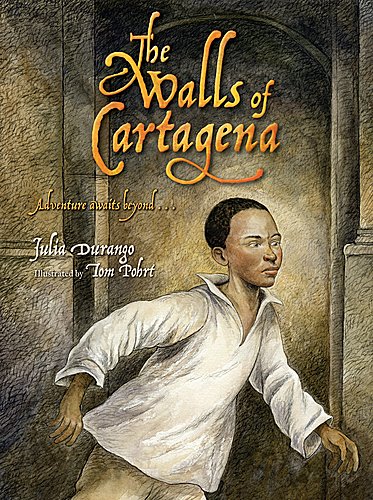
The Walls of Cartagena

by Julia Durango
ages 10+

Calepino has an easy life, especially for one born as a slave. Taken in by Dona Isabel after his mother died when he was born, Calepino has learned to speak eleven languages, can read in several, and spends most of his days lazing around the Dona’s house. That is, until he turns 13. Then Father Pedro, the local Jesuit priest, decides that Calepino needs to earn his keep. So, he is drafted to help translate for the captured Africans who have arrived to be sold into slavery. It’s there that he meets Mara and Tomi, who, along with Dr. Lopez and the San Lazuro leper colony, will change the course of Calepino’s life.

I liked this book — it’s a good, solid piece of historical fiction. Many of the characters, including Father Pedro who was canonized by the Catholic Church in the 1800s (according to the author’s note), were either real, or based on real people. Durango touched upon the evils of slavery, the horror of leprosy, and the Spanish Inquisition and did so in a manner that was serious, but humane and delicate. You understood the importance and horror of the events, but without going into detail that a child couldn’t handle. It’s a good introduction to the topics and the time period, one in which I could see spurring many discussions. In addition, I really liked Calepino as a narrator. He was a likable person, and an eventually diligent and willing one, which made the circumstances that he found himself in (and the ones he propelled) all the more compelling.

Good reading.

(Just for the record: because this is a Cybils nominee, I’ve been asked to make sure y’all know this is my opinion only, and not that of the panel.)

Clementine and Moxy

I started this post with the intention of picking ONE of these two books as the best. But, I can’t do it. It’s like choosing one of my girls as a favorite: I love them all equally, but differently. Just like I love both Clementine and Moxy.

Clementine’s Letter by Sara Pennypacker
Ages: 7 (reading chapter books) +

Admittedly, this was my first dip into Clementine’s world. I bought C a copy of the first Clementine, on a recommendation from Pam (probably, though it could have been someone else; so many people loved the book). She adored it. So much that when she saw The Talented Clementine at a school book fair last year, she bought it with her own money. When this one appeared on our doorstep, she was ecstatic. She nabbed it, went to her room, and came out blissful.

I can’t blame her. Clementine is charming, precocious, lovable, endearing and just plain cute. In this book, she’s just getting the hang of third grade, when her teacher is suddenly pulled away because the principal nominated him for a Teacher’s Only award that would take him away to Egypt for the rest of the year. Clementine is stuck with a substitute for the week, and can’t seem to stop getting in trouble. The only way out is to make sure her teacher does NOT get that award, so when the class is asked to write letters to the judges about their teacher, her’s is about how awful and terrible he is.

The thing I liked most about Clementine’s Letters was Clementine herself. I liked how she was always giving her younger brother vegetable names (makes sense). I liked how she’d try and try and it still wasn’t just quite right, because she’s the sort of girl who colors outside the lines. I liked her family and her friends. They’re quite an awesome bunch. But I think what I liked most of all was the warm fuzzy feeling the book gave me. It’s just so cute and happy I want to wrap it up and put it in my pocket.

(Is that a bad thing for a book to be? I think not, especially when it’s sincerely cute, and not at all saccharine-y and does not talk down to the reader. It’s good, honest cuteness, which is always the best kind.)

Moxy Maxwell Does Not Love Writing Thank-You Notes
Ages: 8+

Moxy on the other hand, is not cute. (Well, she’s not trying to be anyway.) She’s precocious and endearing though. And funny. I laughed more while reading Moxy Maxwell than I did during Clementine, because Moxy is outright funny. I think it’s part Moxy’s voice — always sighing, always trying to get out of what she’s supposed to be doing (and being very inventive about it), and part of is is the way Peggy Gifford writes. As an example I give you:

Chapter 25
In which Mark Says No

“No.”

That’s it. The entire chapter. Which totally cracks me up.

I should back up again and explain the story. Moxy’s had a wonderful Christmas, and she’s looking forward to spending a week in Hollywood with her dad and twin brother, Mark. However, before she goes, she MUST (and there will be “consequences” if she doesn’t) write the thank you notes for her Christmas presents. The whole book is Moxy trying to procrastinate that using various means (including copiers and spray paint). It’s a small premise with grand implications. (At one point, I was laughing so hard, but at the same time thinking that if it was my kid, I would SO TOTALLY kill her. If you read the book, you’ll know which part!)

I like that Gifford isn’t heavy handed in her lessons. We’ve got Moxy dealing with a dad who’s not exactly been the model father (they haven’t seen him in three years!), and a mother who’s giving (in Moxy’s opinion, anyway) unreasonable expectations, and a Christmas vacation that was supposed to be the Best Ever. But… Gifford makes us laugh, makes everything so over-the-top that you can’t help but love Moxy’s ideas and while we’re off looking at the hulabaloo, she sneaks in a quiet message about love and family. That’s talent for you.

And a marvelous book.

(Just for the record: because these are Cybils nominees, I’ve been asked to make sure y’all know this is my opinion only, and not that of the panel.)

Two Books about 11-Year-Olds and Friendship

Eleven, by Patricia Reilly Giff
possibly good for ages 10-12+

Sam MacKenzie is happy in his life, for the most part: he lives with his grandfather, Mack, above their wood shop; the other two store owners: Anima and Onji are also part of his family. Sam is talented with wood, helping Mack in their wood shop. Sam does have trouble reading, but with the support of his teachers and Mack, Anima, and Onji, it doesn’t really bother him much. That is, until the night before his 11th birthday, he’s snooping around trying to find his presents. He sneaks into the attic and finds a box with a newspaper clipping sticking out. It has a picture of him, as a three-year-old, and Sam is able to figure out the words “Sam Bell” and “missing”. Suddenly, his whole life foundation is rocked. Who is Mack? What do these dreams that have started resurfacing mean? He finds himself wondering: who is he, really?

In order to solve the mystery, Sam must read the newspaper article. In order to read the newspaper article, he must find someone to help him. The person he gets to help him is Caroline, a new girl, the daughter of artists, someone who never stays long in one place, and with whom he’s been assigned to work on project at school. Together, they work on figuring out Sam’s past, and in the process discover what frienship truly is.

I liked this book. They mystery is quite intense: at one point, I was imagining all sorts of sordid and wicked and horrible things that may have happened to Sam (what if Mack is some kind of kidnapper?). But that wasn’t the case (and it was most likely me reading into the book more than was there; I’m not sure a kid reading would get what I did out of it), and the ending was sufficently sweet and innocent, but not cloying. I also liked the friendship between Sam and Caroline: they weren’t best friends, but they worked well together, and their strengths played off each other in an interesting way. There was also none of that ew-your-a-member-of-the-opposite-sex stuff; there was a brief reference to it in the beginning, but Sam and Caroline quickly got past it, and worked together notwithstanding.

A good read.

The Trouble with Rules, by Leslie Bulion
possibly good for ages 9+

This one takes a slightly different spin on friendship, though it’s also between a girl and a boy. Nadie and Nick have been friends since kindergarten. They’ve done everything together. But, then they started fourth grade at the Upper Elementary School (grades 4-6; we had one like this when we lived in Macomb), and found out that boys and girls aren’t supposed to be friends. So, they pretend they aren’t. Except for when they’re working on the class magazine, and at home. Then Summer moves in and joins the class. Summer doesn’t know the “rules” and spends her first day “breaking” them, which inadvertantly gets Nadie in a whole lotta trouble. This, in turn, strains her relationship with Nick, and she “loses” her job on the magazine. It takes a couple of very bad weeks, but Nadie eventually figures things out, and learns how to walk against the popular tide.

I probably made it out to be more than it was, but I also liked this book. Mostly because I felt for Nadie. She had two really bad weeks, but they were also really important weeks, because she eventually learned a lesson that I think is important for all kids: it’s okay not to do what everyone else does. Even if that only means being friends with the boys. I liked the way Nadie worked on it, and how she figured out how to be herself and friends with Nick and make things work at school. I also liked Summer, her carefree attitude reminded me of a younger Stargirl — she ate weird, she sat on the boys side, she was friends with everyone. And because of that, she was initially shunned. I’m all for standing on your own, even if it is lonely (because it sometimes can be), because being an individual and not a part of the crowd is the better way to live. And this book addressed that in a way that I think kids could relate to and understand and accept.

Besides, it’s got a great scene with an exploding rotten potato. How can it not be good?

(Just for the record: because these are Cybils nominees, I’ve been asked to make sure y’all know this is my opinion only, and not that of the panel.)
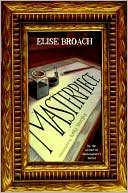
Masterpiece

Name the last book you read where the animal was the main character. Fairly easy, right? Think about the animal: what was it… dog? cat? bird? beetle?

Yup. The main character, for the most part, of Masterpiece is a beetle. Named Marvin. And, honestly, he’s so charming and adorable and… can a beetle be cute?… that it totally carries the book.

Marvin and his extended family live in the Manhattan apartment of the Pompadays: James, 11 years old, his mother, stepfather and baby brother. Marvin has a carefree life (for a beetle): learning to swim in a bottle cap, weekend excursions to the solarium, feasts of PopTarts. Then, on James’s birthday, he is given a pen-and-ink set from his father (who’s an artist). Marvin, wishing to give James something, draws a line drawing of the scene outside James’s window. Which sets off a chain events that eventually involves the work of 16th-century artist Albrecht Durer, a theft, a bunch of lies and a budding romance.

As I said before, it’s Marvin that makes the book worth reading. I was totally and completely charmed by Elise Broach’s imagining of the beetle world, from the descriptions of their house, to the adventures in the solarium, to the everyday workings of staying alive. (The best line, and I’ll have to paraphrase, was during a conversation between Marvin and his parents talking about divorce. Marvin asks why beetles don’t get divorced. His mother says something to the effect of, “Well, our lives are so short, we just want to live them happily and to the fullest.” She pauses, and adds, “Plus, beetles don’t have lawyers.”)

It’s also a book about friendship, as Marvin and James have to learn to communicate, trust each other, and work together. They form a unique bond (are there any other human-beetle pairings out there?) and manage to surpass the prejudices of Marvin’s family, as well as the human tendency to be repulsed at the little scurrying things. I enjoyed the friendship they built. In addition, I thought the resolution was completely plausible; Broach didn’t throw some sympathetic adult in the end, someone who would understand James’s relationship with a bug. James completely figure out how to solve the problem on his own, and managed to keep his relationship with Marvin intact in the process.

It’s not a perfect book, by any means. But there’s so much that’s charming about it that I willingly made it through the slow parts and the art lectures in order to experience more of Marvin’s world. Because it’s a completely captivating one.

(Just for the record: because this is a Cybils nominee, I’ve been asked to make sure y’all know this is my opinion only, and not that of the panel.)

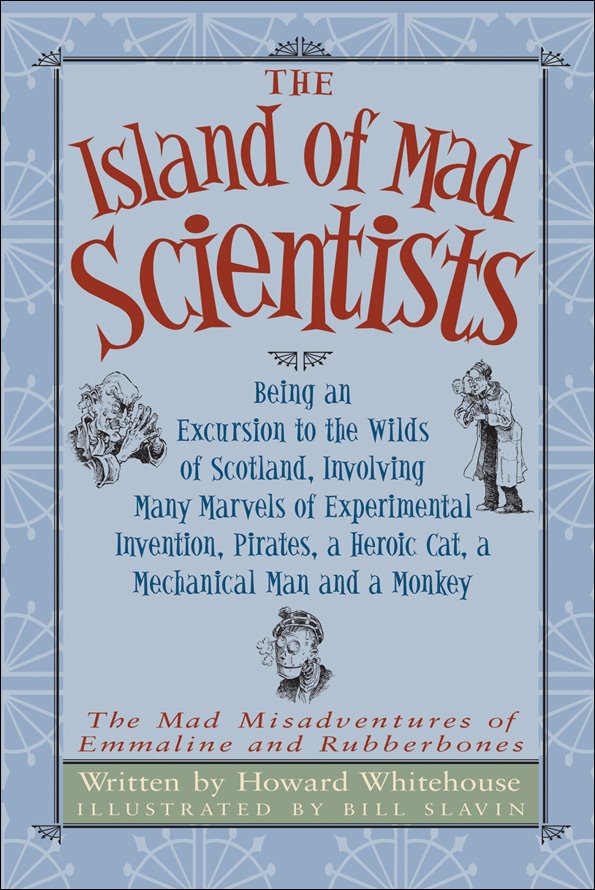
The Island of Mad Scientists

At first glance, this book looks like it’s another one of what I’m calling “The Precocious Kids on an Adventure” books that seem to be all over the place. However, while there are precocious kids (budding scientists, though there is no riddle solving), and adventure, this book is most definately not one of those books.

It’s actually the third in a series that Howard Whitehouse has written. I haven’t ever even heard of the other two, and thankfully (I’m becoming really grateful for this!) it stands on it’s own quite excellently. The plot’s a bit all over the plae, but the fundamentals are: there’s a Collector who collects scientists and wants a boy, Rab, and a girl, Emmaline (who are the budding scientists) to add to his collection. So, he sets thugs after them. In addition, there’s a princess, Purnah, who having escaped (in an earlier book) from an Evil Boarding School, is being pursued by the Authorities in order to put her back where she belongs. So, there’s thugs (and cops) following her. So (of course), they decide to vacation (it’s the middle of November) on an island, called Urgghh (“which means ‘cold and nasty’ in the Scots Gaelic tongue”), off the coast of Scotland, where a colony of Mad Scientists reside.

Clear as mud?

It really doesn’t matter, though, because this book is a grand romp. Hilarious, milk-snorting-through-nose funny, I can’t remember when I’ve had so much fun reading. It’s full of grand asides, amusing language, silly situations… everything a comic novel should have. It practically begs to be read out loud (I’ve already informed C that we’re going to; I can’t wait to do Purnah’s voice!), and thoroughly enjoyed by all, even if one doesn’t get the references to Verne, Stoker, Wells, late-18th-century science and Wodehouse (all of which the author helpfully explains in the note at the end).

Just brilliant. If I do say so myself.

Note #1: Thanks, Betsy, for your short Goodreads review; it gave me the push I needed to read it.

Note #2: Just for the record: because this is a Cybils nominee, I’ve been asked to make sure y’all know this is my opinion only, and not that of the panel.

Forever Rose

What planet have I been on that I have not heard of Hilary McKay or read any of her books? Thank heaven for Cybils nominees… though there’s nothing like reading the last one in a series first. (Though it did quite well as a stand-alone.)

This book (and I’m under a strict deadline here; M needs the computer) was a totally, completely, wonderfully fun and endearing read. Loved Rose. Loved the Cassons in general: they were so, well, that Hugh Grant movie English endearing. Just wanted to wrap them all up and put them in my pocket. They made me laugh. They made me smile. They dealt with tough issues (abusive parents, divorce, single parenting) with humor and love.

Granted, I’ve got a huge soft spot for anything English, and this tickled it just perfect. But, even given my preferences, this book was a lot of… well… wonderful.

And as soon as I finish up my Cybils reading, I’m going to go find McKay’s other four books about this lovely family and read them. Most likely in order, too.

(Just for the record: because this is a Cybils nominee, I’ve been asked to make sure y’all know this is my opinion only, and not that of the panel.)

Radiant Girl

Katya is 11 years old. It’s April 1986, and she lives just outside of Chernobyl, Ukraine. For those of you older than 22, you know where this story is going. For those of you younger, let’s just say that April 26, 1986 was a day that not many people will forget: the day that the Chernobyl Nuclear Reactor exploded. Katya’s caught in the middle of it; not only having to evacuate her little village for Kiev, but because her father works for the power plant, having to move back, and deal with life near the Dead Zone. Everything about her life changes that day, from something as simple as her friendships and hair color, to the more complex and worrisome health issues.

Andrea White takes this horrific event and gives it a personal touch, which makes it all the more haunting, in my opinion. She fills the book full of facts (with footnotes!) so that it feels like a memoir, rather than a fiction novel. I liked that touch; it made Katya come alive in ways that a straightforward fiction book wouldn’t have. There’s also sub-issues of conflict between Katya’s party-line father, repeating the Communist Party line that nothing was wrong. There’s an undercurrent of hatred and mistrust for the party leaders, for the things they put their people through in the name of the State and the Party. If I didn’t know that it truly happened, I’d be disbelieving: how could a government do that to their citizens. There’s a line at the end, that Katya believes the coverup of Chernobyl lead to the Ukraine’s decision to leave the USSR by 1991, and I believe it. Moscow treated the Ukranian citizens abominably.

This book is haunting, and difficult to get through, but only because the events were haunting and difficult to get through. White handles this with grace and style and love, and makes it all come alive. Which makes this book worth reading.

(Just for the record: because this is a Cybils nominee, I’ve been asked to make sure y’all know this is my opinion only, and not that of the panel.)

Ellie McDoodle: New Kid in School

I didn’t read the first Ellie McDoodle book, but C absolutely loved it. Thought it was grand. So I was interested in reading this one, and I can see what C was talking about. It is cute. And fun.

Ellie’s being uprooted by her parents the summer before 6th grade (I can relate!). It’s not fun. It’s not exciting. She hates being the new girl. No one likes her. It’s different, it’s unfamiliar, it’s… well, and upside down heart. But, she slowly makes friends, and figures out how to make things work, and in the end, everything turns out okay (I can relate!).

I think this is a good book for less confident readers — the words are interspersed with some fun cartoonish drawings. And I liked that Barshaw tackles a subject like relocating and starting over. She does it with humor and tenderness, and I rooted for Ellie to make things work out for the best. My only real criticism is that it was probably overly simplistic; Ellie was all settled in and comfortable (mostly) in her new environment in a matter of weeks, where in real life (I can relate, remember?) it takes months. But, since this is a story, not real life, I can forgive that.

Interestingly enough, C didn’t like this one as much as she liked the first. Perhaps it was because we relocated her when she was younger than Ellie (only 1st grade, not 6th), and she’s never really had the problems of fitting in and making friends. But I could have seen my 6th grade self really loving this book. And I can see other kids who have had to move just adoring it.

Which means it was a very good book.

(Just for the record: because this is a Cybils nominee, I’ve been asked to make sure y’all know this is my opinion only, and not that of the panel.)

Tennyson

Tennyson lives in the backwoods of Mississippi and is perfectly happy. That is, until her mother, Sadie disappears. Her father, Emery Fontaine, decides to go looking for her and leaves Tennyson and her sister, Hattie, with their Aunt Henrietta, who runs the Fontaine family house, Aigredoux. Once there, Tennyson is faced with an aunt who can’t live in the present, a house that’s falling apart, the fact that her mother may never come back, and most interesting (and haunting) of all, the dreams of her family’s past that she keeps having.

This book is a hard one to pin down. I liked it; there’s a lot going for it in terms of mood and Tennyson is a good, strong main character. I liked the portrait of the deep South, both in the 1930s and the glimpses into the height of the Civil War. It’s full of tragedy and mood and discovery and dreams. I think out of all of it, I liked the dreams the best — Blume captured the essense of the High South, the grand ladies, the southern mannerisms, the Gone-With-The-Wind fierceness in the face of destruction and betrayal. I found the dream sequences fascinating.

Real life was less so. I was pained by Sadie; I cringed even though Blume just skirted the top of the iceberg when it came to Sadie’s mothering. I felt so terrible for the girls, and for Emery who was just trying to keep it all together. There were so many deeper issues in the book; I’m not sure how many would come across to a child reading this, or if it’s just my life and wide reading that makes the neglect and jealousy and betrayal pop out at me.

For that reason, though, the ending worked for me. I could see what Blume was doing with it. Yes, it ended abruptly, but I think this part of Tennyson’s life was finished, and she was moving on. Therefore, the book needed to end, even if the story wasn’t ended. I could see, though, how it can be unsettling, leaving all the ends dangling, the story unfinished.

It’s at the very least a good mood book, and a good Southern book. And a very good one for a cool fall day.

(Just for the record: because this is a Cybils nominee, I’ve been asked to make sure y’all know this is my opinion only, and not that of the panel. Thank you.)

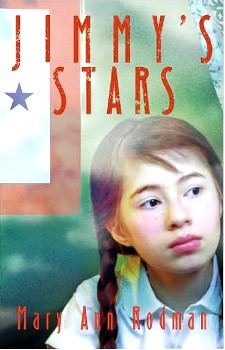
Jimmy’s Stars

True: There are a LOT of books about World War II out there.

True: There is also a lot of books about kids dealing with war and the effects it has on daily life.

True: Jimmy’s Stars is one of those books.

However, even though it’s a WWII book about a child, Ellie (age 11), dealing with how the war touches everyday American life, it doesn’t come off as trite, or overdone, or sentimental. True: it’s a very touching portrait of a girl trying to come to grips with her brother, Jimmy, entering the war. It’s simultaneously a very simple book and a very complex one.

The thing that carries this book from the beginning, is Ellie. She’s so real, so believable, so heart-breakingly hopeful that she literally leaps off the page and into your heart. You want her life to be okay, everything to go on as normal, and yet nothing can because of the war. It touches her life in so many ways — from the big: Jimmy going away, her Aunt Toots coming to live with them, her mother and sister going to work; to the little: to the dreaded summer canning, a girl’s bragging about her brothers being heros.

Interestingly enough it’s both an anti-war book (war does things to people that aren’t very good; is war really worth it), as well as one that subtly chastizes those who don’t appreciate what the soldiers — especially the ones who were just the line soldiers — have done (and do) for the safety of the country (and the world). It’s not often you see those two sentiments paired in a book, but it works well here. And it made me think not only about those who served in World War II, but those that are currently serving. And the sacrifices their families make so I can type here on my computer in relative saftey and freedom, telling you to go read this book.

You won’t regret it.

(Just for the record: because this is a Cybils nominee, I’ve been asked to make sure y’all know this is my opinion only, and not that of the panel. Thank you.)