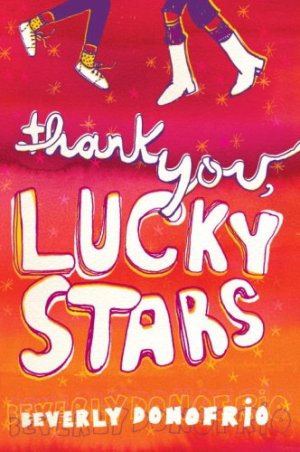
Thank You, Lucky Stars

by Beverly Donofrio
ages 8-12

Ally’s best friend is Betsy. It’s been that way forever (well, at least since kindergarten). They’ve done everything together always. But, on the first day of 5th grade, Ally discovers Betsy dumped her for their arch-enemy, Mona. Ally’s distraught, depressed, downcast, especially since this year is the Fifth Grade Talent show and she was going to perform in it… with Betsy! To add insult to injury, the only person who’s willing to be Ally’s friend is the new girl, Tina, who is odd, to say the least. After some bumps and fits, and a couple of very crucial decisions, Ally decides that maybe, just maybe, 5th grade will be okay after all.

This was an odd, quirky little book. That doesn’t equal bad; I read it out loud to C and we both really enjoyed it. It spurred some interesting discussions of the 70s — Ally’s parents are older, and Ally loves everything disco — and, more importantly, the nature of friendship. Tina’s an interesting character; strong and unafraid to be her own person. I really liked, and appreciated, that about her. Ally, though, I couldn’t quite get a bead on — the mix between 70s and present was a little off-putting (for me, at least; C didn’t mind so much), and I couldn’t quite figure out what Donofrio was trying to do with Ally. But, in the end, the book won me over: there’s so much enthusiasm, and heart, that I couldn’t help it.

My only real complaint, is that it didn’t come with a playlist. I think I could have used that.

(Just for the record: because this is a Cybils nominee, I’ve been asked to make sure y’all know this is my opinion only, and not that of the panel.)

My Cousin, the Alien

by Pamela F. Service
ages 8-11

Zach is a perfectly normal kid. Good parents, doing well enough at school, a few friends. Except that he’s got this cousin, Ethan, who thinks that he’s an alien. Zach and Ethan had an encounter with a cat — they thought they heard the cat talk — when they were younger, and ever since then Ethan’s been trying to convince everyone that he’s an alien prince from another planet. Zach thinks it’s all nonsense, but he does his best to defend Ethan from the people making fun of him. I should say that he think it’s all nonsense, until Ethan notices two big, fat, ugly, bald guys who are constantly following them. He’s convinced they’re alien bad guys trying to kill him.

The thing is: what if he’s right?

I’m not sure what I was expecting when I started this book, but I know I wasn’t expecting to have as much fun with it as I did. I had a blast. It was quick-paced, fun, and interspersed with comic book-style illustrations, it was something that could engage a reluctant reader as well as entertaining more advanced ones. It even had a bit of a surprise ending (even if I could see it coming…) with a nice twist. And a promise of sequels.

Fun, no?

(Just for the record: because this is a Cybils nominee, I’ve been asked to make sure y’all know this is my opinion only, and not that of the panel.)

A Thousand Never Evers

by Shana Burg
ages 12+

Over the years, when I have told people that the year we lived in Mississippi was hell for me, they always ask me what made it so hard. I have struggled to try and find the perfect answer… it’s a combination of moving from a huge city to a smallish rural town combined with the blatant racism of our neighbors that we encountered that made it the worst place on earth for me to live.

Now, when people ask, I’m just going to refer them to this book. Burg — no stranger to the situation, being both Jewish and the daughter of a Civil Rights lawyer — captured, for me at least, the hate that some white people down south had (and have) for African Americans so perfectly that it was both uncanny and disturbing.

It’s the summer of 1963, and Addie Ann just wants to figure out how to survive seventh grade. Then her boss, Old Man Adams, dies, and leaves his six acre garden to all of Kuckachoo — both whites and blacks. Of course, that doesn’t sit well with the mayor or the sheriff, so they conveniently forget to inform the white side of town that Mr. Adams wanted it that way. So, later in the fall, when the garden is discovered to be destroyed, the person that the town decides is at fault is Addie’s Uncle Bump. Being Mississippi, no one expects the trial to come out right, and it’s up to Addie to find the missing pieces in order to set Uncle Bump free.

Actually, this book isn’t that easy to sum up in one paragraph: there’s an awful lot going on. A lot of it centers on the basic conflict between white and black: in employment, in housing, in voter registration, in the administration of justice. Everything negative you’ve ever heard of makes an appearance: the Klu Klux Klan, cross burnings, home bombings. But, I think Addie’s narration has a softening influence — she’s an engaging main character, one who’s vulnerable and tough at the same time. Her voice makes this book worth getting through; without her, it would be too depressing.

It was a very tough book for me to get through at points. But, I think it’s the toughness that comes from a well-written, and honest, book.

(Just for the record: because this is a Cybils nominee, I’ve been asked to make sure y’all know this is my opinion only, and not that of the panel.)

Alvin Ho

by Lenore Look
ages: 6-10

Alvin Ho is allergic: to girls, school, bridges, substitute teachers, the dark… pretty much everything. And he has a quirk about it, too. It makes him clam up. He can’t say a word. He’s okay at home, on the bus, playing outside (for the most part), but when he’s scared, there’s nothing. Nada. Not a sound. Which makes it hard to make friends. (Well, that, and the fact that he carries his Personal Disaster Kit everywhere. A boy can’t be too prepared.) Still, he tries, and through a series of mishaps and pseudo-adventures, he manages to figure some things out.

It’s probably too simple to say that I adored this book. It’s partially because it reminded me of a nephew — not so much the scared part, but the mishaps and adventures — but also because it was so dang entertaining. I wanted to wrap him up and put him in my pocket as a mom, but I could see how he’d be exciting and amusing and fun for kids to read. Especially younger, beginning readers, or those who aren’t as interested. I’d say call it Clementine or Moxy Maxwell for boys, but I think girls would get into it too. (I did.) The best part, though: Alvin’s Wonderful Glossary at the end. That made the book just about perfect.

I’m off to send it to my nephew, and am pretty confident he’ll enjoy it as much (if not more) than I did.

(Just for the record: because this is a Cybils nominee, I’ve been asked to make sure y’all know this is my opinion only, and not that of the panel.)

Chancey of the Maury River

by Gigi Amateau
ages 10-14, but a younger horse lover might like it, too

I am not a horse person. Never have been. I’ve read Black Beauty and The Black Stallion, but neither really stayed with me. I don’t particularly have an affinity for horse books. (I also know I’m not supposed to start a review out this way, but bear with me.) Yet, I found myself captivated with this book. I don’t know if it’s enough to change me into a horse person, but Amateau’s love of the horse came through the story, not just loud and clear, but in such a way that I couldn’t help but care, too.

Chancey is an albino Appaloosa. This, for various reasons, leads to a hardship in his life when, after 20 years, his owner goes bankrupt and he is unable to be sold. Eventually — after months of neglect and abandonment — he’s sold to a stable-school, where he meets 10-year-old Claire. Her parents are going through a divorce, and she’s suffering (internally, of course). Through Chancey, she finds her confidence again, and Chancey — after years of being hardened by abuse and neglect — finds that he can love. The two of them forge a companionship and partnership that will take Chancey through the twilight of his life, changing not only each other, but everyone they come in contact with.

Hubby pointed out, when we were talking about this book, that a lot of animal books aren’t actually about the animal, but rather those who are interacting with it. This one is not that way. Chancey is our narrator, our guide through this world. And for the most part, it works quite well. There are times when Amateau digresses into horse-lecturing (whether about breed, or status, or teaching) that I started to tune out, but when the story is actually going, progressing forward, Chancey is a wonderful guide and an interesting narrator. I liked seeing the world, and the human interactions through a horse’s eyes. I also think Amateau handled the dialogue quite well: Chancey talked, but only to other horses. The humans Chancey interacted with talked to him, but his communication back was limited to whinnys, nickers, and nudges.

And the ending is quite touching; it had me in tears. I’m not sure I’m going to go out and read a bunch of horse books, but I can highly recommend this one.

(Just for the record: because this is a Cybils nominee, I’ve been asked to make sure y’all know this is my opinion only, and not that of the panel.)

Little Audrey

by Ruth White
ages 9-12 (though my library has it shelved in the Teen section…)

There are some books that just floor you when you read them. Either they’re so fabulous that they draw you into their world. Or because the so horrible that you wonder how on earth people existed like that. Little Audrey is the latter. When I read The Glass Castle this summer, I was moved by Jeannette Walls’s courage in dealing with her less-than-ideal living situation. I had much the same reaction to White’s book: it’s deeply saddening that anyone would have to live like they did, and it’s remarkable that they survived and thrived as much as they did.

Little Audrey is the story of a part of White’s childhood. Told (and somewhat fictionalized) though the eyes of White’s oldest sister, Audrey, this is the story of the White family in a mining “holler” in southwest Virginia in 1948. It’s not a pretty life: their father is a drunk, taking the scrips (they don’t get money) and spending most of it on alcohol. They’re barely making it from week to week. Audrey’s recovering from the scarlet fever, and is supposed to be gaining weight, but it’s hard when there’s not enough food to go around. Yet, through it all, and through the tragedy that happens in their life, they find hope. Audrey learns about the inner strength of her mother. She also finds kindness in those around her, from her neighbors to her schoolteacher to her friend, Virgil. It’s an inspiring and hopeful book, something which you don’t expect from the subject matter.

This is a book for younger readers, after all, and White only glances on the wreck that was her father. It’s probably a good thing — Audrey was young enough not to really notice or understand what was going on, but at the same time, she’s an incredibly perceptive girl. She knows her mother is trying to make do even though her father is trying to drink them all into oblivion. She knows her father beats her mother. She knows when to stay out of his way. And she knows that she will make do in spite of it all.

It’s a good book, one that surprised me how much I was drawn in and moved by it. And the fact that it’s a true story made it all the more powerful.

(Just for the record: because this is a Cybils nominee, I’ve been asked to make sure y’all know this is my opinion only, and not that of the panel.)

Steinbeck’s Ghost

by Lewis Buzbee
ages: 10-14

I’m not going to review the book — I liked it, well enough, but thought it fell apart in the end. Instead, since this is what I really liked from reading it, I thought I’d share some of the wonderful bookish quotes from the book.

“Every book he recognized opened up the world of that book to him. These weren’t stacks of paper bound together with glue or string–they weren’t items or products. Every book was an entire universe.” (p. 26)

“Reading a library book wasn’t something you did on your own. It was something you shared with everyone who had ever read that book. You read the book in private, yes, but other hands had been on it, had softened its pages and loosened its spine. With hardcovers, the clear shiny Bro-Dart, put on to protect the dust jacket, quickly got scuffed and crinkly, and sometimes you’d find a thumbprint pressed into the plastic. The book, when you were done with it, went back to the library, and from there to other hands. When you read a library book, you were connected to all these strangers.” (p. 56)

“When you read, the world really did change. He understood this now. You saw parts of the world you never knew existed. Books were in the world; the world was in books.” (p. 89)

Isn’t that so true?

(Just for the record: because this is a Cybils nominee, I’ve been asked to make sure y’all know that whatever brief opinion is in this post, it’s my opinion only, and not that of the panel.)

My Fair Godmother

by Janette Rallison
ages: 10-14
Publication date: January 6, 2009

Sixteen-year-old Savannah has a perfect life… or at least the perfect boyfriend. That is, until he decides that he’s more attracted to, and compatible with, Savannah’s older sister, Jane. All of a sudden, things are looking pretty bleak: after all, who will take Savannah to the prom? Enter Chrissy, Savannah’s “Fair” (she’s going to school, and hasn’t quite earned the whole “fairy” part yet) Godmother. She grants (well, sort of) Savannah three wishes, which creates a bit of a mess. Savannah’s sent back to the Middle Ages in the role of Cinderella, then Snow White, and then Chrissy sends Savannah’s friend Tristan back to become a prince. By this time, Savannah’s a bit fed up with Chrissy, yet Savannah braves the Middle Ages one more time to help Tristan accomplish his quest. And possibly fall in love in the process.

I read this one out loud to C, and aside from a few pages in the prologue where I was wondering if it was a bit too high-school-romancey for her, we both really enjoyed it. It was more fluff than depth, but I thought it worked well for the tale. Savannah spent most of the book being dogged on by other people (she didn’t take school seriously enough, she was just underfoot), but in the end, she understood things and worked with what she had quite creatively. Additionally,there was sufficient adventure to keep C interested (but not too many cliffhangers), and Rallison uses the traditional fairy tales quite creatively. We both especially liked her treatment of the Snow White story.

And it had the most important requirement for reading aloud (at least in our house): lots of fun characters with accents. (My personal favorite was Clover T. Bloomsbottle, the jaded leprauchan.) It was also pretty funny; I’m not sure how much of the humor C “got”, but I was laughing at all the asides and clever references. I’m not sure how well this would stand up if I had read it by myself, but I really enjoyed reading it aloud.

Which is okay, too.

The London Eye Mystery

by Siobhan Dowd
ages: 10+

I was fascinated by this book. I’m still trying to decide if “fascinated” translates into “good” and “liked it” — I think it does — but I do think fascinated is an accurate way to describe my response.

Ted’s brain works on, as he calls it, a “different operating system”. He recognizes systems and patterns — he loves weather, most of all — but can’t understand nuances and idioms. He’s living a nice, quiet life with his parents and older sister, Kat, in London. Then his Aunt Glo and cousin Salim come to visit on their way from Manchester to New York City (they’re moving). Salim desperately wants to go up the London Eye (the link is for your information, since I had no idea that this was a real thing!). Ted, Salim and Kat were standing in line waiting for tickets when a stranger comes up and offers one ticket to them. Salim takes it, goes up the Eye, and… doesn’t get off. From there unfolds a mystery that only Sherlock Holmes — and possibly Ted — can solve.

I liked Ted as a character; he was sympathetic, and even though you knew he was what most people would call disabled in some way, it never felt like a handicap. He did get frustrated when people wouldn’t listen to him, and by the way his sister often treated him, but he was a very determined character. And a very interesting narrator. As for the mystery, well, I’m no judge of mysteries, but this one was pretty good. The adults were dissolving into panic, but betweeen Ted and Kat they were able to look at the situation and reason it out. I’m not sure if that would work for all readers, but it worked for me. I have read a couple of reviews that complained that Dowd broke a fundamental mystery rule in that the reader couldn’t have figured it out, but I’m not so sure. Then again, I never figure out a mystery before the detective does, so I’m a lousy judge of that.

The book does stick with you, though. I’m finding that I’m thinking about it off and on since I finished it, wondering if it was really plausible, wondering about Ted’s unique operating system, musing about the whole situation.

That’s usually a sign that it’s a good book. Isn’t it?

(Just for the record: because this is a Cybils nominee, I’ve been asked to make sure y’all know this is my opinion only, and not that of the panel.)

Little Leap Forward

by Guo Yue
ages 7/8-12

Little Leap Forward is a boy in Bejing, China in 1966. It is the height of Chairman Mao’s reign, but it hasn’t really touched Leap Forward’s life much. He still plays by the river with his best friend, Little-Little, and he still enjoys his silkworms and the music he hears around him. One day, the boys capture a little yellow bird, which Leap Forward calls Little Cloud. He takes the bird home, intending on taming it and enjoying it’s music. The bird, once caged, won’t sing. Then the Red Guards arrive and Leap Forward’s life — and perspective — change.

This is a small autobiographical novel that while not detailed, I think caputures something different about the Cultural Revolution and China during that time. Leap Forward isn’t running from anything, he isn’t being oppressed; he’s mostly just trying to be a kid. Yet, because of the bird and a bamboo flute and a desire, his life was changed. There is a simple humanity and kindness to the book that I don’t remember finding in the other books I’ve read about this time.

Additonally, I loved the paintings, done by Clare Follows, Gue’s wife; they’re simple, yet beautiful. Something that I could spend time absorbing. But I have to admit, what I enjoyed most was the author’s note at the end where Gue tells part of his story. It’s touching and sad and sweet and just perfect. He as also released a CD called Music, Food and Love, which I’d love to find and listen to. He sounds like a remarkable man, one with a fascinating story to tell.

(Just for the record: because this is a Cybils nominee, I’ve been asked to make sure y’all know this is my opinion only, and not that of the panel.)