Turtle in Paradise

by Jennifer L. Holm
ages: 9+
First sentence: “Everyone thinks children are sweet as Necco Wafers, but I’ve lived long enough to know the truth: kids are rotten.”
Support your local independent bookstore: buy it there!

Turtle lives with her mom in New Jersey and has (mostly) become accustomed to her role as “the housekeeper’s kid”. It doesn’t mean kids are nice, but her mom has a job, and since it’s the middle of the Depression, that’s a good thing. Then her mom starts working for a woman who makes Mr. Scrooge look cheery, and Turtle finds herself shipped off to Key West, Florida to live with her mother’s sister.

And all the boy cousins.

There’s Bean and Kermit and Buddy and their friends Pork Chop and Ira. They are incredibly amusing and adorable, these boys: at times fierce and downright mean, at other times completely sweet. They are the Diaper Gang: going around island, helping out mothers of babies, taking care of them in return for candy. They even have a super-secret formula for taking care of rashes on babies’ bungys.

The book is mostly about painting a picture of life in the Keys during late-summer. It’s all about mood and place and experience. There are a few adventures, as Turtle finds her way around the town, and discovers things about the island and her past and her family and belonging that she couldn’t have found out had she not visited. But the plot is almost incidental to the book. And it didn’t really matter. Turtle and the boys were entertaining enough; besides, it felt right for the lazy pace of life in the Keys. If there was a lot of action, rushing around from place to place, it wouldn’t have felt as gorgeously summery as the book did.

And I wouldn’t have traded all the action in the world for that.

The Night Fairy

by Laura Amy Schlitz/Illustrated by Angela Barrett
ages: 8+ (or read aloud 5+)
First sentence: “Flory was a night fairy.”
Support your local independent bookstore: buy it there!

There are some books that just beg to be read aloud. Ones where the narrative is just beautiful that you find yourself mouthing the words while you’re reading, or make you want to grab the nearest child and say “You have to listen to this!”

This book does both of those things.

It’s a simple story — Flory is a night fairy who has her wings accidentally cut off by a bat when she’s very young, and so has to learn to fend for herself, without the aid of her wings or other fairies. She decides to become a day fairy, making the adjustment, and then… learns to grow up. She makes a tentative friend with a squirrel, and learns to adjust and compromise and behave nicely toward others. Of course there’s a moral to the story, but Schlitz handles it so delicately that you really never notice it coming.

Because the book is all about the adventure. There’s tight squeezes, hair-raising rescues, amazing daredevil flights… and yet, it’s also a very girly book. Schlitz says in the afterward that she wanted to give the little girls that love fairies and nature and adventure something lively. And she did. It’s a page turner, one that will leave the girls breathless for more.

It also helps that Barrett’s illustrations are so lush, so beautiful. Is it wrong to want a copy of this book to desecrate it and frame the illustrations? They are that pretty, full of vivid little details that will make you (or your little girl) want to pour over them for hours.

And that, my friends, is priceless.

Wishing for Tomorrow

The Sequel to A Little Princess
by Hilary McKay
ages: 9+
First sentence: “Once upon a time, there was a city.”
Support your local independent bookstore: buy it there!

There are very few people who could get away with a sequel to a classic like Frances Hodgson Burnett’s A Little Princess. Thankfully, Hilary McKay is one of those people.

Charming, quaint, and oh-so-Hilary McKay, this book follows the story of everyone else at Miss Minchin’s Select Seminary for Young Ladies after Sara Crewe leaves them. Ermengarde is mourning the loss of her best friend, resentful that Sara has escaped into a new life. She’s not the only one trying to adjust to the change: Lavinia has met the new boy next door, Tristram, and is suddenly more interested in learning than she is in gossip, which puts her best friend, Jessie, into a snit. Miss Minchin is becoming increasingly suspicious: she believes she sees Sara everywhere, and that means Sara is out to get her. The girls have to adjust to the new maid, Alice (since Sara took Becky with her), who just does everything wrong. And Lottie, the littlest, has become increasingly wild since Sara left.

The question is: will they find a way to survive?

I haven’t read the Burnett original recently, so I’m not really being overly picky here, but this book charmed me to pieces. Everything — from Ermengard’s earnestness and longing for her friend to Lottie’s impish behavior — was just right. McKay even managed to squeeze in a bit of A Little Princess for those of us who haven’t read it in a while (or haven’t at all), but did so in a way that felt natural. There were fun little letters back and forth from Ermengarde to Sara, as well as delightful little snippets of late 19th-century life. Not much happens over the course of the book, but it really didn’t matter; McKay’s writing is so captivating, and the characters so likable, that it doesn’t matter that the plot is pretty thin.

Now I suppose I should go reread the original.

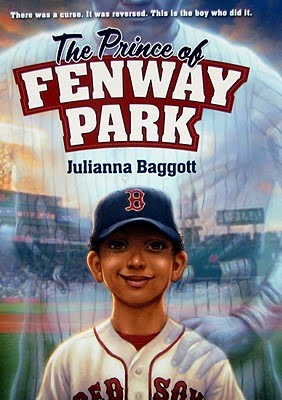
The Prince of Fenway Park

by Julianna Baggot
ages: 10+
First sentence: “The boy who would break the Curse didn’t know that he was the boy who would break the Curse.”
Support your local independent bookstore: buy it there!

Twelve-year-old Oscar Egg feels like he doesn’t fit in anywhere. A mixed-race child, adopted by white parents. He’s the child of divorce, and his father’s a bit on the run-down side. He doesn’t really fit in at school, and even though he’s a die-hard Red Sox fan, he even feels let down by them.

And so when his mother leaves him on the eve of his birthday with his father, he isn’t really surprised.

What surprises him, though, is his father’s world. His dad lives under Fenway Park, along with the other Cursed Creatures. See, the Curse on the Red Sox that prevented them from winning a World Series in 86 years? It’s a real, palpable thing, put on them by an Irish fairy (for reasons I never could quite figure out, but had something to do with selling Babe Ruth in 1919). And it turns out that the only person who can break the curse is Oscar.

There’s some of the Cursed Creatures who don’t want Oscar to succeed, though. And so it’ll take a lot of perseverance, a talent for cracking codes, and some help from some very unusual people to succeed.

This book is impossibly clever. From the moment I realized what Baggott had done — taken a major recent historical event and turned it into a work of fantasy — I was hooked. The fact that Baggott wrote an incredibly engaging story, and threw in a subplot about racism and acceptance only sweetened the deal. Add the fact that it’s a well-written baseball book (and even though I’m not a huge fan, I don’t know how you can grow up in this country and not like it at least a little bit), with facts about the past (from both the Major Leagues and the Negro League) and the spirit of the game; throw in the fact that it’s summertime, and you’ve got a complete winner.

Amazing.

Cosmic

by Frank Cottrell Boyce
ages: 11+
First sentence: “Mom, Dad — if you’re listening — you know I said I was going to the South Lakeland Outdoor Activity Center with the school?”

I had high hopes for this one. I really did. It was on my radar a couple of years ago when it was nominated for a Cybils, but no one could find a copy, so it went unread. And so, when someone (Betsy at Fuse #8? I know Sherry at Semicolon reviewed it…) reviewed it and liked it, I stuck it on my list.

Now, remember: this may just be me. In fact, it probably is. I have a bad habit of not being able to read books from any other perspective than my own. And I can really see an eleven or twelve-year-old boy absolutely loving this one. But, me? I couldn’t get more than a third of the way through the book before my suspension of disbelief completely failed.

See, our main character, Liam, is a 13-year-old boy who can pass as an adult. Well, at the very least people seem to think he’s an adult: he’s tall, he’s mature (physically, at least) for his age. And so, when an opportunity for the “ride of a lifetime” comes up, he gets one of his friends, Florida, to pretend she’s his daughter, and off they went.

And, that’s as far as I got. I really have no interest in seeing what happened once they got there. The book was slightly amusing, though all the Worlds of Warcraft references were driving me nuts. (If I were a gamer, I might care more.) But, honestly, I didn’t care enough about the humor to keep me interested in the story.

Darn.

Finally

by Wendy Mass
ages: 10+
First sentence: “I’m a big wisher.”
Support your local independent bookstore: buy it there!

Rory has a problem (and it’s not her name, though she gets “isn’t it a boy’s name?” all that time): she wants to be grown up. She’s been wishing for this for a long time — at least since she was six years old, and started writing down everything she’d get to do (finally!), when she turned 12.

The day before her birthday, she meets an eccentric old lady who tells her that she won’t get what she wants until she sees what she needs. Rory doesn’t pay it any attention… until things start going horribly wrong.

Things go so wrong, in fact, that I was beginning to wonder what else bad could happen. It seems like there’s a catch with everything on Rory’s list: from getting a cell phone (lost the first one; ends up with the same number as a pizza restaurant), to shaving her legs (the most hilarious, pathetic, horrid one), to getting her ears pierced (it would never happen, or so I tell C, who was a bit freaked out by that one), it all goes horribly, horribly wrong. Of course there’s a happily ever after (of sorts), especially after Rory learns what the woman meant, which isn’t really until the very, very end. There’s no real big fireworks, not really any big life-changing moments. Just a series of events that lead Rory to realize that growing up isn’t all that it’s cracked up to be.

It’s a Wendy Mass book, and so (almost by default), of course I liked it. But… it wasn’t as good as the last couple of her books I’ve read. It’s a sequel of sorts to 11 Birthdays — it took me forever to realize who Leo and Amanda were! — but without all the fancy magic loops and such. It’s more subtle (are the incidents “real” or are they a set up? It could go either way…) and much more realistic than the first book. And, as a result,the book wasn’t quite really, really good. More like just plain good.

It doesn’t help that I wanted to throttle Rory’s parents from nearly page one. (It wasn’t just me: I overheard C saying that she just wanted to strangle the parents.) They give overprotective a bad name. Hovering, helicoptering, annoying… you name it. No wonder Rory wants to grow up so badly; her parents haven’t given her any room to maneuver at all! (*sigh* I guess you don’t want a lecture on my parenting opinions right now.) It made the juxtaposition between what Rory wants to do and her accidents all that more heart-breaking. I just wanted one thing, one little thing, to go right for the poor girl.

Which, I suppose, it does, in the end. It was a fun little book, but nothing grand. Which is a little disappointing, but not too terribly much. It is Wendy Mass, after all.

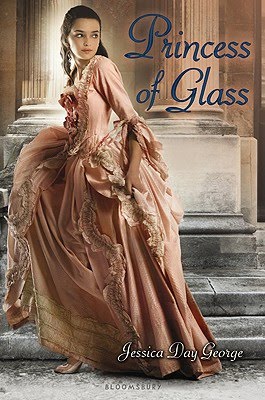
Princess of Glass

by Jessica Day George
ages: 11+
First sentence: “‘Perfect,’, the Corley said, lips stretched wide in a smile.”
Support your local independent bookstore: buy it there!
Review copy sent to me by the publisher.

Ah, fairy tale adaptations. Round whatever. In one corner: Cinderella. In the other corner: Jessica Day George’s newest. And how does the new book hold up against the original? Surprisingly, quite well.

It helps, I think, that this is a sequel, of sorts, to Princess of the Midnight Ball. Our main character is Princess Poppy, one of the sisters forced to dance through the night for the evil King Under Stone. In the aftermath of that, the various countries relations are falling apart, and Poppy’s father and King Rupert of Briton devise an exchange program. Poppy is sent to Breton, but not to stay in the castle. Instead Rupert invites Prince Christian of Danelaw to stay in the castle. And, then becomes obsessed about getting him married off, preferably to a Breton.

Poppy is a delightful character: not your typical princess (it’s best when they’re not, you know): she prefers to play cards and talk rather than dance, for obvious reasons. It makes going to balls uncomfortable, so she doesn’t have much opportunity to meet people. But meet Christian she does, and they fall into a nice, happy, casual relationship.

Enter Ellen. She was once nobility, but then her father got in over his head with gambling debts, her mother died, and then her father sold off everything and died himself. Left alone, she was force into being a maid in the house Poppy’s staying at. Which she was absolutely horrible at. Then The Corley contacted her, told her she was Ellen’s godmother, and offered to make her wishes come true. This is where the story takes some interesting twists; instead of wicked stepsisters, the readers dislike the Cinderella figure, especially as Ellen goes to the balls, upstaging both Poppy and her cousin Marianne. The only problem, I think, is that as Ellen goes in, under enchantment, to steal and get Christian to marry her, there isn’t much reason to not let her. Sure, Poppy and Christian are friends, but there’s not enough of an attachment to make the reader terribly worried.

On the other hand, one of the more interesting parts is watching Poppy — with the aid of some family friends — unravel The Corley’s enchantment, while finally coming to terms with the after-affects of her own. She’s singularly determined to make it work, and while the ending is a bit rushed, it does work.

Which is to say, this is one fairy tale adaptation that does its job quite well.

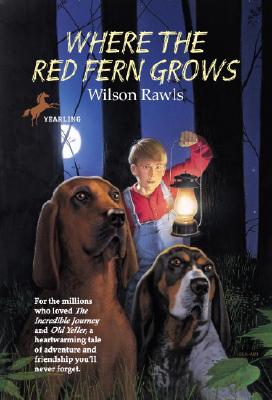
Where the Red Fern Grows

by Wilson Rawls
ages: 10+
First sentence: “When I left my office that beautiful spring day, I had no idea what was in store for me.”
Support your local independent bookstore: buy it there!

First things first: I didn’t cry at the end this time. That’s really the only thing I remember from the first time I came across this book. It was fourth grade (or maybe fifth), and I remember everyone (including the teacher) bawling at the end.

But, you know: it was sad, but not really a tear-jerker. Maybe it would have been if I’d read it out loud.

Some other things that struck me:

  • It has a mood much like the movie of the Snowman. It’s an older man, reflecting on his past, remembering something good — or eventful, a time that was better. Neither has a truly happy ending; it’s more bitter sweet, but then again, what childhood isn’t?
  • It’s really quite religious. Billy is convinced that God helped him get his dogs, and on other occasions he speaks of miracles and Divine guidance. Interesting. Not something I remembered.
  • You can’t help but love the dogs. I’m not necessarily the world’s biggest dog lover (they’re okay), but I was taken with Old Dan and Little Ann. Almost made me want to get a dog. Almost.
  • The amount of freedom and determination Billy had was amazing. Granted it’s a different time, but I’m sure my girls would love that amount of freedom to wander. On the other hand, poor Billy’s mom. She must have done some worrying and a lot of trusting.

There you have it: I’ve tackled one of the great classics. This time, it stood up to the test of time, and the reread. It wasn’t depressing, and it’s incredibly well-written: descriptive and evocative. Very, very good.

Silver on the Tree

by Susan Cooper
ages: 10+
First sentence: “Will said, turning a page, ‘He liked woad.'”
Support your local independent bookstore: buy it there!

This is one of those high fantasy novels, replete with adventure and magic and time travel. It’s got every single person (practically) that we’ve met over the course of the sequence, playing various roles towards a ultimate end. It’s got a Tolkienesque feel — what with swords glowing blue and a Grey Havens bit at the end, not to mention a Quest to end all quests and a Battle to end all battles (though Cooper’s not as bloody as Tolkien). It’s a perfect ending to the series.

But — and maybe this is time and exhaustion talking here — it’s really not as good as some of the other books in the sequence. There were some bits that I liked, sure: particularly Will and Bran’s quest into the Lost Land to get the crystal sword of the Pendragon (if you had any questions about how this fits into the Arthurian legend, Cooper answers them). That was a nice section, replete with high magic, and where Will was mostly operating on his own wits rather than relying on the power of the Old Ones. But, I felt like there was almost too much. Most of the characters were underdeveloped; it seemed that Cooper was relying on what we had learned of the characters rather than giving us anything new about them. It was also disconcerting when some of the minor characters up and changed on us; not drastically, but enough to make me scratch my head. This was more plot-driven, and yet the plot seemed disjointed. It was episodic, and yes it was leading up to a great whole, but the ending seemed rushed and unfulfilling. If you blinked, you would miss it; it was an excuse to get to the denouement, which Cooper seemed much more interested in.

That said, it’s a good series, a grand bit of myth and folklore and magic. If you haven’t read it, you should.

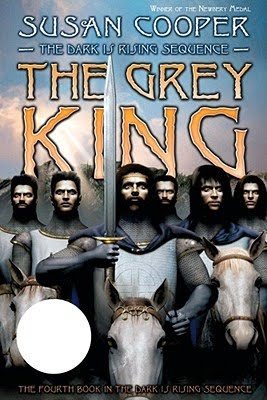
The Grey King

by Susan Cooper
ages: 10+
First sentence: “‘Are you awake, Will?'”
Support your local independent bookstore: buy it there!

Things that struck me while reading this book:

1. That this really is, so far, the tightest — and best (don’t shoot me; it’s better, in many ways, than The Dark is Rising) — of the series. It definitely deserves the Newbery sticker it sports.

2. I like how, so far, each book has a season: Over Sea, Under Stone is summer; The Dark is Rising is winter (which explains its moodiness); Greenwitch is spring; this one is autumn. It has a very autumnal feel to it. That mood is not as strong as the winter one, but it’s still very palpable, and still very there.

3. I like that Merriman is not really there. Yes, he does make an appearance, but it’s Will — and the Welsh boy, Bran — that really do all the work of the plot. It’s nice, for once, to see Will in his own element, exercising his own powers, without the guidance (or interference of Merriman).

4. The Arthurian legends are implied in the previous books — if you know they’re there, you’ll see it — but it’s explicit by this one, especially by the end. I liked that.

5. It bothers me that the cover has on it figures that don’t show up until the last chapter, and even then, don’t really do much of anything. Though, since there’s really no description as to what the Grey King looks like, and a picture of a mountain would be too boring, I guess this is what the designers are left with.

6. I like how Cooper uses prophecy: she writes one out, and it’s there guiding the book, influencing the book, but it’s not heavy-handed. You usually don’t notice she’s jumped you through a hoop of the prophecy until after the fact. That’s some good writing there.

It’s a good book; I like it as much, if not more, than The Dark is Rising, and I’m kicking myself for not realizing it sooner. It would also make a good stand alone: Cooper includes the most necessary information from the previous books (but it doesn’t weigh the book down), and while it’s always nice to read the whole series, this one would work well all by itself.