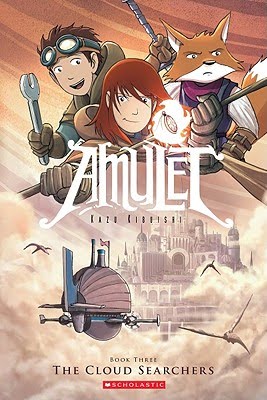
The Cloud Searchers

Amulet, vol. 3
by Kazu Kibuishi
ages: 10+
First sentence: “Luger.”
Support your local independent bookstore: buy it there!

Picking up where we left off, our fearless crew, including Emily, her brother, mother, and assorted robots and guards are off to find the lost city of Cielis, in order to find the Guardian Council to help them overthrow the Elf king. Along the way, they pick up two elf renegades: one just happens to be the elf prince. Emily (and the rest) don’t really trust them, but they also don’t have a choice. And when darker forces come calling, it’s probably a good thing to have all the help you can get.

This book is still just as lovely and as exciting as the first two, but I’m starting to forget the train of the story from one book to the next. Which really isn’t Kibushi’s fault; I’m terrible at remembering things. But, that said, I’m wondering if it wouldn’t be wise to put off reading the rest of this (albeit great) series until the whole story is completed. Because, especially with this one, each book isn’t telling it’s own individual story, being rather a piece in the whole puzzle. And while the puzzle itself is intriguing, it’s not going forward fast enough for my brain to retain the pieces.

Which means I’ll have to get back to the series later.

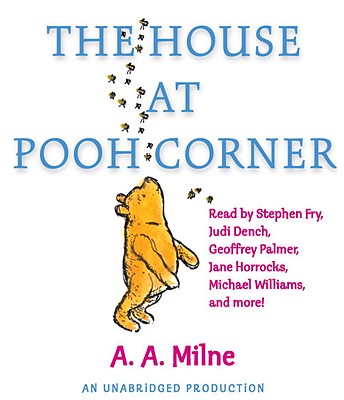
Audiobook: The House at Pooh Corner

by A. A. Milne
Read by: various British actors including Stephen Fry and Judy Dench
ages: 4+
Support your local independent bookstore: buy it there!

What can you say about Pooh Bear? Nothing. Seriously. Pooh Bear is Pooh Bear, and if you don’t love him you are either not a child, don’t have a child, never have been a child, or are a grumpy curmudgeon in need of some humor in your life.

Because the Pooh Bear stories are absolutely wonderful. Funny, sweet, tender, silly, and captivating. How can you not love the characters, Pooh with his earnestness, Eeyore and his sarcastic grumpiness, Piglet and his insecurity, Tigger in his enthusiasm, Rabbit with his bossiness and worry, and Owl with his self-educated importance. I love them all. And the stories: this one has two of my favorites: the one in which Christopher Robin goes to school, leaving a note that says “Gone. Be back son.” and the animals try to figure out what a “backson” is. And Pooh sticks. Yes, I play Pooh sticks with my kids. I love Pooh sticks.

So, when K asked to listen to something for her very own, of course I thought of Pooh. This recording has the benefit of being unabridged, even though it is a full-cast production. I usually prefer a single reader over full-cast, but in this case it worked. It helped K keep track of who was talking — every voice was quite distinct, even if I did find Tigger’s and Piglet’s portrayals a bit grating — and some of them — Stephen Fry’s Pooh and Geoffrey Palmer’s Eeyore, among others — were dead on perfect. I noticed things that I didn’t when I’ve read these to the girls in the past; it’s amazing what a different interpretation of a specific line, what a different emphasis and inflection will do to the meaning of the sentence. And yes, the end in which we have to say good bye did find me teary.

Wonderful, wonderful Pooh.

Audiobook: The True Meaning of Smekday

by Adam Rex
Read by Bahni Turpin
ages: 8+ (though my 4 1/2 year old loved it, too)
Support your local independent bookstore: buy it there!

I’ve enjoyed audiobooks in the past, but I think it’s a rare occasion when I listen to an audio book and then realize that I probably would have not liked the book as much if I had read it. (The last time that happened was with The Tale of Despereaux quite a few years ago.) This was one of those books. Although there were a few moments when I wished I had the book to browse through, Bahni Turpin did such an amazing job with the narration, that I know if I had read the book I would not have had as good of an experience with it.

But, the audiobook? I loved it. (As did all the girls, for the record. And they didn’t even hear the whole thing. We need to go on a nine hour roadtrip so they can all hear all of it. Amanda, you want some visitors??)

The story begins with a school assignment. Gratuity Tucci (“my friends call me Tip”) is assigned to write, for the National Time Capsule contest, an essay answering the question: What is the true meaning of Smekday. See, a year earlier, aliens called the Boov invaded Earth, which they renamed Smekland, on Christmas (henceforth known as Smekday). Gratuity has an interesting story: her mother was kidnapped by the Boov, and Gratuity with her cat (named Pig), set off to Florida (where all the humans were being relocated) to find her mom. Along the way, she falls in with a renegade Boov named J.Lo, who has made a bit of a mistake of his own. The long and short of it is that because of J.Lo’s mistake, and because of Gratuity’s determination, it ends up being their job to save the world.

It’s hilarious, especially as read by Turpin. The voices she picks for the Boov, were at first annoying, but by the end of the book became endearing. You could tell the personalities of the people from the voices she chose. And the book was so funny — I wish I had a copy here to pull out one liners — from the pokes at pop culture to the Boov massacring English, it had us all in stitches. But that’s not to say it’s all fun-and-games; Rex pairs the funny with a darker undertone: there’s strains of Manifest Destiny and imperialism going on. Aren’t the Boov doing to us what we did to the Native Americans, or what the British did to so many other countries? I’m sure my younger kids didn’t pick up on that, but I found it interesting. There’s also themes of prejudice and stereotyping, and going beyond first impressions to find the truth of a person, race or species. It’s fascinating.

I also discovered that listening to the story, for me at least, ramped up the suspense. I couldn’t flip to the back of the book to find out how it ended (confession: yes, I do that). I was forced to listen, to wonder where the HECK was he going with the story, and how in Smekland was it all going to turn out?

Highly, highly recommended.

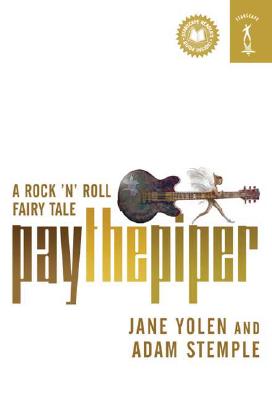
Pay the Piper

by Jane Yolen and Adam Stemple
ages: 10+
First sentence: “The piper caught sight of the river long before the sound of rushing water reached his ears or the salt smell of blood struck his nose.”
Support your local independent bookstore: buy it there!
Review copy sent to me by Corinne, so I can participate in her library’s awesome program.

Callie (short for Calcephony; because of ridiculously lame parents: that’s not even a real word!) wants to be a world-class journalist. So when she snags an assignment to cover the band Brass Rat (they’ve been around since her parents were in college; and yet they don’t look a day over 20), she’s incredibly excited. That is, until she starts seeing and hearing weird things… like rats dancing whenever the lead singer/flautist (can a rock band have a flautist? Really?) Peter Gringas plays.

Callie doesn’t think anything of it, though, until the next night, Halloween, when all the children go missing. It turns out that Peter is a cursed prince of faerie in exile, paying a blood teind to his father for the murder of his brother. It’s up to Callie, if she wants to save her brother and the rest of the children, to figure out how to break the curse. Before midnight. Can she do it? (Need I ask?)

I generally love fairy tale retellings, but this one was clunky. (With a capital clunk.) Maybe it’s the fairy tale: the Pied Piper isn’t one for sweeping grand retellings. (Though I did like Wild Magic well enough.) But, even so, the writing was uneven. The was split in two: reminiscences from faerie and the modern day Callie. The reminiscences were beautiful, lyrical; I could have read a whole book about how Gringas became dissatisfied and eventually killed his brother and was exiled. The rest was mundane, pedantic, and a sad attempt at being hip and cool (or so I thought; I’m not the world’s best judge). The whole thing was a bit rushed, as well: lots and lots of set-up and a quick, and not very satisfying (though logical), resolution at the end.

It seemed to me, that there was a good YA (or even adult) story in here, and they just simplified it for younger kids, rather than making something wholly organic for middle grade readers. Which is just frustrating.

The library program, however, is really quite cool.

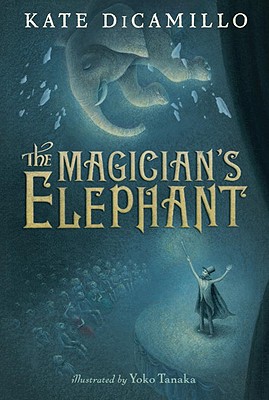
The Magician’s Elephant

by Kate DiCamillo
ages: 9+
First sentence: “At the end of the century before last, in the market square of the city of Baltese, there stood a boy with a hat on his head and a coin in his hand.”
Support your local independent bookstore: buy it there!
Review copy picked up at KidlitCon 2009 (Yes, it really has taken me this long to get around to reading it.)

Peter is an orphan, being taken care of by an old military friend of his father’s. He barely remembers his parents, and his guardian has told him for years that Peter’s baby sister was stillborn. Peter feels no hope of ever seeing any of them again, resigned to his meager lifestyle with a cranky old man. That is, until he spends a coin on a fortune teller who gives him hope. Hope that his sister is alive, hope that he can find her. Sure, it’s impossible, but since when is the impossible — especially when you have a magician and an elephant and a policeman helping — improbable?

It’s a very charming and sweet story. One that has the power to resonate with you afterward: it’s about hope and love and change, but nothing Grand or Sweeping. It’s all very small, very personal. It explores, very subtly, the effects that one person can have on another, and the desires we have to be Grand and Sweeping sometimes. It worked as a parable, the writing was gorgeous. I think it’d work wonderfully as a read aloud. Which brings me to my only quibble: would a kid read this? My friend Tricia assures me her daughter loved it, but I’m not sure.

Even with that, I think it’s a marvelous little story.

Guys Read: Funny Business

edited by John Scieszka
ages: 10+
First sentence: “A kid gets transferred to a new school.”
Support your local independent bookstore: buy it there!

Ah, humor.

It’s such an individual thing, really. Some people snort milk out their nose at the slightest silliness (guilty), others just crack a small smile. It’s so hard to find one style that suits everyone.

The best solution? A short story collection. There’s enough different kinds of stories in here (all with male protagonists, so hand this one to the boys. Which was its point, actually.), from enough different authors, that everyone will find at least one that will tickle their funny bone.

For me, it was Eoin Colfer’s story. If I had been drinking milk (or anything at all), I would have snorted it. I howled. It’s basically a personal essay about his older brother, the evil genius, and how he got his younger brother out of trouble. Seriously, it doesn’t sound that funny, but it is. Or at least it was to me.

The other stories were nothing to sneeze at either: there are stories about not-so-great friends, projects gone bad, getting addicted to danger, stupid English assignments, obnoxious parents and grandparents, and superheroes. Not all were equally funny, in my opinion, but all were entertaining and interesting and fun to read. Completely worth picking up (and not just for the guys.)

Besides, how can you not want to read a book that has a trailer like this?

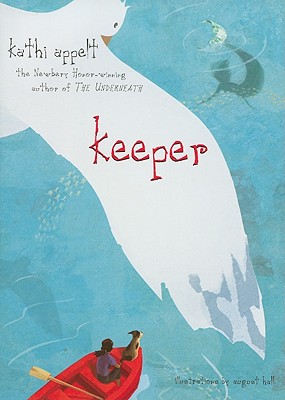
Keeper

by Kathi Appelt
ages: 10+
First sentence: “Keeper leaned over the edge of the boat.”
Support your local independent bookstore: buy it there!

I wasn’t that interested in reading this one because I had such a bad experience with The Underneath. But Pam at Mother Reader convinced me that it’s completely different from Appelt’s first book. And she was right. It’s on that hinterland between reality and fantasy: while it has elements of both, it’s not really either. But even that worked for me.

It’s a simple story: Keeper has grown up on the Texas Gulf of Mexico shore, her family consisting, for the last seven years since her mermaid mother left, of Signe, Dogie and Mr. Beauchamp (that’s not counting the animals). They are the residents of a little road down by the shore. It’s a good life, one that seemed to, in one day, fall completely apart. So, Keeper has decided that she needs to go ask her mother how to put it back to rights. She gets a boat and in the middle of the night, heads out to the ocean to figure out how to put her life back together.

It’s a beautifully written book: sparse in the language, slipping in and out of viewpoints, including the animals, as the story needs. I loved that she used language I haven’t heard for a long time: cooleoleo, calloo callay, shazaam, easy peasy, and so on. It fit the feel of the book, as something both current yet also outside of time. It had the feel of mythology, and incorporated the mer mythos. But it was also very much grounded in reality. I loved how she defined family as anyone who cares about one another, no matter what. I didn’t think there would be enough of a story to manage 400 pages, but with flashbacks to the past explaining how this family came to be a family, it worked for me.

It’s not a flashy book, but it’s a sweet, quiet, tender one. And sometimes that’s exactly what a book should be.

Forge

by Laurie Halse Anderson
ages: 12+
First sentence: “‘Can you walk?’ someone asked me.
Support your local independent bookstore: buy it there!

I’m not sure how you are, but I really shouldn’t read winter books in the dead of winter. It’s too depressing.

Granted, this book, the sequel to Chains, isn’t supposed to be lighthearted fluff. It picks up several months after (spoiler, sorry) Isabel and Curzon escape. They had wandered around a bit, trying to get some money, and squabbling about whether or not to head south to rescue Isabel’s sister Rose. That led to a split between the two, something which Curzon thought he wouldn’t mind. However, through a couple of accidental encounters, Curzon’s ended up in the Continental Army. Again. He signs on to save his skin just as the army’s heading into winter encampment at (dead giveaway because of the title, here) Valley Forge. Anderson spends some time making sure that her readers know just what the conditions of Valley Forge were (not good is an understatement), but this is historical fiction, not non-fiction. The story is Curzon’s and we follow his struggles to get accepted at camp as an African American. He registers as a free man (even though he’s not, technically), and yet there are prejudices and obstacles to overcome even among his friends.

Then his old master shows up and decides that Curzon isn’t a free man. Which means that Curzon has to figure out how to escape all over again.

This book came with expectations, because it’s Anderson’s work and because I adored Chains. I’m not sure it lived up to them, however. Perhaps because it’s been too long since I’ve read Chains. Perhaps because, as I mentioned before, it’s winter, and reading a story about soldiers freezing in the snow just doesn’t help my already glum mood. But it just didn’t grab my attention the came way that Chains did. It’s a good story and Curzon’s an interesting enough main character, and once I picked it up, I did enjoy what I was reading. Anderson does the history justice, and more so: she paints a picture of the situation that’s can’t be found in the history books. The story doesn’t clip along as fast as I remember Chains doing, but it managed okay. However, in the end, I felt it was missing that something to keep me turning the pages, to draw me to the book in between readings.

That said, I’m quite curious to see what happens in the next book.

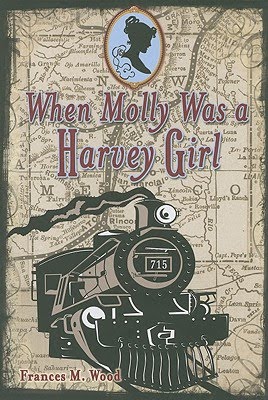
When Molly Was a Harvey Girl

by Frances M. Wood
ages: 11+
First sentence: “By late summer, Molly could always smell the corn growing.”
Support your local independent bookstore: buy it there!
Review copy sent to me by the publisher.

When I first picked up this book, I wasn’t quite sure about it. It’s an interesting premise: a couple of sisters, orphaned by their recently deceased father, decide that there is more opportunities for them out west than in Streator, Illinois. Actually, it’s the older sister, Colleen, 19, who decides that. She signs up to be a Harvey Girl — young women who worked the restaurants at the train depots on the Atchinson, Topeka and Santa Fe Railway — and drags her younger sister Molly, 13, along. The problem is Molly isn’t old enough to be a Harvey Girl, so (because she’s tall for her age), they pass her off to be 18.

I thought to myself: this can’t be a middle grade book. Really. A 13-year-old passing for an 18-year-old? But, you know, it worked. And it worked for middle grade readers (and up; I could see a teen liking this book, especially a history buff). There’s so much to enjoy about the book. Mostly set in New Mexico, Wood writes with an affection for the landscape and the time period. It’s a rich book, with many layers: there’s the initial deception that the sisters pull off and all that entails, sure. But it also touches on race relations, the hunt for marriageable spouses at that time period, envy and jealousy and contention among the girls, and most of all, the hard work it took to be a Harvey Girl.

And then there was the food. It made my mouth water, the descriptions of the dishes that the Creole chef Gaston created. Heavenly stuff.

There’s so much going on, it would seem weighted down. But, Wood remembers her audience (but doesn’t talk down to them!), and keeps Molly grounded in the story. She’s a great character to follow, and while the book does take a while to get started going, it’s really worth the time put in. An excellent read.

(Just for the record: because this is a Cybils nominee, I’ve been asked to make sure y’all know this is my opinion only, and not that of the panel.)

Two Dynamic Girls

Emily’s Fortune
by Phyllis Reynolds Naylor
ages: 8+
First sentence: “When eight-year-old Emily found herself alone in the world, she didn’t have much: a few dresses, a couple of books, and a small green turtle named Rufus.”
Support your local independent bookstore: buy it there!

Emily, who was perfectly happy living with her mother until the day she died in a freak carriage accident, is now an orphan. She has no idea what to do until a letter arrives from her distant Aunt Hilda, who is willing to take her in. However, that means two things: 1) Emily has to get there first. By herself. Which means avoiding the “child catchers”: the people who want to take her and put her in an orphanage. And 2) her mean old Uncle Victor is going to everything he can to stop that from happening. Mostly because, as it turns out, Emily inherited a very large fortune.

It’s a rollicking adventure, somewhat in the style of Lemony Snickett (except with a happy ending). Uncle Victor makes a great bad guy, channeling Snidely Wiplash as he poses and attempts to get Emily (and her fortune). Naylor captures the style of old fashioned serials perfectly, by ending each chapter with a HUGE (literally) question. That particular gimmick drove me bonkers after a bit, but I can see how it would really tickle a beginning chapter book reader.

In all, a fun little book.

Happy Birthday Sophie Hartley
by Stephanie Greene
ages: 9+
First sentence: “On the whole, Sophie felt that the conversation about her birthday present had gone very well.”
Support your local independent bookstore: buy it there!

It’s almost Sophie’s double-digit birthday. It’s a very important birthday, because you only go from single to double digits once in your life. And all she wants is a baby gorilla. Really. Shouldn’t be too hard, should it.

Well, except her family is crazy: her two older siblings are in the middle of their own dramas: sixteen-year-old Thad wants a car for his birthday, the week after Sophie; and 14-year-old Nora wants to move out of the room she and Sophie have shared for forever and into the attic. Plus she’s into boys. Ew.

That, and one of Sophie’s BFF is more into lacrosse than anything else, and maybe, just maybe that’s changing their friendship. The more Sophie thinks about it, the less she’s sure about this whole growing up thing.

It’s a sweet little story, one that deals with change and siblings and expectations and friendships, and does it with humor and creativity. Sophie’s a great character: full of life and color and excitement. And the fact that everything works out in the end is just a wonderful bonus. This is the third in the series, and if the other two are as good as this one, then it’s a great little series for early middle grade readers.

(Just for the record: because these are Cybils nominees, I’ve been asked to make sure y’all know this is my opinion only, and not that of the panel.)