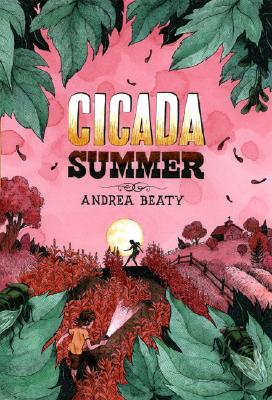
Cicada Summer

by Andrea Beatty
ages: 10+
First sentence: “Some people think the cicadas bring trouble when they come to town.”
Support your local independent bookstore: buy it there!
Review copy provided by the publisher for the Cybils (2008, I think.)

Lily is invisible. Not really, but she’s as good as: she never talks, she never looks people in the eye. She’s been shuffled off to the side in the two years since her brother Pete’s accident, which Lily feels responsible for. She’s been carrying around the guilt and as a result, has all but shut down. On the other hand, she is a grand observer, and when a new girl, Tinny, comes to town, Lily observes some pretty strange things about her. This creates a mystery, and it’s up to Lily, the silent observer, to figure everything out.

I remember throwing this one at C about a year ago, and she loved it. So much that she asked me to read it so she could talk to someone about it. (Bad mom moment. Sorry.) I agree: it’s a good, solid novel for a 10 year old girl. It’s got mystery and a little bit of suspense, and nothing is too heavy-handed (even though there is Death and Grief), which is a relief. (I do get tired of heavy handed Death and Grief books.) The resolution is nice, and Lily’s an interesting character to get to know. On top of that, it’s a summer book: sunshine, heat, water, small town. And Beatty knows how to go for mood; you can feel the summer radiating from this slim book.

A good, quick read.

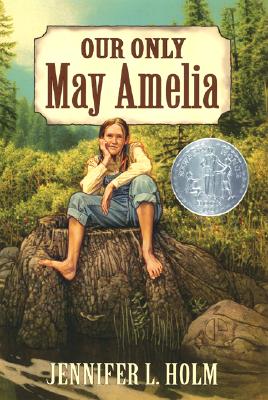
Our Only May Amelia

by Jennifer L. Holm
ages: 10+
First sentence: “My brother Wilbert tells me that I was the first ever girl born in Nasel, that I was A Miracle.”
Support your local independent bookstore: buy it there!

This one has been on my radar for years, but was never quite enough to push me to read it. However, with the buzz about the sequel — The Trouble With May Amelia — I got curious enough to pick up both of them at the library a couple weeks back.

It helps, too, that I’ve been in the mood for middle grade fiction.

May Amelia is the only girl on the Nasel river, in the middle of rural Washington, 1899. She’s twelve, has seven older brothers, and always seems to be Getting Into Trouble. She’s both A Miracle to her family and That Troublesome Girl, something which she finds terribly conflicting. All she wants to do is have adventure: go fishing, maybe hunting, and run around like her brothers, but with her Mama pregnant for the first time in a long while, much of the household work falls to May Amelia. It’s not an easy life but it’s a good one, or at least May Amelia will come to think so.

It’s not a book with a lot of plot — there is some, but to tell you what happens will spoil much of the charm of the book — but it’s one that holds your attention. It’s a grand example of voice: May Amelia’s personality comes through loud and clear, and she’s an interesting, amazing girl to get to know. She feels deeply, and lives fully, wanting to be treated the same as her brothers. Holm’s affection for the stories and the Finnish immigrants is plain in the storytelling; there’s a delightful homeyness to the book that just makes one smile, even through the tough times.

For there are tough times: Holm doesn’t sugarcoat the past at all. It’s gritty, but never so much that it’s not accessible to the middle grade audience it’s intended for. Instead, it gives an honest, yet loving, look at a homesteader’s fate, and life for a girl around the turn of the century. Both of which makes this book priceless.

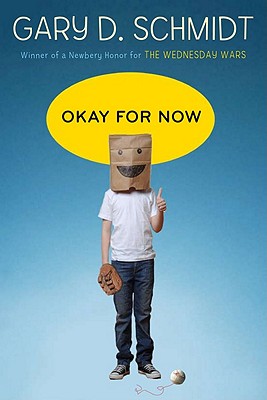
Okay for Now

by Gary Schmidt
ages: 11+
First sentence: “Joe Pepitone once gave me his New York Yankees baseball cap.”
Support your local independent bookstore: buy it there!

Doug Swieteck had a decent, if a bit rough, life. That is until his dad — because of his friend Ernie Eco — up and moves the family to “stupid” Marysville, New York for a new job. It’s 1968, and Doug’s oldest brother is off in Vietnam, and things are tight at home. It’s not easy settling in to the new town, especially since everyone has Doug and his older brother (not to mention his slacker and somewhat abusive father) pegged for hoodlums.

Things go up and down for Doug — who has one of the more personable voices I’ve read in a long time; he’s speaking directly to the reader, but only once does the whole “dear reader” thing — as he discovers James Audubon’s drawings of birds. I’ve never seen the pictures live, but from the illustrations in the book, I can see why they move Doug so fundamentally. It’s a look at how art and nature can influence our lives for the better, if one takes the time to understand it. In fact, if I had to pick a real theme of the book it would be that: people are more than the sum of their parts, and by taking the time to get to know and understand them, the world can be a better place.

The book could have teetered over into the maudlin, with issues of domestic violence and the war in Vietnam. But it never did. It stayed right on the edge of dark and heartbreaking, infused with hope and light and humor. It’s one of the most hopeful books I’ve read in a long time, and definitely one of the most perfect.

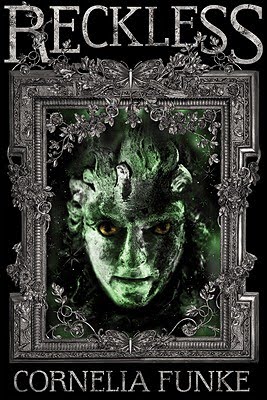
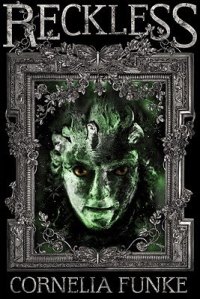
Audiobook: Reckless

by Cornelia Funke
ages: 12+
Read by Elliot Hill
Support your local independent bookstore: buy it there!

When Jacob was 11, his father disappeared. After a year of missing him, and being angry at his disappearance, Jacob enters his father’s study, and following some cryptic notes, ends up falling through a mirror into a completely different world.

Fast forward 12 years, and Jacob has made a life for himself in the Mirrorworld as a Finder for the Empress Therese of Austry. Then once (and once is all it took) his younger brother Will followed him through the mirror and was attacked by the Goyl, stone people who are at war with the humans. As a result, Will is slowly turning into the jade Goyl, cursed by the Dark Fairy to be the protector for the Goyl king.

Jacob is angry — at himself, at the fairy, at the world, at Will — and has vowed to do anything to save his brother. This leads himself, Will, Will’s girlfriend Clara (who came through the mirror after him), and a shape-shifter by the name of Fox (who’s been Jacob’s companion for years, and wishes that Jacob could realize that she’s more than just his shadow) on an interesting, dangerous and possible futile adventure across the world hoping to save Will from becoming a Goyl for good.

It’s a clever story, turning Grimm’s fairy tales upside down, weaving them through this dark tale. And don’t get me wrong, with the age of the characters and the intensity of the tale, I kept wondering why this was a middle grade novel. It’s scary. It’s intense. It’s not for the faint-of-heart. But it wasn’t until I read the review of it at Charlotte’s Library, that I realized that it really is a coming-of-age story, and not just a fairy tale. Charlotte puts it quite nicely:

Despite the ostensibly already grown-up age of the central characters, this is a book about growing-up, about how the relationships of brothers and friends, and perceptions of oneself, change in terrifying ways as adulthood is entered. Jacob might be 24 on paper, but the young man in the mirror world is more an avatar of oldness exploring a fantasy world than a convincing adult–his character is still very much that of the reckless adolescent, confused by his emotional responses to the questions posed by growing up. Although sex lurks in the background (it’s never explicitly or centrally part of the story), for Jacob it is still the hormonally charged lust of the adolescent–he has yet to learn love (oh poor Fox. I felt for her so very much).

It makes so much more sense when viewed at it this way. Though, like Charlotte, I’d be loathe to give it to the younger middle grade readers, for this isn’t of the faint of heart. And as the jacket flap warns: it’s not a happily-ever-after.

As for the medium, I think I enjoyed listening to it better (though there were times when I
wondered about who was speaking; I gather Jacob talked to himself quite a bit) than I would have reading it. Hill did an admirable job narrating as well as with the character’s voices, which helped me get into the story in a way I wouldn’t have if I’d read the print version. It also helped that I couldn’t look to the end to see if it all turned out “okay”.

Also, props to Funke for creating such an elaborate and interesting world. She, much like Rowling, has an incredible imagination and a gift for making everything pop off the page. It’s a strange book, but one that I think will stay with me for quite a while.

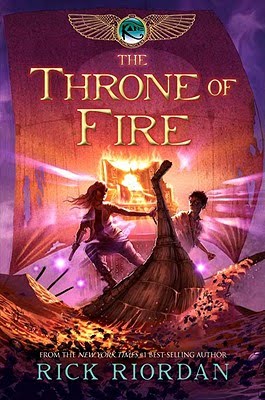
The Throne of Fire

by Rick Riordan
ages: 11+
First sentence: “Carter here.”
Support your local independent bookstore: buy it there!

When we last left our erstwhile heroes, siblings Carter and Sadie Kane, they had defeated the god Set but had realized there was a greater threat: Apophis, the god of Chaos, is rising, and if the Kanes don’t find a way to stop him, he will swallow the sun and the world as we know it will end. To do this, the Kanes need to piece together the Book of Ra — no easy task — and wake the Sun God in hopes that he can rally the gods and magicians in order to put a stop to Chaos once and for all.

It sounds like a tough job, but if anyone can do it Carter and Sadie can — with a little help from new trainees Walt and Jaz, as well as the god of dwarves, and one of my favorite characters, Bes.

A note of warning: it’s a nearly 500-page book, and the first 100 pages are glacially slow. So slow, that for the first time I can remember, I considered abandoning a Riordan book. I stuck it out: it is Rick Riordan after all, and I just didn’t believe he could write a clunker. And he didn’t. I’m going to pull out the tired rock analogy here, because it fits. This book is a huge, enormous boulder. And once it gets going, it really goes. It’s interesting, and funny, and uses magic in clever ways. I still feel like I’m missing something with not knowing my Egyptian mythology well, but for the most part I thought this book gelled better than The Red Pyramid. At the very least, while the book wraps up, it leaves for some interesting threads to be dealt with in the next novel.

There’s something for everyone: twists and turns, adventure and a wee bit of romance, magic and intrigue, humor and suspense. In the end, it’s more than worth the time it takes to get through the beginning.

Audiobook: Falling In

by Frances O’Roark Dowell
ages: 9+
Read by Jessica Almasy
Support your local independent bookstore: buy it there!

I love me some Frances O’Roark Dowell. I first discovered her a couple years ago when Shooting the Moon was nominated for a Cybils. I absolutely fell in love with her books, her writing style, her storytelling. There’s something simple about her books, and yet her stories are actually quite sophisticated, with subtle dark undertones.

This book is pretty much all that I’ve come to expect from Dowell. It was simple: the story of a somewhat neglected girl — Isabel Bean, age 10 — with an aura of the otherworldly about her. She doesn’t really have friends, and while she’s not a bad student or child, she doesn’t really seem to fit in at all. Her mother isn’t very motherly, and Isabel drowns that neglect in a sea of books, especially fairy tales.

It’s all fine and good, I suppose, until one day when Isabel hears this buzz coming from the floor of her school. She gets sent to the principal’s office (because hearing a buzz isn’t exactly normal school behavior), and on the way there gets sidetracked and fell into a closet into the nurse’s office.

Into where, you may ask?

Well, into another world. One which, in Jessica Almasy’s capable hands, was slightly British. Definitely old-fashioned, and most definitely fairy-tale-ish. With a magic, of sorts, a witch that’s terrorizing the county of five villages. Isabel has to help defeat the witch, of course, but it’s not really about that. It’s about making friends, and learning to be a friend. Simple, yet elegant.

And Almasy’s narration was spot-on. Her voice was slightly irritating to begin with, but after a while it became Isabel. And it helped that she had different voices for the characters, ones in which you could picture the character just from their voice. It’s also a book that worked better as an audio — there were lots of interruptions by the narrator, making the book more of a story to be heard rather than read. I’m not sure I would have liked it as much as I did had I read it. (Though it is Frances O’Roark Dowell.) But it was a fabulous listen.

Violet in Bloom

by Lauren Myracle
ages: 10+
First sentence: “You’re invited to a Super Fabulous Flower Power Powwow!”
Support your local independent bookstore: buy it there!
Review copy sent by the publisher

I turned around and read this one as soon as I finished Luv Ya Bunches; I really did want to see what Katie-Rose, Yasaman, Camilla and Violet were up to next. It’s the second week of school, and even though they’ve all declared themselves FFFs (flower friends forever), there’s still a few bumps that they need to iron out.

Katie-Rose is having problems because another girl, Natalia, is making the moves on Yasaman. Part of it is because of Yasaman’s idea to get rid of the Cheezy D’Lites as a snack food. Natalia wants to be a part of it, and Katie-Rose is having sharing and space issues. It’s not pretty, to say the least.

Milla like-likes Max, and is tentatively reaching out to a friendship/whatever fifth graders do with him. Until there is a Tragic Incident which threatens to derail everything. And even though the book suggests it’s about Violet, she really only plays a marginal role: she stands up for the slightly odd Cyril when he’s being picked on by the evil Modessa (of whom there is an interesting insight near the end of the book), and she faces seeing her mom in the mental hospital. I was expecting more from Violet, but it really seemed to be Katie-Rose’s book.

That said, it was still fluffy fifth-grade fun. Myracle has the age group, especially girls, down-pat, which made the characters (this is me as a mom speaking) quite delightful. And, again, she puts enough in the books to make them more timeless and less pop-culture, while maintaining the pop-culture appeal for the kids. It’s a good series.

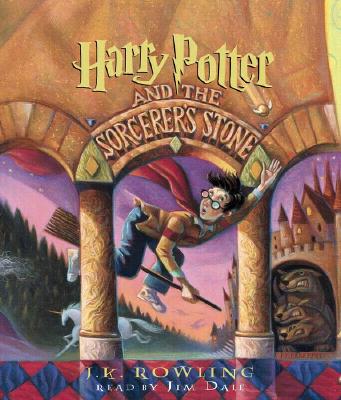
Audiobook: Harry Potter and the Sorcerer’s Stone

by J. K. Rowling
read by Jim Dale
ages: 7+
Support your local independent bookstore: buy it there!

This was A’s choice to listen to as we traveled south for spring break. She’s is a Harry Potter nut, having convinced Hubby to read the first four books out loud to her. So, of course, she wanted to listen to the books again. This wasn’t her first choice, but as K is only not-quite-five, it’s the one that I thought would work best for the family.

And since I don’t have a review of this book here — I first read it in 1999, for a book club at a children’s bookstore in DC — I thought I’d give my impressions of it, even if everyone knows about the books (and Jim Dale’s reading of it) already.

Our first impression was that Jim Dale is a grand narrator, great with suspense and nuance and voices, most of which we liked. Except Hermione. Maybe it’s because by now the movies are really ingrained in our brains, but his Hermione was a whiner. And it drove us all bonkers. Other than that, though, he managed to keep everyone straight for us (and the cast of characters is huge), and kept us engaged in the story.

And the story? It’s Harry Potter! It was nice to visit that world again; I haven’t picked up a book since finishing the seventh one several years ago. (And the movies don’t count. Not really.) I was reminded how wonderful Rowling is at world-building, and how much this one stands alone. Though I also noticed details that were picked up in the later books: the big plotlines, of course, but also little things (and dang if I can’t remember them now!). Not to mention all the little ways the book is different from the movie; C — who really didn’t read the books at all — noticed that the most, and even picked up the book when we got home, rereading several sections.

In short: it was a good book for a long road trip.

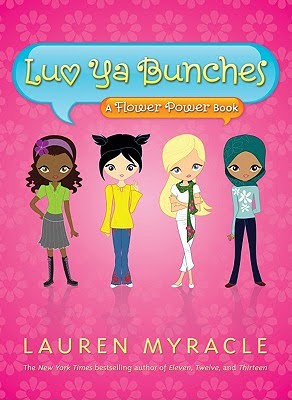
Luv Ya Bunches

by Lauren Myracle
ages: 10+
First sentence: “(Shot from Katie-Rose’s sunshine yellow video camera)”
Support your local independent bookstore: buy it there!

It’s the first day of fifth grade, and Katie-Rose is stoked. And nervous. She just really, really wants a friend. Sure, she’s got Max, but he’s a boy, and while he’s a good friend, he’s not BFF material.

Little did she know that by the end of the week, she would have not one BFF, but four. We get to know them as they figure out their budding friendship: there’s Katie-Rose, of course; but also Yasaman, Turkish Muslim, class observer, and computer wizard; Violet, the new girl with a bit of a tough secret; and Milla, former popular girl who’s trying to figure out what real friendship is. Told through alternating viewpoints, we get to see into the heads and hearts of these four girls as they bond and stand up to the class bully.

I don’t usually go in for books that are so embedded in pop culture, but to my surprise, in spite of the cover, this one wasn’t. Sure, it’s got texting and IMing and cell phones and video cameras, but Myracle does a good job balancing the pop culture with a good old-fashioned story of bullying, lying, and the meaning of friendship. I liked the girls: they were well-developed, and rang true to the whole fifth-grade mentality. The pre-teen angst, the concern about fitting in and yet wanting to be true to one’s own self. Myracle tackled all that with humor and love for the age, for the problems and for the characters. And most importantly, she doesn’t talk down to her readers: the plot is simple without being simplistic. There’s a bit of a crisis with a missing bobble-headed turtle (okay, I kind of want a bobble-headed turtle now), but for the most part it’s just about the girls.

Which is perfectly fine by me.

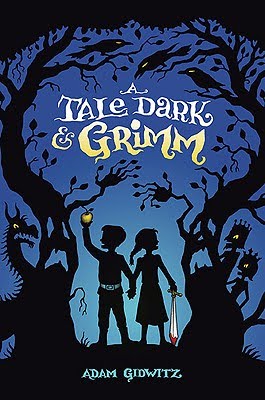
A Tale Dark and Grimm

by Adam Gidwitz
ages: 11+
First sentence: “Once upon a time, fairy tales were awesome.”
Support your local independent bookstore: buy it there!

Throughout the decades, fairy tales have been watered down. One could blame Disney, or blame the fact that we’ve come to believe that children can’t handle violence. That somehow, scary stories, stories with blood and gore are bad for them. And I’m not sure I disagree: violence for violence’s sake can be desensitizing. But the Grimm fairy tales aren’t that way. Yes, they’re scary, yes they are violent, but it seems to all have a purpose.

Adam Gidwitz doesn’t just retell a few of the more obscure Grimm tales. He takes the Hansel and Gretel story and morphs it from a weird step-mother-hate story into something more. There’s kings and queens, danger and temptation, loss and redemption, and dragons! It has everything. Which, even though sounds a bit like overkill, works. Gidwitz gave the original story depth and purpose. And yes, by keeping the tales creepy and violent and fascinating, Gidwitz embodies the original Grimm tales. It’s fascinating and wonderful.

But the best thing about the novel is the narrator. Seriously. Having an active narrator in a story like this is a tricky thing. It could have fallen flat on its face, and maybe for some people it will, because (s)he interjects with humor and explanations quite often as the story goes along. It pulls the reader out of the story, but it doesn’t pull them away from the story. It works as an interjection, because it’s not intrusive. And I think, for kids especially, it actually helps having a narrator — a storyteller, actually — looking over your shoulder, giving you information you need to not only process what’s going on, but to really enjoy it as well.

Excellent.