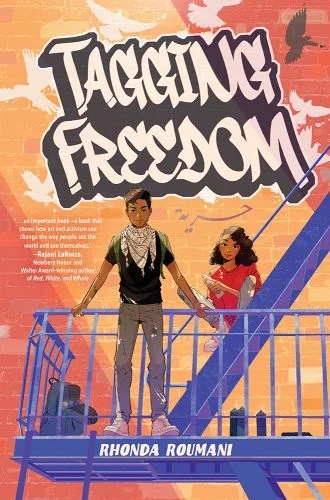
Tagging Freedom

by Rhonda Roumani
First sentence: “Kareem picked up the black spray paint and studied the sandy-colored wall.”
Support your local independent bookstore: buy it there!
Content: There is some talk of war and protests where gunfire opens up. There are also instances of microaggressions and blatant racism. It’s in the Middle Grade (grades 3-5) section of the bookstore.

Kareem is a 13-year-old in Syria in 2011, right as the protests and the civil war began. He is fired up about the abuses by his government and wants to help do something so he and his friends take to spray painting slogans and art on the buildings around Damascus. This lands him in trouble – with his parents, not the government, fortunately – and they ship him off to live with his aunt and uncle and cousin in America.

Said American cousin, Samira, is having her own problems. She wants to join the Spirit Squad, but the girl who runs it is the same girl that bullied Sam all through 4th and 5th grade. But people change, right? And it’s 7th grade now. But joing the Spirit Squad makes her end up fighting with her best friend, and when her cousin arrives, it makes everything a lot more complicated.

The most striking thing in this book is the huge juxtaposition between Kareem’s Syrian life and the way he cares deeply about his family and friends who are still being affected by the uprising and government retaliation and Samira, who is concerned with, well, #firstworldproblems. If there is anything that brings to light the huge disparity (and nonchalance) that we Americans (even children!) have with the other world, this is it. I thought Roumani handled it well – making Kareem care so deeply, you can’t help as a reader but care about what he cares about. And I liked Samira’s growth arc, and the way she shook off superficial concerns compared to the problems that Kareem and his family have.

And because it has a lot of similarities with the genocide in Gaza right now, it was that much more powerful and relevant. An excellent book.

The Apartment House on Poppy Hill

by Nina La Cour
illustrated by Sonia Albert
Support your local independent bookstore: buy it there!
First sentence: “1106 Wildflower Place was what many considered to be a perfect building, plunked right in the middle of Poppy Hill, a not entirely perfect hill but a good one all the same.”
Content: There are three sections of short chapters. It’s in the Middle Grade (grades 3-5) section of the bookstore, but I’m considering suggesting it move down to the Beginning Chapter (grades 1-2) section instead. I think it fits better there.

Ella has lived at the apartments at Poppy Hill her whole life, and she knows almost everything about her neighbors and the building. So, when newcomers Leo and Cleo move in, Ella is there to show them the ropes. The only thing she doesn’t know: much of anything about the Robinsons, the older couple who live in the topmost apartment.

Much like most beginning chapter books, this one is light on plot but leans heavily into charm and character. You meet all the neighbors through our very competent main character, Ella, and there is a very charming assortment of quirky neighbors. Eventually, in the third section, you meet the Robinsons, who are equally charming and delightful.

That’s all there is, which is fine when you’re 7. In fact, I think many seven-year-olds will really like this one.

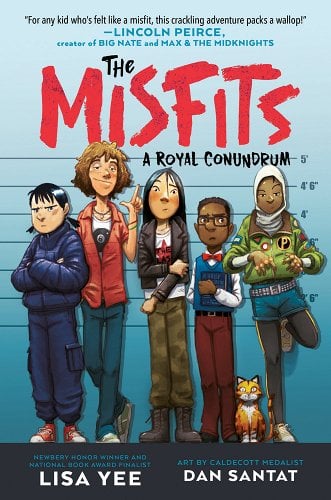
Audiobook: The Misfits

by Lisa Yee
Read by Cindy Kay
Support your local independent bookstore: buy it there!
Or listen at Libro.fm
Content: It’s a fast-paced novel, and there are illustrations in the print version. Some intense moments may be scary to sensitive readers. It’s in the Middle Grade (grades 3-5) section of the bookstore.

Olvie Coben Zang has been an outcast her entire life. Her parents are too busy to pay her much attention, she doesn’t really fit in at school, she has no friends… the works. The only person who really saw her was her grandmother, Mimi, but she has passed on. And then, out of the blue, her parents tell her that she’s being transferred to a boarding school, RASCH, a unique school for unique kids. Once there, she’s lumped in with four other outcasts – James, who’s young but has an encyclopedic knowledge of words and history; Philomena (“just call me Phil”) who is a tech genius; Iggy, who has a bit of temper but a heart of gold; and Theo (TBH, I just thought of him as the White kid). Together, they form the Misfits, as part of an experiment to train kids as spies. Their goal, in the end: Catch the Bling King and get back the infamous, super expensive necklace of the school’s founder.

This was a lot of fun. I liked the mystery (I miscalled the ending!), I liked the characters – they were fun and interesting and sometimes silly. It was well-paced; I could see a kid falling into the book and plowing through it because it’s hard to put down. And Kay, as a narrator, is excellent. She definitely keeps the pace up as well as helping with voices to keep all the numerous characters (including the adults) straight.

I thoroughly enjoyed this and am looking forward to more in the series.

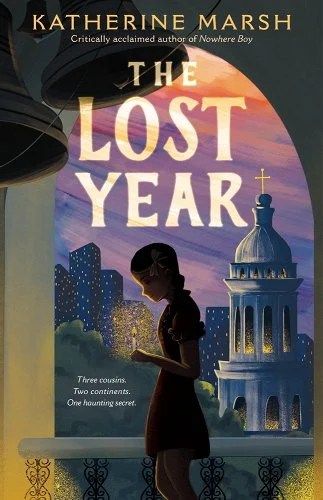
The Lost Year

by Katherine Marsh
First sentence: “Dark Beast Ganon charged.”
Support your local independent bookstore: buy it there!
Content: There is talk of starvation and the deaths of children. It’s in the YA section (grades 6-8) of the bookstore. I read this book for the Cybils, and this reflects my opinion and not that of the whole panel.

It’s spring of 2020, which means that Matthew is trapped in his home due to the COVID-19 pandemic. He’s bored out of his mind, mostly because his great-grandmother – whom they call GG – has come to live with them and his mom is super strict about not interacting with anyone because of the pandemic. He has his Switch, until his mom decides that he needs more to do than sit playing games, and tasks him with helping GG go through her stuff.

When he finds a black and white picture of her and another girl, he slowly gets GG to open up about her childhood in Ukraine and the famine that plagued the country in the early 1930s. Told in alternating voices – we hear Matthew’s story as well as Helen’s, a first-generation American immigrant – and Mila’s – the daughter of a Communist official – stories.

I really liked this one. I liked the parallels between the early days of the pandemic and the Ukranian famine of 1932/1933. I liked how Marsh made each of the three characters come alive on the page, and made the historical parts relevant to today. And even though there is conflict, as a a reader, you can see all the various perspectives. In the end, after all, we’re all just trying to survive somehow.

It’s a good story, and one I think kids who like Jennifer Nielsen or Alan Gratz will enjoy.

Skating on Mars

by Caroline Huntoon
First sentence: “Time with Katya, my figure skating coach, is in high demand.”
Support your local independent bookstore: buy it there!
Content: There is some bullying and misgendering. It’s in the Middle Grade section (graes 3-5) of the bookstore. I read this book for the Cybils, and this reflects my opinion and not that of the whole panel.

All Mars wants to do is skate. They feel the most at home on the ice, especially since their dad’s death. But, things off the ice aren’t simple: they haven’t come out to their family as nonbinary, their best friend is making new friends that aren’t terribly accepting of Mars, and they might have a crush on a girl at the skating rink. It’s a lot for a 12-year-old to handle. And when they decide to skate in the men’s division of a competition, that makes everything they thought they were holding in come spilling out.

I liked this one a lot! I liked the portrayal of Mars as an enby kid, and the way it was expressed. I liked that their mom was supportive, once she found out, and all the conflit and drama was centered around figure skating and the binary way the sport is structured. I liked the relationships Mars had, and the realistic ups and downs they went through. And I never felt like Huntoon was simplifying or dumbig thigns down for the audience.

A solid story, good for both people who love to skate and for those who want a book from a nonbinary perspective.

Dear Brother

by Alison McGhee, Illustrated by Tuan Nini
First sentence: “Dear Brother, I am writing this note of apology from my room, where I have been sent to spend the rest of my life for referring to you as America’s FAmous Nothing.”
Support your local independent bookstore: buy it there!
Content: It’s got lots of illustrations and not too many words It’s in the Middle Grade section (grades 3-5) of the bookstore. I read this book for the Cybils, and this reflects my opinion and not that of the whole panel.

Sister is tired of being the younger sibling. She never gets anything: attention, her way, her desires. Brother is the one who gets what he wants, like a bearded dragon as a pet instead of a dog; or getting to go to sleep away music camp. But Sister learns that maybe a bearded dragon (and Brother) aren’t so bad, and Brother learns that maybe his little sister is okay as well.

This one was… fine. It bothered me that the characters didn’t have names besides “sister” and “brother”; I’m sure it was to make them feel universal, but I just felt like it was stupid. (I suppose I have a thing about calling people by their names..) I did like the Lessons Learned, but there wasn’t much else to the book besides learning lessons. The illustrations were good – it borders on being a graphic novel, but not quite – but there wasn’t much else to it.

I’m sure there is a 3rd grader out there for whom this is their favorite book, and I don’t want to take that away from them. It’s just not for me.

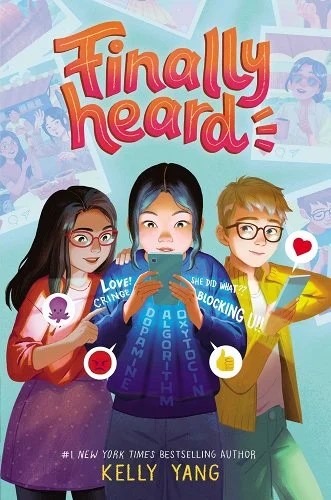
Finally Seen

by Kelly Yang
First sentence: “I listen to the quiet hum of the plane and the not-so-quiet flutter of my heart in my chest.”
Support your local independent bookstore: buy it there!
Content: There is bullying and microaggressions both by other children and adults. It’s in the Middle Grade (grades 3-5) section of the bookstore. I read this book for the Cybils, and this reflects my opinion and not that of the whole panel.

Lina Gao has lived with her grandmother in China for the past five years while her parents and younger sister start a new life in America. She has missed her family but loved her time with her grandmother. But now, her parents have sent for her. She is racked with guilt for leaving her grandmother to go live in a retirement home, but excited to start a new life in America. Unfortunately, it’s not all happiness and roses. She can’t speak English well, so starting a new school is difficult for her. Her parents and sister have a bond that she isn’t part of. And then there’s her parents’ financial situation: back rent from the pandemic is due and her father’s boss at the organic farm is pretty sketchy.

Through the ups and downs of Lina’s life, she gains some friends, helps her parents figure out their finances, and figures out how to navigate her school. And in the end, she feels like maybe she can make a place for herself in her new life.

I liked this one. Reading the author’s note, it seems that some of this reflects Yang’s experience, which makes it that much more interesting. It’s a good immigrant story and a good reminder that everyone wants the best life they can have. Several white adults (mostly men) came off pretty bad in this – they were bullies and racist towards Lina and her family. (One of them – the father of a friend of Lina’s did start to learn and change…) This is a good reminder of how adults tend to use and abuse their power. I like the portrayal of the immigrant story, and I think it’s definitely an important book to have on shelves.

Sincerely Sicily

by Taika Burgess
First sentence: “Demanding to see the email only shows me how real this all is.”
Support your local independent bookstore: buy it there!
Content: There is bullying and microaggressions. It’s in the Middle Grade (grades 3-5) section of the bookstore. I read this book for the Cybils, and this reflects my opinion and not that of the whole panel.

Sicily is upset: for her 6th grade year she is going to a new school, away from all her friends. She doesn’t want to, but she doesn’t have a choice. It’s made worse by the fact that there isn’t many non-white kids at her school. It’s made worse because she is a Black Panamanian – and the kids at school don’t understand that heritage. Then there’s her Abuela, who is critical of Sicily’s box braids, calling them “low class”. Sicily just feels picked on from all sides. How will she ever figure out this new school?

I liked this one a lot. I liked that Burgess focused on the Black Panamanian heritage, but also that she gave Sicily some friend problems as well as a new crush. It made the book well-rounded, capturing every part of Sicily’s journey. I also learned quite a bit about Panama and the heritage of Black people there, which I also liked. It was a really good book!

We the Sea Turtles

by Michelle Kadarusman
First sentence: “In 2003, a leatherback turtle traveled from a remote island chain in Indonesia to the Oregon coast in the western United States of America.”
Support your local independent bookstore: buy it there!
Review copy provided by the publisher.
Content: The chapters are short, and pretty easy to comprehend I read this book for the Cybils, and this reflects my opinion and not that of the whole panel.

This book is a series of short stories connected because they are all set on islands, with mentions of turtles. They are all environmental in nature, either with concerns about climate change or how to better live on the land. They range around the world – from children in Canada and the US to Indonesia and Australia. The stories were pretty simple, most only a few pages long. I liked that there was a book addressing the environmental concerns of children this age, though I do wish the stories were longer and delved more deeply into the issues that were brought up. I liked the diversity in the book, and I did appreciate that most chapters had a land acknowledgment before them. I just wish there was more to it.

Tethered to Other Stars

by Elisa Stone Leahy
First sentence: “Wendy and Tom sat on the plastic-wrapped sofa in the middle of the sidewalk and stared up at the crooked house.”
Support your local independent bookstore: buy it there!
Content: There is bullying and name calling and both racist microagressions as well as racist behavior. It’s in the Middle Grades (grades 3-5) section of the bookstore.I read this book for the Cybils, and this reflects my opinion and not that of the whole panel.

Wendy’s family used to live in a bustling Latine neighborhood of their Ohio town, one where there were lots of families like hers. But then La Migra – ICE – started taking more and more people; parents would disappear, families gone overnight. And Wendy’s parents became unnerved. So they found the cheapest fixer-upper in a nearby town, one that was more white, in hopes that La Migra would leave them alone. Because, while Wendy’s dad was adopted by an American relative when he was little, and Wendy and Tom were born in America, Wendy’s mom has a green card, and maybe that’s not quite enough for ICE. The best thing is to keep their heads down and not make any waves.

Except, at Wendy’s new, mostly white, school for gifted student, she’s finding it hard to keep her head down. She make friends with a Black girl, K. K.; and a Muslim one, Yasmin; and the daughter of a white pastor who is giving sanctuary to a woman whom ICE is trying to deport. And when their little group becomes targets for the richer, whiter kids in school, things get, well, a bit messy.

It sounds like a lot, and it is, but Leahy makes it work. Wendy is the first-generation daughter of immigrant parents, and Leahy weaves that in. She weaves in treating those who are looking for a new, better home in America humanely. She weaves in STEM – Wendy is fascinated with space and astronomy and wants to be an astrophysicist. And she weaves in the real ways in which white kids absorb the opinons and actions of their parents. You can tell what kind of parents the kids have by the way their kids treat those not like them.

It’s a good book with a good heart, and some tense moments. And in the end, I loved how everyone grew, learned, and changed for the better.