Spy School

by Stuart Gibbs
ages:10+
First sentence: “‘Hello, Ben,’ said the man in my living room.”
Support your local independent bookstore: buy it there!

Ben is basically your average kid. He goes to a regular school, is a regular loser, and aside from being a math whiz, there’s really nothing special about him.

So, it’s to his surprise when Alexander Hamilton, of the CIA, shows up at his house, inviting Ben to join this super-secret, super-exclusive spy-in-training school.

Well, who wouldn’t jump at the chance?

 Except, once he gets to spy school, Ben realizes that things aren’t exactly what they seem. Sure, he makes some friends, develops a crush on a super-hot 3rd year girl (who also happens to be a great spy), but it turns out that he’s well, a fall-guy. And there’s a mole in the school. And people are out to kill Ben.

The question is: will he survive long enough to find out who?

I hoped this one would be all the fun of Belly Up and maybe more. I mean: espionage, a cool cover, a spy school, and a mystery? What could go wrong?

Well…. it’s not that it went wrong, it’s more that it just didn’t go right enough. Ben was a bit of a wash as a main character; it’s not that I never connected with him, it’s just that Erica — his crush, and the one who makes the plot move — so outshines Ben that it’s hard to really connect with him. I felt like he was the loser sidekick for most of the book (sure, he comes through in the end), which is okay, but not what I was expecting. On the other hand, Gibbs never really quite got the fish-out-of-water thing quite right either.

Still, the mystery is solid, and while the Big Reveal comes a little out of left field, there are enough clues that perhaps someone who was paying better attention than I could figure it out.

It was a decent second effort; I just wish is was more.

The Phantom Tollbooth

by Norton Juster
ages: 10+
First sentence: “There was once a boy named Milo who didn’t know what to do with himself — not just sometimes, but always.”
Support your local independent bookstore: buy it there!

I missed this one as a kid. I don’t know how; it seems like it would have been the perfect one for a pretentious reader like myself. But, for whatever reason, I didn’t first encounter the Tollbooth until I was married, and Hubby (who loved the book as a kid) introduced it to me. I bought it early on in our marriage for him (we own the 35th anniversary edition), read it, loved it, and didn’t pick it up again.

So, when I was asked by a friend to review it for her website (she’s working me through a bunch of Middle Grade classics), I was excited to pick it up again, especially since I didn’t remember it well enough to write a lengthy review.

The story, if you haven’t read this yet, is about a boy named Milo, who is constantly and persistently bored. One day, he comes home from school to find a tollbooth with instructions: “Easily assembled at home, and for use by those who have never traveled in the lands beyond.” Curious, he assembles it, gets in his little car, and heads off to have Adventures. He visits lands, meets an actual “watchdog”, rescues princesses, and makes it home in time for dinner.  (And it was still hot?)

This book is has clever coming out of it in spades. So much so, that I think, even though it’s geared towards middle grade kids, the older you are, the more you get out of it. While it can work as a adventure book, if you know about “jumping to conclusions”, if you have a grasp of idioms, if you get the whole double meanings of our language, you’ll get just how wonderfully clever this book is.

It’s also surprised me just how didactic it is. Juster has a Moral Hammer (“Knowledge is good. Boredom is bad. Get out there and Observe the World with all its Wonders.”) and he pounds. it. over. your. head. But, honestly? You don’t mind. Because it’s fun. It’s clever. It’s interesting. It’s amusing. And yeah, maybe you’ll even get the moral in the end (it’s pretty dang hard to miss), and Do Something About It.

Even if you don’t, it’s a ingenious middle grade book. And definitely worth reading.

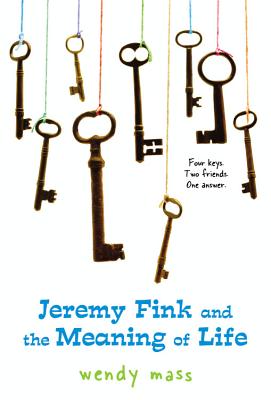
Jeremy Fink and the Meaning of Life

by Wendy Mass
ages: 10+
First sentence: “My sweat smells like peanut butter.”
Support your local independent bookstore: buy it there!
Review copy won in a contest sponsored by the publisher (I think.)

Things you need to know:
1. Jeremy Fink is nearly 13 years old and Lizzie is his best friend, NOT girlfriend. (It’s hard to be romantic about someone whose diapers your mother changed.)

2. His father died five years ago, at the age of 39. A fortune teller in Atlantic City told him he wouldn’t live past 40.

3. He has received a box, from his dad, that has “The Meaning of Life” on it. Only problem: it needs four keys to open, and all are missing. He’s supposed to open this box on his 13th birthday.

4. Which means that Jeremy and Lizzie have exactly a month to find the keys. In New York City.

Sounds impossible, or at least improbable, and it is. But what comes out of their searching is a sweet, funny, touching story about a boy learning about what life Really Means. The most wonderful thing about this book is that it’s insightful and not preachy, yet full of good Lessons. I adore Wendy Mass for exactly this reason. It’s a gem.

Postcards from Pismo

by Michael Scotto
ages: 8-10
First sentence: “Dear Soldier, I’ll bet you weren’t expecting a letter from me, were you?” 
Support your local independent bookstore: buy it there!
Review copy provided by the author.

It started out as a school assignment. Felix, in fourth grade, was supposed to write to a soldier in Afghanistan. What he never expected was for the soldier — Lieutenant Marcus Greene — to write back. Thus begins a 7-month correspondence in which we, as readers, learn a lot about Felix — about his life in Pismo Beach, California, his family, and his concerns — and a little about life as an active duty military member.

The thing I liked best about this book was that it really, truly was written for a beginning chapter book crowd. It’s simple, easy to read, but it’s not simplistic. Felix deals with a lot of issues in a way a 10-year-old would: he has kids who pick on him, but instead of confronting them, he avoids them. He idolizes his older brother, Quin, and when Quin decides to join the Army National Guard to earn money for college, Felix takes his concerns to Lt. Greene. He is a curious kid, and Scotto finds a way for us to learn a bit about Marcus and his life without having Marcus be a direct character: we never see the letters and emails from Marcus to Felix. And when Marcus goes missing, not answering his emails, Felix freaks out in a way only 10-year-olds can.

It’s a good, non-depressing way to give kids a glimpse into the military and to address concerns of leaving and fighting and standing up for oneself.

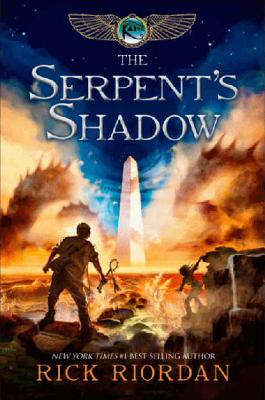
The Serpent’s Shadow

by Rick Riordan
ages: 11+
First sentence: “Sadie Kane here.”
Support your local independent bookstore: buy it there!
Others in the series: The Red Pyramid, The Throne of Fire

It’s the end of the world. Seriously. Apophis is rising and is going to swallow the sun, sending the whole world into Chaos. And the gods, from the dotty old man Ra down to Carter and Sadie Kane’s father in the underworld, are powerless to stop it.

Which means, saving the world is up to a 12- and 14-year-old.  Can they trust the dead, somewhat evil, ghost magician and go through with their certifiably insane plan? And if they do, will it actually work? (And in the meantime, can they figure out their love lives?)

I’m not sure that I have anything original to say about this one, that I haven’t said about the other two in the series. It’s still a fun adventure, and Carter and Sadie are still acting way older than their age (though Riordan deftly acknowledges this: he has a throw away line about how kids who channel gods and are technically orphans tend to act older). I still think the whole channeling gods thing is weird, though, again, Riordan deals with this in a clever way, addressing the readers’ concerns through the voice of Sadie.  It’s not as funny as the Olympus books, but there are moments of laughter. I do have to admit, that Riordan ended the series well. There are a few loose ends, so he could revisit Carter and Sadie if he wanted to (including a vague reference to joining up with “other gods”, which should make Percy fans happy), but this story is complete.  (And he managed without an overlong epilogue telling us where Carter and Sadie are in 20 years!)

It’s not my favorite series, or even my favorite of Riordan’s work, but it’s a good solid one, that should appeal to those fascinated by Egypt and Egyptian mythology.

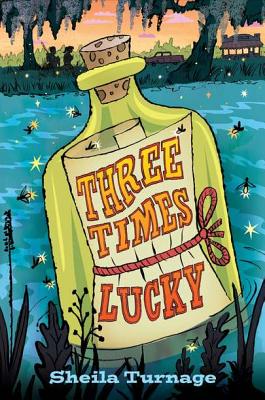
Three Times Lucky

by Shelia Turnage
ages: 9+
First sentence: “Trouble cruised into Tupelo Landing at exactly seven minutes past noon on Wednesday, the third of June, flashing a gold badge and driving a Chevy Impala the color of dirt.”
Support your local independent bookstore: buy it there!
Review copy provided by the publisher.

It was all just being in the wrong place at the wrong time. See, Mo (that’s short for Moses; and yes, she is a girl) LoBeau’s (emphasis on the second syllable because it classes it up) friend Dale (Earnheart Junior III) just wanted to borrow Mr. Jesse’s boat, and then decided to return it for a “finders fee.” It wasn’t Dale’s fault Mr. Jesse turned up dead.

Honest.

(It has occurred to me that I’ve read a number of middle grade books with dead people recently. Must be a trend…)

From there, of course, Mr. Jesse’s murder (It’s not grisly, at all. Promise.) turns the tiny, rural, North Carolina town of Tupelo Landing upside down. And Mo and Dale are smack dab in the middle of it. To clear Dale’s name, they set out trying to solve the mystery, and are thwarted at every turn by Detective Joe Starr, the adult who’s (really) working the case. Mo and Dale keep at it, though, because the whole case somehow seems to involve the Colonel and Miss Lana, the two people to whom Mo, an orphan, is closest.
Honestly: I’ve read my share of Southern novels, and so I figured it was just another run-of-the-mill, murder-mystery-light/Southern thing. But I couldn’t put it this book down. In addition to murder, this book has everything: drama, car racing, suspense, plucky kids, arch-enemies, robbery, unrequited love, and karate.  It’s everything Southern, but the pecan pie. (And I’m sure that would have shown up, had the book been set at Thanksgiving instead of during the summer.) There’s a little something for everyone here, which makes any book appealing.

But the real reason to fall in love with this book — as I did — is because Turnage has created a wonderful couple of characters in Mo (“My heart leaped like the cheerleader I will never be.”) and Dale (“Dale may not know much from the classroom, but his recess skills are legendary.”). In fact, all the characters, from Miss Lana (“I passed the wigs to Miss Lana, completing her Hollywood Through the Ages collection. Miss Lana has a flair for drama.”) and the Colonel (“Miss Lana says hugging the Colonel’s like hugging a turning plow.”), down to Mayor Little (“We always choose a Little for mayor in case a television crew ever comes to town. Littles like to talk and they’re naturally neat; even their babies dress good.”) and aspiring lawyer Skeeter (“Rumor has it she’s already written to Matchbook University for a paralegal course under an assumed name. She won’t say if that’s true or false, only that unsubstantiated rumor won’t hold up in court.”) pop off the page, and it’s entirely because of the way Turnage writes.

It’s also the small-town, rural Southern feel: kids biking everywhere, technology limited because coverage is spotty, rusted cars on lawns. It’s a place caught out of time, perfect for two kids to have the adventure of a summer. And perhaps to learn a little bit about themselves, and the meaning of family, in the process.

For us, it means an perfectly charming book. Period.

Searching for Dragons

by Patricia C. Wrede
ages 9+
First sentence: “The King of the Enchanted Forest was twenty years old and lived in a rambling, scrambling, mixed-up castle somewhere near the center of his domain.”
Support your local independent bookstore: buy it there!
Others in the series: Dealing with Dragons

The King of the Enchanted Forest, Mendenbar, doesn’t really appreciate messes. (Especially ones made by wizards.) So, when he finds a patch of his forest dead — completely void of magic and life — he’s not only annoyed, but also a bit curious. How on earth did that happen? Especially since there’s dragon scales lying around the area. That sends him off to see the King of the Dragons, Kazul, but only finds her princess, Cimorene, setting off to find Kazul, who has been missing for several days.

From there, Mendenbar and Cimorene set off on an adventure to find Kazul (and stop those pesky wizards), that will take them all over the Mountains of Morning, meeting giants, dwarves, and a theoretical magician before they will figure it all out (and rescue Kazul) in the end.

I remember listening to this one on audio years and years ago (I didn’t write a review), and I remember thoroughly enjoying it then. That hasn’t changed. I thoroughly enjoyed reading it aloud to A. Mendenbar and Cimorene are such engaging, fun, witty characters, and Wrede does a fantastic job weaving in fairy tales throughout her original story. It was a lot of fun to read for both A and me.

On to the next book!

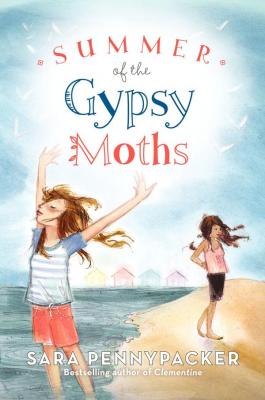
Summer of the Gypsy Moths

by Sara Pennypacker
ages: 9+
First sentence: “The earth spins at a thousand miles an hour.”
Support your local independent library: buy it there!

Stella hasn’t had an easy life. She’s currently living with her Great-aunt Louise, because since her grandmother died, she and her mother have been wandering aimless, practically homeless, from city to city until the government finally stepped in and separated the two of them.

Now, she and Louise — and another foster child, Angel — are hitting it off in their little house on Cape Cod, readying for the summer season with the gardening and the vacationers in the four little cottages they manage.

That is, until Louise dies.

(That’s not a spoiler: it happens in the first chapter.)

Stella and Angel panic: if they call people to come and take Louise away, then the same people, the ones who put them in the foster-care system in the first place, will take them away, send them to homes that might not be so nice. So the two of them make a pact: they’ll bury Louise in the back yard and run the cottages as if Louise were just injured and unable to help out, take the money they get as tips and save it until they have enough to go somewhere.

It’s all quite vague — very much the way 12-year-olds would think — and they don’t do everything perfectly. Thankfully, even though it’s one of those “bad mother” books, it doesn’t ever seem either overly desperate and sad or overly implausible. Because of her situation with her mother, Stella is more grown up than she otherwise would be, and is able to take charge, with the help of Heloise’s advice columns. Granted, I’m not sure two 12-year-old girls could go four weeks (which is how long they end up faking everyone out) without someone noticing that the responsible adult is never around, but somehow they do. But, as a consequence: they end up going hungry because there isn’t a grocery store nearby, and they don’t have money for them anyway. It’s a small thing, but it’s a nice touch.

I’ve been trying to pinpoint what I liked about this book. The lying got to me, of course; as did the far-fetched situation. But, in the end, I liked it for its simplicity, I think. Pennypacker’s writing is simple and direct without being simplistic or pandering, which is part of the reason I like her Clementine books. It holds true for this: Stella and Angel are opposites, but they learn to work together. Problems are solved. Ocean is enjoyed. There are moments of loneliness and hardship, but it’s never overly dramatic. It’s got that classic feel, without being old-fashioned.

The other thing I liked was that it was a true middle grade novel: there had to be bad parents and dead great-aunts so that the two girls could learn to shine and grow and learn and develop. It’s a humble adventure, but it’s still an adventure: learning that they really do need people to take care of them, and what the meaning of home and friendship are.

In the end, even with the drawbacks, it’s a sweet little summer read. And proof that Pennypacker can write middle grade novels as well as beginning chapter books. Both good reasons to pick this one up.

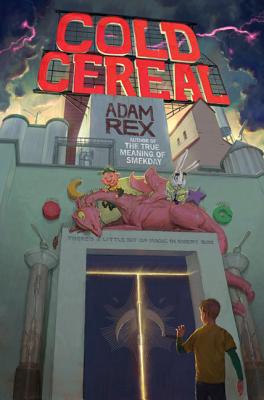
Cold Cereal

by Adam Rex
ages: 10+
First sentence: “In the busy airport, baggage turned slowly on a carousel.”
Support your local independent bookstore: buy it there!

First off: this book has the most amazing jacket flap copy. Seriously. One of the best I’ve seen in a long time.

Scott Doe — aka Scottish Play Doe — has just moved to Goodborough, New Jersey, because his mother has just gotten a job at the cereal company: Goodco. They’ve been wanderers since his father (John Doe, ha!) left when Scott was six, and event though Scott’s moved a bunch, that doesn’t make starting at a new school any easier. Then he starts seeing things: a rabbit man, a unicat (a cat with a horn, of course), a small, cranky man. All of a sudden, what was typical is atypical.

Throw in the twins: brilliant Emily Utz and her brother (even though he’s dark-skinned and she’s not…) Erno Utz, who live with their foster father who has a tendency to give them riddle quizzes, pitting them against each other; a giant named Biggs, and a secret organization called the Freemen, and you’ve got one weird book.

But then, isn’t that what Adam Rex is known for?

On the one hand, this book is all sorts of weird. Rex takes sugared cereal, evil corporations, and mixes them with magical beings and gives us a concoction that, by the end, doesn’t really make a whole lot of sense. There are twists and turns and turns and twists and possibly a plot in there somewhere. (There has to be: I noticed that Rex left threads dangling, so there had to have been a plot…) It was confusing, and at some point, I stopped caring if I actually understood what was going on, and just let it wash over me.

Because it was hilarious. I’m not sure how many of the jokes kids would get, but I loved it. The fact that the rabbit-man was a pooka named Harvey. The references to Lucky Charms, Trix, Sugar Crisp. The fact that Sir Reggie Dwight punched the Queen of England in the face (funnier than it sounds). The advertisements. Scott’s name. That the Arthurian legend came into play. This segment:

“SHUT UP! OR YOU KNOW WHAT’S GOING TO HAPPEN? LET ME TELL YOU WHAT IS GOING TO HAPPEN –”

They never got to hear what he thoguht was going to happen, though in all liklihood he would ahve gotten it wrong. “My partner and I are going to be run over by a rabbit driving a Citroen” just isn’t the sort of thing that occurs to most people, no matter what kind of life they’ve led.

So, yeah. It’s weird. It’s confusing. But it’s hilarious. Bring on the sequel.

Remarkable

by Lizzie K. Foley
ages: 9+
First sentence: “High on the top of a majestic mountain, in a spot where every view of the valley below was more breathtaking than the next, was a small town called Remarkable.”
Support your local independent bookstore: buy it there!
Review copy provided by the publisher.

I have to admit up front that any book with the title “Remarkable” has the decks stacked up against it. Because to be remarkable, you have to be so much better than good, you have to be, well… remarkable.

And so it helps that this one, at least in my opinion, is using the word somewhat ironically. See, in a town full of remarkably talented, amazing, wondrous people, ten-year-old Jane Doe is just average. Plain, not especially talented in anything, she goes through life in the shadow of her remarkably talented architect mother, best-seller novelist father, supremely talented painter (of photorealistic portraits) brother, and math genius sister. That’s not even mentioning her grandmother, the mayor. The only person in town who even comes close to Jane in plainness is her grandpa, who people generally seem to forget is there.

From that premise, however, things get both really weird and yet never quite develop in ways that I wanted them to. There’s something about a bell tower and pirates and the sea monster in the lake and a jam feud with the next town and evil genius twins, but it all kind of just seemed like it was a hamster on a wheel: spinning in circles, but never really going anywhere.

I wanted it to be more ironic, more of a parody (it was, to an extent, but not far enough for my tastes), but most of all, I wanted Jane to do something. I wanted her to be a hero, to discover that she was remarkable, in some little way. (You know have the reverse happen: since everyone is remarkable, only those who aren’t labeled as such really are?) Or maybe for everyone else in the town to discover that being remarkable was overrated, and stop discriminating against unremarkable people. But, it just kind of petered out by the end, which I found disappointing.

That said, C really enjoyed reading this one, so maybe it’s a case of me not being the right audience for the book. Which is not really remarkable at all.