Prophecy

by Ellen Oh
ages: 10+
First sentence: “People feared Kira.”
Support your local independent bookstore: buy it there!

In the seven kingdoms on this peninsula, there are two problems: first is the force of the Yamato nation to the south: greedy and powerful, they are looking to conquer the nations to the north. Second, is trickier: the demons who kill and then possess people, infiltrating armies and families in order to take over the world.

While Kira, even though she’s the daughter of the Hansong kingdom general and niece to its queen, can’t do much about the first problem, she’s the only defense the people have against the second. She can sense — through smell and sight — demons, knowing exactly whom to attack and how to kill them. Except, the only people who know truly what she does are her father and the king. The rest of the populace think she’s some sort of demon herself, ostracizing her.

Then the unthinkable happens: a traitor kills the royal family, and lets in the Yamato soldiers (and a few demons). Kira, her brother, a trusted monk, and some loyal soldiers are on the run, solely responsible for the young prince’s safety. She’s lost her parents in the attack, she’s on the run, she’s responsible for her cousin, and on top of that, there’s this Prophecy about the Dragon Musado that’s hanging over everyone’s head. What’s a girl to do.

I have to give props to Oh for creating a brilliant world. I liked the Korean influence in the world, from the land through to the various Korean words (with a glossary!) sprinkled throughout. I thought she handled the whole prophecy thing pretty well; it wasn’t a Chosen One exactly, and because the prophecy was old enough and vague enough, there wasn’t a set List of Hoops she had to jump through over the course of the story. I did like her family loyalty, and the fact that her parents believed in her capabilities. (Which is why, sadly, they had to go.)

However, the book fell flat for me. Some of it was the writing: too much telling (“Kira hid her disappointment.” “Kira was puzzled.” “She pondered her father’s words, profoundly affected by his confidence in her.”) and not nearly enough showing. Which made the book choppy. Especially choppy was the attempt at romance. Kira’s been betrothed to a horrid man, and she doesn’t like him. But he goes around preening that she will love him, and that he can’t wait to get married. All the while, she’s developing a friendship with another young man, and it’s a nice enough relationship, until Kira starts having “feelings” that she doesn’t know what to do with. It’s not enough to make this uninteresting to a MG reader, but it is enough to wonder why Oh felt it necessary to include. The story was fine without it.

So, it’s a mixed bag. While I am happy there’s a Korean-inspired fantasy out there, I’m not sure this was enough to make me interested in keeping up on the series.

The Runaway King

by Jennifer Nielsen
ages: 10+
First sentence: “I had arrived early for my own assassination.”
Support your local independent bookstore: buy it there!
Others in the series: The False Prince
ARC brought back from ABA Winter Institute for me by my co-workers.

Obviously, there will be spoilers for The False Prince. If you haven’t read that yet, you should. 

Sage — now King Jaron — has had a month to settle into his new life. To be frank about it: it’s not going well. His regents don’t really like or trust him (the feeling’s mutual), he’s not really getting along with the princess he’s supposed to marry, and his chief captain is not exactly helpful. Things just come to a head on the night of his family’s funeral with a (failed) assassination attempt  by the pirates.

Which leaves Jaron — who is convinced war is coming, even if his regents refuse to see it — with one option: go to the pirates and deal with them head-on.

And, because he’s Sage, that means things won’t go exactly as planned. (Not that there was a plan to begin with, mind you.)

I didn’t reread The False Prince first, so I was a little worried I wouldn’t remember enough to keep up with this story. Thankfully, that wasn’t the case: I immediately fell back into Neilsen’s world was thoroughly taken with Jaron/Sage’s story. There’s a lot of action and adventure here as Jaron tries to keep his kingdom from thoroughly collapsing, from the thief camp to the pirate camp and back again. One of the things I liked most about this was the way Nielsen kept Sage/Jaron’s personality pretty much the same (from what I remembered) as in the False Prince, enabling the book to have a sense of levity to it, while giving him the weight necessary to be a good ruler. (Yes, he still reminds me of Gen.)

On the other hand, there is also a lot of posturing by the minor characters (how many times to they have to say “Don’t do that” before they realize he’s just NOT going to listen!), not to mention all the growling of the Big Baddies. (Especially the pirate king. He was just a bit too stereotypical thuggish.) And I do have to admit that Roden’s motivations weren’t always consistent or clear, both of  which did get a wee bit annoying.

But not enough for me to dislike the book. For the most part, I found myself immersed in the book, not willing to put it down, wanting to know just how Jaron was going to make everything work for him.

Almost Home

by Joan Bauer
ages: 10+
First sentence: “Mr. Bennett walked into room 212 carrying a plastic bag.”
Support your local independent bookstore: buy it there!

Having been on a Middle Grade Fiction Round 1 Cybils panel a few times, I am quite familiar with dead moms, absent moms, crazy moms, overbearing moms, controlling moms, and all sorts of other bad moms. Kids have had to deal with homelessness, with abuse, with death. Which they usually do with varying degrees of success.

But never before have I read a character with so much down-to-earth pluck and good-natured spirit as I have in Sugar Mae Cole.

Her father — she calls him Mr. Leeland — is a gambler, and comes with pretty much all that baggage that that entails. He’s taken out loans against the house, gotten involved with less-than-respectable characters, and is absent more than he is home. Sugar’s been basically raised by her mother, Reba, and her grandfather, King Cole (pretty awesome name if you ask me). But, King died a year back, and it’s been increasingly more difficult for Reba and Sugar to make ends meet. Until they don’t anymore, and the lose the house.

The bounce around from living with family to living in a shelter while Reba tries to find a job. Then she gets a sort-of lead on a job in Chicago, so on a whim the two of them head up there. Things — of course — don’t go the way they are supposed to, and Reba has a mental breakdown. Sugar is shuffled off into foster care, and Reba’s in an institution while they figure out the best way to rebuild their lives.

I should mention the dog on the cover: his name is Shush and he’s adorable. He’s more a metaphor than an actual character: he’s been abused by a previous owner, and is insecure about his place in the world. But, through love and acceptance, Sugar helps him gain the confidence he needs to be a courageous dog. Which is a parallel to Sugar’s experience: she has a difficult time trusting, but through a loving foster family and an amazing teacher, she blossoms.

As I said to begin with, this novel rests squarely on Sugar’s shoulders, and she carries it superbly.

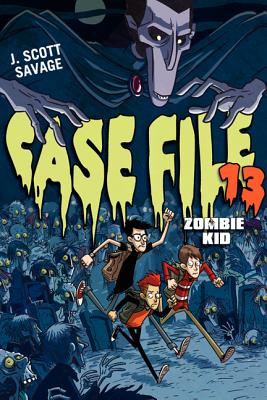
Case File 13: Zombie Kid

by J. Scott Savage
ages: 9+
First sentence: “Please relax and make yourself comfortable.”
Support your local independent bookstore: buy it there!
Review copy provided by the author.

There are two things you should know about Nick, Carter, and Angelo. One: they are inseparable. Two: they love Halloween. This Halloween’s a bust, though, because Nick has been spirited off to the Bayous of Louisiana in order to go to the funeral of a great-aunt he’s never met.

Who might possibly have been a voodoo witch.

So when Nick finds an amulet in a crypt (at midnight), you should expect weird things to happen, right? How about turning into a zombie? At first it’s cool — who wouldn’t want to be a zombie, right? — but Nick and friends eventually end up racing against the clock before Nick ends up undead permanently.

On the one hand, this is a fun, silly, horror-lite story. It’s just about my speed when it comes to zombies (I just don’t do the undead), and I kind of liked both Nick and Co’s reaction to the zombifying. Very 10-year-old reaction. And the chapter titles –“Do Not Try This Part at Home” and “This Chapter is Where Things Really Start to Get Weird” — totally killed me. Oh, and I liked the increasingly decaying cartoon of the boy at the beginning of each chapter.

But, the more I read the less I liked it.  From the narrator that bookends the story (unnecessary) to the snotty girls that were supposed to compete with Nick and Co (pointless; why have them, if all they’re going to do is get in the way?) to the mildly weird and kind of confusing ending (huh? Where’d HE come from?), it’s internal logic (as Sondy would put it) just didn’t hold up for me.

Then again, I’m not 9. So it may just be me.

Twelve Kinds of Ice

by Ellen Byran Obed, Illustrated by Barbara McClintock
ages: 8+
First sentence: “The first ice came on the sheep pails in the  barn — a skim of ice so thin that it broke when we touched it.”
Support your local independent bookstore: buy it there!

There are some books where you can write pages and pages about them. There are other books when one word can sum up everything you read.

Charming.

It’s not really a story, it’s a catalog of winter memories. The progression of winter through ice, from the first crack of ice through building a rink in the backyard, to the melting that comes with spring. The illustrations are lovely, the prose spare, and the result: charming.

It made me miss a real winter, the winters I remember from my childhood (though I’m not sure I’ve ever had a winter like they get in Maine). And it made me wistful that my children don’t get those kind of deep winters that make for good ice here in Kansas.

In short: charming.

Number the Stars

by Lois Lowry
ages: 9+
First sentence: “I’ll race you to the corner, Ellen!”
Support your local independent bookstore: buy it there!

I read this a long time ago, but only wrote this little review about it:  “A compelling story about a Danish family during the Nazi resistance and how they help save their Jewish neighbors. Made me proud to have Danish ancestors. (Though, admittedly, none were there in 1943.)”

While I had much of the same reaction upon rereading, I was struck with how simple this book was.

It’s the story of a Danish family in 1943. The Nazis have taken over Denmark, and the Johansens — Father, Mother, daughters Annemarie and Kirstie (their older sister Lise died a couple years before) — is learning to adapt. It’s not fun, it’s not easy, but they’re stalwart and determined. Then, one night, the rabbis warned their congregations that the Nazis were coming for them. That includes the Johansens’ neighbors and good friends, the Rosens. It falls to the Johansens to help the Rosens escape to Sweden.

I think the best part of the book is that it’s based on a true story. The Danish really did help the Jews escape the Nazis. There really were courageous people who sacrificed their safety to help their friends.

But the story itself was… simplistic. I know Lowry was writing for middle grade readers, but there lacked a complexity that even the best middle grade readers have. It was straightforward, matter-of-fact, and lacked a depth that I had hoped for.

It’s not that I didn’t enjoy the book; I did. It’s just that there are better WWII books out there. Even though, as a Dane, I do appreciate having this story told.

Navigating Early

by Clare Vanderpool
ages: 10+
First sentence: “If I’d know what there was to know about Early Auden, that strangest of boys, I might have been scared off, or at least kept my distance like all the others.”
Support your local independent bookstore: buy it there!
Review copy provided by my place of employment.
Additional disclaimer: I’ve chatted with the author on numerous occasions when she’s stopped into Watermark.

It’s 1945, and Jack Baker’s father has come back to Kansas from serving in World War II. Except, he came home to a son he doesn’t recognize and a wife who recently died. So, he packs up the house and tows Jack up to Maine to attend a boarding school near the Naval station where he’s based.

None of this sits well with Jack.  He’s a Kansas boy, through and through: loving the wide-open spaces, the sky, the heat, the wheat fields. And so Maine, especially Maine in the fall, throws him for a loop. Not to mention that he’s lost his anchor — his mother — and he’s adrift in the sea of boys and New England customs (like rowing), that are completely foreign to him.

Until he meets Early Auden, a boy who only listens to Billie Holiday when it rains; who lives in the school basement and only comes to class when he feels like it; and — most amazingly — has all the digits of pi memorized, seeing colors, patterns, and stories in the numbers. It’s all overwhelming for Jack; he really has no idea how to deal with everything. Until fall break, when Early leads Jack on an adventure, both literal and metaphorical, to find something that neither boy thought they were looking for.

It’s an evocative novel, one which explores loss and belonging, of being uprooted and searching for a place to fit.  To be honest, everything I said about Moon Over Manifest works here as well: even though the novel isn’t set in Kansas, Jack’s love for his home state comes through loud and clear. (And after 6 1/2 years here, I’m beginning to see what it is to love about being here.) But, Vanderpool also creates a sense of the Maine wilderness, of the early- to mid-fall glory of the woods, of tramping around in the rain. I enjoyed the juxtaposition of the two climates.

In fact, the thing I enjoyed most about the novel was the way Vanderpool juxtaposed elements: Kansas and Maine; the death of a mother with the death of a brother; Early and Jack’s story with that of Pi’s (pi the number becomes Pi the character in Early’s mind; the numbers tell his story.); the various characters Early and Jack meet on their journey. It kept me interested throughout, wondering how everything would weave together in the end.

Actually, the end was probably my least favorite part: while it came to a conclusion, I felt something was, not quite fitting together. It doesn’t have a happily-ever-after bow — something I appreciated — but it didn’t quite sit well with me either.

But that’s a small quibble in an otherwise excellent book.

The Second Life of Abigail Walker

by Frances O’Roark Dowell
ages: 9+
First sentence: “The fox had been stepping into stories since the beginning of time.”
Support your local independent bookstore: buy it there!

Sixth grade has not been the best for Abigail Walker. Her best friend recently moved away, and she’s been caught up in a group of mean-ish girls because her mother wants Abby to be friends with them. In addition, her parents (especially her dad) are always on her case about eating, since she’s a bit more overweight than they’d like her to be. Between these two things, all Abby wants to do is hide in her closet and eat candy bars.

I’m going to interject here:  I want to give this one to parents. Just so they can see the effect their comments have on their children. The parents in this one earn a great big huge OY, PEOPLE. I want to smack them.

Anyway. Abby starts frequenting the field across the street from her house, and discovers a fox, which bites her (not hard). She also meets a boy, Anders, and his father who is recovering from PTSD from his tour in Iraq. Between Helping Anders with his dad and the fox, Abby begins branching out, discovering a strength in her to make new friends and to begin to stand up to her parents.

Aside from the whole parent-issue thingy, this was just an okay book. Abby is dealing with lots of issues, and I was glad to see her being to make things right. For a while, I was thinking O’Roark Dowell would wrap everything up in a nice bow, and I was quite glad she didn’t. (I should trust her more; she rarely steers me wrong.) The only real misstep in this one was the fox; I was never quite sure why the fox really needed to be there. It seemed like it belonged in a different book, one that was wholly an animal fantasy, rather than a middle grade issue-oriented book.

But aside from the fox, it was a sweet story about a girl who’s trying to figure out who she really is in the face of everyone’s expectations.

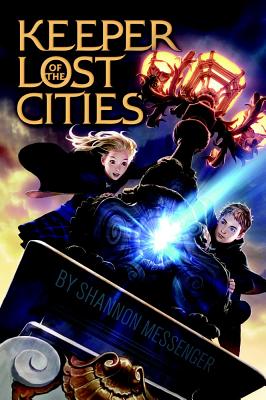
Keeper of the Lost Cities

by Shannon Messenger
ages: 10+
First sentence: “Blurry, fractured memories swam through Sophie’s mind, but she couldn’t piece them together.”
Support your local independent bookstore: buy it there!

A young boy girl is raised among humans, never knowing that he’s she’s not one of them. He She manifests some special abilities, but mostly what he she does is lay low, living with his her family, knowing somehow that he’s she’s different than they are. Then on his eleventh birthday a school field trip soon after she turns twelve, he she is found by an emissary of the different world, gaining a glimpse into his her real future: that of the wizards elves. As he’s she’s introduced to this world by a soon-to-become good friend, he she learns that his place in the world is a unique one: that of the Chosen One Keeper. (Possibly; it’s not really clear.) He She is sent off to Hogwarts Foxfire, the wizard boarding school elf nobility school, where he she makes friends, endears himself herself to some teacher and offends others, shows incredible abilities in certain areas, gains a mentor, and ends up breaking a lot of rules. He She succeeds in thwarting the evil that he she faces in the end, but it’s only a temporary fix. How can he she, a mere boy girl, save this world?

If you haven’t figured it out by now, my main problem with this one — that I started with high hopes: a separate world with elves! Cool! (And, no, that’s not a train on the cover. I thought it was) — was, that by about halfway through, I realized it was Too Much Harry Potter Knockoff, and not enough cool elves doing cool, unique, elvy things. I thought that Messenger had a cool idea for the world, but in the end, just wasn’t able to pull it off as well as I’d hoped.

That, and  I realized that halfway through, at 488 pages, this was Much Too Long. All of which makes me kind of sad.

(Just for the record: because this is a Cybils nominee, I’ve been asked to make sure y’all know this is my opinion only, and not that of the panel.)

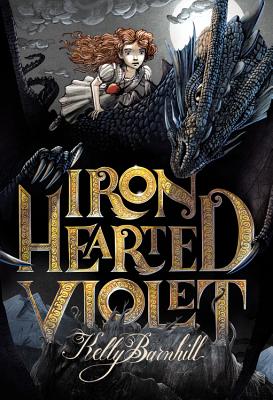
Iron Hearted Violet

by Kelly Barnhill
ages: 10+
First sentence: “The end of my world began with a story.”
Support your local independent bookstore: buy it there!

Princess Violet is not beautiful. In fact, she is the furthest thing from it. But, she is gregarious, intelligent, and well-loved by all. She isn’t entirely satisfied by this arrangement: she thinks she’d much rather be beautiful than anything else. So, when the 13th God, the Nybbas, starts whispering in her ear, making promises to Violet, she’s willing to risk the entire mirrored world for beauty.

Or, so she thinks.

That’s about as far as I got. It’s not a bad premise, though the illustrations don’t do Violet’s deformities justice, but the execution drove me batty. Generally, I have no problems with intrusive narrators (I liked A Tale Dark and Grimm and the Incorrigibles of Ashton Place books, after all), but this one drove me batty. First of all, the narrator is an actual character in the story, and an adult one at that. And the story is written in first person. All of which doesn’t add up to me. Who is the main character? Violet. Then why is this storyteller guy (who calls me “my dear” all the time, too!) telling the story?

Sad to say, even though I think that this book has a good moral (be accepting of yourself, and you may change the world), I never got past the annoying narrator to get to that point.

(Just for the record: because this is a Cybils nominee, I’ve been asked to make sure y’all know this is my opinion only, and not that of the panel.)