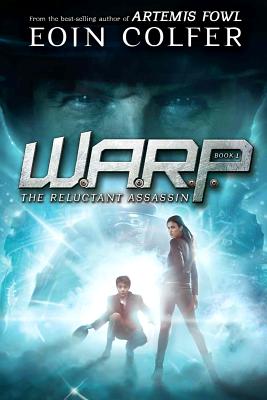
The Reluctant Assassin (W.A.R.P. 1)

by Eoin Colfer
ages: 12+
First sentence: “There were two smudges in the shadows between the grandfather clock and the velvet drapes.”
Support your local independent bookstore: buy it there!
Review copy provided by the publisher through the bookstore.

Chevron Savano is a 17-year-old FBI junior agent, stuck in London as a reassignment after an undercover debacle in Los Angeles. She’s basically babysitting this weird pod with an agent who calls himself Agent Orange. It’s all very odd and extremely boring. That is, until one day the pod shakes and shivers and a boy from the past comes through. It turns out that the pod is actually a time machine with a link to Victorian London (as part of an experimental FBI witness relocation program) and the scientist who invented it was just murdered.

Riley is the assistant to former magician and current assassin for hire Albert Garrick. He’s not a willing assistant: he owes Garrick his life, but is becoming increasingly disillusioned about Garrick and his, well, we’ll call them sensibilities. Riley lives his live in constant terror: Garrick is evil at his core and he has a sense of ownership for Riley that is positively creepy. And so, when Riley activates the wormhole (with the death of the scientist) and slides through., Garrick does the only thing possible: kills the FBI cleanup team, and heads through the wormhole. With one addition: his consciousness merges with that of Agent Orange, effectively making Garrick a supervillian. Riley and Chevron are both on the run from Garrick and determined to stop him from completely destroying the fabric of time.

On the one hand, Colfer –whose work has been hit-and-miss for me over the years — really knows how to pile on the action. It’s non-stop! It’s one thing after another, but I never felt it was too over the top. It all made sense to me. Also: I thoroughly enjoyed both Chevie and Riley as characters. They complimented each other — which could have been a tricky thing considering they are from two different centuries — and Colfer played each to his or her strength. Additionally, Garrick is a great villain: creepy and evil to the core.

In fact, my only real complaint is the same as Ms. Yingling: for a book the publishers are marketing for 10+, there is an awfully high body count. Garrick has absolutely no qualms about murdering anyone and everyone, which means that there is someone being offed (and sometimes more than one) quite often. I know there are other dark middle grade books out there (the Harry Potter series and Graveyard Book are two that come to mind), but there is a casualness about the killing in this one that is a little, well, creepy.

Aside from that, however, it’s a gripping read. Oh, and Eoin Colfer’s going to be at Watermark on Wednesday! If you’re in town, stop by. It should be fun!

Here Where the Sunbeams Are Green

by Helen Phillips
ages: 10+
First sentence: “So here we are in this shaky little airplane high above the jungle which is kind of (very) scary.”
Support your local independent bookstore: buy it there!

Madeline (only her family and close friends call her Mad) and Ruby (Roo, to her older sister) are sisters whose father is the Bird Guy: he will go anywhere to study birds. So, when he gets invited to Central America to track a bird that has supposedly been extinct, he jumps at the chance.

He was only supposed to be gone a month. But 10 months later, he still hasn’t returned, and there’s this guy, Ken, from the corporation La Lava, who keeps hanging around. And there are what Mad calls “the Creepies”: feelings that they’re being watched. And, finally, the Very Weird Letter from their dad to Roo. All of this prompts the girls and their mother to head down to La Lava in search of their father. But little do they realize the complicated mess they’re walking into, or their role in helping their dad escape.

I have mixed feelings on this one. On the one hand, the present tense bugged me (it always does), but there also felt like there was something off. Perhaps it was because it was written in present tense, and the reader figures things out along with Mad and Roo. Perhaps it was because our main character (in my opinion) is the least interesting person in the book. Perhaps it was this weird mix between science and “magic” (anything magical was explained away by science, yet sometimes the coincidences were a bit… much).  It was never enough for me to want to put the book down, but it was enough for me to not entirely embrace it, either.

That said, by the end, Phillips had won me over (albeit tentatively) to her world, and I wasn’t sorry I put in the effort to get there.

The Different Girl

by Gordon Dahlquist
ages: 11+
First sentence: “My name is Veronika.”
Support your local independent bookstore: buy it there!

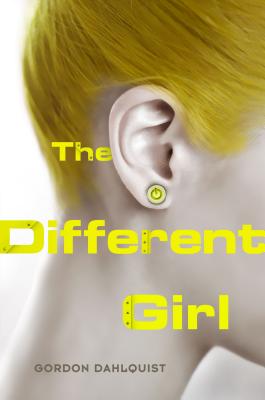
On this island there are four girls — Veronika, Isobel, Eleanor, and Caroline — who are exactly alike. Same size, same weight, same temperament. They tell each other apart by their hair: Isobel’s is yellow, Caroline’s is brown, Eleanor’s is black, and Veronika’s is red. They’ve been on this island as long as they can remember with their teachers Irene and Robbert.

I’m going to make an aside here and mention that one of the things that truly fascinated me about this book was the puzzle that it presented. Dahlquist doesn’t come out and say that these four girls are some sort of robot. Or that this world is some sort of dystopian place. Rather, he put clues — a click behind the ear when the girls go to sleep; an aversion to water; how their hair has to be in the sun — throughout the book in order to give us a sense of how these girls view themselves.

Especially once May — a real, live girl — is shipwrecked on their island. She brings with her questions, ones that Veronika, our narrator, can’t answer. And when an outside ship comes to the island, it’s up to May and the four girls to figure out how to keep safe.

It takes a really unique premise to get me hooked these days, especially when it’s a dystopian/apocalyptic world. And this one did it. I loved the robot narrator, I loved the questions that the book presented, I loved that the world was implied but never fully explained. I loved the science fiction elements of the story, but also how very human it was. I don’t know if kids would “get” it the way I did; there’s a lot of room for confusion, but also a lot for discussion.

I think this is one that will stay with me for a while.

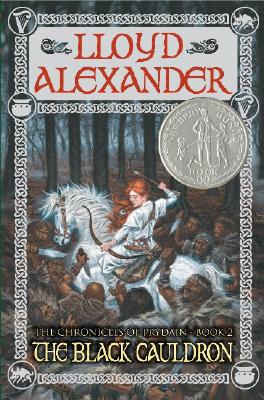
Audiobook: The Black Cauldron

by Lloyd Alexander
read by James Langton
ages: 7+
Support your local independent bookstore: buy it there!
Others in the series: The Book of Three

I picked this up because I thought the kids would want to listen to it (and they didn’t have Book of Three) on our recent vacation. But, when we put it in, there was much complaining and whining. And a couple of the kids, after listening to the first disc, said they were lost and confused. I guess after Harry Potter, even the simplest of books are boring. Either that, or The Black Cauldron starts out  too slow, and there are too many characters to keep straight. Which does make sense.

The plot is simply this: Taran is still the Assistant Pig Keeper at Caer Dallben, even though he’s fresh from his journey with Gwydion. He’s basically content (though he still longs to do things “men” do), but that changes when Gwydion shows up with a bunch of other lords and military men to hold a council. Their agenda: going after Arawn’s black cauldron and destroy it so that he doesn’t make any more of his undead cauldron born soldiers.

Sounds easy enough: go into Annuvin, get the cauldron, and get out. Except it isn’t that easy: someone has already come in and gotten the cauldron, and now it’s missing. So, the band — including Taran and his faithful friends, Fflewder Fflam (the reader actually said it “Flewdur Flam”! And here I was thinking it was some weird Welsh pronunciation), Princess Eilonwy, and Gurgi — splits up, and sets out looking for the cauldron.

Taran and his bunch get saddled with the most annoying character in the book: Ellidyr. He’s the worst kind of character: and annoying, proud, brat who thinks he’s too good for everything. I wanted to smack him whenever he came around.

Which brings me to the narration. I actually liked the was Langton read the book — he gave Eilonwy a slight Scottish accent, which suited her nicely (and she wasn’t terribly whiny, either), and he made other characters suitably menacing.  And while I thought his Gurgi was off at the beginning, the way Langton portrayed him grew on me over the course of the book.

One more thing: as I listened to the story, it occurred to me just how much Alexander drew on Tolkein’s world to create this little series of books. It’s not just the similarities in names or the magic, but the whole feel of the book. The quest that Taran has to go on. The fact that he’s mostly reactive rather than proactive (much like Frodo). The Big Evil Bad Guy lurking in the background with the Lesser Evil Bad Guy that they have to deal with immediately. It’s not a bad thing that this book felt a lot like Lord of the Rings. It’s just an observation.

I remember these books being some of my favorites as a kid. And while I’m not sure I ever found them brilliant, this one, at least, is still a good, entertaining adventure tale.

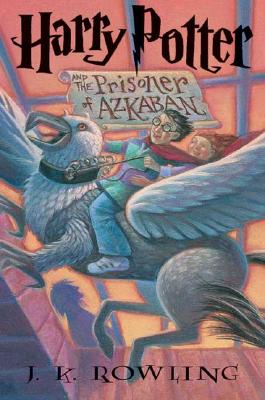
Audiobook: Harry Potter and the Prisoner of Azkaban

by J. K. Rowling
read by Jim Dale
ages: 9+ (Listening 6+)
Support your local independent bookstore: buy it there!

I could have sworn I had a review of Prisoner of Azkaban on here, but I only found a smallish blurb about the whole series here. But, I guess, I read this before the blog, and I haven’t gotten around to a reread until now.

The reason for picking this particular Harry Potter? Well, we went to the Wizarding World of Harry Potter for our family vacation a couple of weeks ago, and figured since we were going there, we needed to read a Harry Potter book. And since this is the next one in the series for K to read (her dad’s read her one and two), that’s where we started.

My thoughts, since everyone knows the plot already:

Out of all the books, this one is one of the tightest, I think. As they go on, they become more meandering and Rowling tries to pack so much in.

That said, at the end, when Sirius and Lupin confront Peter Pettigrew, there is an awful lot of monologuing. I know that Rowling needs to give us a whole bunch of information that existed before the story even started, but still. It slows the story down.

I really, really dislike the way Jim Dale reads Hermione. She’s a capable, smart girl, and every time she opens her mouth, Dale makes her sound like a whiny brat.

I adore Lupin as a character. That is all.

Hubby and I got into a discussion about adult figures in middle grade books. It was started because we realized that Dumbledore is a Really Bad Headmaster. He’s terrible at his job. Don’t get me wrong: I adore the character, but think about it: he’s neglectful, he’s bad at enforcing rules, and he plays favorites like no other. But then, if  Dumbledore were good at his job, there wouldn’t have been a story.

I think the lack of Voldemort in the story actually helps the book. It’s not as Dark and Foreboding as some of the others. 

It’s still one of my favorites of the Harry Potter series.

And I’d really like — for comparison’s sake — to hear the Stephen Fry audio versions. I wonder if he can do Hermione any better.

Timmy Failure: Mistakes Were Made

by Stephan Pastis
ages: 9+
First sentence: “It’s harder to drive a polar bear into somebody’s living room than you’d think.”
Support your local independent bookstore: buy it there!
Review copy provided by the publisher.

Timmy Failure is the founder, president, and CEO of Total Failure, Inc. Detective Agency (“We won’t fail, despite what the names says”), the only other employee being his pet polar bear, Total. (Hence the name. Total insisted.) They haven’t had many cases, but as long as his friend Rollo or The Evil One (her name is Corrina Corrina) don’t interfere (they’re always interfering), he just knows he’ll become Famous. He’s got the brains for it.

Except… well… Let’s just say that The Diary of a Wimpy Kid made dorks loveable. And in some ways, this buys into the whole loveable dork thing. Timmy is full of bravado, but it’s not loveable dork as much as Completely Clueless and Delusional.

See — and I’m not sure kids will get this while reading it —  but there’s an undertone (I’m not quite sure it’s intentional or not) of pure Pathetic here. Timmy’s younger than Greg is (9 or so), and his litany of things going wrong is long. He’s failing school, because he doesn’t want to work. He has to move into an apartment because his mother (his father isn’t explained: Divorce? Death?) can’t hold onto the house. His mother is dating someone he really doesn’t like. He’s no good at catching things. He obsesses over Corrina Corrina. He’s friends with a polar bear, but you’re never quite sure if it’s real or if it’s imaginary. I felt bad for the kid.

 But, I do have to admit that I laughed sometimes. Sometimes, Timmy was funny in his pathetic delusions. And Pastis does capture those delusions quite well with his text and art. In fact, my favorite thing about this was the drawings. If you’re at all familiar with Pearls Before Swine, then you’ll know what to expect. More often than not, the illustrations are what made me laugh.

I’m not quite sure how kids are going to react to this, or if they’re going to eat this up the way they do Diary of a Wimpy Kid.  I was kind of lukewarm about it all, but maybe that’s because I’m an adult. I’m curious to read the next volume, though, just to see where Pastis takes Timmy’s story.

Rump

The True Story of Rumpelstiltskin
by Liesl Shurtliff
ages: 9+
First sentence: “My mother named me after a cow’s rear end.”
Support your local independent bookstore: buy it there!
Review copy provided by my place of employment.

Rump lives in the Village on the Mountain in the Kingdom, a place where there are two surefire things: names have power (which is why they don’t name living things), and the king loves his gold. The second is vital to the Village’s survival: it’s their duty to find gold in the Mountain for the king. Except their supply is dwindling. The first is Rump’s curse, or so he feels: he’s only got half a name. He doesn’t really believe his mother — who died shortly after giving birth — only meant to name him Rump. But as to what the rest of the name is, he has no clue.

Then: his grandmother dies, and Rump’s slowly starving because he’s too sad to work. That, and the miller — who’s in charge of the rations — is becoming stingier. Then, one night, he finds his mother’s old spinning wheel, and Rump discovers something: he can spin straw into gold.

If you’re familiar with the fairy tale at all, you pretty much know what’s going to happen next. Except, Shurtliff does some fun, fresh things with the tale while staying true to the basic story arc. The most unique, I think, is the idea of a “rumple” — magic that catches a person in it’s tethers — and a “stiltskin” — powerful magic that can break the rumple. I liked how she played with the name of the fairy tale character, giving it meaning, which also fit into the world she had built.

Shurtliff made this into a journey story as well: in order for Rump to figure out his own True Name, he has to leave the Village and travel to Yonder and Beyond in order to figure things out. On his way he meets several other characters that were clever and endearing, most notably: the trolls, who find magic items and hide them from humans; and his three aunts, who weave and spin marvelous things.

It’s a tight, clever little book, one that captures what’s best about middle grade fantasy (indeed: I picked this one up because both C and A raved about it, and I thought it sounded delightful), and what we love about fairy tales.

Jinx

by Sage Blackwood
ages: 9+
First sentence: “In the Urwald you grow up fast or not at all.”
Support your local independent bookstore: buy it there!

The setting: the Urwald, a forest of no uncertain danger. There are trolls, werewolves, witches, and wizards out there and no one — NO ONE — left the Path unless they were asking for trouble. Needless to say, there is magic here. The Urwald has no king, and belongs to no country, in spite of what the two neighboring kingdoms seem to think.

The main character: Jinx, a boy who lives in one of the clearings, being raised by his stepparents (mother died; dad remarried; dad died; stepmother remarried), who don’t particularly want him. So, his stepfather takes him off the path, presumably to leave him there. Except they run into Simon, a wizard of some power. He’s not as Powerful (or Evil) as the Bonemaster (whom, everyone knows, sucks your soul out with a straw), but he’s powerful enough to stop Jinx’s stepdad and take Jinx as a sort of serving boy/apprentice.

The other characters: One of the most delightful things about this enchanting novel were the characters. There is the mysterious, yet somehow comforting, Simon and his spitfire wife, Sophie. There’s the cackling witch (I swear I could hear her) Dame Glammer, who traveled by butter churn. There were the friends (of sorts) that Jinx met when he finally (not that I minded the set up; it was so cleverly imagined) got around to Questing, Reven (whose curse was that he could not say who he was) and Elfwyn (whose curse is that she always has to tell the Truth). And then there was the Urwald itself, written in such a way to be a character in itself.

It’s not an action-packed page-turner of a middle grade fantasy, and I appreciated that. It was a slow reveal, a world to revel in, characters to enjoy a journey with. And if there’s a sequel, I will happily follow Jinx through whatever adventure he has next.

Two Middle Grade Verse Books

I read these two back to back while getting my hair done a while ago. And since they were so similar in style and tone, I figured I needed to review them together.

Eva of the Farm
by: Dia Calhoun
ages: 9+
First sentence: “On top of the hill, I lean against the deer fence and write a poem in the sky.”
Support your local independent bookstore: buy it there!

Twelve-year-old Eva lives on her family farm in Eastern Washington. For the most part, she’s been happy, but tough times have hit the area, and things are Changing for her. Her best friend’s family lost their farm and had to move to Seattle, and they’ve grown apart in the months since. And since finding out her family’s finances — not to mention the mounting medical bills from her younger brother’s illness — were more than precarious, Eva’s been trying to find ways to help, to find Hope in her life again.

For the most part, the book is a lovely verse novel. I liked that Calhoun tackled the plight of small farmers, and how hard it is to keep the small family farm going in this era of Big Farm. I enjoyed the imagery, and I especially liked the relationship Eva has with the Bead Woman, and the things about Hope and Love she learns. The thing that didn’t work for me was the poetry within the poetry. See, Eva’s a poet, and her poetry played a big role. But I almost felt like it was overkill: to have a novel in verse, and then throw in extra poetry. It just didn’t work for me. (And, yes, I skipped all the poems.)

But, otherwise, it’s a lovely little book.

Looking For Me
by: Betsy R. Rosenthal
ages: 9+
First sentence: “I’m just plain Edith.”
Support your local independent bookstore: buy it there!

This one is a slim historical book about a large Jewish family in Baltimore based on the author’s mother’s life. Edith is number four in a family of 12 children, growing up during the Depression. Her father is remote, trying to make ends Follow my blog with Bloglovinmeet running a diner. Edith doesn’t really know who she is: she’s always being bossed around by her older siblings and being expected to take care of her younger ones. She doesn’t think she’s the brightest person (she doesn’t know all the big words, and she can’t spell terribly well). But she has a good heart.
 
While enjoyable, Looking for Me lacked the emotional punch that I wanted from this story. Maybe it had something to do with the form — though usually, verse novels don’t turn me off — but, I wanted more from this one. There’s a death that wracks the family, but I felt… nothing. I wanted to feel pain and hurt, and hope when Edith began recovering, but I was kept at a distance by the novel, and I found that ultimately disappointing. Also, while she got the business and crowdedness of a big family, she missed, somehow, the deep friendship and love that exists in a family that large.

It wasn’t bad, but it wasn’t brilliant either.

Follow my blog with Bloglovin

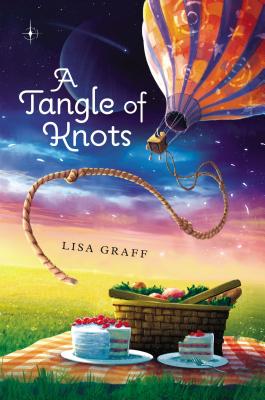
A Tangle of Knots

by Lisa Graff
ages: 9+
First sentence: “The line for the number 36 bus out of Hattiesburg, Mississippi, was the longest at the station.”
Support your local independent bookstore: buy it there!

In this town, in this reality, there are people who have Talent. A special ability to be good at something — matching orphans to families, for example; or spitting perfectly; or getting lost; or tying knots. Or like Cady: baking the perfect cake for the perfect person.

Ten-year-old Cady has been with Miss Mallory’s Home for Lost Girls longer than anyone else. Mostly because even though Miss Mallory’s Talent is for matching people, she hasn’t quite yet found the right  match for Cady. So, they spend their time together, Miss Mallory matching people and Cady baking cakes that are just exactly perfect for people. That is, until a series of coincidences (or are they?) set things in motion that result in a lost boy, a perfect match for Cady, six St. Anthony’s suitcases, a perfect peanut butter recipe, and a disastrous baking competition.

On the one hand, Graff’s book is sweet and magical. The huge cast are all, for the most part, charming and likeable, doing delightfully quirky things. I also have to admit a soft spot for books that involve food, and this one does not disappoint on that level. There are recipes to try, and yummy cakes to read about.

That said, I feel like I’ve read this story before. I’m not quite sure where or which one, but I couldn’t shake the feeling that I have experienced this story before. Maybe not with the exact sequence of events, but an girl with a talent to bake, a baking contest, a giant in a gray suit somewhat channeling events, the happily-ever-after? It was all very, very familiar. That, and I just didn’t feel like the conflict — the grumpy Owner who was lurking in the background — was enough to counteract the fluff. It felt like a dinner of cake and ice cream, which is all fine and good, but lacks the substance necessary to make a filling meal.

It’s not that it was a bad book; it wasn’t. It just was… unsatisfying. Which made me a little sad.