Lord and Lady Bunny — Almost Royalty

by Polly Horvath
First sentence: “It was summer on Hornby Island.”
Support your local independent bookstore: buy it there!
Others in the series: Mr. and Mrs. Bunny — Detectives Extraordinaire
Content: The only thing I can think of is that some of the vocabulary (like synchronicity or textured soy protein or materialized) might make it challenging for younger readers. It’s in the middle grade (grades 3-5th) section of the bookstore.

Fresh off their last adventure, both Mr. and Mrs. Bunny and their human friend Madeline are finding life a little boring. Madeline’s still stressing about money (thanks to her parents’ — Flo and Mildred — lack of foresight), and most especially about a college fund. Mr. and Mrs. Bunny are back to squabbling and comparing themselves to their uppity neighbor Mrs. Treaclebunny. But never fear: adventure is in the cards. Flo and Mildred discover they’ve inherited a candy shop in a small English village and Mr. and Mrs. Bunny decide to head to England on vacation. Of course they meet up on the cruise ship ride to England from Victoria, Canada (implausible, I know  — but some of the funniest scenes are on the cruise ship), and of course madcap farce ensues.

I don’t know if it was my mood, but I didn’t find this one as funny as the first. Maybe it was because it was very much the same thing over again, and not being New and Fresh, it wasn’t as enjoyable. But I also think it was because there was a lack of a consolidated conflict. In the first book Madelline and the Bunnys had to save Madeline’s parents from the bad foxes. This time, they were just going across the ocean and puttering about England trying to raise money. Not as, well, interesting in my book.

Though there were some brilliant moments. My favorites was the often-repeated aside that went like this:
“American?”
“No. Canadian.” When would they learn to tell the difference?

I laughed every time.

I was also amused at the meta part where Mrs. Bunny ended up at a book signing that the “translator” of the first book was at. Because, well, the humans think the translator is making things up, and Mr. and Mrs. Bunny don’t exist. It was pretty amusing.

But, in the end, it didn’t tickle my funny bone the way the first one did.
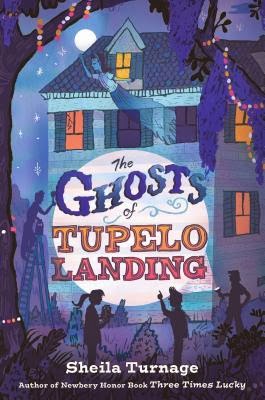
Ghosts of Tupelo Landing

by Sheila Turnage
First sentence: “Desperado Detective Agency’s second big case snuck up on Dale and me at the end of summer, dressed in the happy-go-lucky colors and excitement of an auction.”
Support your local independent bookstore: buy it there!
Others in the series: Three Times Lucky
Content: There may be a few instances of mild swearing (but I really don’t think so), and some talk of abuse, and another (potential) murder. But it really is innocent and happily belongs in the middle grade (3-5th grade) section of the bookstore.

Every once in a while, a series of books captures my fancy so completely that I fall head-over-heels in love with the characters. The Casson family books are that way. As is My Most Excellent Year. I’m adding the Tupelo Landing books to that list. I adore the town, even with all its quirks, and the people in it. I want to live next door and enjoy them every day.

This installment picks up as the school year is starting, and Mo and Dale are about to enter sixth grade. This is a good time as any: one of the amazing things about this book is that while it is a sequel, it really does stand on its own. Turnage works in the story from Three Times Lucky as you go along, in ways — like press releases or newspaper clippings or just dropped comments — that don’t stop the narration of the current story. It was lovely to get a refresher while being immediately immersed in the new story.

The case that the Desperado Detective Agency is working on this time is a good old-fashioned Haunting. Miss Lana and Grandmother Miss Lacy bought the old inn at an auction, mostly because they didn’t like the look of the “city” woman (whom Mo less-than-affectionately calls “Rat Face”) who was bidding on the property. They didn’t want her to come in, tear the dilapidated inn down, and put up condos in place. Unfortunately, buying an inn to renovate and then renovating it — especially when there’s a bona fide ghost lurking about — are two different things.

Mo and Dale get involved because of a history assignment. They’re supposed to interview one of the town “elders”, and Mo’s nemesis, Anna (whom Mo less-than-affectionately calls “Attila”) nabs Grandmother Miss Lacy first. So, Mo — in a fit of pique — says they’re going to interview the inn’s ghost. That sets them to unraveling a 60-year-old mystery of how a girl — one of Grandmother Miss Lacy’s best friends — met her death.

The only real criticism I have of this book is that all the conflict seems a little contrived. The outside city girl just lurks in the background being uptight, and the new character, Harm Cremshaw, turns out to have more bark than bite.  Even the resident town grump, Red Baker, turns out to be mostly harmless. That said, I’m not reading these books for the conflict. Or even for the mystery. (Or the ghost story in this case, though it’s so slight, I’m not really considering this as a “speculative fiction” though it probably is.) No, I read this because I love the characters — Mo’s spunk and observations; Dale’s adorable cluelessness, Miss Lana’s optimism, the Colonel’s stoic nature — and I love the way Turnage writes them.

And that’s why you should be reading these as well.

The Year of Billy Miller

by Kevin Henkes
First sentence: “It was the first day of second grade and Billy Miller was worried.”
Support your local independent bookstore: buy it there!
Content: None. It’s currently in the middle grade (grades 3-5) section of the bookstore, but after finishing it, I’m wondering if I should move it to the beginning chapter books section. Since Billy’s a second grader and the type is pretty large and the words pretty simple.

Billy Miller is in second grade. That’s a Big Deal. He’s never done that before. And he’s not sure he can. Especially since the first day of school — with his very kind, and probably unrealistically good teacher, Ms. Silver — gets off to a bad start.

But, as the book unfolds in a series of short vignettes, each focusing on a different member of Billy’s family and in a different season, we find that Billy has ways of dealing with each and every challenge that comes his way.

It’s a very sweet little book. Simplistic, sure — there’s a girl, Emma, in Billy’s class that isn’t very nice, but instead of dealing with (or expanding) the problem, Henkes just kind of glosses over it — and without much conflict. But that doesn’t stop it from being sweet and charming. But really, that’s all it is.

Which isn’t a bad thing.

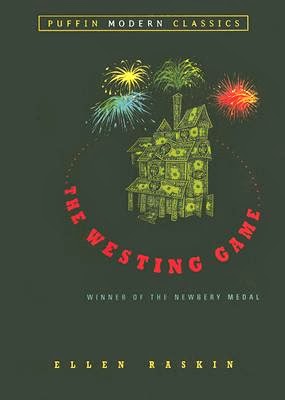
The Westing Game

by Ellen Raskin

First sentence: “The sun sets in the west (just about everyone knows that), but Sunset Towers faced east.”
Support your local independent bookstore: buy it there!
Content: There are about three mild swear words, and some talk of murder. Plus a couple of bombs. It’s in the middle grade (grades 3-5) section of the bookstore (actually, I have a Newbery Award Winner section; it’s in that), and I can see no reason for this not to be there. 
Review copy provided by the publisher as a complimentary copy for my bookgroup.
There are very few books I have fond memories of from when I was a kid. The Little House books, and Wrinkle in Time are a couple. And this one. I’m not sure why I remember it so well; maybe it was because it’s a pretty decent puzzle book/mystery, or maybe I just liked the spunk that Turtle Wexler has. Either way, this one has stayed with me throughout the years as a charming, fun little book.

I’m happy to say that this is still — even after all these years — a charming, fun little book. For those who don’t know the plot, it’s this: Sam Westing has died, and 16 people –all connected to Sam Westing in some way — are called into solve the mystery of his “murder” in order to win his inheritance. It’s a rag-tag collection of people, from a judge to a doorman, to a dysfunctional family, to a couple of restaurant owners. There are several sympathetic characters: Doug Hoo, the resident jock/track star; Theo Theodorakis, an incredible support to his disabled older brother; and (my favorite) Turtle Wexler, 13-year-old spitfire. There are also some despicable characters, most notably Turtle’s mom. She is the epitome of overbearing mothers who have good intentions but go about it all wrong. Pushing her older daughter (at age 19!) into a marriage she doesn’t want, and emotionally abusive to Turtle… I disliked her with every fiber of my being.

I’m not sure if the puzzle was terribly well-plotted. I knew the answer, having remembered it from a previous read (maybe 10 years or so ago), but A read it and kind of felt the answer came out of nowhere. That didn’t much matter; she enjoyed the story for the characters. And perhaps that’s the real charm of the book. Raskin created a group of people that we can’t help but identify with and either love or hate. Either way, we’re more than happy to go on a bit of an adventure with them. 

Jinx’s Magic

by Sage Blackwood
First sentence: “It wasn’t that Jinx didn’t like people.”
Support your local independent bookstore: buy it there!
Review copy snagged from the ARC shelves at my place of employment.
Content: There are some tense moments that might scare a more sensitive child. But, even though there are deaths, it’s all very abstract and kind of distanced from the reader. It’s in the middle grade (grades 3-5) in the bookstore.
Others in the series: Jinx

Jinx’s life has gotten more complicated. Not that he expected any different, really. He’s been told he’s the Listener, but no one has bothered to explain what that means. The trees he talks to are becoming increasingly more panicked because someone — well, the neighboring kingdom — is chopping them down. And Simon — the wizard Jinx is apprenticed to — is trying to stop the Bonemaster (Evil Villain) without much success or help from the other clearings in the Urwald. It’s all a big mess, really.

Jinx has two missions in this book: get Reven out of the Urwald and to that neighboring kingdom, where he is (presumably) the long-lost rightful heir. And then get to Samara to learn how to use Knowledge is Power (or KnIP). Neither is what he wants to do. (He just wants to make sure Simon doesn’t kill himself when he goes up against the Bonemaster, really.) But, do them he must, and so he does. Sort of.

This is very much a middle book in a series. It takes the elements of magic and setting that Blackwood laid out in the first book, and builds on them, but nothing really is resolved. Jinx does grow in his magic usage, though not really in his understanding, and he makes a couple more friends. But nothing is really clearer than at the end of the first book. Additionally, new elements are introduced: an impending invasion from Reven and his newfound power, the existence of an underground society for the use and freedom of KnIP in Samara (of which at least two of the characters are members), and Jinx’s role as the Listener is expanded (at least a little bit). So, the ending really is quite unsatisfying, but that’s just because it’s not, well, done yet.

It works well as a middle book, I think. But I’m reserving final judgement for the whole series until the third book comes out.

What the Heart Knows

Chants, Charms, & Blessings
by Joyce Sidman, Illustrated by Pamela Zagarenski
First sentence: “
Support your local independent bookstore: buy it there!
Content: None. The book would go in the children’s poetry section at the bookstore.

I picked this one up because it made the list for the SLJ’s Battle of the Books and I was curious. I didn’t know it was poetry.

Let me just say, up front, that the artwork is gorgeous (you can check some of it out on this video here). I almost want to buy this book because of the gorgeous artwork. And maybe buy some notecards with it as well.

I liked the idea of the book: a series of chants, songs, incantations, and blessings. But, I just. don’t. get. poetry. So I don’t know if they were any good or not. I enjoyed some of them, and didn’t enjoy others. And maybe that’s all I need to know about poetry. I guess, sometimes, that I feel I need to have a deep connection with poetry, and I just… don’t.

I don’t know if the answer is to stop trying, or keep on hoping that someday it’ll make sense.

Better Nate Than Ever

by Tim Federle
First sentence: “I’d rather not start with any backstory.”
Support your local independent bookstore: buy it there!
Content: There is some bullying, a bit of swearing, and some frank talk about sexuality and alcoholism. I probably wouldn’t give it to a third grader (it just feels more mature than an 8-year-old, but you know your kid), but a 4th or 5th grader would be fine with it. It’s in the middle grade (3-5th grade) section of the bookstore, though the library has it in the teen section (which surprised me).

Nate Foster is a 13-year-old kid living in the blue collar town of Jankburg, PA (just outside of Pittsburg). His dad is a “maintenance engineer” and his mom runs a slowly dying flower shop. They have put all their hopes, dreams, and expectations on Nate’s older brother, Alex, the sports star. Which leaves Nate as the… well… outcast. It doesn’t help that he’s a Broadway musical fanatic, knowing them all, singing away, quoting incessantly. Which leaves his family (and the town) baffled.

Of course, Federle is playing off of stereotypes here: people in blue-collar towns are (obviously) backward and don’t understand Culture. People — boys especially — who like musicals are (obviously) gay. (There is much too much discussion about Nate’s sexuality here. And while his position is “I’m 13, how would I know if I were gay?” it bothered me that musicals are, necessarily, lumped in with being gay. Can we just get over that, now, please?) Boys who are short, overweight, and awkward are (obviously) bullied at school (and by his — jerk is not a strong enough word — older brother).

When Nate finds out about open auditions for a new musical based on the movie E. T. he jumps at the chance. And because he knows his backward parents would never let him, he takes the opportunity (with the help of his friend Libby) to run away to the auditions. He was supposed to go there and back again in a day, but (of course) things don’t quite work out. Which brings us to another cliche here — the kid from the backward blue-collar town has NO IDEA how to make it in New York City. (Which may be true, having never run away to the big city when I was 13.)

Even with all the cliches and stereotypes, this wasn’t a terrible book. And I think what saved it, for me at least, was Nate himself. Federle caught the voice of an awkward, insecure, hopeful kid someone who has been beaten down his whole life, and yet still remains optimistic about everything. He’s adorable, and heart-warming, and just plain fun. It was this that kept me reading, and when I finished, it was this that made the book a good one for me.

Additionally, it’s one of those books that’s good to have out there, if only because it addresses stereotypes. There aren’t that many books out there where the male main character gets to be something other than stereotypically male. Hopefully, boys will pick this up and give it a shot. If only to increase their empathy.

There’s a sequel — Five, Six, Seven, Nate — which just came out. I may even like Nate enough to give that one a shot.

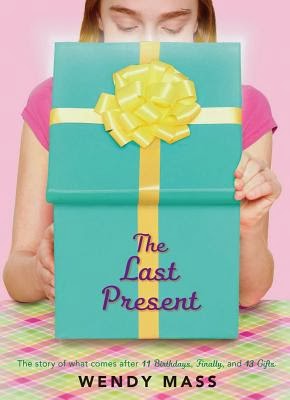
The Last Present

by Wendy Mass
First sentence: “When you’ve drawn breath for nearly a hundred years, not much surprises you.”
Support your local independent bookstore: buy it there!
Others in the series: 11 Birthdays, Finally, 13 Gifts
Content: There some kissing (a first kiss) and a bit of fudging the truth, but other than that, nothing objectionable. Sits quite happily with the rest of the series in the middle grade (3-5th grade) section of the bookstore.

Amanda and Leo have gone without talking for a year. Again. This time, though, it wasn’t a fight that did it: Angelina — the mysterious, magical woman in the town of Willow Falls — asked them to. Because when Amanda and Leo don’t talk, they have the power travel through time.

This time, they’re tasked with going back in time to fix their friend’s sister’s birthday party. See, Angelina bestows a “benediction” of protection on all the children of Willow Falls, something that will keep them safe. But she didn’t make it in time to help Grace (that’s the friend’s sister), and every attempt she made in the intermittent 10 years didn’t work either. And she’s tasked Amanda and Leo with going back and making sure that Grace’s benediction happens. Three times.

It sounds simple, and in many ways it is: Amanda and Leo head back to a different year each day over the course of a week, and all they have to do is fix one little thing at each birthday party. But as they find out, it’s not as easy as it sounds. And then there’s the problem that all this might be more about Angelina than it is about Grace.

While it’s nothing earth-shattering or ground-breaking, it’s a very sweet little book. I liked how Mass brought in all the elements of the whole series, and though this is Amanda and Leo’s follow-up story (they were always my favorite, anyway), Rory and Tara do have parts to play. It’s very much one of those “on the cusp of adulthood” books: Amanda and Leo have their first kiss, and they are beginning to make decisions that will effect their future. But even with that, it’s a simple, sweet (I know: I keep saying that. There really is no better word.) story about moving on and making things right.

And a fitting end to this series.

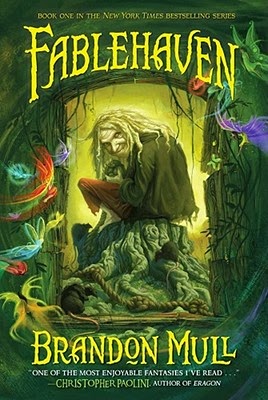
Fablehaven

by Brandon Mull
First sentence: “
Support your local independent bookstore: buy it there!
Review copy sent by the publisher because this is my January book group pick at work.
Content: Some mild fantasy violence, and one intense scene. Resides happily in the middle grade (3-5th grade) section of the store, though the language may be a bit difficult for the younger end of the spectrum.

People have been telling me for YEARS that I need to read Fablehaven. That they LOVE Fablehaven. That it’s brilliant. So I jumped at the chance to pick it for my 3-5th grade book group.

Seth and Kendra are off to spend a couple of weeks at their grandparents’ house while their parents are off on a cruise. The thing is: this is the side of the family they don’t know very well (you know there’s always one). Their grandparents are reclusive, and they’ve hardly seen them. In fact, their mom had to beg and plead in order to get them to let Seth and Kendra to stay there. So no one is really expecting things to go well. This feeling is exacerbated when, upon arriving, Seth and Kendra are shuttled off to the attic and told to stay either there or in the yard.

(Complaint #1: REALLY?  I’ve heard of controlling parents, but controlling grandparents is a first. I wanted to smack Grandpa for this. “It’s for your safety.” BAH. It’s a middle grade fantasy novel. Lighten up. Also: if that’s the way he treats the creatures in Fablehaven, I’m not surprised at the way he treats his grandkids.)

The kids are complete opposites. Kendra follows everything to. the. letter while Seth is the macho end of things and completely disregards Grandpa’s rules. (Complaint #2: why is it that 11-year-old boys are often
 portrayed as brats? I don’t have a son, so I don’t know if it’s typical. But I wanted to smack. the. kid. I also wanted to shake Kendra: lighten up a little, girl.) This not only leads to the discovery that Grandpa’s house (Grandma’s “missing”; she turns up later, just in time to help save the day. Which leads to Complaint #3: while Seth did a grand job creating conflict, the kids did very little in solving it. Sure, they were there, and they helped, but they didn’t DO much of anything.) is full of fairies and mythical creatures, but also to Seth creating a whole bunch of havoc.

And the book is already half done.

(Complaint #4: It seems like authors use series books to be lazy with world building. They take half the book SETTING THINGS UP and then hurry to wrap things up — or not — in the second half. *sigh*)

I wasn’t much interested in Seth or Kendra much after the halfway point. They did some stuff, they got Grandpa into deeper hot water, they rescued Grandma, blah, blah, blah.

I just didn’t care.

Perhaps this was a victim of high expectations. Or maybe it was reading it after reading So Many Cybils books (it wouldn’t have made my shortlist!). Or maybe it was lousy world building, with obnoxious characters, excessively floral language, and an uninteresting plot.

But it could be me.

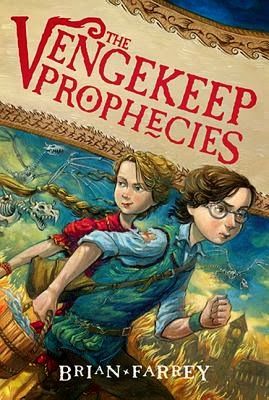
The Vengekeep Prophecies

by Brian Farrey
First line: “Even weeks later, I heard rumors that I had ruined the Festival of the Twins.”
Support your local independent bookstore: buy it there!
Content: Aside from the fact that Jax and his family are thieves — and  I suppose adults might have a problem with their kids reading that (though I don’t know why…), and maybe some scary monsters (depending on how sensitive your kids are; they’re not that scary) there’s absolutely nothing untoward in this book. Resides quite happily in the middle grade (3-5th grade) section of the bookstore.

Jax Grimjinx is a thief. He comes from a long line of thieves. It’s the family business, and has been for centuries. There’s only one problem: Jax is a bookish nerd, a klutz, and actually is quite a terrible thief. (Yes, it is his fault — this time — that the Grimjinx family ended up in jail.) Then a suspiciously convenient prophecy turns up, putting his family at the center as the Heroes. It predicts all sorts of Dire Perils for the town of Vengekeep, which start coming true. (It wasn’t supposed to: there really is no such thing as Lava Men.) There’s seemingly no stop to it. Until Jax with his bookishness figures out there might be a Way to break the prophecy. And it’s up to him — and his new friend, Callie — to go and get what is needed.

There’s so much to love in this book. Jax is a terrific character: a bookish kid (I love that he’s wearing glasses. I know it’s a little thing, but I do love it.), an unwilling hero, and yet he finds a way to outsmart the more Savvy characters and Save the Day. I love his relationship with Callie; none of that sappy romance stuff (I’ve decided that I don’t like romance in my middle grade fanatsy), but a good solid friendship that works. I love that it’s all plausible and that the “prophecy” isn’t something that’s set in stone, which gets old after a while. And the writing is tight; it kept me reading, turning pages, wondering what is going to happen next. I’m just glad the second one, The Shadowhand Convenant, just came out. Because I don’t want to wait to see what happens next to Jax and his family.

(Just for the record: because this is a Cybils nominee, I’ve been asked to make sure y’all know this is my opinion only, and not that of the panel.)