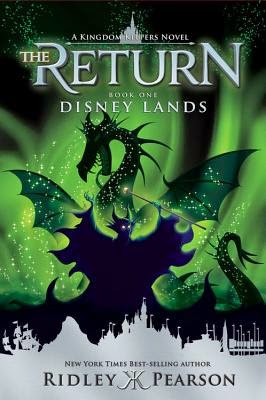
The Return: Disney Lands

by Ridley Pearson
First sentence: “
Support your local independent bookstore: buy it there!
Review copy provided by the publisher.
Content: I was made a bit wary when I started and discovered that the main characters are high school graduates, but (aside from the age) it really is a middle grade novel. Lots of action, a little bit of romance, and easy to follow. It’s in the middle grade (grades 3-5) section of the bookstore.

I got an email, as part of my new role at the store, that Ridley Pearson was interested in coming to visit. I got excited, said hey sure! And then promptly realized that the only thing I’ve ever read by him was Peter and the Starcatchers, which I didn’t really think of as “Ridley Pearson” but more “Dave Barry and the other guy.” So I had the publishers send me a book, partially because I wanted to read it, but also because I wanted to test their claim that it would “bring new readers to the series.”

The series is this: there are five kids who, at night when they sleep, become holographic hosts at Disney World and Disneyland and fight the evil Disney villians for control of the world. They thought their job was done, they’re moving on — graduated from high school and are off to Bigger and Better Things — but WAIT, something has happened and they need to Fix It.

On the one hand, this book is an elaborate set-up, so yeah, it worked for me. I’m sure I missed some in-jokes, and some references went over my head, but as a start of a new adventure, I Got It. The best comparison I can think of (and that I’ve been using with customers) is that reading this without reading the first series is kind of like reading Heroes of Olympus without reading Percy Jackson and the Olympians series. You can do it. It’s probably not the best way to go about it, but it can be done.

In fact, there’s a lot of similarities between Pearson and Riordan’s writing styles: short chapters, a lot of action, overarching mythology, a plethora of characters (7, in fact) to keep track of. The difference is that Pearson is playing around in the world of Disney rather than Greek Mythology. No, they’re not as fun as Riordan’s books (but then, I’m saying that as a long-time Percy Jackson fan), but they are good. It’s good, solid, accessible, middle grade fantasy. Nothing SuperWowAwesome, but it’s not horrible either.

As for the event…

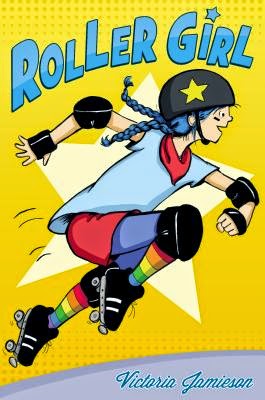
Roller Girl

by Victoria Jamieson
Support your local independent bookstore: buy it there!
Content: It’s in the middle grade graphic novel section.

It’s the summer before sixth grade — middle school (gulp!) — and Astrid has things all Planned Out. She and her BFF, Nicole are going to hang out, go to derby camp, and have tons of fun!

Except. That’s not the way things happen. Nicole is off to dance camp, and is becoming someone Astrid can’t even relate to. And derby camp, well, let’s just say it’s a LOT harder than Astrid ever figured it’d be.

I picked this one up for K a while back, who really enjoyed it. But had some issues with it, especially with the friendship element. Why do things this happen, she wondered. It spawned a discussion about friends and change, and trying new things. So, I needed to see what it all was about.

And I loved it. I loved that Astrid was who she was, and while she changed — she realized that she was being a bit self-centered and not a very good friend — she still remained the same person she always was. I liked that it showed that things can pay off when you work hard at something. And that sometimes, it’s okay when other people take the spotlight. The drawing’s fun and colorful, and I love that Astrid is (at least) half-Puetro Rican.

It’s a sold graphic novel, and one that I know kids will love. (K did!)

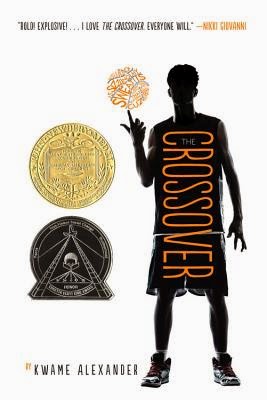
Crossover

by Kwame Alexander
First sentence: “At the top of the key, I’m MOOVING & GROOVING, POPping and ROCKING — “
Support your local independent bookstore: buy it there!
Content: It’s poetry, which is a plus and a minus: plus, because it means it’s a quick read. Minus, because you have to convince kids that it’s okay to read poetry. There’s some kissing, but I’d give this to kids ages 10+. It’ll be in the Newbery section of the bookstore (yes, we do have one!).

I really didn’t know what to expect going into this. I’m sure it would be good — it won the Newbery, after all — but is it one of those good books that are just all style and no substance?

Because this book does have style. You can tell that right from the first page. Alexander’s not only writing a novel in verse, he’s playing with form. There’s style to these poems, it’s not just words on a page; they sometimes (like in the opening poem) leap right off the page. (There’s one poem, about 2/3 of the way though, that can be read in two different directions. I love that!) But, there’s also substance as well.

Twins Josh and Jordan Bell are inseparable, both in life and on the basketball court. Sons of a retired (due to injury) Euroleague player, basketball is their Sport. Their Religion. Their Life. But, during their 8th-grade year, things change. They drift apart, mostly because Jordan — JB as he wants to be known — starts going out with a girl. And their dad has serious heart problems. All of this weighs on Josh, and he lets it interrupt his game.

It’s a simple story, but one with tremendous amounts of heart. Josh is a complex character, who worries about his parents, misses the connection with his brother, and wants to be the top of his game. And yet, he has a temper, one that gets in the way of his wants and desires sometimes. There’s a depth to him that makes him real, which I appreciated it.

I did have a couple of complaints… I didn’t like the portrayal of the girlfriend, but I do understand it’s from Josh’s point of view, and he didn’t really like her intrusion into the relationship with his brother. So, I can understand why she was a bit of a caricature.) The other thing I didn’t really care for — and this is a spoiler — was the dad dying in the end. I did like that there wasn’t a “neat and tidy” ending, but it was a bit, well, Dramatic.

But aside from those two little complaints, I loved this one. I loved the style and the characters and just immersing myself in this world. For the Bells, the highest compliment is that they are Da Man. And this book is definitely that.

Eddie Red Undercover: Mystery in Mayan Mexico

by Marcia Wells
First sentence: “I’m back.”
Support your local independent bookstore: buy it there!
Review copy provided by the publisher.
Content: There’s some mild violence and some mild romance (it’s not a kissing book), but the language/chapter length level works for the younger readers as well as the older ones in the age range. It’s in the middle grade (grades 3-5) section of the bookstore.

I had a woman in the store the other day, looking for a Harriet the Spy-type mystery for a 10-year-old boy, who wanted something with intrigue and adventure. (They’d already read Harriet the Spy, or I would have given them that.)  Thankfully, I had just finished this one, so I had a great, middle grade mystery with intrigue and adventure to hand to the customer. (Bonus: this is the second, but you don’t need to read the first at all!)

Edmund (call him Eddie, please!) and his family are in need of a vacation. He’d just gotten done being grounded (for events in the previous book), and his mother was given a vacation/opportunity to go to a conference. In Mexico. Sounds delightful, no? Especially since Eddie’s best friend, Jonah, was along for the ride. But once there, an ancient mask that’s on display at the hotel is stolen and Eddie’s father is blamed for the theft. So, it’s up to Eddie, Jonah and their new friend, Julia, to solve the crime and find the real thief.

I really did thoroughly enjoy this one. It’s well-paced, with intrigue, suspense, and action, as Eddie and Jonah follow the twists and turns through this mystery. I liked that they were reasonable kids, doing reasonable things, and that aside from Eddie’s photographic memory and artistic skillz, they’re pretty normal kids.

But what I really liked is that Eddie is an African American kid, and its not an issue. At all. In fact, it’s not something I even realized (shame on me?) until I was about a third of the way through. It’s a diverse cast, being set in Mexico, and it’s not something that’s pointed out. It just is. Which is always nice.

A good, refreshingly solid, middle grade book.

Willy Maykit in Space

by Greg Trine
First sentence: “When Willy Maykit was three years old, his father went on an African safari and came home with amazing stories of lions, tigers, and bears.”
Support your local independent bookstore: buy it there!
Review copy provided by the publisher.
Content: It’s on the simpler end of things, language-wise. Short chapter, easier words. Good for reluctant and younger readers. It’s in the middle grade (grades 3-5) section of the bookstore.

Willy Maykit has exploring in his blood: his father was a fantastically adventuresome explorer. The problem is that he went missing in the Amazon a year ago. And so, Willy’s problem is getting his mother to let him go on the field trip to Planet Ed. Of course, she lets him  (or there wouldn’t be a book), and of course he, and another friend, get left on this strange planet (that looks a lot like Colorado), Of course they have adventures and fight monsters. Of course they get rescued (sort of). And, of course, the book is filled with knock knock jokes and silly puns.

(My favorite? The book Yellow River, by I. P. Freely.)

It’s a silly premise for a silly book. And you know what? It totally works. Especially if you’re 8 years old at heart. (And even if you’re not, it’s a good punny book.) No, it’s not Deep with well-drawn characters or a good plot, but it is Fun, and sometimes, that’s what counts.

The Trap

by Steven Arntson
First sentence: “The last day of summer break before the start of my seventh grade year was the first time I ever got punched in the face.”
Support your local independent bookstore: buy it there!
Review copy provided by the publisher.
Content: It’s some pretty dark subject matter — kidnapping and out-of-body experiences. Plus there’s romance, but nothing too mature. It’s in the middle grade (grades 3-5) section of the bookstore, though it’ll probably be of interest to the older end (and maybe into the 6th grade).

It’s the summer of 1963, right before seventh grade, and Henry Nilsson is pretty sure nothing exciting is going to happen. His dad is being laid off at the railroad and they’re having to tighten their belts at home (they even sold the TV!). Henry like-likes his twin sister’s best friend, Nikki, but has no idea what to tell him. And his best friend, Alan’s, brother bullying has increased.

Then, two things happen to change the trajectory of Henry’s summer: Alan’s brother goes missing. And they discover a book to teach them how to have an out-of-body experience, called “subtle” travel. Once they figure out how, they enter the subtle world, where things aren’t as nice as they seem. And where there’s some pretty scary things going on in them thar woods.

On the one hand, I enjoyed this one. I liked the historical detail, which was never the point of the book, but rather just background to give it some weight. I liked the friendship between Henry and the rest, including his sister. I liked that both Nikki and Alan were people of color — Nikki is Asian; Alan, Latino — but that it was never really an issue. (Well, it is, once.) I liked the mystery, the discovery of what was going on with Alan’s brother, and the realization that even though he’s often mean, he has some good in him.

What I didn’t like was the whole speculative fiction part of it. The subtle travel was weird (Seriously.) and I was never really able to suspend my disbelief enough to make it work for me. There was just too much left underdeveloped, that was just plain weird.

But, perhaps, those are adult concerns creeping into a middle grade book. It is a dark book, one that’s kind of creepy, and for those who like a slight creep factor to their book, it’s a good one. And perhaps, the positives outweigh the negatives.

Genuine Sweet

by Faith Harkey
First sentence: “Genuine Sweet.”
Support your local independent bookstore: buy it there!
Review copy sent by the publisher.
Content: There’s a bit too much lovey-dovey stuff than I like for books this age (they kiss a bit and hold hands). Even so, it’s really a middle grade novel, so it’ll be in the middle grade (grades 3-5) section of the bookstore.

I’m a sucker for small town Southern books. (Unlike Ms. Yingling, who loathes them.) I love the small community feel, the quirkyness, and you throw in a bit of magical realism and I’m sold.

Genuine Sweet has all of that. She lives in a small town in Alabama where everyone knows everyone’s business, so that means everyone knows that her daddy is a drunk. Genuine’s (pronounced gen-u-wine) grandma takes care of her, since her mother’s dead, and it turns out that a gift runs in the female side of the family: wish fetching. They don’t grant them, per se, they sing to the stars and fetch the star juice (for lack of a better word) and give it to people who need things. The one cardinal rule: they can’t grant any for themselves.

So, burdened with this knowledge, Genuine sets out to make life a little better for those in the town. But, even as she does so, things get worse at home. No money, no food, no electricity. And as word gets out about her wish fetching Genuine has more and more pressure to fill them ALL. Which takes a toll.

On the one hand, quirky Southern charm. It was very sweet and very Southern, and I liked the way the magic worked: nothing major, nothing huge, just small little helps that fit in with the mood of the book.

But, even with all the quirkyness and the Southerness and the magic, I didn’t absolutely love this book. Partially, because I thought the romance between Genuine and Travis was a bit, well, out of place in a book aimed toward the younger set. And the drunk dad was pretty unnecessary. As was the angry, bitter woman who opposed Geunine’s wish fetching. And all of that added up to make me like, but not thoroughly enjoy this one.

It was a good book, but I think it could have been so much better.

Mark of the Thief

by Jennifer Nielsen
First sentence: “In Rome, nothing mattered more than the gods, and nothing mattered less than its slaves.”
Support your local independent bookstore: buy it there!
Review copy snagged from the ARC shelves at my place of employment.
Content: There’s violence, since it’s set in ancient Rome, but it’s not graphic. It’s basically on the level of the Percy Jackson books, so I put it in the middle grade (grades 3-5, though it probably skews to the upper end of that) section of the bookstore.

Nicholas Calva is a slave in the mines, digging up stones and jewels for the wealthy of Ancient Rome. This is not something he chose to do; his family was captured in one of Rome’s many invasions of other, smaller countries. Or sRomething he wants to do: he would much rather be a free man. But, because his mother was sold away, and because he needs to watch after his sister, Livia, he sticks around and is (mostly) obedient. Then, one day, his master sends him down to find and fetch Julias Ceasar’s bulla, a medallion that he carried with him that was supposedly given to him by Venus. Nic finds it, of course, and fights the griffin guarding it, and is endowed with magical powers.

Which gets him in to all sorts of trouble.

See, the current emperor is weak, and there’s a war brewing between the Praetors and the general of the army, and Nic seems to be caught in the middle. The question is, will he even survive long enough to pick a side?

I loved this one. Seriously. Nielsen knows how to create a world, and I was happy to immerse myself in an ancient Rome that had magic. (And pretty cool magic, at that.) Nic, much like Sage, is a impulsive character, one is more than willing to go out on a limb to do what he thinks he should, which makes him a lot of fun to read about. I enjoyed getting to know Aurelia — his friend/pseudo romantic interest — and thought she was a great foil for Nic impulsiveness. My only regret was that Livia was more an idea than a character; I never really felt the connection that Nic did for her, and was never really upset when her life was dangled before Nic as motivation.

But there are some nice twisty moments, especially at the end, and it’s a solid first book in a series.

Red Butterfly

by A. L. Sonnichsen
First sentence: “Mama used to have a piano
with an on/off switch
and a dial to make drums beat.”
Support your local independent bookstore: buy it there!
Review copy snagged from the ARC shelves at my place of employment.
Content: It’s pretty long, which will turn some readers off, though it’s in verse, which makes it easier to read (but also might turn readers off). The Chinese words, while spelled phonetically, might also be a deterrent. It’s in the middle grade (grades  3-5) section of the bookstore.

Kara was abandoned at birth, and in China, that generally means certain death. Especially since she is a girl and born with a deformed hand. But a kind, elderly American woman living in Tianjin took Kara in. Now, eleven years later, Kara is wondering why Mama never leaves the house, why she has never gone to school, and why they can’t leave to go join Daddy in Montana.

It takes a while for things to spill out: Mama is always telling Kara to be content with what she has, and not long for something more, but things do eventually come to light. In China, one needs papers to be a legal resident. Kara, because she was abandoned and rescued, has none. And so, they’ve been in hiding all these years.

On the one hand, I enjoyed this peek into China, especially the lives of those children who are neglected and abandoned to the orphanages because of the one-child laws. It’s told in verse, which suits Kara’s contemplative nature and her desire to figure out who she is and where she belongs.  I liked the people Kara met and her interactions in the orphanages.

However, while I got to know Kara and her story, it felt, well… too American. An American pulled her off the streets when she was a baby. She befriended a New Zealander worker in the orphanage (not American, but English-speaking/Western). She ended up in Florida with a second adoptive family. There were Chinese characters, but they were almost afterthoughts in Kara’s life. And while I understood why, I was sad not to get to know China or the Chinese.

It wasn’t bad, overall, but it wasn’t my favorite either.

Fish in a Tree

by Lynda Mullaly Hunt
First sentence: “It’s always there.”
Support your local independent bookstore: buy it there!
Content: The chapters are short, and while there are some bigger words, there’s nothing that a 3rd grader couldn’t handle. It’s in the middle grade (grades 3-5) section of the bookstore.

Ally doesn’t like school. Part of that is the result of her moving so much — her dad’s in the military, currently deployed in Iraq/Afghanistan (it didn’t say; I’m assuming this) — of it is because Ally can’t read. It’s a fact she’s hidden by becoming a troublemaker and through her art, but whenever she tries to read, the words swim, her head hurts, and she just. can’t. do. it.

Enter in Mr. Daniels, the permanent sub for her regular sixth-grade teacher who’s off on maternity leave. He picks up on Ally’s defense mechanisms, and realizes that there’s more going on than meets the eye. He espouses the believe that not everyone’s smart in the same way (yay for that!), and draws on Ally’s strength, giving her the confidence to make friends — Albert, the science geek, and Keisha, a baker extraordinaire — and to stand up to the classroom bully, Shay.

There are some nitpicky things that bothered me throughout that kept me from loving this as much as I wanted to. First, why did the teacher have to be male? I’m torn on this one: on the one hand, it’s showing a man doing things that are “normally” reserved for women. He’s concerned about his students, he’s caring, and he reaches out. Not to mention that he’s a man in a female-heavy profession. However, it seems to me in books like this — where a teacher saves a struggling student — the teacher is always male. It’s the men who get to think outside the box, who find ways to connect with the struggling students, who make changes within the system. And that bothered me.

Additionally, there’s a point when Albert comes out of his shell to fight back against his bullies, in order to protect Ally and Keisha from them. Perhaps that was in character for Albert, but it bothered me deeply. Why did he need to protect them? I initially thought it was because they were his friends — maybe he’d do the same for boys who were his friends — but then he says something about “never hitting a girl”and I cringed.

On the other hand, I was glad that Hunt included a broad spectrum of personalities and classes: there are people who are hyper, middle of the road kids, rich kids, kids on free lunches. The usual suspects — drugs, bad parents, etc –aren’t anywhere to be seen. The focus, really, is on celebrating our differences, and recognizing that intelligence isn’t tied to doing well on tests. And that’s worth celebrating.

So, while it’s an uneven book, I’m glad it’s out there.