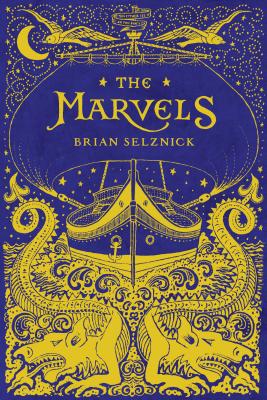
The Marvels

by Brian Selznick
First sentence (which comes about 400 pages in): “Joseph was lost.”
Support your local bookstore: buy it there!
Review copy provided by the publisher.
Release date: September 15, 2015
Content: It’s a huge book, which will be daunting. But 2/3 of it is pictures. And the text section may be a big confusing for younger readers. There is some smoking by adults, but other than that, there’s nothing that would stop me from giving this to a precocious 9- or 10-year-old. It will be in the Middle Grade (grades 3-5) section of the bookstore.

I don’t usually like to write about books months before they come out. But, since this is the first one I finished for the 48 hour book challenge, I figured it was okay.

I’m also going to be coy and not tell you too much about the book. I knew very little about it going in, and I think that’s the best way to experience it.

That said, I liked this one nearly as much as Hugo. It’s about the theater and family and truth in storytelling. Selznick’s art is gorgeous, as always, and even though the text section starts out a bit confusing, stick with it. It’s completely worth it at the end. Oh: and read the afterword. It makes everything that much better.

There’s really not much else to say, except: I can’t wait to share it with everyone else.

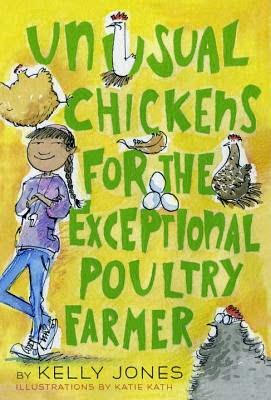
Unusual Chickens for the Exceptional Poultry Farmer

by Kelly Johnson
illustrated by Katie Kath
First sentence: “My great-uncle Jim had your flyer in his barn.”
Support your local independent bookstore: buy it there!
Review copy swiped off the ARC shelves at my place of employment.
Content: There’s some tricky words, and I’m not sure whether or not the epistolary format will turn off reluctant readers or encourage them. There’s a lot of fun illustrations and some good chicken facts, though. It’s in the middle grade (grades 3-5) section of the bookstore, but I’d probably give it to a confident 2nd grade reader.

Sophie Brown and her parents have just moved from the bustling city of Los Angeles to a farm in the middle of nowhere California. It was a move partially because of necessity — her dad lost his job and hasn’t been able to find a new one — and partially out of happenstance — Sophie’s dad’s uncle died and left him the farm. So, they’re trying to figure this whole thing out. And it’s not going terribly well. That is, until Sophie discovers a catalog for “exceptional” chickens. Turns out, that Uncle Jim was not only a farmer (he had a vegetable garden and some grape vines) but he raised, well, unusual chickens.

The chickens are not quite magical, and they’re based on real chickens, but they’re not quite normal either. (One lays glass eggs, for example.) Sophie is given instructions by the person who runs the catalog on how to catch and care for the chickens, but someone is trying to steal Sophie’s chickens. The question is: will she figure out how to keep the chickens (without divulging their magical properties)? And can she stop the thief from stealing her chickens?

The cleverest thing about this book is the format: Sophie’s story spills slowly over the course of the book through letters she writes to her dead abuela, dead great-uncle Jim, and the chicken place. (It’s kind of unusual her writing to dead people, but it works. She doesn’t really expect an answer back.) It’s a very one-sided story, and we only get snippets of things other than chickens: her mother’s free-lance writing, or her father’s failing search for a job. But, the tone is light, and there is a mystery to be solved with the chicken thief. But what really comes through is Sophie’s voice. She’s a determined child, someone who is willing to figure things out and solve problems. She’s spunky. And she’s half Latina. All of which makes for a charming book, a fun read, and a book worth checking out.

Circus Mirandus

by Cassie Beasley
First sentence: “Four small words.”
Support your local independent bookstore: buy it there!
Review copy provided by the publisher. (Plus: popcorn!)
Release date: June 2, 2014
Content: It’s kind of slow, and definitely heavy on the exposition, which may make more reluctant readers, well, reluctant to give it a try. But I’m assuming there will be gorgeous art throughout (I haven’t seen it yet), and so there’s that to give it a boost with those who like pictures with their books. It’ll be in the middle grade (grades 3-5) section of the bookstore.

Micah has been raised by his grandfather since his parents died when he was young. He’s had a good life; his grandfather is one of those Good people who know how to be happy. He was also a storyteller, raising Micah on stories of the grand Circus Mirandus and the Lightbender, who promised Micah’s grandfather a miracle.  Now, when grandfather’s health is failing, he calls in the Lightbender’s miracle. But getting that isn’t as easy as all that. And it’s up to Micah (and his friend Jenny Mendoza) to help grandfather get the miracle he deserves.

I am not a critical reader. I fall head first into stories, and they either work for me or they don’t. I don’t stop to think much about a deeper meaning, or issues, or (sadly) stereotypes and cliches. I like characters (or not), I like the plot (or not), I like the writing (or not). And so, I find myself loving books and not having a real “reason” for it.

This is one of those books. I loved it. Wholly and unabashedly. I fell into the magic and the suspension of disbelief. I understood the magic and the story that Beasley was trying to tell. I cried at the end. I am not sure I’ve felt this in love with a book since I read the first Penderwicks. This book? This book is my people.

I loved it. I loved the Big Fish-esque feel of the story. I loved Micah and his grandpa’s relationship. I loved the flashbacks to grandpa’s time with the circus. Yeah, so some of the characters — Aunt Gertrudis, especially — were pretty much caricatures, but so is Trunchbull in Matilda, and no one complains about that. I loved that Jenny was smart, and that they were just friends and that she wasn’t a romantic interest. I loved her skepticism, and her belief in her friend (if not in the magic). I loved the whimsy of the book. But most of all, I loved the heart of it. It has such a big heart.

I’m sure there are drawbacks, and people who this book won’t speak to. But, for me, this was a little slice of perfection.

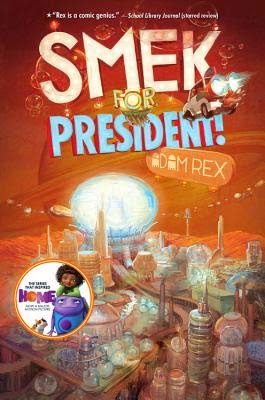
Audiobook: Smek for President

by Adam Rex
Read by Bahni Turpin
Support your local independent bookstore: buy it there!
Content: Nothing. Nada. Some fake swearing (“pardon my language”). The audio version is probably good for kids who have an attention span longer than 20 seconds; the book is in the middle grade (grades 3-5) section of the bookstore.

I loved the audiobook of The True Meaning of Smekday, so when I heard that Bahni Turpin was doing the sequel, I KNEW that was how I needed to experience this book. And I was right. Turpin is perfect for this. Seriously.

The story picks up a year and a half after Gratuity “Tip” Tucci and J. Lo save the world. The Boov have moved to New Boovworld, on one of Saturn’s moons. J. Lo and Tip are hanging on Earth, trying to get used to having Tip’s mom around. And, for J. Lo, trying to to fit in. They need a break, and so J. Lo soups up their car, Slushious, and they head off-world to check out the new Boov homeland. Since they saved the world, they’ll be welcomed as heroes, right?

Well, no.

Things don’t go quite like they planned. J. Lo is named Public Enemy Number One, and thrown into jail. Tip repeatedly avoids being captured, but only just barely. Which sends her on an adventure through New Boovworld. She meets and befriends a delightful flying billboard, whom she names Bill (of course), as well as several other Boov (and one human; Dan Landry’s son), in her attempts to free J. Lo and set everything right. There’s a lot of action, tons of humor, and a bit of time travel in the mix.

But what really made the book was Turpin. I adore her reading style, and it’s perfect for Adam Rex’s humor. I was chortling, guffawing on occasion, and I was thoroughly charmed by all the Boov voices (with their distinctive quirks). I was pleased to see that the Chief was back (if only in Tip’s imagination), as well as other favorite characters from the first book. I loved how Rex imagined New Boovworld. And it was satisfying (as a parent) to see that there were real consequences for Tip’s actions.

In short: I adored it.

Lost in the Sun

by Lisa Graff
First sentence: “When we were real little kids, Mom used to take Aaron and Doug and me to Sal’s Pizzeria for dinner almost every Tuesday, which is when they had their Family Night Special.”
Support your local independent bookstore: buy it there!
Review copy snagged from the ARC shelves at work.
Release date: May 26, 2015
Content: There’s some bullying, and some tough subjects and a couple of instances of mild swearing. It’ll be in the middle grade (grades 3-5) section of the bookstore, though I would hesitate giving it to the younger end of that spectrum.

Eight months ago, Trent was the cause of a fatal accident. He hit a hockey puck into the chest of one of his friends, who then died. Not really from the hockey puck: his friends had a heart condition that no one knew about, and that’s what caused the death. But Trent is convinced that it’s his fault. And he feels like everyone — well his father, his brothers, and his former friends — blames him for what happened.

Now, on the first day of sixth grade, Trent is completely depressed. Until the “weird” girl, Fallon, decides that they need to be friends. Fallon’s the one everyone shuns, mostly because she has a scar down her face. Everyone asks how it happened, but she keeps the true story close, choosing instead to make up ones. Over the fall, Fallon and Trent deal with his grief, guilt, and anger, as he tries to make life work.

A lot of books deal with grief from dead or sick parents, or dead or sick siblings. But the idea that a kid could be the catalyst for a friend’s death hits home and deep. I thought Graff captured those emotions perfectly, from Trent’s self-loathing to his feelings like everyone hated him. And because we saw the rest of the world through Trent’s eyes, I could tell which adults were reaching out (his homeroom teacher, eventually) and which adults just needed a good smack (his father). The longer Trent’s self loathing went on, the more I was afraid that Graff wouldn’t be able to give Trent a good resolution. But, in so many ways, she did. I was thoroughly satisfied with Trent’s arc, and with the way things weren’t neatly tied up in a bow.

Quite good.

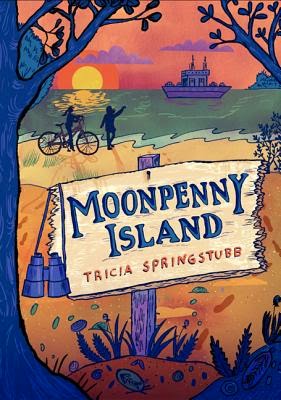
Moonpenny Island

by Tricia Springstubb
First sentence: “Transparent.”
Support your local independent bookstore: buy it there!
Review copy pilfered from the ARC shelves at my place of employment.
Content: It’s pretty basic, language-wise, with short chapters and simpler words. Good for anyone who likes friendship stories. It’s in the Middle Grade (grades 3-5) section of the bookstore.

Flor and Sylvie have been best friends forever. Growing up on a small island in the middle of Lake Erie (it’s doesn’t exist, but it’s possible, though I had to look it up) on the Ohio side, they were pretty much all they had. Which was just find with Flor. Then things change: Sylvie is sent to Cleveland to live with her aunt and go to school there. And Flor’s mother leaves as well, and they don’t know when — or if — she’s coming back.

With her life falling apart, how can Flor cope?

Once I got over my annoyance about the whole there’s an island in Lake Erie by Toledo thing… I found I really liked it. It’s not magical quirky, but it does fit with the whole small-town quirky thing. I liked how Flor knew everyone on the island, and was willing to stick up for the less “acceptable” members of their community. I liked how Springstubb introduced a scientific-minded, homeschooled girl into the mix, and how she wasn’t weird or unusual or super-religious. I felt like Springstubb tackled everything — from problems at Flor’s home to problems with her friends — with an evenness that suited her audience.

The only thing that bothered me, really, about the story was that it had the feel of a first person narration, but it wasn’t. For the most part, I was able to flow with it, but every once in a while, it pulled me out of the story.

But that’s a small quibble in an otherwise good book.

Bayou Magic

by Jewell Parker Rhodes
First sentence: “My name is Madison Isabelle Lavalier Johnson.”
Support your local independent bookstore: buy it there!
Review copy provided by the publisher in conjunction with the ABA Children’s Institute.
Content: It’s a pretty basic story, and aside from some French scattered through, it’s pretty basic in its vocabulary. I’d give it to anyone 2nd grade and up. It’s in the middle grade (grades 3-5) section of the bookstore.

Not-quite-ten-year-old Maddy is the youngest of five sisters in New Orleans. She’s the one that is always the tag-along, never quite fitting in with her sisters. She is often teased, and the only time she feels comfortable is when she’s cooking with her mom. Then, her turn to spend the summer in Bon Temps, in the Louisiana bayou, with Grandmère comes around. At first, Maddy doesn’t know what to expect: her sisters all spent summers with Grandmère and came back with horror stories. But Maddy is different: she likes the quiet, earthy nature of Grandmère and the bayou. She wants to learn the old ways. And she finds friends and adventure there. And magic.

Rhodes simple, lyrical style was really well suited to this story. I loved the earthy feel of the book, and the connection to old stories and family roots. I loved the mix of African and French, of Creole and magic and modern. The environmental crisis aspect of it wasn’t as important as the back blurb led me to believe — it was really just tacked on at the end — but the theme of caring for and connecting to the earth was prominent and important for the story. At first, I thought that this could pass for “realistic” fiction, that maybe the mermaids Maddy saw were just dreams and imagination, but no: this is speculative. And it worked for me. I loved seeing Maddy grow and learn and develop, and yet she was still a 10-year-old girl with all the concerns and abilities of that.

I haven’t ever read Ninth Ward, but I think I need to, now. I’ve come to really love Rhodes simple style.  

Momo

by Michael Ende
First sentence: “Long, long ago, when people spoke languages quite different from our own, many fine, big cities already existed in the sunny lands of the world.”
Support your local independent bookstore: buy it there!
Content: If you can read The Phantom Tollbooth, then this one is for you. It’d be in the Middle Grade (grades 3-5) section of the bookstore.

This book is one of the reasons why, busy as I am, I won’t give up an in-person book group. (I’ve been a slacker with my on-line one lately…) While I read The Neverending Story by Ende as a child (when the movie came out…), I had no idea (and no inclination to find out, for some reason) that he’d written any other books. But, because it’s probably been 30 years since I’d read Neverending Story (or seen it for that matter; we may have tried showing it to the kids), I had no idea what to expect.

What I got was a sweet little fable. Momo is a little orphan girl that shows up in this town and moves into the old amphitheater. What endears her to the people in this town to Momo is twofold: she has a remarkable imagination, and she truly listens to them. Then one day, the grey men show up and infiltrate the town, stealing time from people. Suddenly, no one has enough time for Momo to listen to them, and everyone except the children stay away. And even the children are different. Momo happens to find out the grey men’s plan, and then sets out on an adventure to get her friends back.

It reminded me most of The Phantom Tollbooth: it was a bit on the preachy end — YEAH I get it, unplug from being busy and actually CONNECT with people — but it was also sweet and tender and had that late-60s/early-70s feel to it. It’s nothing earth-shattering, but it is very sweet.

The Tapper Twins Go To War (with each other)

by Geoff Rodkey
First sentence: “Wars are terrible things.”
Support your local independent bookstore: buy it there!
Review copy picked up at Winter Institute for me by my co-workers
Content: There’s a lot of silliness, and it’s a “notebook” book and told in an oral history form, which means lots of pictures, not a lot of exposition, and a generous mix of technology. Perfect for reluctant readers. It’s in the middle grade (grades 3-5) section of the bookstore, but it’d be good up through 7th, I think.

The Tapper twins, Claudia and Reese, are at war. They disagree on how it started, but both are pretty invested in making each other’s life miserable now. It escalates from name calling to pranking (a dead fish left in a backpack) to online bullying to out-and-out destruction in an online gaming forum.

It’s told as an oral history; Claudia is the narrator, and nominally the one telling the events as they unfold, but she interviews friends and family (well, she uses text messages from her parents) and neighbors to defend or refute her point: that Reese is the one who started the War, and that he Deserved It. Of course, Reese totally rejects that idea.

Sure, this isn’t a lot of things, but it IS a lot of fun. And honestly: that’s what kids want and like. Personally, I loved the dynamic between the twins, their push and pull with each other. And while it’s an upper-middle class life that they live (computers, tablets, phones, babysitter, private school), and while it’s yet another New York City book, it’s a fun “fantasy” life for those of us in middle class, Midwest America (although yeah, I’d like to have their life and their problems) and a fun look at kids in New York City. It got me laughing, aloud at times, and sometimes that’s exactly all you want out of a book.

And I’m sure kids will love it.

The Island of Dr. Libris

by Chris Grabenstein
First sentence: “Billy Gillfoyle’s dad shifted gears and gunned the engine.”
Support your local independent bookstore: buy it there!
Review copy provided by the publisher.
Content: It has a few big works, but there’s a lot of white space, short chapters, and quick pacing. Good for reluctant readers as well as the middle grade crowd. I’d give it to anyone 8 and up who’s interested. It’s in the middle grade (grades 3-5) section of the bookstore.

I really REALLY loved Escape from Mr. Lemoncello’s Library a couple of summers back. And so, I was really REALLY excited that Grabenstein was returning to a similar idea in this one. Anything that celebrates books and bookishness for kids (while making it kind of techy cool) is a win in my world.

Billy Gillfoyle’s parents are having issues and so he’s spending the summer out at a cabin by a lake with his mother that she has rented from a university colleague of hers. She’s going to write her dissertation, and he’s going to… explore the woods? Ugh. There’s no TV, no internet, and the next-door neighbor is a Mean Kid. This is going to be the Worst Summer Ever. Especially since there’s no cool books in the library of Dr. Libris (the colleague, whose first name is Xiang, so he can be X. Libris. Ha!), only old Classics. BORING.

But, when Billy begins reading, he hears weird things off in the distance, at the island in the middle of the lake. And when he goes to investigate, he discovers that the characters in the books have come to life! Not actors, not holograms, but real, live people who are interacting.

Cool so far, even though the “technology” behind the island is a bit squidgy and feels more like magic. (It’s supposed to be technology, but the science was so vague, I just considered it magic. I’ll be interested to see where it ends up during Cybils season.) I really liked seeing the classic characters come to life and I thought Grabenstein made them fresh and interesting for a new crowd. If I hadn’t already read The Three Musketeers or Robin Hood, I’d be tempted to pick them up.

But I didn’t utterly love the book, for one reason: there were no girls. Seriously. Maid Marion was there, a little tiny bit, being Robin Hood’s sidekick, but she really didn’t do anything. And Pollyanna was there, but she was mostly annoyingly cheerful (well, that’s to be expected) and served as a love interest. And Billy made a friend with his other next door neighbor (not the Mean Kid) and he had a younger sister, but her role was to 1) introduce Billy to her brother and 2) be annoying and mess up the island. And, yeah, there’s Billy’s mom, but she was barely there. It was a glaring hole. (As was the lack of diversity: all the classic characters were white, and the other characters were never really given physical features,  so I suppose they could have been diverse, but it was never really defined as such.) I wish there had been more girls, stronger girls, more interesting girls.

I’ll still recommend it to kids, but I do wish it had been… more.