Switch

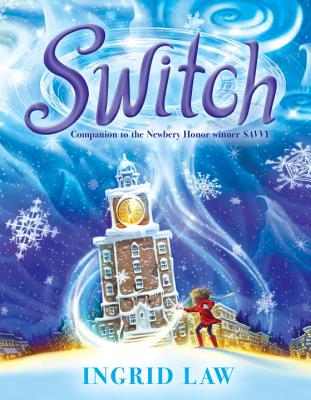
by Ingrid Law
First sentence: “Please, Mrs. Foster– I’ve seen your future, and you really don’t want to buy this soap.”
Support your local independent bookstore: buy it there!
Review copy provided by the publisher rep.
Others in the series: Savvy, Scumble
Content: It’s pretty basic for younger kids (though I think it might be a handful for some 3rd graders), and though there’s some kissing and a little bullying and some scary driving in the snow, it’s mostly harmless. It’s in the Middle Grade (grades 3-5) section of the bookstore.

One of the things I like best about Law’s books is that even though they’re a trilogy, they’re also three stand-alones. Sure, it helps if you know what a savvy is and what scumbling means, but other than that, the whole story is basically self-contained. And that’s wonderful.

This one is Gypsy’s story (who was a wee babe in the first book). It’s a couple months after Gypsy gets her savvy, which is seeing a person’s future (or past) when she looks at them. It’s a tough one to scumble, but she’s trying. Then comes the news that her Grandma Pat (her dad’s mom, one without a savvy and who doesn’t really like the Beaumont kids) is deteriorating and needs to come live with them. This is not something that Gypsy is happy about; she and her grandma don’t really get along. But, she doesn’t have much say in the matter, so she’s dragged along to Colorado when her mom takes her and her brothers Samson and Tucker off to Colorado to fetch Grandma Pat.

And that’s when things get interesting: somehow their savvys are switched. Mom is no longer perfect, Samson went from being invisible to being the Lord of the Fire, and Tucker, who is only eight, got his savvy five years early. And Gypsy discovers she can stop time. Then Grandma escapes the house (she has Alzheimer’s and is determined to go to a school dance) in the middle of a blizzard and it’s up to Gypsy, Samson, Tucker, and their new friend Nola to bring her back.

It had very much the same feel as Law’s other books: sweet, family-centric, with a bit of unbelievableness thrown in. I had a hard time suspending my disbelief: why on EARTH were they wandering around in Denver during a BLIZZARD? But, aside from that I loved Gypsy and Samson (and Tucker was adorable, though acted a bit young for an eight-year-old; he felt more like five). I liked the story, I liked that most of the book was over one night, and I liked that Gypsy learned to understand and accept her grandmother for who she was, not who Gypsy wanted her to be.

I’m not sure it’s my favorite of the series, but it’s a solid addition.

The Blackthorn Key

by Kevin Sands
First sentence: “I found it.”
Support your local independent bookstore: buy it there!
Review copy provided by the publisher.
Content: There’s some violence, but it’s not grisly and mostly off stage. There’s a lot of white space and fairly large print, so even though it appears long, it goes fast. It’s in the Middle Grade section (grades 3-5) of the bookstore.

Christopher Rowe has a good life, especially considering he was brought up in an orphanage. He’s apprentice to an apothecary, he has a best friend, and he’s given a bit of freedom. Until the Cult of the Archangel strikes, killing off apothecaries one by one. And finally, they reach Christopher’s master.

Suddenly Christopher’s stable life is turned upside down: the Guild, the King’s men, and the Cult are all after him. And he’s got to figure out the cryptic note that his master left in the ledger before they catch up.

It’s a simple premise, and yet it’s SO much fun. Seriously, people: So. Much. Fun. And no magic, which is really refreshing these days. It’s historic fiction — set in 17th century London — and I loved that it didn’t get too bogged down in history. Sands keeps a balance between historical tidbits and action so that it feels like it’s 17th century London, but it moves like a modern book. There’s a mystery of who is in the Cult, and who is behind all the murders. Sure, it’s pretty much white boys (I think there was two female characters, and no people of color), which means it’s same-old in that respect. But, I can forgive it for that because it was SO much fun. (I’m just going to say it again. You want some fun action/adventure/mystery? This is it!)

I couldn’t put it down.

Full Cicada Moon

by Marilyn Hilton
First sentence: “I wish we had flown to Vermont instead of riding on a bus, train, train, bus all the way from Berkeley.”
Support your local independent bookstore: buy it there!
Review copy sent to me by the publisher rep.
Content: There isn’t anything objectionable, and it’s a novel in verse so it’d be appropriate for the younger readers. Good for conversation as well. It’ll be in the middle grade (grades 3-5) section of the bookstore.

Mimi Yoshiko Oliver is obsessed with space. It’s 1969, the height of the space race, and she wants to be an astronaut. The problem? She’s a girl. No one takes her desire seriously, especially in her school in Vermont. It also doesn’t help that she’s Afro-Asian, one of the only people of color in an all-white community.

As she goes through seventh grade and the beginning of eighth, Hilton gives us Mimi’s struggles and triumphs, from her attempts to get into shop class — there are some pretty strong gender norms in the late 1960s —
to her struggles to make friends. There are lots of stories about racism in the south in the 1960s. It was actually quite refreshing to be reminded that even northerners had issues with civil rights.

It’s a lovely novel in verse, as well. Hilton captured Mimi’s sense of wonder an awe at the world around her as well as her desire to go into space. It wasn’t overly detailed, something which might bother some readers but I found I didn’t mind. Perhaps it’s because I’m older, and I remember what it was like (sort-of). But, I also think it was a conscious choice on Hilton’s part to make it more accessible to those reading it. So, on the one hand, it’s historical fiction. But the other, it didn’t really feel all that much like it.

Even so, I thoroughly enjoyed spending time with Mimi and her family, as they adjust to a new home, broaden their horizons, and have a memorable year.

Confessions of an Imaginary Friend

A Memoir by Jaques Papier
by Michelle Cuevas
First sentence: “Yes, world, I am writing my memoir, and I have titled the first chapter simply this: EVERYONE HATES JACQUES PAPIER.”
Support your local independent bookstore: buy it there!
Release date: September 4, 2015
Review copy provided by the publisher rep.
Content: Aside from a few big words, this one is written at an 8-year-old’s level. I’d give it to 3rd-graders and up. It’ll be in the Middle Grade (grades 3-5) section of the bookstore.

For all eight years of his life, Jacques Papier has been happy. He has a wonderful twin sister, Fleur, and even though is parents seem to ignore him and the weiner dog, Francois, hates him, he’s pretty happy. Then one day, in second grade, his is forced to face this realization: he’s imaginary. This sets off both an existential crisis and an adventure as Jacques figures out what to do now that he’s no longer “real”.

It’s a pretty simple premise, but Cuevas executes it brilliantly. It’s framed as a memoir, and her voice for Jacques is spot-on. I love the other imaginary beings he comes across in his travels, and the way he becomes the imaginary friend of several other children. It’s scattered through with drawings (I think done by the author), which just adds to the whimsy of this one. And the ending is incredibly sweet without being too saccharine.

I adored it.

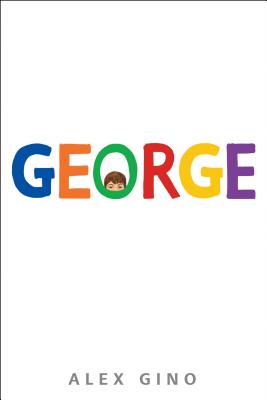
George

by Alex Gino
First sentence: “George pulled a silver house key out of the smallest pocket of a large red backpack.”
Support your local independent bookstore: buy it there!
Review copy provided by the publisher rep.
Content: There’s a lot to talk about and think about here; be prepared for questions. Content-wise, however, it’s simply written,  and so is in the middle grade (grades 3-5) section of the bookstore.

I don’t quite know what I expected from this. It’s got an agenda from the beginning: it’s the first middle grade book about a transgender female child. So, from the start, there’s that underlying the entire book.

There isn’t much plot. George is physically a boy, but identifies as a girl. It’s a secret she keeps from everyone. Except that, as the fourth grade is putting on a play of Charlotte’s Web and George would love to be Charlotte. And she wants to be Charlotte. Which means, in a round about way, being brave and informing people of her true self.

It’s a very open, accepting book; there are bullies, true, but mostly people are accepting once George comes out and confesses her true self. It’s quite liberating.

But, that’s all it is. It’s an important book, true, and an open-minded one. But it’s not really a good book. It’s kind of pedestrian, language-wise, and there’s way too much that’s told and not enough shown. I always felt like I was on the outside, looking in (maybe that was on purpose), and I never quite connected with the story, either. Not that I don’t understand its importance; I do.

I’m just not sure I liked it.

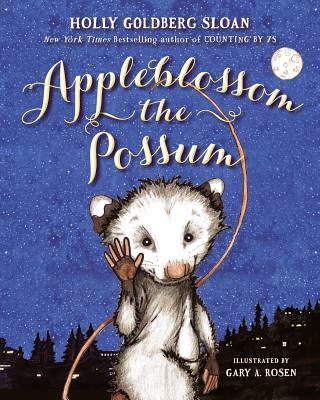
Appleblossom the Possum

by Holly Goldberg Sloan
First sentence: “One moment she’s calm and cozy with a knee in her nose and a tail around her neck.”
Support your local independent bookstore: buy it there!
Review copy acquired at CI3 and signed by the author (squee!).
Release date: August 11, 2015
Content: It’s pretty basic: simple language (though there are a few difficult words thrown in), and a lot of white space and illustrations. It’s probably appropriate for a strong 2nd grade reader and up. I think it’d make a great read-aloud for younger children, as well.

The store’s publisher rep warned me, when she highlighted this book (and I got all excited), that this is a departure for Sloan. And she’s right: talking possums is a bit of a departure for Sloan. But that’s really the only departure; many of the themes — of family and resilience — are the same.

Appleblossom is the youngest of Mama Possum’s first litter (which is why Appleblossom and all her siblings have A names). She’s happy when she’s younger, hanging out with her brothers and sisters, and learning acting lessons from Mama. It was scary, especially the lessons about People monsters and Dog monsters, but she knew she had her family with her. And then the day came that Mama left. (It’s the wild. It happens.) Appleblossom and two of her brothers — Antonio and Amlet (because Hamlet isn’t an A name) — decide that they don’t really want to go off on their own so they stick together in their neighborhood. And then tragedy strikes: Appleblossom falls down a chimney into a house. With a Dog.

First off: I think this is one of those books that would be better read aloud. The way the book is written feels like a story one would tell around a campfire or at bedtime, rather than a book to lose yourself in. The language Sloan uses to describe the people world, and the characters of the possums — the brothers end up meeting their dad, Big Poss — as well as the simple adventures the possums have all lent the story an air of whimsy that lends itself more to reading aloud.

Given that framework, it’s a wonderful tale. It’s full of adventure and humor and charming artwork. I think (even though I didn’t absolutely love it like I did Sloan’s other books), given its intended audience, it’s absolutely perfect.

The Wand & the Sea

by Claire Caterer
First sentence: “Holly Shepard was unlike most twelve-year-olds in that she didn’t at all mid sharing a cramped cottage bedroom with her pudgy, snoring, laptop-loving younger brother.”
Support your local independent bookstore: buy it there!
Others in the series: The Key & the Flame
Review copy provided by the author’s publicist.
Content: It’s kind of slow to start, and the fantasy is more Narnia-esque than Harry Potter or Percy Jackson. Even so, there’s nothing content-wise, and if there’s a 9- or 10-year-old who likes Narnia, they’ll probably love this. It’s in the middle grade (grades 3-5) section of the bookstore.

It’s been a year since siblings Holly and Ben and their British friend Everett have been to the magical land of Anglielle, where Holly can do magic, and where they’re caught up in a good versus evil battle. They’re determined to get back, but this time, the portal they used before won’t work. This time, it’s the water element that’s highlighted. This time, they need to rescue their friends, who have been imprisoned by the king, and try and find the other adepts, who have been exiled from Anglielle.

Of course, it’s not a simple thing: Everett is still playing the role of the sulky somewhat traitor (think Edmund), the prince Avery’s loyalties are still in question. They do meet a group of pirates, on the ship the Sea Witch, that are quite fascinating. And when Holly finally confronts the Big Bad Guy, it’s pretty intense.

I went back and re-read my review/reaction to the first book in the series, and it seems I liked it. I had a less positive experience this time around; the first book didn’t stay with me as much, and it’s been a couple of years, and it took me longer to get into this story. Still, it’s channeling Narnia quite well, and in the end, the adventure was satisfying, while leaving room for another sequel. (I’m starting to suspect there will be four in all; one for each element.)

Not bad, overall.

The Golden Specific

by S. E. Grove
First sentence: “Dear Shadrack, You ask me for news of the Eerie, and I can tell you that there is no recent news of them in the Indian Territories.”
Support your local independent bookstore: buy it there!
Others in the series: The Glass Sentence
Review copy provided by the publisher rep.
Content: It’s a long book, and it’s one of those that take some investment. Probably not for the younger end of the middle grade spectrum, even if it’s in the Middle Grade section (grades 3-5) of the bookstore. I’m actually wondering if these might do better in the YA (grades 6-8) section, with the Philip Pullman books…

I’ll be honest: I don’t really remember what happened in the first book. The good thing? You don’t really need to. There’s no real sum-up at the beginning (thank heavens!) but you get the sense, fairly quickly, about what’s going on. And Grove is nice enough to let us know what we need to know as the book progresses.

Which helps, because there are three story lines going here. One is Sophia’s continuing quest to figure out what happened to her parents 10 years ago. This involves going to restricted libraries and ending up across the Atlantic (accidentally by herself) in the Papal States, looking for the lost land of Ausentintia. (I read that Austen-tia every. single. time.) Her adventures there are weird and wild, and the way Grove messes with time, religion, and fantasy are quite mesmerizing. She makes new friends, particularly Errol and Goldenrod, who are fascinating additions to the world Grove has built.

The second story line is related: it’s the diaries that Sophia goes looking  for, the writing of her mother that Sophia was looking for. (This is a second in a trilogy, so there’s a lot of loose ends.) This was the least interesting part to me; yeah, I was curious about Sophia’s parents, but not especially invested in their journey, so to have the story I was interested in interrupted with this one was a bit annoying.

The third — and my favorite this time around — story line was that of Theo, who stays behind in Boston, and attempts to prove that Sophia’s uncle Shadrack didn’t, in fact, kill the prime minister. It’s a fascinating plot line, full of deceptions and intrigue. Additionally, it has the most intriguing characters; Theo’s new friend, Nettie, is the daughter of the police inspector, and absolutely delightful.

I don’t know if it’s as strong as The Glass Sentence was, but I do think that this will be a compelling series once it’s completed.

The Curious World of Calpurnia Tate

by Jaqueline Kelly
First sentence: “To my great astonishment, I saw my first snowfall on New Year’s Day of 1900.”
Support your local independent bookstore: buy it there!
Review copy snagged off the ARC shelves at my place of employment.
Content: It’s a bit old-fashioned and there are a lot of scientific words, but if you’ve got that sort of 9 year old reader, it’d be perfect for them. It’s in the middle grade (grades 3-5) section of the library.
Others in the series: The Evolution of Calpurnia Tate

I was super excited to find out that my favorite scientific Texan was back in a second installment. I really adored Calpurnia the first time around, and was very excited to spend more time with her. It’s 1900, and Calpurnia is doing her best to keep up with her scientific studies with her grandpa. It’s hard, especially with pressure from both her parents to be more ladylike. Calpurnia would much rather be tromping around the forests and swamps near their central Texas home, collecting specimens. Or studying the stars and weather.

Then a hurricane hits Galveston (a fact which sent me to Google to find out if it was real. It was.), and Calpurnia’s life changes. In to town blows an older cousin (who is, understandably, distraught) and a veterinarian. All of a sudden, Calpurnia has found a calling. The problem? She has to fight to let people even consider the idea of her wanting to be a vet.

Much like the first one, the charm in this is in the narration. Calpurnia is such a delight to spend a book with. This time, I felt her frustration and pain at being a second-class citizen, in her school, in her house, around the town. It seems that everyone, except grandpa, decided already that girls can’t do anything non-girly, and it was a wall Calpurnia kept banging up against. I admired her perseverance in breaking down barriers.

Also, like the first one, I thoroughly enjoyed all the science and the little historical details that Kelly uses to make Texas in 1900 come alive.

Delightful.

Spelled

by Betsy Schow
First sentence: “
Support your local independent bookstore: buy it there!
Review copy picked up at CI3 and signed by the author, who was a delightful person to talk to.
Content: Language-wise, it’s probably more advanced than the younger middle grade set can handle (unless they’re precocious), but content-wise there’s nothing. It’s in the YA section (grades 6-8), but it’d be good for a 4th or 5th grader as well.

You know, living in Kansas there’s one thing we get a lot around here: Oz stories. Seriously. It has its own section in the bookstore. And every time a spinoff comes (or a new reissue of the classic story, or a book about the film), we all kind of roll our eyes, knowing that we’ll have customers who just eat this stuff up.

This book is no exception.

It’s basically a twist on the Oz tale: Dorothy (Dorothea in this version) is a princess in the Emerald tower, and she’s kept captive because of a curse that was placed on her when she was born. As she’s gotten older, she’s grown to hate the restrictions on her life, and so she breaks the protection spell…. and all havoc breaks loose. Magic is turned upside down, the wicked witches are let loose, and suddenly Dorothea, her maid Riz, and her fiance (it happened very suddenly) are on an adventure to set things right.

If you know the plot of the book (or the movie for that matter). you’ll recognize the arc of Dorothea’s quest. And that’s okay. Schow was riffing on the well-known story, adding her own elements (having Ozma be the Hydra and turn into Baba Yaga was a nice tough). But, it was really just okay. The humor was okay. The romance was okay. The twist at the end was… okay. It never really became more than just “this is a decent book.” Which isn’t bad. And I’m sure fans of Oz will really like this one.

I suppose I was just hoping for more than okay.