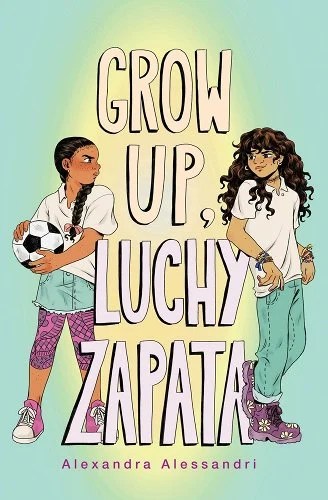
Grow Up Luchy Zapata

by Alexandra Alessandri
First sentence: “It’s a well-known fact that Colombians living outside the motherland will find a way toward each other like magnets.”
Support your local independent bookstore: buy it there!
Review copy pilfered off the shelves at work.
Content: There is some bullying. It’s in the Middle Grade (grades 3-5) section of the bookstore.

Luchy and Cami have been friends their entire lives – it comes from being Colombian in Miami and having parents who are good friends. But, the summer before sixth grade, Cami goes to Colombia and comes back different: she’s into make-up and boys, and wants to “reinvent herself” now that they’re in middle school. Except Luchy likes things the way they are. She’s content with herself and where she is, and she doesn’t want things to change.

But what starts as a change becomes a huge rift, and things escalate until they get out of control. How does Luchy figure out how to navigate middle school without her best friend.

I was talking to a librarian of a K-8 school in a nearby town at the store the other day, and we were lamenting how many middle-grade books had characters who have crushes in them. It’s all fine and good to write characters with crushes, but sometimes, you just need to have a story about kids who are friends and not make it about relationships. Thankfully, Alessandri stuck to the friendship element of the story (Cami has crushes, but it wasn’t a big deal to the story) and doesn’t go down the “who likes who” road. I’m not saying there’s not a place for that; I’m just a little tired of reading books where that is a main element. I like that this one focused on Luchy’s struggle with her heritage – her parents didn’t speak Spanish at home and so she never learned, and she doesn’t really feel connected to Colombia – as well as her friendship with Cami. It’s a good portrayal of the struggle that sixth grade and middle school often is, and I’m glad Alessandri didn’t gloss over the friendship struggles that come along with that.

A really solid middle grade book.

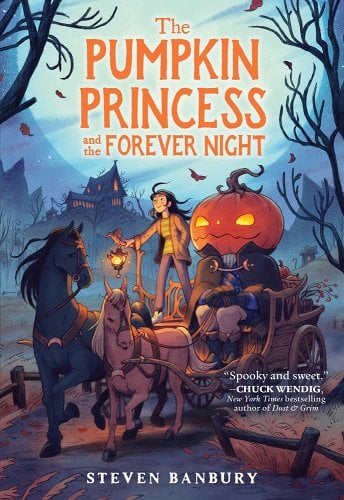
The Pumpkin Princess and the Forever Night

by Steven Banbury
First sentence: “She ran.”
Support your local independent bookstore: buy it there!
Content: It’s a little long, and mildly scary at moments. It’s in the Middle Grade (grades 3-5) section of the bookstore.

Eve was in an orphanage, but she was incredibly unhappy. She had several failed escape attempts, but one Hallows Eve night, she ran away and straight into the path of the Pumpkin King. He was impressed with her spirit, and adopted her on the spot: he needed an heir, she needed a home. It was perfect. Except that she’s living and Hallowell Valley is a haven for the undead – witches, ghosts, gouls, vampires, and werewolves, and the like. She stubbornly makes her home there, and even makes a couple of friends. That is, until things go sideways, and it looks like someone it trying to take the Pumpkin King’s kingdom away. Can Eve and her friends figure out what’s going on before it’s too late?

To be honest: I thought this was a graphic novel when I picked it up. It’s not – just in case you were wondering. But it is a very cozy, very sweet little story of found family and learning to love and making good change where you’re at. I thought it was cute and charming, but I’m not entirely sure it’s going to be one that kids will gravitate to. Maybe certain kids, and I’m sure it would be a very fun Halloween read-aloud. But, I am not sure that it’s one of those books that kids are going to love. I might be wrong. At any rate, I thought it was a clever idea, well-executed, and very sweet in the end.

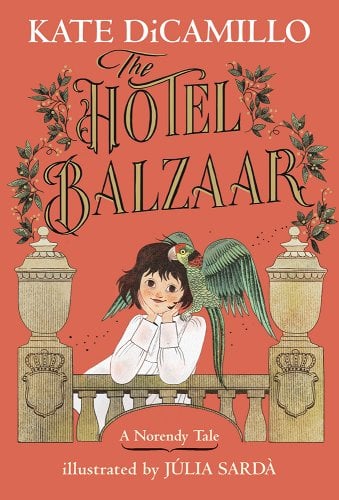
Audiobook: The Hotel Balzaar

by Kate DiCamillo
Read by Allan Corduner
Support your local independent bookstore: buy it there!
Or listen at Libro.fm
Others in the series: The Puppets of Spellhorst
Content: It’s a short book, and there isn’t anything objectionable. It’s in the Beginning Chapter section of the bookstore (grades 1-2) but it could go older.

Lest you think this is a continuation of the puppet story in the first book, it’s not. I think it’s only a “series” because it’s so similar in feel and tone as the first one. There are no continuing characters and you absolutely could treat this as a stand-alone.

Marta is a girl that lives with her mother in the attic of the Hotel Balzaar. Her father is in the war, and has gone missing, and Marta has been told to not make any disturbances. But when an elegant Countess comes to the hotel, Marta finds herself entranced and spends time with the old woman, as she tells her seven stories.

That’s it for the plot. But, much like the first one, the charm is in the telling of the story. Again, like the first one, I think it’s best read aloud/listened to – Corduner does a fantastic job – because it’s not the plot or the characters that drive this book forward, it’s the telling. There’s an anti-war message and a bit about how telling stories gets us through hard times. It’s slight, but it’s enjoyable.

I’m curious to see what DiCamillo does with the next book in the series.

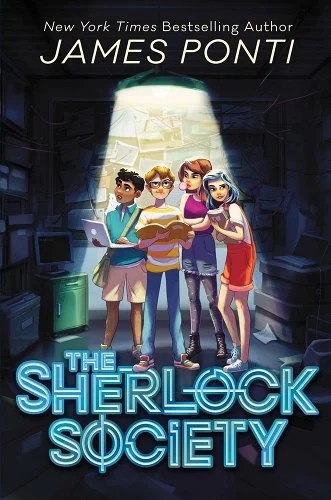
Audiobook: The Sherlock Society

by James Ponti
Read by Marc Sanderlin
Support your local independent bookstore: buy it there!
Or listen at Libro.fm
Content: There are some intense moments. It’s in the Middle Grade (grades 3-5) section of the bookstore.

Alex Sherlock has taken inspiration from his last name and started The Sherlock Society at his middle school. It’s mostly just him and his friends Yadi and Lina, until the last day of school when Alex’s sister, Zoe, joins. She’s the one who comes up with the plan to take this society out into the larger world. With the help of their former-reporter grandfather, they set out to find a mystery to solve.

What starts out as trying to find Al Capone’s buried treasure in the Miami area turns into a discovery of corporate corruption and environmental disaster. Can they prove their case, or will the end up taking the fall?

Oh, this one was a lot of fun. I really liked Sanderlin’s narration; it was a good combination of earnest and deadpan to reflect the middle-grade book. Some moments were intense (I can see a younger kid being on the edge of their seat!) and it was often hilarious. I liked that the kids all had good parents (it was the grandpa out there helping them get into trouble, of sorts) and that their lawyer mom kept things mostly above board. It was a solid mystery, too; I guessed the ending but not too long before the characters got there.

I’ve had a coworker who has been trying to get me to read James Ponti’s spy series, and after this one, I think I really need to give it a try. He’s a fun writer, and I’m impressed with this book.

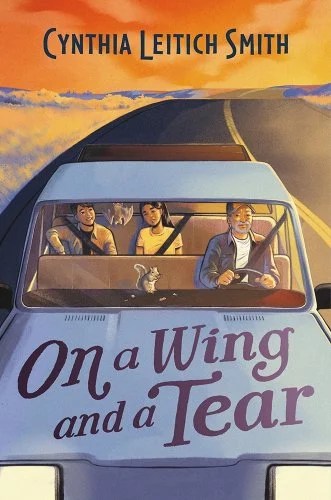
On a Wing and a Tear

by Cynthia Leitich Smith
First sentence: “Hesei, cousins!”
Support your local independent bookstore: buy it there!
Content: There are a couple of intense moments. Otherwise, it’s a short book with short chapters. It’s in the Middle Grade (grades 3-5) Section of the bookstore, but I’d give it to a good younger reader as well.

Mel and Ray are off for spring break, and the only thing they want to do with Grandpa Halfmoon is go to a Chicago Cubs game. Except they are thrown a loop: Great-Grandfather Bat was injured and is recuperating in Mey and Ray’s backyard. And he’s been summoned to another Birds vs. Animals baseball game, and it’s up to Grandpa, Mel, and Ray to take Great-Grandfather Bat from Chicago to Georgia.

It’s a road trip!

There are adventures on the way, as they make the trek, stopping to see relatives in Kansas and Oklahoma, before getting Great-Grandfather Bat to his game.

On the one hand, this was a sweet modern folk tale. It has the cadence of a Bre’r Rabbit tale – the omniscient narrator talking directly to the reader, with folksy asides. And I do like the way Smith weaves in Native traditions, cultures, and challenges throughout the book. But it wasn’t quite a straight-up fantasy (Smith even says it’s not fantasy, it’s fiction, even though she warns not to interact with wild animals the way these characters do) but it wasn’t a realistic fiction book either. Maybe it was that there was a little bit of everything and the whole didn’t quite add up.

I didn’t hate the book, but it wasn’t my favorite either.

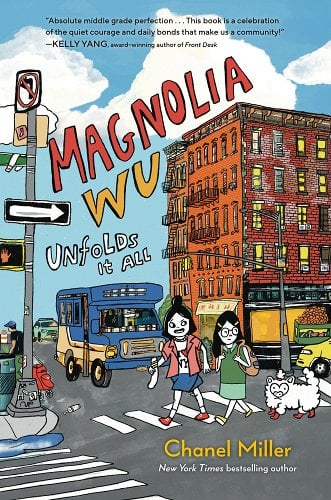
Magnolia Wu Unfolds it All

by Chanel Miller
First sentence: “Magnolia Wu was almost ten.”
Support your local independent bookstore: buy it there!
Content: It’s heavily illustrated, short, and with lots of white space. It’s in the Middle Grade (grades 3-5) section of the bookstore, but I’d give it to a precocious younger reader as well.

While Magnolia likes her family’s laundromat, she feels like nothing ever happens. Then, the summer that she turns 10, she and her new friend Iris decide to return all the lost socks that have been left. What follows is an adventure as Magnolia and Iris learn about their neighbors in their New York City neighborhood.

It’s a cute little book, full of fun illustrations. There’s not much depth to it: Magnolia and Iris solve one little sock mystery after another while Magnolia learns the value of hardworking, caring parents, and Iris and Magnolia navigate a friendship.

Cute, especially for those beginning/struggling readers.

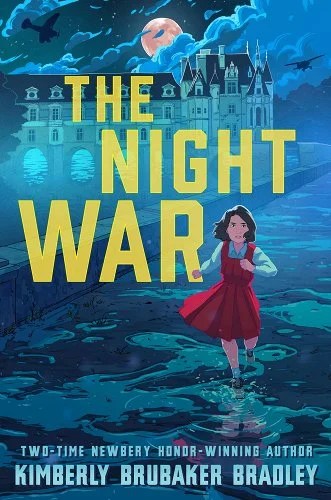
The Night War

by Kimberly Brubaker Bradley
First sentence: “I could hear sirens.”
Support your local independent bookstore: buy it there!
Content: There are intense moments, including a round-up of Jews to go to concentration camps. It’s in the Middle Grade (grades 3-5) section of the bookstore.

Miri and her parents are living in Nazi-occupied Paris in 1942, after fleeing Germany after the kristalnacht. They’re making do in a small apartment, but they have Jewish neighbors and it’s working. That is, until the French police raid the neighborhood and round all the Jews in France up. Miri escapes with her neighbor’s 2-year-old daughter, Nora, and after finding refuge in a nunnery (the nun saved her from an interaction with a Nazi soldier), she is separated from Nora and sent to a Catholic school in the French countryside. She has to pretend to be a Catholic, which is hard. The only bright side is that she’s close to the Vichy border, and escape. Can she find Nora and get across before she is found out?

On the one hand: this is a well-written book. (I have issues with the ghost, but aside from that.) Bradley knows how to pace a story and knows how to make a historical story relatable (in this one: all religions are valid, we shouldn’t be afraid of those who are not like us, we shouldn’t believe the propaganda we hear). However, I am just so tired of World War II books. I just am. I know these stories need to be told, but I am so so very tired of them. And, I don’t think that the ghost in this one was necessary. Bradley used the ghost as a narrative cop-out – Miri was the only one who could see the ghost and it helped her get out of sticky situations.

I just wanted more (or something entirely different) from this one.

The Cookie Crumbles

by Tracy Badua and Alechia Dow
First sentence: “Generally speaking, cookies don’t kill people.”
Support your local independent bookstore: buy it there!
Content: There is talk of almost-murder, and there are some intense situations. It’s in the Middle Grade (grades 3-5) section of the bookstore.

Laila loves to bake. Lucy is a budding reporter. They both want to get into the prestigious Sunderland boarding school, and the cookie competition hosted by the school, with the grand prize of a scholarship, is the only way they can make it work. The plan was for Laila to bake and be brilliant and for Lucy to write and be brilliant. What they didn’t anticipate was one of the judges – Chef Remy – almost dying after eating one of Laila’s cookies. Now, they need to figure out who tried to kill Chef Remy (it wasn’t Laila!) – especially since there was a storm that wiped out all the ways to get into and out of Sunderland.

This was a fun little mystery. The stakes were high – a lot of the other kids had motives to hurt Chef Remy – but it wasn’t so high that it would scare younger kids. The clues were there to figure it out if you were paying attention (I did), but it was clever enough to keep me entertained. I liked that the authors conceived of a clever way to get parents out of the picture – it was kind of like a sleep-away camp for the competition – so that it wasn’t weird that the kids were running around the school by themselves. I liked the alternating chapters between Laila and Lucy, and I thought it was all done very well.

A really solid Middle Grade mystery.

Audiobook: Buffalo Dreamer

by Violet Duncan
Read by Ashley Callingbull
Support your local independent bookstore: buy it there!
Or listen at Libro.fm
Content: There are some tough subjects, including the residential schools, but they are handled in an age-appropriate way. It’s in the Middle Grade (grades 3-5) section of the bookstore.

Summer is looking forward to a relaxing summer at the rez in Alberta where her mom grew up. But this year, there is a change: they have discovered a mass grave at a closed-down residential school where Summer’s grandfather was forced to attend. Additionally, Summer is having vivid dreams about a girl who ran away from a residential school and walked through a blizzard to escape.

It’s not a long book or even a harrowing one. But it is a sweet story about respecting and learning history, even (or maybe especially) hard history. Summer’s mom and aunties doesn’t think she’s ready to learn the history, and her grandfather is hesitant to speak about it, but when Summer shares the dreams, they are more willing to admit that talking about the hard and painful history can be a healing thing. I also appreciated learning about Summer’s heritage and family traditions as we went along; Duncan was excellent at weaving the small details in with the larger story.

The narrator was excellent as well; I really love listening to books by Native authors in audio because I know I would have no idea how to pronounce some of the words. I thoroughly enjoyed this one.

Ultraviolet

by Aida Salazar
First sentence: “Who invented love, anyway?”
Support your local independent bookstore: buy it there!
Content: There is some sexual objectification of middle-school girls by middle-school boys. It’s in the YA section (grades 6-8) of the bookstore.

At the start of eighth grade Elio Selis starts noticing changes. Specifically girls. There are other changes too, with his body and with his friends, but all of a sudden girls are on his radar. Camellia in particular. He most definitely likes her, and she likes him back. Things are perfect for a while – ultraviolet, Elio things – but then things go south. Camellia takes up with a guy that Elio thinks is trash, and his heart is broken. He discovers he has an undetected heart problem that needs to be fixed. His parents decide that he and his dad need to join a Circle as a way to express and learn about masculinity. It’s all very confusing.

In the afterword, Salazar says she wrote this for her son, once she realized that there weren’t many books out there depicting what it’s like for boys to go through puberty, to feel their feels, to explore what it means, and how to be a man, and she wanted to write one. Which she nails. I didn’t particularly like puberty or being 13 or eighth grade, but I think Salazar gets all the big emotions and the big feelings and the confusion that goes along with that time in one’s life. She handles it all with grace and with compassion: Both Elio and Camellia make mistakes as they try to figure out what “relationships” and “liking” and just what feeling feelings mean. And it’s wonderfully age-appropriate. It’s an excellent book to hand kids in the 11- to 12-year-old range, on the cusp of all of this, to help them navigate it. I’m not sure there are many adults who would buy this for their boys, but honestly: they should. It’s an excellent book about growing up, learning to be a compassionate and kind person, and how to navigate an incredibly confusing and difficult time of life.