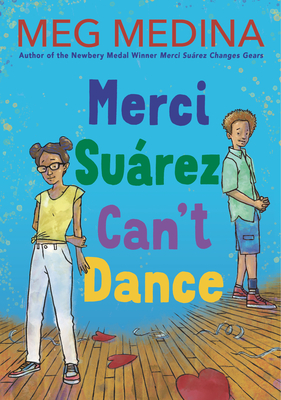
Merci Suarez Can’t Dance

by Meg Medina
First sentence: “It was Miss McDaniel’s idea for me and Wilson Bellevue to work together in the Ram Depot, a job that nobody wants.”
Support your local independent bookstore: buy it there!
Content: There is talk of kissing, periods, and puberty. It’s in the middle grade (grades 3-5) section of the bookstore, but I bet 6th graders would love this.
Others in the series: Merci Suarez Changes Gears

It’s halfway through seventh grade, and Merci is kind of (sort of) figuring things out. She’s not happy with her grandfather’s continuing descent, and her aunt isn’t around as much anymore, leaving Merci to babysit her terror twin cousins. And at school she’s trying to get along with Edna, but it doesn’t seem to be working well. And now, there’s the Heart Ball, the seventh grade fundraiser, which Edna is in charge of, and Merci is trying to avoid. But there’s Wilson, the boy she runs the Ram Depot with and maybe (?) may like-like. It’s all, well, a LOT.

This book had a ton of heart. I loved Merci trying to figure her way out, and I adore her family and the way they have each other’s backs. I loved the way Media wrote a character that was dealing with Alzheimer’s, and how the family worked to make his life easier. You could just tell how much the family loved each other. And I liked the middle school angst of it as well. Merci was delightfully awkward, making the best decisions she could, mostly, and terribly realistic. It was just a delight to read.

I know this book wasn’t really “necessary”, but I’ll take more Merci books any time.

Me, Frida, and the Secret of the Peacock Ring

by Angela Cervantes
First sentence: “Whether she liked it or not, Paloma Marquez was in Mexico City for a whole month. “
Support your local independent bookstore: buy it there!
Content: There are a few intense moments. It’s in the Middle Grade (grades 3-5) section of the bookstore.

Paloma is being dragged to Mexico City because her mother has a fellowship there. It’s the home of her father, who died when Paloma was young, but even that doesn’t make Paloma any less grumpy about not being able to spend the summer with her friends by the pool back in Kansas City.

Once in Mexico, though, things start to change. She discovers the art of Frida Kahlo, art that her father loved, and then meets twins Gael and LIzzie, who pull Paloma into solving a mystery: who stole Frida’s peacock ring.

This was a fun little mystery. Paloma did most of the work, figuring out clues, and learning about her father’s heritage as she worked on the mystery. The book was full of facts about Frida and her life and art, as well as small bits about life in Mexico City. Cervantes never tried to make Paloma Mexican; she was always American, she always looked at life from the outside, but she learned to appreciate the culture and language and life around her.

It was a fun read, and possibly my favorite of Cervantes’ books.

Black Boy Joy

edited y Kwame Mbalia
First sentence: “Homegoing.”
Support your local independent bookstore: buy it there!
Content: there is some slight romance. It’s in the middle grade (grades 3-5) section of the bookstore, but my teacher considered it a YA novel, so it’ss good for all ages?.

Here are the things I liked about this book:

It’s super diverse, even though all the authors are black men. There are science fiction stories, poems, art, contemporary stories, and ones based in mythology. They have protagonists that are non-binary, interested in sports, and interested in music and art.

It focuses on joy and celebration, even when it touches on hard things like funerals.

It’s a delight to read.

Not all the stories are equal, but that’s to be expected in a short story collection. And sometimes the joy felt unearned, but that’s because we weren’t given enough time with the characters. (Another fault of short stories.)

Even with the faults, it’s an excellent collection. Highly recommended.

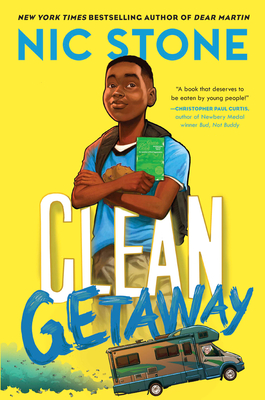
Clean Getaway

by Nic Stone
First sentence: “It might sound silly, but to William “Scoob” Lamar, the Welcome to Alabama the Beautiful sign looks… well, beautiful.
Support your local independent bookstore: buy it there!
Content: There are some uncomfortable moments. It’s i the middle grade (grades 3-5) section of the bookstore.

William “Scoob” Lamar is having a rough year at school. First, he got in trouble for beating up a bully who was making fun of Scoob’s st friends’ younger brother. Then, he figures out how to cheat on a programming quiz, and shows other kids how to do it. He doesn’t cheat, but ends up suspended because he was the “instigator” of it all. He’s at hoe, grounded, with the spring break trip canceled. But, just when all hope was lost, his G’ma sows up with an RV asking him to take a strip with her. So, he does. and leaves his phone at home, so his dad can’t stop him from going.

But, things aren’t what Scoob expected.. While the history of his (white) grandma and his (black) grandpa is interesting — his grandma kept the Green Book that helped them travel safely though the south during the Jim Crow era — things aren’t, well, right. His grandma keeps changing the plates on the RV. She won’t answer calls from Scoob’s dad. She is being super cagey. While Scoob enjoys the history, he’s not entirely sure this vacation is all it’s cracked up to be.

This is what I wrote for my class (spoilers): “Scoob’s grandfather was arrested for grand larceny and died in prison but in the end we find out that it was Scoob’s grandmother who had stolen the jewelry. She literally let a black man take the fall for her crimes. A person she was supposed to be in love with! That she had a son with! The ending didn’t provide a lot of resolution; instead of getting punished for her life of crime (she had been stealing jewelry for YEARS), she got cancer and died. And then Scoob found her stash and got his dad to drive it to Mexico to bury it. I have NO idea what to think about this. I get the underlying message is that white people are not to be trusted, even if you’re related. That a white person will always find a black person to blame things on.”

Someone in the class pushed back and said they thought the underlying message was more about how our actions can affect more than just ourselves, and maybe that’s a better way to look at the book. It does make it more age appropriate. At any rate, the book did give me a lot to think about.  

Two Black Historical Fiction Books

Finding Langston
by Lesa Cline-Ransome
First sentence: “Never really thought much about Alabama’s red dirt roads, but now, all I an think about is kicking up their dust.”
Support your local independent bookstore: buy it there!
Content: It’s short, with short chapters and about an 11-year-old. There is some bulling. It’s in the middle grade (grades 3-5) section of the bookstore.

Set in 1946, the book follows 11-year-old Langston, who has recently moved to Chicago with his father from Alabama. It’s a bit about a southern Black family trying to make a life in a big city. It’s not easy: they live in a one room apartment, Langston is bullied because of his accent, and they don’t have the comforts of family being nearby. The one thing Langston finds that is welcoming is the branch of the Chicago Public Library . he finds Black authors and learns about Langston Hughes. It makes grieving for his dad mother and the dealing with the bullies at school easier.

It’s a sweet family story, one with sympathetic characters (I even liked the dad), and a good look into issues surrounding the Great Migration. It went quick because it was short, but it had some complex character development and dealt with touch issues like classism and Northerners looking down on their Southern neighbors. I’m glad I read it.

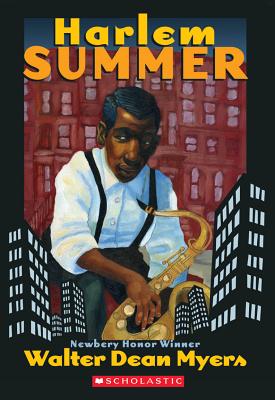
Harlem Summer
by Walter Den Myers
First sentence:”I like Harlem in the summer except when it gets too hat, which it had been for the last week and we hadn’t even reached July yet.”
Support your local independent bookstore: buy it there!
Content: There is some violence and talk of people drinking but it’s short. It’s in the Teen section of the library, but I’d probably up t it in the YA section (grades 6-8) of the bookstore.

Set in Harlem in the 1920s, it follows the summer of a 16-year-old named Mark. He gets a summer job at the Crisis, a magazine run by WEB DuBois celebrating the “New Negro”. All Mark wants to do, though, is play his saxophone and impress Fats Waller (who was a real person!) with his jazz. Unfortunately, that gets him into a whole mess of trouble involving stolen whiskey, gangsters, and Langston Hughes.

I didn’t like this one as much, partially because I felt like it was a who’s-who of 1920s Harlem, which is fine and all, but doesn’t led itself to a really great plot. But I also kept thinking of Kendi’s description of assimilationists, and how they wanted Black people to “prove” themselves to white people. That was a huge part of the book, the talk of “New Negros” and how the 10% was going to save the rest of the race. And that’s just, well, racist. Myers may have been poking fun at them; in the end Mark decides that the Crisis and the people there aren’t nearly as much fun or interesting as the people involved in jazz music. Even so, it bothered me. I didn’t hate the book, but I did struggle to finish it, and it just wasn’t what I had hoped it would be.

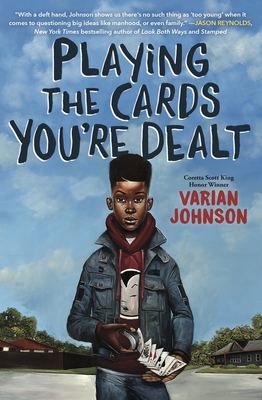
Playing the Cards You’re Dealt

by Varian Johnson
First sentence: “The house always wins.”
Support your local independent bookstore: buy it there!
Review copy provided by the publisher.
Release date: October 5, 2021
Content: There is talk of addiction in adults, some bullying, and a mild “relationship”. It will be in the Middle Grade (grades 3-5) section of the bookstore.

AnthonyJoplin — Ant to his friends, but don’t call him little — comes from a family of serious Spades players. His grandfather, his father, his brother, were all really great at it, winning the local tournament (and then some). But Ant can’t seem to get in the game. He’s “weak”. Or that the way he feels, especially around his dad, his brother, and his friend. That he needs to be stronger, better. He needs to win the tournament, for starters.

He and his friend make a good team, but when his friend is unexpectedly unable to play, Ant turns to the new girl – Shirley – as a partner. Which is its own set of problems. Add to that his father is acting weird, staying up in the middle of the night playing online poker, and Ant is just confused about what he really is supposed to expect out of life.

I love that Johnson gets the middle grade audience, tackling touch subjects like addiction and masculinity without talking down to his readers. I love that he gives us characters that are interesting and complex, which makes them and their problems seem more real. I love that he sprinkles his books with humor, so they are not depressing, but rather reflect life’s ups and downs.

The only think I didn’t like about this book was the narrator: I liked the folksy aspect of it, with the slang and the way it felt like someone telling a story, but I often felt the narrator — who was a character in their own right — got in the way of the story.

But it was’t enough to turn me off of this book. Definitely another very good read!

The Elephant in the Room

by Holly Goldberg Sloan
First sentence: “What SilaTekin would remember about that afternoon was that she had been wearing her favorite shirt.”
Support your local independent bookstore: buy it there!
Content: It deals with heavy subjects, but on an accessible level. It’s in the middle grade (grades 3-5) section of the bookstore.

Sila Tekin has lived in Oregon all her life, but her parents are immigrants from Turkey. They’re in the United States legally, but one day, Sila’s mom gets deported because her paperwork is not “correct”. It was supposed to be short deportation, but turns into nearly a year as Sila and her dad become more and more depressed. Enter Gio – an older man whose wife passed four years earlier and who recently won the lottery. The three of them – and they add a school mate of Sila’s, Mateo, later – make a sort-of family, helping each other through the process of healing. And then there’s an elephant.

The elephant is a rescue from a family circus, and brings more healing for our characters. I think Sloan was trying to advocate not only against circuses but in favor of humane animal treatment in captivity. She also had a strong case for elephant-human bonding. I just think Sloan really likes elephants.

The story itself was… okay. I think it’s good for a picture of immigration — and as a reminder that not every immigrant comes through from the southern border — and to help kids deal with tough situations. I’m just not sure Sloan was the best person to tell this story. Sloan says she has been profoundly affected by her time in Turkey, but I think this story may have been told better by someone who has had the experience of being an immigrant.

It’s not a bad book, but not my favorite by her either.

Unsettled

by Reem Faruqi
First sentence: “I grab Asna’s hand, palm to palm.”
Support your local independent bookstore: buy it there!
Review copy provided by the publisher.
Content: It’s a novel in verse, so even though it looks long, it goes quickly. There is some talk of bullying and dementia. It’s in the middle grade (grades 3-5) section of the bookstore.

Nurah is happy with her life in Pakistan: she has friends at school, she lives near her grandparents, and loves her home. But then, her father gets a job offer in Peachtree City, Georgia, and relocates the family there. Nurah finds it hard to adapt: she is out of place at school and her brother, whom she used to have a good relationship with, is increasingly distant. The one place Nurah feels at home is the rec center swim team; she’s not the best, but she feels at home in the water.

This was a very sweet and heartfelt story. I thought it worked really well as a novel in verse; it was simple without being simplistic. And Nurah’s challenges with fitting in at school, getting along with her increasingly distant brother, a grandmother with dementia, and just experiencing a new country are presented in a way to make them incredibly relatable.

It was a charming book, but one with a deeply felt heart.

Otto P. Nudd

by Emily Butler
First sentence: “‘Otto, you’re splendid,’ mumbled Bartleby Doyle.”
Support your local independent bookstore: buy it there!
Full disclosure: the author is a friend of a friend, and I am friends wtih her on social media.
Content: The font is pretty large and there are illustrations on every chapter header. There is some talk about parent deaths. it’s in the Middle Grade section (grades 3-5) of the bookstore.

Otto considers himself a Very Intelligent Bird. He was raised in captivity by Bartleby Doyle, but the Old Man (as Otto calls him) has let Otto go free, to make a nest nearby. Otto still comes and helps Bartleby with his inventions, but he really just wants to make sure the neighborhood is in order. This means he’s not very nice to the other birds and animals. However, when Bartleby has an accident, and Otto can’t get in the house to push the emergency button, Otto is forced to turn to the “lesser” birds and animals in the neighborhood to help him out.

I am sure there is some animal-loving second- or third-grader out there who is just perfect for this book. Butler has a very chatty style and is often very humorous in spots. Otto — and Marla the squirrel and Pippa the girl – is an interesting character to hang with for a while, and there is a very delightful birds vs. raccoons skirmish at the end. The book has a nice lesson about making amnends and resitution for wrongs (even if it is just hurt feelings).

But this just didn’t rise above the level of “just fine” for me. And I get it: I am definitely not the target audience. (And, to be honest, I wasn’t when I was in third grade, either.) That doesn’t mean it’s not a good book. It’s just not one for me.

From the Desk of Zoe Washington

by Janae Marks
First sentence: “The day I turned twelve, I was certain it’d be my favorite birthday yet, but then I got the letter.”
Support your local independent bookstore: buy it there!
Content: It talks about wrongful imprisonment, but in a very age-sensitive way. It’s in the middle grade section (grades 3-5) of the bookstore, but would probably be good up through 6th or 7th grade.

Zoe is just a normal twelve-year-old: she likes hanging out with her friends, she lvoes baking, and she just wants to enjoy the summer (even though she’s currently fighting with her former best friend and neighbor, Trevor). Then, on her birthday, she finds a letter from her biological dad, Marcus, whom she’s never met, because he was arrested and convicted of murder before she was born.

Curious, she opens the letter, and then decides — against her mom’s will — to write him back. They start a relationship of sorts and when Zoe asks why he’s in prison, Marcus says he is innocent and was convicted wrongly. That sets Zoe off on a hunt to prove to herself — and her mother, and possibly the world — that Marcus is who he says he is. Along the way, she gets an internship at a bakery and learns a bit about that world, and makes up with Trevor.

It’s a very sweet little book, this (no pun meant with the baking, though I do wish there was a recipe for the Fruit Loop cereal cupcakes in the back) story of a girl getting to know her biological dad. Marks finds a balance with the parents — Zoe isn’t trying to replace her stepdad, whom she calls “dad” — but she does want to know this person who, up until this point, was just a sperm donor. I liked that Marks brought out that the prison system is not always about justice: Marcus had a bad lawyer, yes, but Zoe’s mother was also convinced that because the system found Marcus guilty that must have meant he was. We’re all so conditioned to believe that, and I appreciate that Marks explained that it’s not true in a way a younger kid could understand. I liked that Zoe had a good support system of adults around her, but that she also gets in trouble when she does things that, well, a kid would get in trouble for.

It was a very charming book, and one that is dealing with heavy subjects — like wrongful imprisonment — but not in a heavy-handed way. I truly enjoyed it!