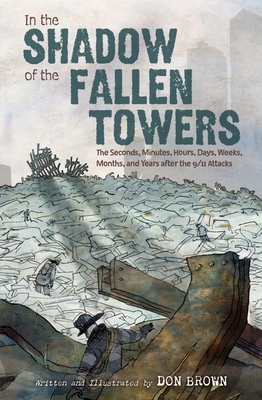
In the Shadow of the Fallen Towers

by Don Brown
Support your local independent bookstore: buy it there!
Content: It’s not graphic, but it is frank about the events of 9/11.

The subtitle of this book says it all: The seconds, minutes, hours, days, weeks, months, and years after the 9/11 attacks.

It’s a good anniversary book, timed to come out on the 20th anniversary of the attacks. It essentially covers the events of that day and the following days, focusing on personal stories. Probably a good introduction to someone who knows nothing about the attacks (say, young kids these days, though my kids still get remembrances in school). The art is done in grays and browns, keeping it from being too graphic, and underscoring the seriousness of the story.

But.

I am tired of 9/11. I am tired of remembering. Especially in this time of COVID, when more than the number of people who died in the attacks have died every single day. I am tired of rallying around the “remember New York” cry. I am tired of this America.

So, no, this book wasn’t the best thing for me to read. Perhaps someone else will enjoy it more.

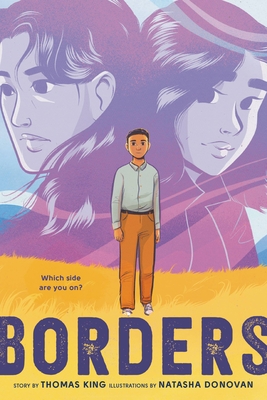
Borders

by Thomas King, illustrations by Natasha Donovan
Support your local independent bookstore: buy it there!
Content: There are some moments that might be intense for some readers. It’s in the middle grade Graphic Novel section of the bookstore.

The premise is simple: A boy and his mother want to go visit family in Salt Lake City from Canada. However, when they get to the border, the customs agents want them to declare a country The mother says “Blackfoot” which isn’t an acceptable answer. The rest of the book is the story of them being caught in the space between border crossings and how they get out.

It’s a simple story, but a powerful one. I admire the way the mother stuck to her values: they are Blackfoot, not Canadian, and that should be an acceptable answer for border crossings. The art is clear and realistic but not overly so. It was the story that I really appreciated in this one. I appreciated the back story about their lives, even if the only person named was the sister, and I enjoyed the way this story was resolved. It may not be the most brilliant graphic novel out there, but it is an important and interesting one.

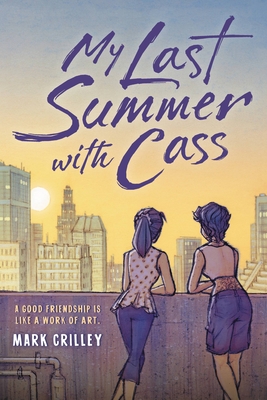
My Last Summer with Cass

by Mark Crilley
Support your local independent bookstore: buy it there!
Content: There is some teenage drinking and nudes in art. It’s in the graphic novel section of the bookstore.

Megan and Cass have known each other their whole lives. They used to spend summers together in a cabin by a lake in Michigan, and that’s where they discovered their mutual love of art. But., as they got older, Cass’s family stopped coming and they grew apart. But the summer fore their senior year, Megan begs her parents to go spend the summer in New York City with Cass. What Megan experiences when she gets there, though, opens her eyes to a whole new art world.

This in some ways is very much a small-town girl is changed by big-city ways” book. Megan is a midwesterner, Cass is a New Yorker. Her ways, especially when it comes to art, are better. Of course. As a midwesterner, I kind of resented that. There is personal growth for both Megan and Cass, which is good, but I really felt the story felt flat. What did amaze me is the art. It’s a gorgeous book. Simply stunning to look at. But that wasn’t enough for me to really love it.

Measuring Up

by Lily LaMotte and Ann Xu
Support your local independent bookstore: buy it there!
Content: There is some pressure on a character by a parent, which may be triggering for some. It’s in the Middle Grade Graphic Novel section of the bookstore.

Cici and her family live in Taiwan. She’s happy; she has her A-ma there to keep her company while her parents work and to teach her how to cook. So when Cici’s parents take jobs in America, Cici is heartbroken. Especially since A-Ma isn’t coming. Life in America is strange, and Cici wants to find a way to help A-Ma visit, so she enters a cooking competition for kids. The only problem is that Cici only knows how to cook Taiwanese dishes, and not “American”. She learns about Julia Child (yay!) and practices and practices to become better. And yet, she doesn’t want to lose her own identity and heritage.

What a delightful book! I loved the meshing of the immigrant story and food. There is a huge metaphor about how immigrants have to balance assimilation and their own heritage. There’s also a theme about finding your own path and not the one that your parents set out for you. I loved the characters, and how Xu drew them. She also met the challenge of drawing food and cooking, which isn’t easy.

I adored this one.

Across the Tracks

by Alverne Ball and Stacy Robinson
Support your local independent bookstore: buy it there!
Content: There are depictions of violence, including lynching. It’s in the graphic novel section of the bookstore.

In the early 1900s, due to Jim Crow, the Blacks in Tulsa developed their own community. They had stores, libraries, doctors, and were a thriving community. Of course, because of white supremacy, the white people in town couldn’t have the Blacks getting all successful. They invented a reason to arrest and lynch a Black kid, and then, when the Black families rose up in defense, burned the Black part of town, killing and unhousing families. The Black people built things back, but it wasn’t ever the same, and the white people swept history under the rug.

This is a very good history of that moment in time, highlighting the achievements of the Black people — doctors, lawyers, businessmen, educators — as well as the maliciousness of the white people. The text is pretty frank, and the art reflects that: it’s realistic and descriptive.

I think this is an important graphic novel and one that everyone should read. But, I’m not sure it was a great graphic novel It was lacking something to bring me into the story – perhaps because it was history and not really a story. it lacked a personal element, something to make me really care when the Black part of town burned. (That sounded harsh; I mean I care that white people were awful and racist and destructive. I just meant the story lacked an emotional core, if that makes sense.)

Recommended for the history.

Chunky

by Yehudi Mercado
Support your local independent bookstore: Buy it there!
Content: There is talk about weight loss and body issues, including some bullying, which might be triggering. It’s in the middle-grade graphic novel section of the bookstore.

Hudi is a bit overweight and his parent and doctors think he should join a sport to lose weight. The only thing that keeps Hudi engaged in the sports — he’d rather be telling jokes — is his imaginary friend, Chunky, who is Hudi’s own personal cheerleader. But when Hudi gets in with a group of boys who want him to be something other than he is, Chunky and Hudi get into a fight (can you get into a fight with your imaginary friend?) and Hudi has to decide what’s truly important.

I wanted to like this one. It’s got a Jewish Latinx main character (and author). It’s sometimes funny. But it mostly just made me uncomfortable. I suppose there are some kids out there who might like it, and perhaps it’s good for representation and empathy’s sake, but mostly this was a hard no from me.

Cheer Up: Love and Pompoms

by Crystal Frasier, illustrated by Val Wise, lettered by Oscar O. Jupiter
Support your local independent bookstore: buy it there!
Content: There is some bullying and a boy who won’t take no for an answer (though nothing “bad” happens). It’s in the graphic novel section of the bookstore, but I’d say 5th grade and up would enjoy it.

Annie is smart, but has a problem: she’s often antagonistic and her high school counselor thinks she needs to join something to show colleges that she can actually work with other people. She suggests going out for the cheerleading team. Bebe is an out trans girl, the captain of the cheer squad, but her parents are unhappy with her grades. The two of them form a team: Annie will help Bebe with her grades, and Bebe will help Annie become, well, more likable.

I went in thinking this was going to be a “cheerleader” book – yes, I have some deeply ingrained biases against cheerleaders — but came away absolutely loving this one. I liked the diversity on the team, not just ethnicities, but also shapes and sizes. It defied the expectations that a cheerleader has to look one certain way. I also appreciated how the cheerleaders were allies — the book very subtly teaches allies how to be better ones — and accepting of Bebe. It’s a simple story, but there are complex emotions and the art is good at reflecting what the characters are feeling.

I hope there is more in this series; I would love to spend more time with these characters.

Cranky Chicken

by Katherine Battersby
Support your local independent bookstore: Buy it there!
Content: To be honest, this is more of an early chapter book than a graphic novel. Think of it one step up from Elephant and Piggie. It’s in the Beginning Chapter book section (grades 1-2) of the bookstore.

Cranky Chicken is cranky. That’s just how it is. And then one day, she inadvertently kicks a leaf off a worm, and suddenly Cranky has a friend (which she’s not sure she wants): Speedy the Worm. From there, the book is a hilarious exploration of them getting to know each other and becoming friends.

Oh my goodness, this was so funny. I haven’t laughed this hard at a book this simple since Elephant & Piggie. Cranky Chicken is supposed to be cranky, but really he’s just charming and funny. I enjoyed Speedy’s optimism — it was just the right amount — and their adventures together. The drawings are simple but evocative and funny.

I know humor is subjective, but I found this one just delightful.

Friends Forever

by Shannon Hale and LeUyen Pham
Support your local independent bookstore: buy it there!
Others in the series: Real Friends, Best Friends
Content: There is talk of crushes and “going together” and mental illness. It’s in the middle-grade graphic novel section of the bookstore.

It’s eighth grade, and Shannon finally feels like things are going to go Her Way. She’s basically found her people in the drama club and thinks she understands how to navigate middle school. Except, she doesn’t feel beautiful, compared to her best friend, Jenn. There are friendship ups and downs. Her classmates keep asking whether she and her other best friend, Andrei, are “going together”. It’s hard when everything everyone says sticks in her brain, rumbling around, making her question her worth. (I get that.) Is she “good enough”? Can she even be good enough? Will anyone really gruly get and like her?

This is such a smart book: Hale and Pham get not just the mid-1908s (it’s the 1987-1988 school year), but the inherent angst of being 13/14. There are good moments, ones where Hale captures the silliness of young teenagers, but also ones that she uses as teaching moments, like the time she was assaulted by a mall Santa. She is open about her mental illnesses, and the mistakes she made (and her parents made) as a teenager — most telling was the way he “threw” her appointment with a therapist. It was the 1982s; therapy was only for “bad” people, and she didn’t want to be seen that way. It does have a hopeful ending, though. And Pham’s art captures everything perfectly.

I am going to miss this series, but I can’t wait to see what Hale and Pham do next.

Graceling

by Kristin Cashore, illustrated by Gareth Hinds
Support your local independent bookstore: buy it there!
Content: There is some violence and an implied sex scene. It’s in the graphic novel section of the bookstore.

Graceling, if I had to choose, is one of my favorite books of all time. So, I’m glad it exists in graphic novel form if only to draw in more readers to the world that Cashore has built. And I admit that I’ve been meaning to reread these before reading Winterkeep (I’ve been putting it off), and reading the graphic novel gave me a reason to read it without having to actually read it.

On the one hand, it was wonderful to be back in Katsa’s world, to see the story that Cashore built, follow its twists and turns. And Hinds’s illustrations are pretty great; I loved the way he illustrated the fights, and how he imagined Cashore’s world.

But I think the graphic novel diluted some of the impact of the novel (or maybe it’s just because I know what’s going to happen). It didn’t have the same punch that the novel did. I didn’t feel the same connection for the characters, the same dread. Maybe, though, it’ll inspire people to pick up the books. Or maybe Hinds will illustrate the other ones. Either way, I’m glad I got a chance to visit the world again.