Calamity Jack

by Shannon Hale, Dean Hale/Illustrated by Nathan Hale
ages: 9+
First sentence: “I think of myself as a criminal mastermind… with an unfortunate amount of bad luck.”
Review copy provided by the publisher.
Support your local independent bookstore: buy it there!
Release date: January 5, 2010

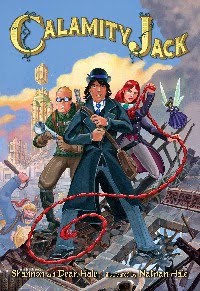
Remember Jack from Rapunzel’s Revenge? No? That’s okay, because this is his story.

It seems that Jack has always had a knack for scheming. From the get-go, he’s been trying to find ways to swindle people. Sometimes, they deserve it, sometimes they don’t. Then… he decides to take on Blunderboar, the biggest (literally: he’s a giant), meanest guy in Shyport. Jack breaks into the tower (with the help of some magic beans), makes off with Blunderboar’s magic goose, and manages to accidentally kill a giant while chopping the beanstalk down. (Does all of this sound familiar? It should.)

Insert brief interlude, while Jack goes out west, meets Rapunzel and has adventures.

Then, Jack brings Rapunzel back to the city, where things have changed. Blunderboar has gotten more powerful, literally razing parts of the city as well as taking Jack’s mother into captivity. Along with a couple of new sidekicks, it’s up to Jack and Rapunzel to save the city.

I liked this graphic novel well enough — it’s the Hales, after all. But I really wanted to love it as much as I loved Rapunzel’s Revenge, and honestly, well, it’s not as good as that one. It wasn’t as funny — or, at the very least, the funny fell flat in my opinion. There was a wee bit of a love triangle, which also did nothing for me. And, while I thought it was a clever spin on the Jack and the Beanstalk fairy tale and I liked the action and mystery in the plot, there just wasn’t enough… oomph, I suppose, is the word I’m looking for.

But oomph or not, it’s a decent sequel to Rapunzel’s Revenge. And I can’t argue with that.
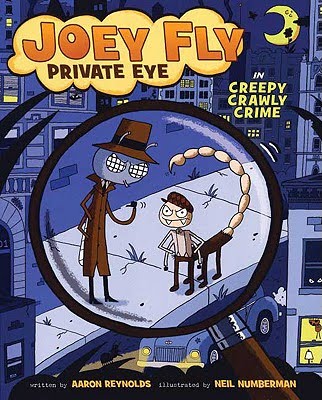
Joey Fly, Private Eye

in Creepy Crawly Crime
written by Aaron Reynolds/Illus. by Neil Numberman
First sentence: “Life in the bug city.”
Review copy sent to me by the author, as part of a blog tourish-type thing.

I had this sitting out, intending to read it and A, my darling nearly 6 year old, asked if I’d read it to her. Honestly, I was a little suspect: it’s a bug book, a detective book, and I thought it wouldn’t be of any interest to her.

I was wrong; she loved it. It’s a graphic novel with something for everyone: noir humor and asides for me, pretty bugs for A to like (and ugly bugs for the boys), and a mystery for both of us to figure out.

Joey is your quintessential noir detective in the big city — a bit jaded, yet with a heart of gold. He solves all sorts of crimes, and is pretty much determined to eek out an existence by himself. Until Sammy Stingtail shows up in his office. Much of the slapstick humor comes from Sammy: when his long tail is not wreaking havoc in Joey’s office, the two are bantering back and forth about the “rules” of detective work. The “crime” is fairly simplistic — a butterfly comes in accusing one of her former friends of stealing her diamond pencil case out of jealousy. Of course there will be twists and turns, and the resolution is definitely age-appropriate. (No bug squashing here.) The world created is also quite clever: it’s a city, but everything was proportionate to bugs, and bug-themed. My favorite was the high-rise made out of a milk carton (I think; I’d check that, but my kids have lent out the book!).

The art is pen and ink, in various shades. Blue for night, sepia for daytime; I initially thought that the art would be distracting for A, but in the end, it not only enhanced the atmosphere of the book, it gave us good stopping points — when the color changed, we stopped.

The humor was a bit over A’s head, butoverall she enjoyed the whole reading experience. As did I. A strong start to a new series. I’m looking forward to the next one.

Babymouse: Dragonslayer

by Jennifer Holm and Matthew Holm
ages: 8+
First sentence… oops… didn’t write it down (you’ll see why in a minute)
Support your local independent bookstore: buy it there!

Today, I took M across town to Barnes and Noble so she could spend a giftcard she got for her birthday. And while she was killing time figuring out which book to get (or how many), I searched out the newest Babymouse. Figured I could read it by the time M finished her shopping… (Cut me some slack, I didn’t buy the book, so this is totally from memory.)

Say it with me, people: Babymouse totally rocks!

Babymouse’s challenge this time: math.

She flunks a math test, and as retribution (or, rather, extra credit), she is forced to join the mathletes and participate in the upcoming Math Olympics in order to win the Golden Slide Rule. Can she do it? (Of course she can!)

There is so much to like about this one, like the other; from all the fantasy novel references — my favorite: Another Long Book About an Orphan Who Defeats the Dark Side (book one of twelve) — to the math references; to the silly bat (who “talks” upside down) and the total math geek teasing (but they’re good at skateboarding!). And, of course, Babymouse is as winning, and the narrator as snarky as ever.

This one is probably more accessible than Babymouse: the Musical, if only because more people are aware of fantasy novels (I caught, Eragon, Lion, Witch, and the Wardrobe, and Lord of the Rings references…) than musicals. And, I have to admit, that while I laughed most at the LOTR (Fellowship of the Slide Rule) pages, this passage totally and completely killed me:

Teacher (who looks like a lion): “You’re late because your locker is a portal into another world where time runs at a different rate and a witch tried to turn you to stone?”
Babymouse: “How did you know?”
Teacher: “It happens to the best of us. Also, the fur coat was a dead giveaway.”

I’ve said it before, and I’ll say it again: Babymouse totally rocks.

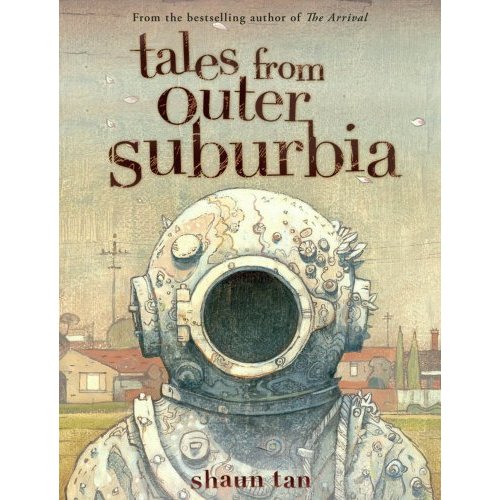
Tales from Outer Suburbia

by Shaun Tan
ages: 11+
First sentence: “When I was a kid, there was a big water buffalo living in the vacant lot at the end of our street, the one with the grass no one ever mowed.”

Someone — Tricia? Andi? Heather? — wrote in a review I read recently that one doesn’t read Shaun Tan books as much as experience them. Which I totally have to agree with: this isn’t a book (it’s not even really a proper graphic novel; more like a grown-up picture book; it reminded me of a more sophisticated Stinky Cheeseman) as much as it is an experience.

I also wasn’t expecting this book after reading The Arrival. It’s got the same surrealness, but I wasn’t expecting, well, words. The stories were odd, to say the least, but that’s one of the things I like about Tan: he takes the everyday and makes it fantastic. There are fifteen short stories in this collection, and all of them sound quite ordinary — The Nameless Holiday, Alert by not Alarmed, Stick Figures, Eric, and my favorite, Distant Rain — and yet, there’s this element that turns it from the ordinary to extraordinary: the art.

As was evident in The Arrival, Tan is an amazing artist. Which is really why you should pick up this book: to marvel at the genius that is Shaun Tan.

Buy it at: Amazon, Powell’s, or your local independent bookstore.

Manga Shakespeare: The Tempest

by William Shakespeare/Illustrated by Paul Duffield
ages: anyone interested in Shakespeare

Since my on-line book group began reading a Shakespeare play every summer, I’ve struggled with the form. First of all, I think Shakespeare should be seen, not read, and I’ve found that just reading the text isn’t at all beneficial for me. I have tried watching movies and reading it at the same time (watch a scene, read a scene), and that works all right.

But now I have Manga Shakespeare! It’s like reading and seeing the play simultaneously: very helpful. (Actually in the spirit of full disclosure, I read the graphic novel once, read the introduction to the play in our Riverside Shakespeare, and then read the graphic novel again. And it worked beautifully.) I liked the drawings: it made it easy to figure out who was who, and even though I never quite got a grasp of the setting (it was this weird hybrid between modern and historical), it didn’t really bother me. I’m not one to comment on manga having never read it, but I do have to say that this was an excellent way to read the bard.

As for the play itself: I liked it. Reading the scholarly introduction helped, because it clued me in to the nuances of the play that I didn’t get the first time around (like why it ended the way it did). It’s a silly little play (not as funny as his comedies, though) with people wandering around the island, and a thwarted assasination attempt, fairies and sprites, and love at first sight (which was not as gag-inducing as many other love-at-first-sight plotlines).

Anyway. I’m not going to go out and recommend that you read The Tempest, but I will recommend Manga Shakespeare as a way to read the Bard. It’s really a very good way to access the plays.

Buy it at: Amazon, Powell’s, or your local independent bookstore.

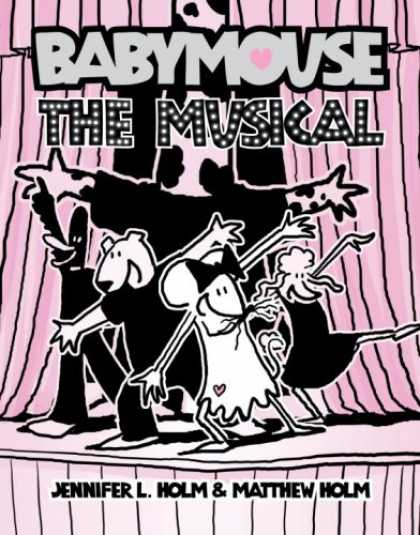
Babymouse: The Musical

by Jennifer L. Holm and Matthew Holm
ages: 7+
First sentence: “The show is about to begin.”

Alysa said it was her favorite so far, and I have to agree. Totally. Completely. Awesome. (Especially if you love musicals.)

Babymouse is awesome no matter what she does… and in this one, she tries out for the school musical, getting the understudy part. LOVED the hedgehog Henry Higgins (yes, he’s British). He totally cracked me up. But the best part was that they (including the narrator, in a brilliant spoof of Modern Major General) kept breaking into song. The fun, for me, was identifying all the references to musicals (only two I didn’t get). Totally hilarious.

C loved it, too, especially the narrator. I’m not sure she got all the references — she hasn’t seen Grease or Phantom of the Opera — but she thought it was a fun book.

But what we’re both REALLY looking forward to is the next one this fall: Babymouse: Dragonslayer. Awesome.

Supernatural Graphic Novels

I’m not sure if that’s the right description, but “fantasy” and “paranormal” didn’t quite work for this pairing either.

First up:
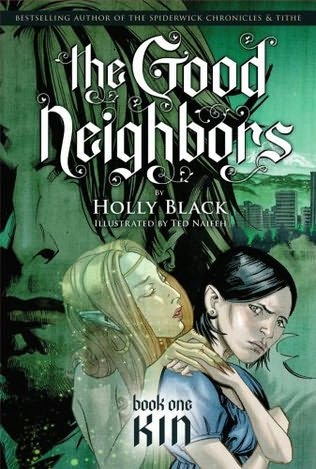
Kin (The Good Neighbors, Book 1)
by HollyBlack and Ted Naifeh
ages: 14+
First sentence: “West City, Thursday evening.”
(First sentences in a graphic novel is almost self-defeating…)

I’m conflicted about this one. I liked it well enough: the basic story is a girl, Rue, whose mother has disappeared after a fight with her father. Soon afterward, Rue starts seeing things she’s not supposed to. Turns out her mother was a faerie, and is slowly dying because Rue’s father had betrayed her. The art was a lush black and white (I think color would have overwhelmed the book, so I appreciated that choice), and I liked the characters okay (especially Tam; even though he doesn’t have a large role, I appreciated that nod). However, while I think it’s a good beginning to a series, it doesn’t really hold up as a stand-alone. It’s all set-up, no action, no resolution. And just leaves you feeling weird. However, I’m going to have to get the next volume, if only because I’m curious what happens to Rue.

Up next:

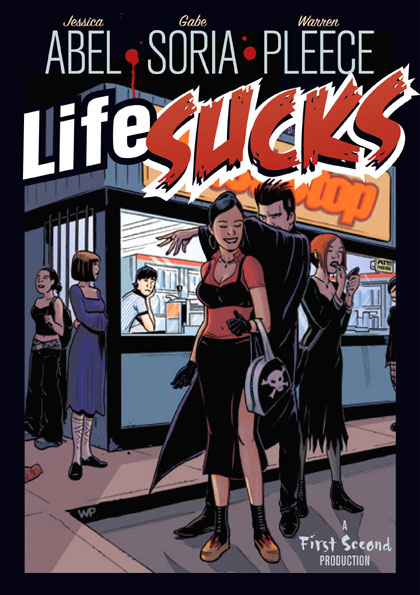
Life Sucks
by Jessica Abel, Gabe Soria, and Warren Pleece
ages: 16+
First sentence: doesn’t really have one. As I said, that’s pretty self-defeating when you’re dealing with a graphic novel.

This one has a fantastic premise: the undead are alive and among us. Dave, a college schlep who needs a job, applies for one at a 24 hour convenience store called Last Stop. Little did he know that applying for the job comes with a catch: being turned into a vampire. Stuck in a dead-end job (ha, no pun intended) working for a vampire master he loathes, Dave figures there’s nothing worth living (ha, again) for. So far, so good. Dave making his way as a vampire is pretty funny, the fact that he’s got a human roommate, and undead friends. His boss, Lord Radu is a great parody of the immigrant entrepreneur.

Then Dave sees Rosa, that is. A goth girl with an obsession with vampires, she would die (ooh, I’m killing myself… whoops, did it again.) to actually know (or be) one. He musters up some courage and strikes up a friendship with Rosa, not revealing that he’s a vampire. Then things start to go south, at least for me. Wes — the evil undead surfer dude (such an oxymoron) — decides Rosa is hot, and he decides that what he really wants to do is bite and bag her. (He’s got three vampire brides and could use one more.) Dave makes a valiant attempt to stop Wes, making in the end a dare out of seeing who Rosa would go for. And that’s when the book tanks. It gets all sex-obsessed (big-boobed, scantily-clad bimbos anyone?), and violent, and just plain weird. It wraps up badly — could they not think of anything better? — and leaves us hanging.

Sigh. I had such hopes for both of these.

Maus I and Maus II

by Art Spiegelman
age: adult
First sentence, Maus I: “I went to see my father in Rego Park.”
First sentence, Maus II: “Summer vacation.”

These are two books, but like Persepolis, they’re essentially one story, so they get lumped into one review.

One review in which I’m not sure what the heck to say about the book. I’m always at a loss for words when it comes to the Holocaust; it’s so depressing — humanity at its worst — that I almost would rather not go there. However, these graphic novels — stark and depressing, yet somehow ultimately hopeful — are worth reading.

I’m not sure if this is a story that couldn’t have been told in a different form, but for what it’s worth, it works as a graphic novel. It’s spare, but then, I’m not sure the story of a survivor of Auschwitz could (or should) be anything but spare. Even though Spiegleman didn’t go into detail about the situation, or the harshness, it was all there in its stark, depressing reality.

I was fascinated by the relationship between Spiegelman and his father — how did the Holocaust fit into it? Did the Holocaust make his dad into the grumpy, miserly, bitter, racist person? He fits squarely into the Jewish stereotype, and yet I could sense that Spiegelman was trying to understand his father, understand why their relationship was so strained. I’m not sure any of us got any answers — Spiegelman or the rreader — but I appreciated not having it spelled out or sugarcoated in any way. Something like this shouldn’t be.

I’m sorry I don’t have more coherent thoughts about this one. I think it’s an experience — kind of like the Holocaust Museum is an experience — that’s beyond words. There are horrors out there, and sometimes it’s good to face them. Even if its in a book.

Babymouse Extravaganza

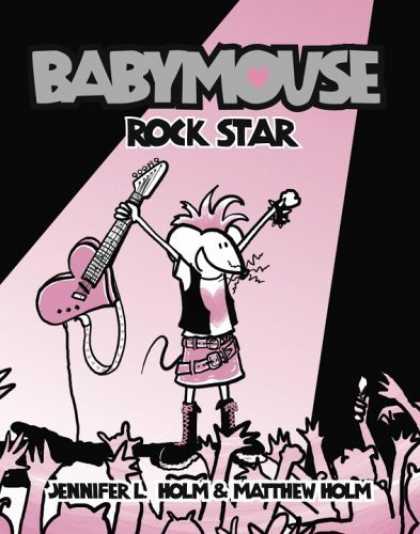
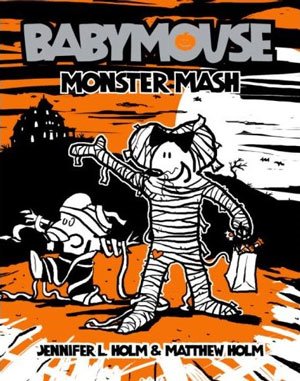
Babymouse: Rockstar and Babymouse: Monster Mash
by Jennifer Holm and Matthew Holm
ages: 6-10 (but I like them, too!)

We got a present from my younger brother and his wife for Christmas. I spent the month of December trying to figure out what it was; I figured it was a game of some sort because that’s the kind of people they are. Imagine my surprise when C opened the present Christmas morning, and it was five Babymouse books! We all squealed (well, C and I did), and the words used to thank dear brother and wife were: “Babymouse ROCKS!”

Because, you know, Babymouse is awesome.

I am indebted to Babymouse (and those who recommended her to me last year), for C’s increasing love of reading. She was looking for something inbetween picture books and chapter books, and Babymouse hit the spot.

And, I have to admit, I find them quite entertaining, too.

If you haven’t had the delightful experience reading Babymouse, then you must rectify that. Or, if you’re too embarrassed to be seen reading the graphic novel equvialent of an early reader, then get it for your favorite first- or second-grader. And then sneak a read. Witty (love the narrator), funny (Babymouse and her imagination), with clever storytelling (Rock star is actually about a band concert and Babymouse learning to play the flute; Monster Mash deals with peer pressure from other kids and finding one’s own way), they are a delightful look into the imagination of Jennifer and Matthew Holm.

I suppose I could gush on… but honestly, there really isn’t much more to say. Go discover Babymouse for yourself, if you haven’t already.

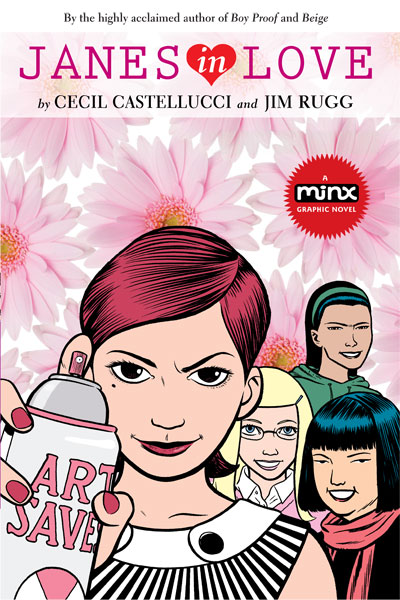
Janes in Love

Back in March, I read Plain Janes, and liked it enough that when I heard there was a sequel, I was terribly excited. I needed something light (not just subject matter, but reading style!) after the last book, and thankfully this one was in at the library on Tuesday. Oh, happy day. I curled up for an hour last night and lost myself in Jane’s world.

This graphic novel picks up right where the last one left off. The girls are still at their promotion of art (pegged vandalism by the town’s police chief, who’s a real jerk), but in addition, they’re trying to figure out their love lives. (It’s February, and the heart turns to love…) Damon, who took the fall for P.L.A.I.N.’s art on New Years eve, is suspended. Our Jane like-likes him, but can’t tell him. Theater Jane has an enormous crush on a Metro City actor, and is constantly talking to him. Jayne (she’s the science geek), has a crush on fellow science lover, and in one of my favorite bits of the novel, creates a pheromone potion that works on every other guy in the school… except the one she wants. Polly Jane is the most direct: she tells the star basketball player that he’s going to be her boyfriend. He says yeah. How I wish it were that easy.

There’s other things going on in the book, too. Jane’s mother is still having seclusion issues — she refuses to come out of the house after her friend from college is killed in an Anthrax attack. After getting caught and arrested during one of their attacks, Jane works at getting legitimate support from the town, and applies for a grant from the National Foundation of the Arts, which poses its own problems and challenges.

It’s not a deep read, or even a terribly complex one. But it’s an enjoyable, fun, quick read. And I love the characters. I can only hope the Cecil Castellucci and Jim Rugg write more.