Off the Menu

It’s not often I get a request to be a part of a book tour, and so when I got an email about this one, as part of the TLC book tours, I jumped at the chance.

The novel follows three Asian-American women — Whitney, Hercules and Audrey — two of which are children of immigrants (the other is an adopted child of rich, white parents). All three were valedictorians of the same high school, and have kept up their friendship (albeit a slightly competitive friendship) ever since. It’s an interesting look at women and friendships, Asians and achievement, and how friendships and dreams and parents all work together (or not).

I don’t think I went in with any expectations — good or bad — but I invariably compared it to the Amy Tan novels I read. (I’m sure that Son is going to get a lot of those comparisons…) And I didn’t find it lacking. In fact, while I didn’t get the same cultural feel that one gets from a Tan novel, I did find I could relate to the characters on a more visceral level. Sure, they’re younger than I am and Asian, but what woman (or man) doesn’t have problems with their parents sometimes? Or their friends? Or harbors secret dreams of doing something other than what society expects of her (or him)?

In addition, I liked the characters. Hercules is a vibrant character — brash and abrasive, yet lovable and approachable. She was my favorite, I think, because she worked so hard, and cared so much and yet was completely clueless as to how to show it. I think I liked Audrey the least — she’s brilliant, beautiful, rich, loving, with a totally supportive man… in short, completely perfect. Sure, her mom’s a total control freak, but that didn’t do enough to humanize her in my mind. In fact, when her dreams all worked out for her in the end, I just rolled my eyes. Whitney was somewhere in the middle — good, perfect even, but had enough challenges to make her seem less goddess-like than Audrey came off.

Son managed to balance the three perspectives quite nicely; I never felt like the story was choppy, or that any of the lesser characters were slighted for Whitney’s story (even if hers felt like the main one). My only real complaint is that I felt confused with the passage of time; the events of one chapter would unfold, and then the next would take place three weeks, or six months later. It would always take me a bit to catch up and figure out when everything was going on.

But that’s a minor quibble. On the whole, it was a good, interesting read.

Don’t forget to check out the rest of the tour!
Friday, November 7th: Ramya’s Bookshelf
Monday, November 10th: Pop Culture Junkie
Tuesday, November 11th: 8Asians
Wednesday, November 12th: Savvy Verse and Wit
Thursday, November 13th: In The Pages
Friday, November 14th: She is Too Fond of Books
Monday, November 17th: Planet Books
Tuesday, November 18th: B & B ex Libris
Wednesday, November 19th: DISGRASIAN
Thursday, November 20th: Booking Mama
Monday, November 24th: The Literate Housewife Review
Tuesday, November 25th: Feminist Review
Wednesday, November 26th: Diary of an Eccentric

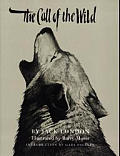
The Call of the Wild

I honestly didn’t know what to expect when I picked up this book. Obviously, it’s about a dog, since there’s one on the cover. (As an aside: the illustrations in the book are done by Brian Moser, who also did the edition of Dracula I read. They were fabulous.) I also knew it was considered a classic. But beyond that I had no idea what to expect.

I was suitably impressed.

For those who don’t know: it’s the story of Buck, a husky. He was initially a pet, living a comfortable life in southern California, about the turn of the century, until one of his master’s servants sold him to pay off his gambling debts. Buck then found himself shipped north to Canada/Alaska, and was beaten and trained as a sled dog. He learned the ropes (unlike many “Southerner” dogs, who died from the hardship and the work), and was eventually passed through several masters. And practically run to death. He was saved by his last master, and stayed with him for while. Buck, however, became more and more restless, hearing (sorry), the call of the wild, until he finally left humanity (if that can be possible for a dog) altogether, joining the wolves in the end.

London is a tight writer — almost a poet — in that no word is wasted. There is so much packed into each sentence, into each page, that even though the book is only 111 pages long, it feels complete. There really was nothing missing, or anything superfluous. I’m also not one to enjoy pages and pages of narrative, but in this case, I was captivated. I liked how London treated the dogs, Buck especially. I felt like I knew Buck, even though he never spoke a word. He was personified for me, with emotions (fear, rage, jealousy, love), and with ambitions and desires. And the emotion of the book: it’s an adventure story, but it’s full of pain and love and anger and disappointment and happiness. I’m still amazed at how much London captured through the eyes of a dog.

I suppose this one could be easily written off as one of those English-major-only books, or perhaps one of those animal-lover-only books, but it’s not. (Since I’m neither of those….) It truly is a classic: something that can be enjoyed by everyone, on some level. It really is worth the time spent reading it.

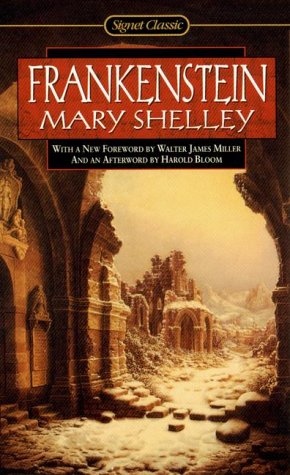
Frankenstein

I think the thing that struck me most about Mary Shelley’s Frankenstein was how un-horror-inducing it was. I didn’t find it to be a horror novel; sure Victor Frankenstein did a horrific thing (more on that later), but the novel itself wasn’t much of a horror book. In the edition I read, Walter James Miller pointed out that it’s actually more a work of science fiction than gothic or horror, and I’d have to agree. It’s a treatise on many things, the primary one being what happens when a scientist tries to become God.

Other observations:

Frankenstein, the scientist, is not a very sympathetic character. He creates this monster, mostly because he can, figuring the creation will bless his name. Instead, when the creature is made alive, Frankenstein freaks out, and bolts, leaving the creature to fend for himself. From this moment, I realized that the narrative was tainted; how could I respect or like or believe Frankenstein when he so casually creates life and then abandons it. Perhaps that’s the mother in me talking.

Along the same lines, I actually liked the monster better, or perhaps I should say that I felt more pity for the monster than for Frankenstein. I’m not sure whom Shelley wanted us to sympathize with, but I was entirely on the monster’s side. Frankenstein behaved abominably, and all the monster wanted was a companion. How could Frankenstein, having gone so far, deny the monster that thing?

There is an interesting discussion of nature versus nurture in the novel. The monster, by his own account, is actually a sensible, feeling, kind being. It’s the fact that he’s universally abhorred that makes him turn to violence and revenge against Frankenstein. It’s all in the nurture of the monster, or lack thereof, that calamity is brought upon Frankenstein and his friends. I’m not sure I agree, entirely, with that reasoning, but it made sense in the framework of the story.

The story itself was long-winded and plodding. I have to admit I skimmed sections, reading only enough to get the gist of the story. In the intro (which I liked, can you tell?), Miller blames Percy Shelley for that — he “edited” Mary’s language to make it more “literary”. I probably would have preferred something more straightforward.

This book has made me think, though. I’d love the opportunity to hash it out in a classroom or good book group setting; there are a lot of topics and thoughts for discussion in the 198 pages that Shelley wrote out. And for that, it’s well worth reading.

Sense and Sensiblity

I read this once, about 6 years ago. It was the very last of an Austen kick, where I read all of her works back-to-back over the course of a month. Needless to say, by the time I got to Sense and Sensibility, all the books were sounding alike, and the 561 pages of this book were just daunting. I decided I liked Emma Thompson’s adaptation better, and haven’t bothered re-reading this one since.

That said, I thoroughly enjoyed reading it this time around. While the story of Elinor and Marianne and their suitors lacks the chemistry of Darcy and Lizzy and the humor of Emma, it more than makes up for in drama. I think this just might be the most intense of her stories… between the libertine and cad Willoughby and the tension and heartache that Elinor goes through with Edward, I’m not sure if there’s a more soap-opera-ish Austen. I also think that this one explores class and money in a more explicit way than in the other novels. Sure, it plays a part in Mansfield Park and P&P, but it’s more in the background. Fanny and Lizzy shouldn’t be getting the men they do because they’re out of their class. But, if it wasn’t for money, Marianne’s heart wouldn’t have been broken, Edward wouldn’t have been cast out. There are a lot of money-conscious characters in this one (right from the start with John and his wife!) and it factors heavily in the plot. I think Austen could rightly be pegged as showing what money *can* (but doesn’t necessarily) do to people, and how Elinor and Marianne deal with it.

I think I still like the movie version of this more than the book, though. There’s a lot of excess — characters, descriptions, plot points (what? Willoughby came back? I didn’t remember that!) — that Thompson streamlined while still maintaining the heart of the story. It’s one of my favorite adaptations, and I think I’m going to indulge myself tonight.

Glad I read the book first, though.

The Acts of King Arthur and his Noble Knights

I really liked the idea of this book. I was searching for a copy of Malory’s Morte d’Arthur and came across this one, “written” by John Steinbeck. I thought it was interesting: who knew that Steinbeck had done anything with King Arthur? I got it from the library, and perused the introduction. It turns out that Steinbeck hated reading until an aunt gave him a copy of Mallory, and it was because of that book that Steinbeck became who he did. He wanted so much to “translate” it into common vernacular, so he took it upon himself to go to England, study the manuscripts and create a version of the work of his own.

However, he never finished it. This was published after his death, in 1976, with a series of letters from Steinbeck to his agent and editor about the process. I found both the introduction and the letters fascinating.

But. (You knew there would be one, didn’t you?)

When it came to the actual reading of the tales, I was bored out of my skull. I won’t say that it was Steinbeck’s — or even Mallory’s — fault, because there was a part of me that was intrested to see the origins of all the novels I’ve enjoyed. I just realized about 100 pages in that I like the novelizations. I like to have my mythical characters have motivations, and conversations, and to be more fleshed out than they were in this telling. (For the same reason, I don’t really like Greek myths, although Hubby and M tell me I’m missing out.) And since my time is better spent reading something I really like, I abandoned it.

If you’re interested in Arthurian legends on an intellectual level (or you handle myths in pure form better than I do), this really is an interesting way to read it, especially if you can’t get your hands on a good version of Le Morte d’Arthur. It’s just not for me.

Dracula

In my quest (though not a very diligent one) to read all things vampire, I figured that I should probably start at the beginning, and read Bram Stoker’s vampire classic. Thankfully, I had the encouragement of the RIP III challenge (and everyone telling me to be excited) to get me off my lazy butt and actually read it. And… well… WOW.

I’m sure everyone’s heard of Dracula — he’s a part of our culture in a way that I don’t think Stoker expected him to become. And vampires, too, especially these days; between Buffy and Twilight they’ve become hip. But, I didn’t know — and I’m not sure how many people who haven’t read the book do — the whole story, the whole mythos. And I found all that fascinating, from the various devices to keep the vampires at bay, to the methods Dracula took not only to access his victims, but to just get around. It was interesting stuff. Even the plot of the book, while a bit simplistic for my taste, still managed to keep things moving enough to hold my interest. I wasn’t expecting that, either.

But what really made the book fabulous (well, as fabulous as a gothic horror tale can be) for me was the mood. Stoker is amazing at setting mood. He has a way with words that just captivated me. The tension and suspense were palpable. I got about 150 pages from the end, at 10 p.m., and realized I’d either have to stop or push through to the end; I was that freaked out by what was going on. There were many occasions, right from the first, when I had to put down the book and walk away because the mood was so intense. Actually, while reading this, I was reminded of why I went on an Edgar Allen Poe kick in 8th grade. We had read The Tell-tale Heart in English class, and I was blown away. Not by the plot, or even by the characters (the ones in Dracula didn’t really do anything for me, either), but because of the mood. While I don’t like to be grossed out (hence my shying away from Stephen King), I don’t mind the occasional fright. And Dracula hit that right on the spot.

Terrific. Creepy, terrifying, and absolutely terrific.

Balzac and the Little Chinese Seamstress

I won’t profess to be an expert on Chinese Revolution/Mao literature, but I have read a few books based on/about that time in Chinese history. And the one thing that really struck me was how tame it was compared to the other books. The only reference to the time was that the main character and his friend, Luo, were in the mountains because they were being re-educated. Sure, the revolution is there in the background, but it’s not a forceful presence. In the end, then, this novel is a gentler, kinder look at the harshness of the re-education program. I’m not sure if it’s a good thing, but it was interesting.

The basic plot of the story is when our narrator (whose name you never find out) and Luo discover that their friend, Four Eyes (don’t you love Chinese names?), has a leather suitcase full of Chinese translations of forbidden Western novels. The friends decide that they want to read them, do all sorts of interesting (and possibly stupid) things in order to get Four Eyes to give them a book. They start with a novel by Balzac, which they love. Luo takes it to the next village to read to their friend, Little Seamstress, and that ends up in an affair between the two (well… not really an affair, since neither was married, but you get the point). This book leads to a desire for more, and so they steal the suitcase from Four Eyes. They devour the books, manage not to get caught, but because of them, their lives — and especially the life of Little Seamstress — is changed forever.

Aside from the gentle tone of the book, and the general promotion of freedom of stories (or storytelling; that should be a basic right: to be able to tell all kinds of stories without censorship… though I guess that’s covered in freedom of the press!), the book wasn’t one that I could sink my teeth in to. It was a quick read, and I didn’t dislike it… I just didn’t find myself caring much one way or the other for most of the book. I did care at one point, near the end, but then the ending came so abruptly, I was kind of thrown. I’m still trying to figure it out. Thankfully, though, it was a read for my online book group, so there’s lots of opportunity for discussion. Becuase I think that’s one thing that can be said for this book: it’s a good one to discuss.

Grail Prince

Hunky/scary man aside (I’m leaning toward scary, personally… he weirds me out), this is not a romance. It has romance in it — in fact love is central to the plot — but it’s not a foray into the bodice-ripping genre. Which is not necessarily a bad thing; it just wasn’t what I was expecting from the cover.

This book picks up the Arthurian legend after Arthur has died (there’s flashbacks to the last years of Arthur’s reign, so I’m counting it for the Arthur challenge), with Galahad, son of Lancelot, and his search for the Grail. It’s a long and torturous journey, partially because Galahad is a bit of a single-minded twit, but it’s fairly interesting. He wanders all over Britain, taking his friend Percival back to Wales, challenging the kings of the north, serving for right and justice, fighting for Constantine, falling in love with Percival’s sister Dandrane, and essentially being a Hero. The quest is interspersed with sections flashing back to Galahad’s childhood, his relationship (or lack thereof) with his mother, Elaine –I’m not sure if this is true to the legends or not — and Lancelot, and how he became to be that single-minded twit.

It was an interesting story, but one that didn’t quite do it for me. Perhaps it was because Galahad is so unlikeable for most of the book — he’s unmerciful (cruelly castrating a man for raping a king’s daughter), he’s judgemental (especially of Lancelot and Gueneviere), he’s dismissive and suspicious of women (oh, boy is he!), he’s obsessive… in short, he’s frustrating. Incredibly so. Which makes the book, itself, hard to like. It has to be that way, though, for Galahad Learns many Important Lessons about Life and Love (and mercy, and judging, and relationships, and responsibility) before he can find the grail. Which is another thing I didn’t like: it got almost heavy-handed, preaching about all the things that Galahad was deficient in (sinning by being sinned against, to put a religious spin on it?) and how he had to reform himself (which he began to do because he fell in love) before he could be the Worthy Knight everyone thought he was.

I also found it interesting that McKenzie rewrote a bit of the legends, giving Elaine a much more defined (and sinister) role, and chasitifying the relationship between Lancelot and Gueneviere. They loved each other, but they were noble about that love, never giving in to it. Which was okay, but not the legends I was used to.

All those elements should have added up to a good book… but they just didn’t. It wasn’t that it was bad… but maybe what I really did want was more bodice-ripping?

The Three Musketeers

I read The Count of Monte Cristo about 10 years ago, and I remember really liking it. I also remember it taking me nearly 3 weeks to read, but I’ve always thought it was because it was 1500 pages long. However, The Three Musketeers, which is roughly 1/3 of the the length took me about as long to get through, so maybe it’s the way Dumas writes and not the length of the book?

Because Dumas is a long-winded writer. In one of the Breaking Dawn reviews, someone pointed out that Stephenie Meyer writes lousy sentences but tells good stories. The same could be said for Dumas. The story — convoluted and complex and labyrinthine as it is — is a lot of fun. The actual page-to-page reading…. not so much.

We begin with d’Artagnan (that’s ar-tanyan; I had problems until someone pronounced it for me), a young hot-headed Gascon (I’m sure there’s some significance here, but not knowing 17th century French history, it was lost on me) headed to Paris to become a musketeer. He’s denied his request, but because he’s courageous, willing to get into duels, and a good swordsman he 1) makes friends with three musketeers — Athos, Aramis, and Porthos — and gets a place in the king’s guards. From there things get complicated. D’Artagnan falls in love with his landlord’s wife, gets involved with the queen’s affair (of sorts) with the Duke of Buckingham, chases a mysterious stranger who offended him, gets involved with the pretty evil Lady de Winter, is involved in a “war” (of sorts) with England, doesn’t quite save the day, and ends up getting promoted. In all this, his three friends come along, mostly, for the ride, though Athos plays a more significant role than either of the other two. Trust me, it makes slightly more sense reading it than typing the plot out.

Was it worth it? I’m not sure. On one hand, it’s a classic adventure story that has inspired movies and other novels for a couple hundred years. There must be something there. On the other hand, it’s incredibly dull for long periods of time interspersed with quick — and interesting and fun — bursts of action and plot. I suppose what Dumas really needed was a good, solid editor, someone to say: “Hey, Alexandre, do you really need four sentances to say what could be said in one? Or, do you really need to include Latin poems? Really? And the point of the whole Porthos-Madame Coquenard chapters are?”

Either that, or I just need to find a good, solid abridged version. At who knows: ten years down the line, I may be telling people that I absolutely LOVED The Three Musketeers, even though it took me three weeks to read.

The Code of the Woosters

I got this one as an audio book to read on our trip to Spokane. We didn’t get it on the drive here (we listened to Prisoner of Azkaban instead — Jim Dale is really an excellent narrator. We thoroughly enjoyed it, even though we’ve all read the book… some of us numerous times.) so Hubby and I took it on a little 15th anniversary jaunt we took to Portland over the last couple of days.

I’m not sure if it was the full version, a radio production of it — it was the full story, but only 3 CDs — but I wasn’t that impressed. Sure, there were funny moments (there’s always funny moments) but I think I’ve been forever warped when it comes to Jeeves and Bertie by Fry and Laurie. I enjoy watching the episodes so much more than I enjoy reading or listening to them. I kept comparing the voices to the ones on the series and it just wasn’t doing it for me. (I have to admit that I even fell asleep during part of it; that’s how engaging I found it… either that, or I was just really tired.) I think I’ll stick to the Blanding Castle stories Wodehouse wrote; I find them infinitely funnier.