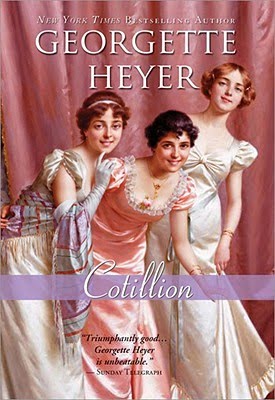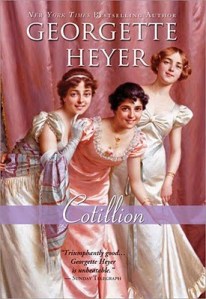
Cotillion

by Georgette Heyer
ages: adult
First sentence: “The Saloon, like every other room in Arnside House, was large and lofty, and had been furnished, possibly some twenty years earlier, in what had then been the first style of elegance.”
Support your independent bookstore: buy it there!

Now this is quintessential Georgette Heyer. Silly, fun, captivating, and all-around good times: the Georgette Heyer that I would happily recommend to everyone.

Kitty is the ward of a grumpy, miserly old man, who has bequeathed his fortune to her under one condition: that she marry one of his grand-nephews. It doesn’t sound like a bad deal — Kitty thinks she’s in love with one of them already — except that the one that Kitty likes doesn’t show up at his uncle’s command to offer for her. She attempts to run away, and then runs into Freddy — another grand-nephew — and talks him into offering for her, mostly because she wants to visit London. Freddy — an all-around good guy, and plain hilarious in the book — agrees, they both away to London, where all sorts of adventures, misadventures and happenings, well, happen.

I did this one as a buddy read with Corinne at The Book Nest and we chatted a bit about it.

Melissa: A bit of background: I noticed that Corinne had had a less-than-positive experience with a Georgette Heyer book (as did I recently), and I thought it’d be fun — since I was reading one for my in-person book group — to see if we could both have a better experience with Heyer. We searched our collective libraries for a common book, and decided upon Cotillion (which I think was recommended to me by Heather at A High and Hidden Place). So… what did you think overall?

Corinne: OH HO HO!! I can now see why people are thrilled with Heyer this was a complete gem. Full of frivolity and love and match-making and characters that made me laugh out loud. Really, out-loud laughing.

Melissa: I totally agree! There were parts that just had me in tears… and I absolutely LOVED Freddy. He killed me. I loved the way he talked, though it occurred to me when I finished that he was a bit more 1920s than 1820: he reminded me of Bertie Wooster! (I dog-eared this quote as quintessential Freddy: “Dash it, Jack!” said Freddy, stung. “Any girl would rather marry me than Dolph or Hugh! No use saying Dolph’s an Earl: he’s run off his legs, besides being dicked in the nob! As for Hugh–lord!”)

Corinne: I didn’t think of Bertie, but of course! I totally agree. It slayed me every time he said someone was “touched in the upper works,” or “buffle-headed.” And of course, there ARE those characters that actually were “touched” – as Freddy says – Heyer’s characters felt perfectly caricatured and yet…NOT annoyingly predictable. At first I worried that Kitty would be too simpering for me – but what a lovely surprise to have her be so scheming and forthright!

Melissa: That’s a great point. They are pretty caricatured — the innocent girl, the annoying rector, the simpering Earl, the frivolous lady, the cad (ooh, we must talk about Jack!). But I loved them all. And I loved how they interact with each other, too. There were some great character dynamics going on in the book. Did you have a favorite character?

Corinne: Freddy – to be sure, for reasons already mentioned. He’s a riot, but deeper than you’d think. And to be honest, Uncle Matthew was also a favorite. Maybe I just have a soft spot in my heart for crabby and penny-pinching old uncles, but lines like this: ‘Man’s an idiot!’ said Mr. Penicuik. ‘Small fire be damned! Not when I’m going to sit here myself, clodpole!” We didn’t get to see him much in the book, but I enjoyed our time with that guy. So, what did you think of Dolph, though? And Jack? Can you imagine a more opposite pair of cousins?

Melissa: No, I can’t! I felt sorry for Dolph, being pushed around by his mother so much. And maybe he was a bit “dicked in the nob” but he was sweet, and he meant well. And, Jack, well… actually, I was surprised at what a cad he was. One of the things I find interesting about Heyer (as opposed to, say, Jane Austen) is her willingness to delve into the seamier side of Edwardian society. The fact that it was well known that Jack was a, um, libertine, was pretty surprising to me. Aren’t they supposed all supposed to be pure and unsullied?

Be sure to check out her blog for the second half of the conversation!

Fifth Business

by Roberston Davies
ages: adult
First sentence: “My lifelong involvement with Mrs. Dempster began at 5:58 o’clock p.m. on the 27th of December, 1908, at which time I was ten years and seven months old.”
Support your local independent bookstore: buy it there!

I first became aware of this trilogy several years ago when Julie at On the Curve (Back then she was Bookworm…) told me I HAD to read it. I started it, once, got nearly a third of the way in, and then abandoned it because life got in the way.

Thankfully, my online book group chose it for this month’s book, and I was able to sit down to thoroughly enjoy this book.

The first in a trilogy (I will read the other two… later…), Fifth Business is the personal history of Dunstan Ramsey: historian, scholar, Deptford boy. He’s also a friend to Boy Staunton, recently murdered. The history seems almost pointless, aimless in its endeavor: why does Dunstan’s connection with Mrs. Dempster — the woman of the first sentence, and a fairly major presence for much of Dunstan’s life — matter in the ultimate rise and fall in the plot? I found that it didn’t matter: Dunstan’s story, mundane as it was, was immensely fascinating. The writing was at once elegant and accessible: Davies didn’t go in for the long, flowery, overwrought descriptions that seem to plague many authors, instead choosing a first-person narrative that drew you in with simple, yet evocative language.

It was also surprisingly religious. I think I was expecting something more along the lines of the fantastical: magical realism and all that. What I got was an introspective, philosophical work about faith, doubt, and life’s purpose. Dunstan’s fascination with saints, his discussions with the Jesuit priest about a God to help him grow old; all incredibly fascinating, yet somehow didn’t have much to do with the plot.

I wonder — and this is why I’ll eventually get around to reading the other two — how the story all plays out, because this book felt very much like a beginning. While there was a story arc, the plot, the mystery, didn’t kick in until near the very end of the book. Which makes me wonder in what direction the other two books — The Manticore and World of Wonders — takes the plot.

At any rate, Julie (if you’re still out there), you’re right: Davies is a brilliant writer, and this book is definitely worth the time. I’m just sorry it took me so long to get around to it.

The Guernsey Literary and Potato Peel Society

by Mary Ann Shaffer and Annie Barrows
ages: adult
First sentence: “Dear Sidney, Susan Scott is a wonder.”
Copy won in a contest sponsored by A High and Hidden Place
Support your local independent bookstore: buy it there!

Sometimes, when I read a book, one word keeps popping in my mind. For this book, the one word I constantly thought was charming. Utterly, unabashedly, and unreservedly charming.

The book reminded me in many ways of 84 Charing Cross Road, and it wasn’t just that it was an epistolary novel. Shaffer and Barrows got a feel for the time (post-war), the place (England), and the people. That, and it’s a book about readers and community and belonging, all of which I totally love. It’s got a bit of everything, too: romance, literary illusions, soaring descriptions, history. It’s a war book, an epistolary novel, a romance, a work of historical fiction.

It’s nearly perfect.

Perhaps the only thing holding it back was the hype. I’m always suspicious of NY Times best-sellers, and while I think this one proved my suspicions wrong, I do think that I wanted more out of it. I wanted it to be more soaring, to be more than it actually was. Perhaps that’s the nature of the book, though: to get so involved in it that you want more at the end. Whatever the reason, I did enjoy the journey: I just wanted something more out of it.

But what I did get was thoroughly captivating.

The Stand

by Stephen King
ages: adult
First sentence: “Hapscomb’s Texaco sat on US 93 just north of Arnette, a pissant four-street burg about 110 miles from Houston.”

This one definitely takes some doing to wrap your brain around. It’s huge (even though I read the “original” version — the one that was published in 1978 — and not the “definitive” version — the one that King went back and added 200 pages to). It’s sprawling. It’s weird and wild and wacky. It’s dystopian, political, religious, horrific, gross, amazing.

It’s… well… Stephen King.

This was my first experience with King (aside from his Entertainment Weekly reviews, and reading The Lawnmower Man in 6th grade, which I don’t remember at all). And what an experience. I was blown away by the sheer craft of the man: not the plotting (which I felt dragged in spots), but the imagination (warped) and the world building, and the characterization, and just the fact that he. made. this. book. work. Not many people could imagine something so sprawling and huge and you’d be able to say that in the end.

The basic plot (in case you haven’t read the book, or seen the miniseries, which I have to admit I’m curious about now): a superflu (something which threw me for a loop: “Government heath officials emphasize that this is Russian-A flue, not the more dangerous swine flu.”) virus gets out and, because it has a 99.4% mortality rate, wipes out most of the population of the country. How or why you survive isn’t known; you either don’t catch it, or you’re dead. The first part of the book is the horror: watching people die terrible, horrible, gross, pathetic deaths not only is difficult, but incredibly unsettling. Shoot: it’s terrifying, especially with H1N1 floating around. King is brilliant in this part: he gives people names, occupations, dialogue, a history… and then kills them off. It’s brilliant watching the spread of the virus, and terrifying how it affects the world, and the reader.

Then, once everyone who is going to die is dead, the book changes tone. It becomes a political book as the survivors gather — either around Mother Abigail in Boulder, Colorado (the good team) or around Randall Flagg, aka The Dark Man (the bad team), in Las Vegas. There’s a whole section, and this is where the book (for me, at least) lags, about setting up a community, how the Free Zone works, about the human race’s urge to gather and organize and build. There’s this one character, Glen, who is the sociologist (he’s the Hermione of the book) who explains everything. And explains. And explains. Yawn.

Then — because having a horror book and a political commentary isn’t enough — King decided to turn religious on us, and has a showdown — though not in the way I expected — between the good and evil forces. Once the focus switches away from the community in Boulder, once Stu, Glen, Ralph and Larry — they’re the leaders, of sorts, of the Free Zone — begin their quest as commanded by Mother Abagail on her deathbed — and once we see what the Dark Man’s been up to in Vegas, the action picks up again. Perhaps King is only brilliant when he’s twisted? I was fascinated with the downfall of Randall’s society, with twists and turns of the plot, and with the climax.

Then — and why do authors feel a need to do this? — the book went on for 50 more pages. Yeah, sure, I suppose we need some sort of denouement, some sort of resolution, but honestly, 50 pages worth? (I was actually glad I got the 1978 version by this point.)

It was an uneven book: when it was on, it was brilliant; when it was off, it was incredibly boring. But, now that I’ve forayed into the world of Stephen King, I have to admit I’m curious to read more. He’s an amazing writer.

Warped and weird, yes. But definitely amazing.

Sweetness in the Belly

by Camilla Gibb
ages: Adult
First sentence: “The sun makes its orange way east from Arabia, over a Red Sea, across the volcanic fields and desert and over the black hills to the qat- and coffee-shrubbed land of the fertile valley that surrounds our walled city.”

This was a buddy read with Kailana — and if it seems a little weird, it’s because she has the first half of the conversation up on her blog. Go visit it, then come back for the second half…

Melissa: That’s funny. I don’t know of many white Muslims, but I do have friends (who are white) who are very interested in Islam, so I knew a bit about the religion going into the book. I do like the portrait that Gibb painted of the religion: how there are some extremes (like the female circumcision, which was very difficult for me to read!) but most Muslims are just trying to find their path back to God. I liked how she looked upon Christians as “misguided”. That made me chuckle.

Kelly: Yeah, I have always had trouble with female circumcisions. It is so horrifying to hear described, and I know I never want to experience it first-hand! In other cultures the male circumcisions can be pretty graphic, too. Then it is less about religion and more about making the men feel less manly, but still, I will never understand the practice!

Melissa: Me, either! I got into an argument with my husband over it: I compared it to foot-binding in China (he disagreed that there were similarities), and wondered why women put their girls through such things for the sake of a “good marriage”. I’ve never encountered this in a book before (pretty sheltered reading, I guess): it was horrifying. One of the other things I liked about the religion is how much of it was cultural; how much of her religion when she got to Britain was almost more Ethiopian than what we’d consider (as an outsider) to be “Muslim”.

Kelly: It is actually China that is one of the places that would cut off men’s manly parts to make them better servants… And, women put themselves through that because it has become a norm that it is what is desired. So, it really is the men’s choice as much as the women’s. Women are worthless in many cultures if they don’t marry, and men won’t marry them if they don’t abide by cultural norms for what a woman is supposed to be!

Melissa: Very true. And very unfair! So… one of the things I noticed about the book was the language. Usually, it stands out to me and grates on me when a writer is so very effusive? technical? with language — like they’re trying to be flowery and trying to show that they have a mastery of it — but this felt very natural, very poetic. I loved it. What did you think?

Kelly: Oh, so happy you brought this up because I never would have thought to. I totally agree, though. Flowery writing is something I have never been a big fan of, but Gibb did it so well that I didn’t even pay attention. Normally I would also find writing like that slows the book down, but once I got into the book I found it was over with really fast. For the style it was actually a pretty fast read. I was impressed. I learned a lot, too, which was great. She says in the note in the back that it is mixed with fiction, so obviously not a true story, but I think she captures well what a character in Lilly’s position would be thinking. Would you agree?

Melissa: I totally agree. I have had problems with current “classics” in the past because the way the writer’s written the book is distracting from the story and the characters. I like the way you put it: that Gibb captures well the character of Lilly. I also felt like she gave a real sense of what it was like to be living in Ethiopia; the feel, the rhythm, the smell. It almost felt like I was there.

Kelly: I know! I really felt like I got a sense for everything, which is always a good thing in a fiction novel. Was there anything that you didn’t like about the book?

Melissa: Aside from the circumcisions and the medical stuff in general (I have a weak stomach!)? No. I think that’s one of the things that really surprised me about the book: there wasn’t anything that stood out as being really negative? How about you?

Kelly: I know! It is great, huh? I have read a bunch of good books in a row. I think I have another book by her on my TBR pile, so I am really looking forward to it! I can’t remember what book actually won the Giller the year she was nominated, but it must have been some book for her to lose to it! Medical stuff doesn’t really bother me, but I am bothered by the ways that women try and make themselves ‘appealing’ for men. Anything else that you want to mention?

Melissa: You have a stronger stomach than I do! You’ll have to let me know how her other book is; I’m not sure the library here has anything else by her. It was good reading this; thanks for introducing me to her books!

Kelly: Welcome! I am glad this worked out so well!

A Civil Contract

by Georgette Heyer
ages: adult
First sentence: “The library at Fontley Priory, like most of the principal apartments in the sprawling building, looked to the south-east, commanding a prospect of informal gardens and a plantation of poplars, which acted as a wind-break and screened from view the monotony of the fen beyond.”

Actually, that first sentence up there is pretty indicative of the whole novel. And part of the reason I bailed halfway through.

See, I wanted to like this. For many reasons: I really liked the last Georgette Heyer, this is the one we’ve put out for my face-to-face book group in a couple of months, it’s the favorite of a really good friend of mine. But… it’s long winded, schmaltzy, and not nearly silly or light-hearted enough.

The basic plot is decent: Adam Deveril is a captain in the army when he learns of his father’s, Viscount Lyndon, death. Upon returning home, he also learns that his father was overly extravagant, and piled up so many debts that Adam is going to be forced to sell not only his horses and London home, but the family seat, also, in order to just pay off his debts and provide for his mother and sisters. However, that will leave him penniless, so he can’t marry the woman he loves: Julia. Instead, in order to save his ancestral seat, he contracts with a wealthy upstart businessman to marry his daughter, Jenny, in exchange for the money to keep his home. Jenny is practical about this: she knows Adam doesn’t love her and even though she feels affection for him, she doesn’t ever really expect to have him feel it back.

And that was the first half of the book. Sure, I get that Jenny is long-suffering and patient and loving, and will venture to say that Adam will soon learn to value her qualities (beauty is not among them) more than he valued Julia’s beauty and singing voice. (They always do, you know. Men.) And I’m sure there will be a soaring conclusion where Adam and Jenny if not fall happily into each others’ bosoms, then at the very least, marriage will not be so odious and they will be happily practical together. Which is all fine and good.

But I couldn’t wade through the exc!mation marks, and the pages and pages of clothing descriptions and bad dialogue to get there. I wanted light-hearted humor, I wanted a dash of adventure, I wanted silliness, dang it. And I didn’t get any of those.

So, Georgette Heyer, all your books are not equal (which is forgivable). I’ll just have to try another one.

Tess of the D’Urbervilles

by Thomas Hardy
ages: adult
First sentence: “On an evening in the latter part of May a middle-aged man was walking homeward from Shaston to the village of Marlott, in the adjoining Vale of Blakemore or Blackmoor.”

Men are jerks.

Really.

That’s basically the bottom line that I got from this book, the one that I stomped around the house growling about, that I vented on the phone to a friend about, once I finished the book.

Men — all men, from fathers to lovers — are just basically going to take a woman’s innocence, their good hearts, their good will, and stomp. all. over. them.

Cheery, isn’t it?

For those who are unfamiliar with this classic, Tess Durbeyfield is part of the Victorian working poor — oldest daughter of a lackadaisical farmer. When her dad inadvertently finds out that he’s a decedent of a noble family — the d’Urbervilles — he decides (practically pushes out the door) to send his daughter to a branch of the family who lives in a nearby town in order to beg them for money.

Male jerk #1.

Tess, being the kind, good, loving daughter that she is, does her father’s (and mother’s — she’s not much better!) will, and heads out. There she meets Alec: pretty boy, ladies man, and who is completely and utterly smitten with his “coz”. (Because as these things go, Tess is not only pure, but beautiful as well.) He pursues her very aggressively, and while she’s able to withstand his advances for quite a while, eventually he rapes her. Or at least, that’s how I see it.

Male jerk #2.

A short while later, Tess up and leaves the house and ends up back at her parents’ place. She gives birth and while the baby dies shortly thereafter (a very touching, passionate scene with her desperately trying to get the baby baptized before it dies), she’s determined to move on with her life. Fast forward a couple of years, and she gets a job at a dairy farm where Angel Clare is working.

A bit about Angel — he’s a gentleman’s son, and an enlightened Soul. He was meant for the Church, but unable to commit because of a lack of faith. And so, he decides to be a gentleman farmer, setting about visiting farms to get training. He falls head over heels in love with Tess, because of her purity and earthiness. She tells him she’s no good for him, that it would be better for him to marry one of the other dairymaids. He persists, and eventually she gives in (either these guys were REALLY persistent, or she really didn’t have much of a backbone), agreeing to marry him. On the wedding night, they decide to be confessional (word of advice: the wedding night is not a good time to be confessional). Angel confesses to having a short affair, whereupon Tess gets hopeful: perhaps he will be sympathetic to her plight. So, she tells him about her past.

Male jerk #3.

Actually — at this point, I don’t know who I was more incensed at: Alec for abusing and using Tess for his own personal pleasure or Angel for being such a merciless hypocrite. I had to put the book down for quite a while (a day or so) before I could deal with the story again.

Tess is totally the victim here, and it’s very frustrating for me as a reader to experience that. Especially since Tess is really the only sympathetic character in the novel. All that said, Hardy is a brilliant writer; engaging, descriptive, gorgeous language. And able to span all the emotions — from love to hate to disgust; he’s a master. The rest of the book is totally downhill, of course. A criticism of Victorian society and norms and a portrait of good intentions gone horribly wrong couldn’t have a happy ending.

That said, I’m not sure I’m going to run out and get more Hardy any time soon. Unless someone can convince me that it’s not full of horrid men. Because, I’m not sure I can handle much more of that!

Great Tales and Poems of Edgar Allan Poe

by… um… Edgar Allan Poe
ages: 13+

I saw this on display at the library, it having been chosen as the Big Read Wichita book for October and November. Not having read any Poe since Junior High/High School when I went through a morbid kick where he was my favorite author, I figured what better reason than this to pick up the book and see if I still like Poe as much as I did.

Oh, and I can count it for the RIP IV Challenge… 🙂

First off, I should mention that I didn’t read every story or poem in this book. I read the ones I remembered liking, which are basically his best-known ones — “The Tell-Tale Heart”, “The Cask of Amontillado”, “The Fall of the House of Usher”, “The Pit and the Pendulum”, and “The Raven” and “Annabel Lee” — as well as a couple I’d never read before: “The Black Cat”, “Ligeia”, “The Masque of the Red Death”, “The Gold-Bug”, and “Ms. Found in a Bottle” as well as assorted poems found in the Poetry for Young People collection we have kicking around the house.

Some general thoughts? When Poe is on, he’s brilliant at mood. “The Tell-Tale Heart”, “The Black Cat”, “The Pit and the Pendulum” and “The Raven” are all absolutely chilling. One of my most vivid school memories is listening to “The Tell-Tale Heart” in eighth-grade English, the lights out and curtains drawn. Deliciously terrifying. And it still is.

The other thing I noticed about Poe’s horror stories is that his protagonists are liable to flip off at any little thing; they, on many levels, are genuinely crazy. Take the guy in “The Black Cat”, for instance: he totally loses it because the cat is bothering him (obviously, he’s not a cat-person), and hangs it. Then another cat comes along, which he begins to believe is the dead cat out for vengeance, so he tries to kill it with an axe. And ends up offing his own wife, for which he feels no remorse. Sometimes, you just have to scratch your head and ask, “What was Poe on when he wrote this?”

The thing is, when Poe was off whatever it was that he was usually on, his writing is really not very good. “The Gold-Bug” was an interesting exercise in deduction to find a pirate’s treasure, but “The Masque of the Red Death” was odd (and not in a good way, either) and “Ligeia” made no sense at all. (It might have been me, though.) However, I did find that I enjoyed much of his poetry. In fact, my new favorite poem of his is a sweet one called “For Annie“, about a man expressing his love and gratitude for Annie, who helped him through a severe illness. It’s very touching and tender (and sane).

Do I love Poe as much as I once did? No… but that’s probably more of a factor of age and temperament than anything else. Poe was a brilliant writer, and is deserving of the praise he has gotten over the years.

The Moonstone

by Wilkie Collins
ages: adult
First sentence: “I address these lines — written in India — to my relatives in England.”
Support your local independent bookstore: buy it there!

Ten things about this classic mystery:

1. Basic plot summary: sacred diamond taken from India, gets bequeathed to flighty high-class (Victorian) girl, gets stolen same night. Who done it?
2. I did like this book a LOT better than I liked Woman in White.
3. Though, I think it had some similar problems — it was too slow for almost too long, and all the characters were pretty one-sided. But…
4. About 2/3 of the way through, it takes a sharp left turn which, no matter how clever you are, you will most likely not see coming.
5. And that totally makes the novel.
6. As for characters: I liked Sargent Cuff: he was very clever, though Collins didn’t let us know how much Cuff knew until the very end.
7. Which is kind of cheating, you think?
8. However, Betteredge was a HILARIOUS narrator. As was Miss Clack.
9. In fact, this one was funnier overall than Woman in White. (Which means it really wasn’t all that suspenseful.)
10. That said, it lacks the good baddies that Woman in White had. There really wasn’t a real bad guy in this one, and I felt that loss. One wants a good bad guy to hate.

Overall, though: a fun mystery. Glad I read it.

Twilight of Avalon

by Anna Elliott
ages: adult
First sentence: “So I say to call the visions into the scrying bowl.”
Support your local bookstore: buy it there!

When the lovely Kailana and I discovered we were both reading this book, we thought it would be fun to do a buddy review. Below are some questions she asked me about the book (as well as a couple I asked her, that I wanted to answer myself!)… Enjoy!

Twilight of Avalon takes two ancient myths — Arthur and Tristan and Isolde — and fuses them together into one story. The story picks up after Arthur was betrayed by his bastard son, Mordred, who also happens to be Isolde’s father. Isolde was made high queen, married to King Constantine, but seven short years after their crowning, Constantine is dead and Isolde fears for her own life. Especially since she knows that Constantine was murdered by Lord Marche, who is scheming for the high kingship himself. It’s only through her own wits, abilities, and the help of a half-Saxon prisoner named Trystan, that she’s able to escape and find a way to prove to the court the truth about Lord Marche.

What lead you to pick up this book? Will you be reading the rest of the trilogy?
I was sent it by the author (or a publicist; I can’t remember), but it was Trish’s review gave me the push I needed to pick it up. And yes, I will be reading the rest of the trilogy.

Do you have a favorite character?
I think I like Isolde best: she’s strong without being overly modern, and yet she had doubts and fears and insecurities. Though, it may just be that she was one of the few female characters in the book, and I needed someone to relate to.

What was your favorite scene?
Hmmm… it’s been a while since I’ve read it (bad memory…), but I think the scenes that stand out in my mind are the ones where Isolde is being a healer. I especially liked the one near the end when she’s helping Heneric recover from some serious wounds. Very touching.

What do you think of the mixing of fantasy and historical fiction? Was it believable?
I read in the material that was sent with the book that the author was going for a Mary Stewart feel — not exactly magic, but more than realistic. And I think, while it’s not as fluid as Stewart’s books, it works well. When you’re dealing with something as far removed from us as mid-6th century Britain, it’s easy to view it as fantasy. Which is perfectly okay with me!

What are your thoughts on the cover and the title?
Hmmm… first reaction: too Marion Zimmer Bradley. Which means I went in with a bit more feminist-mysticism expectations, which really isn’t what I thought the book is about.

What did you think of the “romance”?
Um… I expected something more. Truthfully, from the jacket flap, and the cover and the title, I really thought that there’d be some sort of hot and heavy romance… and there wasn’t. It was a more political book than I was expecting, and while I think Trystan and Isolde work well together, there really wasn’t much chemistry there. Maybe in the next book…