Shadow of Night

by Deborah Harkness
ages: adult
First sentence: “We arrived in an undignified heap of witch and vampire.”
Support your local independent bookstore: buy it there!
Others in the series: Discovery of Witches

How about this for a brief teaser: if you liked Diana Gabaldon’s Outlander, you’ll probably really like this one.

The long explanation is a lot more complicated, however. There were elements of Shadow of Night that I really liked. And there were some that I didn’t. But my major problem with the book — and this is one I have with many works of “adult” fiction — is that I thought a good third to half of this book was wholly unnecessary.

Because of the conflicts set up in Discovery of Witches (which I won’t go into, but partially are caused by the love Matthew and Diana have for each other; witches and vampires aren’t supposed to mate.), and because Diana needs help figuring out what kind of witch she is (and to control her magic), they end up in the past. In England, circa 1590, to be exact. Which brings me (so soon?) to problem number one: too often, I felt Harkness was using her status as a historian to show off. I got the sense that she set the book in the past not because it best served the story (though in some ways, it did), but because she KNOWS STUFF and wanted to share. Too often I was pulled out of the story because of some name dropping (though Diana has a moment of exasperation, wondering out of all the people in England in the past, how come Matthew knows all the famous ones. That kind of helped.) and historical elements. It was hard for me to enjoy the past because she kept pulling me out of it with details about clothes, food, the weather, and blasted Christopher Marlow.

Anyway. Matthew and Diana aren’t in England very long before they cause a ruckus and get sent to Sept Tours, Matthew’s ancestral home. Where his dead father is still very much alive. And who forces them to get married. (In way too many pages. Followed by many, many more pages of [not graphic, or even titillating] married sex.) Back to England they go, where (in some of the best passages) Diana begins to figure out that she’s a unique sort of witch, and gets a handle on her magic. Oh, and manages to get pregnant by the vampire.

Before you think that Harkness went all Breaking Dawn on us, she didn’t. Oh, sure, there are influences there: Matthew is just as protective and oppressive as Edward; apparently it’s in a vampire’s “nature”. The difference is that rather than being pushed around, Diana takes him on. Thank heavens for that; in many, many ways, Diana as a character is the best part of this novel. She’s strong, interesting, clever, inquisitive, and plain fun to be around as a character.

There’s more, of course: It’s a nearly 600 page book, and Harkness finds ways to fill them out. And it’s not a bad book, per se: I did finish it. Because even with all the extra historical stuff, and the poor plotting (for my YA-saturated brain), I am invested in Matthew and Diana’s story. Which means, I’m already asking when the next one will be out.

If you’re still interested in this one after all that, I’m offering a giveaway of this book. I’ll even throw in a set of five pins, and a temporary tattoo. Maybe you’ll like it more than I did. You have until Friday, July 13th (ooooh, auspicious) to enter.

A Lady Cyclist’s Guide to Kashgar

by Suzanne Joinson
ages: adult
First sentence: “I unhappily report that even Bicycling for Ladies WITH HINTS TO THE ART OF WHEELING – ADVICE TO BEGINNERS – DRESS – CARE OF THE BICYCLE – MECHANICS – TRAINING – EXERCISES, ETC. ETC. cannot assist me in this current predicament: we find ourselves in a situation.”
Support your local independent bookstore: buy it there!

Two things drew me to this book. First, the cover: I love it. I don’t know why (it’s not a young girl in a pretty dress, after all), but something about it just calls to me. And second, that first sentence. It’s wonderful, full of promise, of something … exciting.

And the premise sounded interesting as well: it’s 1923, and Evangeline English and her sister, Lizzie, have thrown their lot in with a evangelical missionary and are traveling to the wilds of Eastern Turkestan/Upper China. Lizzie and the missionary, Millicent, are there to convert people; Evangeline is there to write a book about cycling in this wild, unknown (at least to the English) place. It doesn’t go well, to say the least. They try to help a girl give birth, but the mother ends up dying, and they are placed under house arrest and given charge of the baby. From there, things only go down hill. There’s a lot of resistance to their missionary message, and Millicent is overbearing; she and Evangeline don’t get along.

However, that’s not the only story: it’s modern day London, and Frieda, the daughter of hippy parents and world traveler — is in a dead-end relationship with a married man. She’s back in town after a trip to Cairo, when two unusual things happen: one, she gets a letter telling her that she is the next-of-kin for an Irene Guy, whom she’s never even heard of; and a Yemeni man, Tayeb, parks himself outside of her door. Both of these things will change her life.

I spent a good portion of the book trying to figure out how these two stories were connected. I should have realized how much sooner than I did; if you’re paying attention, it’s pretty obvious. Even so, each of the stories might have made a decent book on their own; together it kind of seems forced. I wanted more from each of the stories, more than I got anyway, and I feel like in combing them Joinson somehow cheated me of the full story. That, and I think the most interesting character was the elusive Ilene Guy; her story seemed like the most intriguing.

That said, it wasn’t a bad book. There’s enough in it to keep my attention throughout it all, and while I didn’t love it in the end, at least I wasn’t bored by it. And that’s something.

Right?

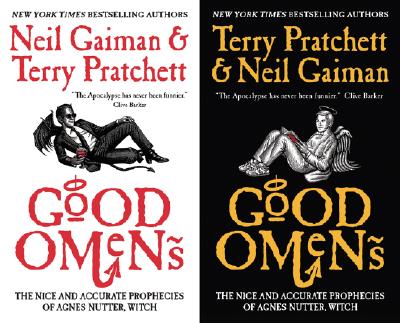
Good Omens

by Terry Pratchett and Neil Gaiman
ages: adult
First sentence: “It was a nice day.”
Support your local independent bookstore: buy it there!

This is one of those “everything but the kitchen sink” kind of books. There’s witches (who carry bread knives around for protection, because that’s the sort of witch they are) and witch hunters. Prophetesses (well, one: who wrote the Nice and Accurate Prophecies of Agnes Nutter, which is surprisingly correct) and anti-Christs (well, one. He’s eleven.). Demons and angels. Not to mention the four riders of the Apocalypse, as well as several telephone salespeople.

And all are headed toward Lower Tadfield. Because, of course, that’s where the End of the World/The Great War/Impending Doom is going to take place.

I adore Gaiman and Pratchett separately, so I figure together (and, yes, it was about time I read this book!) they’d be brilliant. And they were. So much so, that I think I missed a good 60% of the jokes. Completely. It’s not that I didn’t like the book: I did. I laughed at parts, I kept turning pages, I did love bits and pieces of it. But really (and Hubby says it’s because I haven’t seen The Omen, nor do I have plans to), I felt like I was sitting in on a conversation where I got some of what was being talked about, but was, for the most part, left completely out to pasture.

Which means, although it’s brilliant (I really did like the forward and afterward in my 2006 edition), it’s not my favorite Gaiman or Pratchett.

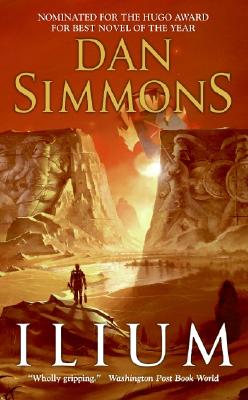
Ilium

by Dan Simmons
ages: adult
First sentence: “Rage.”
Support your local independent bookstore: buy it there!

There are books and then there are Books. Ones that throw their heft around, demanding things (heaven forbid!) of you as a reader. This is one of Those Books.

To be fair: I don’t think I’m smart enough for this book. For starters, there’s just so bloody much going on. It’s got Greek mythology, dystopian post-apocolyptic societies, Proust, Shakespeare (in more ways than one!), magic, technology, robots, some weird species called morovecs, and Little Green Men on Mars.

The plot, you ask? Well, there’s three:

  • On Mars, the Gods of Olympus are re-enacting (possibly) the Iliad, using dead 20th- and 21st- century scholars to observe and predict the action. 
  • On Earth (possibly), there is a group of friends who end up setting off to find the post-humans (no, I’m not quite sure what they are, either) and end up meeting a 1400-year-old Jewish woman who leads them to an asteroid above earth where the post-humans are supposed to be. Along the way, one of the party gets eaten by a dinosaur (or maybe that happens first?) and they meet Odysseus.
  • There are two moravecs (robotic entities, mostly scholars of Earth, that live on the moons of Jupiter) sent on a mission to figure out why Mars has been terraformed.

 For me, the Iliad one was the most interesting, and really what kept me reading the book. Then came the dystopian-human-Earth one. I do have to admit, that for a good half of the book, I skimmed the moravec chapters. I can only take so much Proust. That said, I kept hoping the three plots would converge and start to make sense. They do end up converging — and honestly, about two-thirds of the way through, it got really interesting — but I’m not sure about the making sense part.

See, the entire book, all 570 pages of it, was an elaborate set up for the next book, Olympos. (I’ve never read the Iliad: is it just a huge set-up for the Odyssey?) Which really, really frustrated me. I wanted some sort of ending, some sort of resolution, and I’m left hanging in a major way. So, I’m torn: do I want to read yet another Book (it’s 690 pages, for heaven’s sake!) just so I can figure out what the whole story was about? Or do I just cut my losses and walk away?

I’m leaning toward the latter.

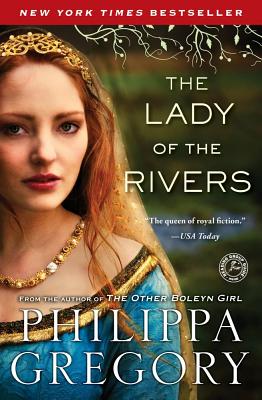
Audiobook: The Lady of the Rivers

by Philippa Gregory
Read by Bianca Amato
ages: adult

So, I have loved Philippa Gregory in the past. The intrigue, the sweeping historical drama, the women behind the kings. And, this one has such a pretty cover (though I like the hardcover one better). So, I got the audiobook and started to listen to it, hoping for that same grandiose, sweeping world that I love from Gregory.

And what I got was a petulant, whining brat.The story is of Jacquetta, a French girl married to the Duke of something or other, who wants her for her “powers” (they never really manifest into anything, and peter away after a while; it would have been better had they gone somewhere and did something). They never consummate their marriage, and when he dies, she ends up with his squire, Richard Woodhouse (I think. I never really cared that much.) From there they go to England, have tons of babies, serve the king (who is a total douche), and then I gave up.

I do have to admit that perhaps a lot of my feelings about this have to do with the person reading the book. She. Drove. Me. Batty. Seriously. What may have come off in print as strong, or at least caring, came off as petulant and whiny. And the plot was moving a glacially slow pace; nothing happens for pages and pages and pages. (I checked the print book: I bailed at 190 pages.) I felt the plot spinning in a hamster wheel: going around and around but never moving forward. (I think reading MG/YA books have completely spoiled me for long, complex, SLOW plots. I can’t stand them.)

On the other hand, maybe the 15th century just isn’t as interesting or sexy as the Tudors are, and there’s nothing that Gregory could have done to make it interesting. Which is a distinct possibility.

Either way, I couldn’t hack this one.

True Sisters

by Sandra Dallas
ages: adult
First sentence: “The two sisters leaned forward, their hadns flat against the rear of the handcart, waiting, fidgeting, impatient.”
Support your local independent bookstore: buy it there!

When this book came into the store last week, they all looked at the jacket flap copy, said “It’s Mormon,” and then looked pointedly in my direction. I took a look at the book, said “It’s the Martin Handcart Company,” and took one home.

See, my ancestors — my grandmother’s grandmother, I think — came over with the Martin Handcart company. I listened to my grandmother tell me stories of hardship and survival. It’s part of my heritage. And even though I’ve never picked up a Sandra Dallas book in my life (um, she’s popular, right?), I needed to see what this woman — someone who is outside of my “tribe”, for lack of a better word — was going to do with my heritage.

The basic story is that of the Martin Handcart Company — a group of immigrants from Great Britain (and Scandinavia, something which she omitted much to my disappointment), who for economic reasons made and pushed handcarts across the plains from Iowa to Utah. It was an ill-fated trip from the start: the handcarts were made of green wood, and weren’t very sturdy; they left late; and winter in Wyoming came early. Out of the 650 that started, more than 100 died before making it to Salt Lake City.

Dallas focuses on four women: Anne, whose husband is a member but who has refused to join the church; Jessie, an unmarried woman with two brothers making it over on their own; Ella, a pregnant woman who is crossing with her husband and sister; and Louisa a young wife of one of the company’s leaders. Their stories never really intersect — I kind of was expecting them to, given the title — but, rather, the narrative switches to follow each one as they cross the plains and experience trials and hardships and setbacks and miracles.

While it wasn’t a great novel — she never really got much tension going, and it seemed as if she was just checking things off a list (mention Joseph Smith? Check. Polygamy? Check. Hardship? Check.) — it was a good one, and she did treat the Mormons sympathetically. I liked how she had characters along the whole spectrum of faith: men who were overbearing and overly zealous to men who were sympathetic and supportive; women who were doubters, ones who were strong (both physically and mentally), and ones who were blindly following their husbands. It gave a more nuanced picture of our faith — unlike books in the past, we are neither all always gung-ho about the edicts we’ve been given, nor are we all dissenters.

It’s not a great book, but it’s a good one, something which I wasn’t expecting.

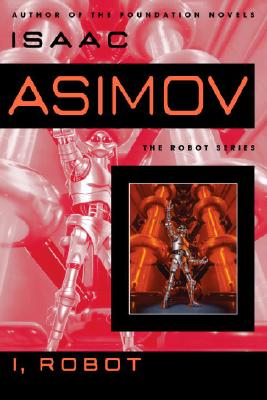
I, Robot

by Isaac Asimov
ages: adult (ish)
First sentence: “I looked at my notes and I didn’t like them.”
Support your local independent bookstore: buy it there!

This is one of those books that I’ve always heard of but never had gotten around to reading. I can’t really tell you why; it just never seemed like something I’d be interested in.

Thank heavens for book groups.

Framed as an interview with retiring robopsychologist, Dr. Susan Calvin, it’s a series of interconnected short stories detailing the evolution of robotics in the “future”. It’s an interesting look into what Asimov thought our future would be like, and the prevalence of robots in society.

I’m not quite sure what to say about the book other than I really, really liked it I thought it was fascinating to read about what Asimov though the future would be like. I liked the character of Dr. Calvin; she was an interesting person to frame the book around, smart and capable (if a bit cold), and gave the book a good grounding. In fact, the stories went down better for me than short stories usually do, mostly because they seemed like chapters in something larger.

That said, two of my favorite stories were “Liar”, in which a mind-reading robot just tells humans what they want to hear; and “Little Lost Robot,” in which a robot goes missing, hiding in the midst of a bunch of other robots that look exactly like it. I found it fascinating the things the psychologists and scientists go through to figure out which one is the missing robot.

But my favorite was one near the end, “Evidence,” where a man is running for mayor of the region, but there are allegations against him: he’s a robot. The point is to prove he’s not. It’s a fascinating look at the line between robotics and humanity, and the issues about whether or not it’s ethical for a robot to actually “act” human.

It’s a good work, one that stands up to the test of time, even if there were moments when I cringed at the 1950s-ness of it all. Even so, I’m glad I had the chance (finally!) to read it.

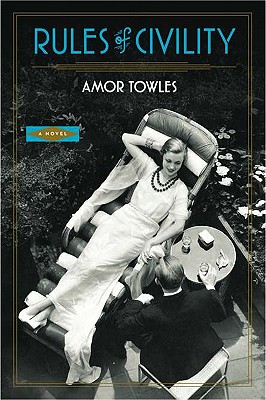
Rules of Civility

by Amor Towles
ages: adult
First sentence: “On the night of October 4th, 1966, Val and I, both in late middle age, attended the opening of Many Are Called at the Museum of Modern Art — the first exhibit of the portraits taken by Walker Evans in the late 1930s on the New York City subways with a hidden camera.”
Support your local independent bookstore: buy it there!

The thing that first drew me to this book (aside from the catchy cover), was that someone at work called it “Gatsby-esque.” Adoring all things Gatsby, I figured that I would (eventually) need/want to read this one. So, when it came through at the library, I snatched it, hoping to be thoroughly engrossed by it.

And I was. Sort of.

The setting is New York City, 1938. Our main character, Kate Kontent (the emphasis is on the second syllable), is a working girl from Brighton, trying to make ends meet. She rooms at a boarding house and there makes friends with Eve Ross, who has slightly higher ambitions. They’re out for a night on the town, when they meet — almost by accident — Tinker Grey: young, handsome, rich, suave. They both pounce, grasping at the chance to get out of the dead-end they’re in.

The book follows Kate’s year: one in which, either directly or indirectly because of Tinker, she gets a new (and better) job, dates a couple of rich socialites (while all the while pining, deep down, for Tinker), and watches as Eve managed to nab Tinker and swing into his lifestyle with ease. It’s a remarkable year, if only for the changes, and revelations it brings in Kate’s life.

It’s Gatsby-esque for the time period (roughly) and the love of jazz (again, roughly), but it’s missing all the other things — regret and fate as well as Gatsby’s elusiveness — that makes The Great Gatsby great. But, even though the characters are rich and reckless, with their lives and their money, there lacks a certain gravitas about it that would help give it a center. Perhaps it’s because Kate is really the least interesting person in the book: Tinker, Eve, and eventually her friends Wallace and Bitsy are all far more elegant and interesting. Once in a while Kate shows some class — like her love of books, and their organization system — but it wasn’t enough for me to truly care about the ups and downs of her year. And the end, the final twist and reveal, fell flat as well.  Perhaps it was because by that point, I was really quite past caring.

I make it sound worse than it was; there was enough to keep me going, since I actually did finish the book. But, it’s not enough to make me love it.

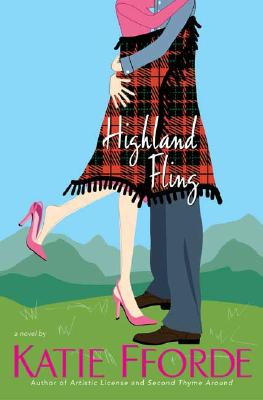
Highland Fling

by Katie Fforde
ages: adult
First sentence: “‘I gave you a home, for goodness’ sake!’ said Henry.”
Support your local independent bookstore: buy it there!

After being laid off when her IT firm went bust, Jenny Porter decided that she’d never work for anyone but herself again. She became a virtual assistant, which is essentially a glorified secretary, even though she rarely meets her clients. Then, one of her clients, M. R. Grant-Dempsey, decides to send her into the wilds of Scotland to check out Dalmain Mills, and see whether or not it’s worth salvaging.

Once up in the wilds of Scotland, away from her increasingly insufferable boyfriend, Henry, (yes, he really is that bad) she discovers that not only does she really like Scotland, enjoys working in a fast food stand, and wants to find a way to salvage the mill, she is really attracted to possibly the least amiable man in the region: Ross Grant. (Yes, it is who you think it is.)

It’s fluff. Really. There’s no way around it. It’s predictable, enjoyable, fluffy romance, where you want the guy to get with the girl, and the stupid, silly boyfriend out of the way. Everything else about the plot is immaterial. There isn’t much sex (just one scene, in a snow cave… cozy…), though Fforde does know how to write a good kiss. And to be gratuitous in my review, this is who Ross Grant looked like in my head:

You’re welcome.

Not a bad way to spend some time, I think.

Pride and Prejudice and Zombies

by Jane Austen and Seth Grahame-Smith
ages: adult(ish)
First sentence: “It is a truth universally acknowledged that a zombie in possession of brains must be in want of more brains.”

I avoided this book when it was all the rage a few years back for one reason: zombies. I really don’t do zombies. That, and I really like Jane Austen and I suspected that I probably wouldn’t be amenable to a mash-up of one of my favorite books.

I was right, on both counts.

For my mother-daughter book group (they’re in 6th and 7th grade), one of the girls picked the prequel to this one, Dawn of the Dreadfuls, as her book choice for this past month. (By the way, the discussion was quite good, even though no one finished it, or even liked it.) I decided here was my chance to see what everyone was talking about, and chose to read this one.

I didn’t finish it, and I didn’t like it. Partly because of the zombies, true. It’s not exactly for the squeamish. The basic plot is that of Pride and Prejudice, except the countryside is swarming in zombies, and the Bennet sisters are skilled zombie killers. They have to be in order to survive.

Which brings me to my second issue: they just smashed zombies into P&P, without a thought to characterization, plot, or even if it would work in Austen’s work. Which it doesn’t. (For me.) Adding zombies changed the characters, and instead of having charming, witty, loveable Lizzy, we’re left with this weird, strange, honor-bound, vengeance-seeking woman. Who beats Darcy up when he proposes to her. (Which is completely out of character. Even if he deserves it.)

So, while I can see the humor in it and the appeal of it, no, it didn’t work for me. Now I know.