Couldn’t Pass This One Up

I found this meme over at turtlebella‘s while I was gone on vacation, and I saved it to do when I got back. It was too much fun to pass up. I did change one from “I want to marry” to “I have a crush on” since I’m already married, and I don’t believe in polyandry, even with fictional characters. 🙂 Feel free to take this one and pass it on.

Legend:

I’ve read it
I want to read it
I’ve seen the movie*
I have it on DVD
I have a crush on the leading man/lady!
Holy smokes, I didn’t know this was a book!

1. Wuthering Heights, Emily Brontë, 1847

2. Pride and Prejudice, Jane Austen, 1813*

3. Romeo and Juliet, William Shakespeare, 1597*

4. Jane Eyre, Charlotte Brontë, 1847* (though I need to re-read it, and I want it on DVD)

5. Gone with the Wind, Margaret Mitchell, 1936*

6. The English Patient, Michael Ondaatje, 1992

7. Rebecca, Daphne du Maurier, 1938*

8. Doctor Zhivago, Boris Pasternak, 1957

9. Lady Chatterley’s Lover, D.H. Lawrence, 1928

10. Far from the Madding Crowd, Thomas Hardy, 1874

11. My Fair Lady, Alan Jay Lerner, 1956*

12. The African Queen, CS Forester, 1935*

13. The Great Gatsby, F Scott Fitzgerald, 1925*

14. Sense and Sensibility, Jane Austen, 1811*

15. The Way We Were, Arthur Laurents, 1972

16. War and Peace, Leo Tolstoy, 1865 (Though I should probably want to read this.)

17. Frenchman’s Creek, Daphne du Maurier, 1942

18. Persuasion, Jane Austen, 1818*

19. Take a Girl Like You, Kingsley Amis, 1960

20. Daniel Deronda, George Eliot, 1876

Additions:

Maurice, E.M. Forster, 1971 (posth.)

Anna Karenina, Leo Tolstoy, 1877

A Room With a View, E.M. Forster, 1908*
A Canticle for Leibowitz

This one, by Walter Miller, Jr., made it on my top ten list when I first read it about ten years ago. I haven’t read it since then, so all I really remembered was that I was really impressed with the book. So, when my online book group picked it for our August book, I was thrilled to read it again.

I do have to admit that I spent the first few chapters wondering why I liked the book so much. It opens in a monastary in the desert, with Brother Francis of Utah on a Lenten fast. The world has blown itself up, purged itself of all intelligence and started over. Isaac Edward Leibowitz, scientist and unwilling perpetrator of the first nuclear holocaust, decides to help save the knowledge, and organizes a group of monks into bookleggers and memorizers, a group which eventually becomes a monastery devoted to the work of Beatus Leibowitz. Anyway, back to Brother Francis…. he discovers, with a help of a wanderer, a fallout shelter, a shopping list and a blueprint of Leibowitz’ which guarantees his sainthood.

By the second part, set 600 years in the future from the ending of the first section (I think we’re at 3175 by this point), I remembered why I liked it. It’s a compelling story of human history. The second part, age if you will, is telling of learning, of discovery. The Age of Reason, when people are not discovering electricity, but re-discovering it. There are some very interesting and involved passages in this section between Thon Taddeo, a respected scientist and natural philosopher, and the abbot of the monastery, Dom Paulo.

However, by the third part, I realized that while this is a very deep and profound and possibly important book, it is also a very hopeless and depressing one. By 3781, human society has advanced enough to have space travel and computers and, yes, nuclear weapons again. And because human nature is primarily a violent one, they are set about trying to kill each other again. In spite of its depressing nature (really, isn’t there any hope for us? Are we really doomed to repeat history? Can’t we learn?), I found it incredibly relevant. The opening passages of this section are a press junket with a defense minister, that could be something that some upper level administration flunky gave yesterday. And there are some challenging passages about euthanasia, too; heart-wrenching ones after a nuclear bomb was launched on the city where the monastery is.

It’s not a perfect book; just when you get involved in one character, Miller up and kills him. There is very little compassion, and as I’ve already said, hope. It’s a dark, depressing look at what the future might hold, especially if we can’t get past our current violent tendencies. It’s a very anti-war book, which as a pacifist I can totally sympathize with; but it’s also an anti-technology and anti-progress book. At least progress for progress’ sake. And I’m not sure I totally agree with that. Are we really better off when the knowledge is in the hand of a few, even if (especially?) they are devoted to God? Isn’t it better that we know more, and have learned more?

I guess the rub is that it is, only if we use it responsibly. And we so seldom do.

Reviving Ophelia

Number one book finished on vacation. I didn’t pick light and fluffy books. I did, however, read everyone’s reviews of Eclipse, and am very happy that it’s now waiting for me at the library. Unfortunately (maybe), I have two Austen-sequels to get through before Saturday, so Bella and Jacob and Edward will have to wait (as well Pretties…). I do promise to put pictures of Amira and booklogged up, if it’s okay with them. 🙂

On to the review…

After reading Girls Gone Mild, and since M is due to start Middle School any day now, I figured it was about time I got around to reading Mary Pipher’s book. My mom sent me this one a year or so ago; she had read it a while back when my sister was going through some tough times at home. Mom figured it could help me — you know, the whole four girls thing and all.

I found this book — it’s the 1994 version — to be both incredibly helpful and completely out of date. Well, mostly out of date. I think we’ve come a long ways in the 13 years since this book was written. I’m not sure the teenagers of today are nearly the demure, confused girls that Pipher was interviewing. There is greater equality in education (in fact, I read a report that quoted statistics that said more girls than boys are likely to graduate high school and go to college.) At the same time, I completely buy what Shalit was writing about: we are still an incredibly sexist, lookist and misogynistic society and that the incidences of eating disorders and other self-abusive practices are actually up, rather than down.

It was really a lot of personal stories, many of them disturbing and sad. But, there were a couple of places where Pipher gives some much-needed advice. (Unfortunately, they were at the end of the book.) She has a chapter on “What I Learned from Listening”, which is essentially a primer on how to listen to your teenager, and how to guide her through the process of discovering her own opinions, thoughts, and belief systems. Invaluable. And the final chapter, “A Fence At the Top of the Hill”, she gave suggestions on how to keep your girl from being swept away by the storm that is teenage years. I found it to be encouraging and helpful.

It’s not a perfect book, but I am glad I read it. Maybe I will survive my girls being teenagers. It’s like everything else: hard work, perseverance, mistakes, crying, and joy. Either that, or just cross my fingers and hope. Right?

Home Again, Home Again

Well, after 2652 miles (there and back again) we’re finally home. It was a fun trip… not only did we see both extended and extended-extended family, but we saw a couple of old college friends of Hubby’s, as well as some old friends of ours from past places lived. The bloggersnacker with the LDS blog people was interesting… I chatted for a long time with an old college friend (we spent the time wondering what happened to everyone; he was much more up on them than I am), and I bumped into a guy from my freshman year. (Unfortunatly, our primary relationship was one of snogging behind the Tanner Building at BYU, so it was a little embarrassing. Thankfully, he didn’t remember me. At first.)

I also met two blogging friends: Amira and booklogged. I really enjoyed finally seeing both ladies (it really isn’t meeting if you’ve “known” someone via blogs for three years, is it?), and thoroughly enjoyed the time spent chatting with them.

I did get a couple of books read, and I will post reviews of them, when I get the time. For now, it’s getting the pictures from the vacation posted, dealing with the post-vacation unpacking, and getting the girls off to school in the morning. Can you believe that summer’s already over?

‘Tis The Season…

for family vacations. We’re off tomorrow bright and early for Utah … and for 10 days of crazy running around trying to see as many people in as short of time possible. Oh, that, and a family reunion. C and M are missing the first three days of school so we can do this, but since this reunion was planned two years ago (when we were living some place where school started just a bit later) and we figured that the second week of August wasn’t a bad time to go on vacation. Ha! Were we wrong! (I’ve had to tell principals, teacher and other assorted school personnel the same story over and over again. Thankfully, everyone’s been pretty sympathetic. It does mean that the girls — M especially — will be hitting the ground running when they start school on the 20th. Can you say, “Make up work”?)

At any rate, we are looking forward to seeing relatives — my grandparents and aunts, uncles and whatever cousins show up to the shin-digs; in-person friends — both old-old, semi-old and new-old; and blogging friends — I get to meet Amira, finally, and we’re planning on going to the bloggersnacker to see as many Times & Seasons and By Common Consent people as possible.

I’ll probably get some reading done in between all the visiting (we’re going to a family camp where I don’t have to see my kids for a week! I may just like this….), but I’m going to try and tear myself away from my little addiction here, and not blog for the next week and a half.

Hopefully, I can remember what the books are about when we get home!

Liszt’s Kiss

I’m a pianist, of sorts. I used to be really pretty good — not professional or anything, but good enough. But since I haven’t practiced regularly in years, I can only say I’m probably above average now. Enough to play when asked at church, but that’s about it.

But this book, by Susanne Dunlap, made me want to practice again.

I’m not sure that was her intended outcome…. it’s a historical romance and mystery (of sorts). It’s set in Paris during the cholera epidemic of 1832 (what’s it with me and French books?). Anne, the daughter of marquis de Barbier-Chouant, recently lost her mother to the cholera epidemic. Her mother’s friend, Marie d’Agoult, takes Anne under her wing in spite of Anne’s fathers’ disapproval. From there, she engages noted pianist and composer Franz Liszt to give Anne’s natural talent for the piano some polish. And from there, of course, things develop.

While the story itself was quite intriguing, the real power of this book, for me, was in it’s musical passages. My only regret is that I don’t know music well enough to know what “lively Schubert dances” or “sonata by Beethoven” or even the work by Chopin that Anne plays at her salon debut was. I feel like the book should have come with a CD of all the music played (I’m even deficient enough that I didn’t know which aria from Don Giovanni was being quoted at one point.) That said, though, I completely related with Anne’s relationship to the piano. She played to express herself. When she was heartbroken, she played. When she was angry, she played. When she was upset, she played. When she was happy, she played. In fact, the greatest harm her father ever did was shut her off from playing the piano. It was Anne’s desire for the piano that woke up my own latent pianist. When I finished this book, I dug out my Liszt and Chopin and Beethoven and spent a wonderful 20 minutes playing. (I would have spent longer, but that was as long as I got before K decided that she needed to practice with me, ending all my hopes for a long session.)

The other intriguing thing about this book was that it was told from at least five different points of view — there was Anne, Marie, Pierre (a medical student), Liszt, Armand (Anne’s cousin) and possibly others. Often an event would happen, and then the next section would back up and retell the same event from a different perspective. I have found that this is a hit and miss idea for me; sometimes it works, others it falls flat. This time, it worked. I enjoyed getting to know each of these characters, from the budding Anne, to the passionate Liszt, to the concerned doctor to the hesitant Armand, to the very intriguing and independent Marie. Each character had something interesting to contribute to the story and the story would have been less without each perspective.

I did know enough music history to know that the characters of Liszt (of course) and Marie were based historical figures. But, Dunlap managed not to let the history get in the way of the story. And she chose to make both Liszt and Marie less central to the story, which also allowed the other characters to shine through.

In all, a wonderful way to spend a summer day.

At Least You Don’t Read With Your Toes

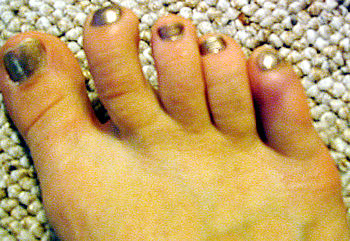
Look what I did to myself on Monday night:

If you can’t tell, my pinky toe is swollen and purple. Yup. It’s broked. And it hurts like hell. (I didn’t know cutting parsley is a dangerous activity, but apparently it is.) Thankfully, I only fractured it near the top, so I’m not stuck in a walking boot. I do have a nice limp, though. And my running regimen? Snort. At least it’s only for a couple of weeks.

In other news, the August Estella’s Revenge is up. It’s a small issue (it is August, after all!), but, like usual, there’s some good stuff. For more pictures of me (albeit when I was a kid), check out my essay on why I like children’s books. (There’s also my review of Wendy Shalit’s new book. And I really enjoyed Nancy’s interview with Colleen Gleason.)

And don’t forget the Bookworm Carnival’s August deadline is quickly approaching. For more details, check reading is my superpower (she’s hosting, after all).

Try not to break your toe doing it. 🙂

The Birchbark House

I wanted to like this book, by Louise Erdrich, I really did. Back in May, when I wrote my post on Caddie Woodlawn and was chastised because I wasn’t sensitive enough to the depiction of Native Americans in that book, this one was suggested as an alternative. And I really wanted to like it.

On one level I did. It’s full of passages and descriptions of Native American life in the mid-1800s. The things they did to survive. The relationships they had with each other. The interactions with white people. Omakayas, the main character, works and plays and makes friends with bears and crows and is annoyed by her little brother, Pinch.

But, the problem was: there was no story. Or, rather, there was a story there (a baby girl — Omakayas — is the only one on her island to survive the small pox, is rescued, and eventually helps her adopted family through another bout of the disease) but it wasn’t told well at all. In fact, it was incredibly difficult for me to get through this book because it was, well, boring. They work, they sleep, they argue, they get sick, they survive to get maple sugar in the spring. I didn’t care for any of the characters, not even when baby Neewo dies (it was so surreal that I didn’t feel any emotion at all for anyone). Pinch was supposed to be annoying, but I found him to be downright mean. Even Omakayas, who I felt was supposed to be spunky, fell flat.

At least I can say I tried, right?

Filler and Tips

I’m still not done with the book I started… it’s one of those really slow ones, even if it’s a YA book. So, more filler (lots of filler this week.) Becky tagged me for the blog tips meme (ish thing). And I thought, hey, it’s a meme, and I’ve been tagged (ooh, me, me!), so why not? (Took me a while to come up with something. All the good advice is already taken!)

START HERE:

It’s very simple. When this is passed on to you, copy the whole thing, skim the list and put a * star beside those that you like. (Check out especially the * starred ones.)

Add the next number (1. 2. 3. 4. 5., etc.) and write your own blogging tip for other bloggers. Try to make your tip general.

After that, tag 10 other people. Link love some friends!

Just think- if 10 people start this, the 10 people pass it onto another 10 people, you have 100 links already!

1. Look, read, and learn. **-http://www.neonscent.com/

2. Be, EXCELLENT to each other. ***-http://www.bushmackel.com/

3. Don’t let money change ya! *-http://www.therandomforest.info/

4. Always reply to your comments. ********-http://chattiekat.com/

5. Link liberally — it keeps you and your friends afloat in the Sea of Technorati. **** http://chipsquips.com/

6. Don’t give up – persistence is fertile. **-http://www.velcro-city.co.uk/

7. Give link credit where credit is due. *******-http://www.sfsignal.com/

8. Pictures say a thousand words and can usually add to any post.*** –http://scifichick.com/

9. Visit all the bloggers that leave comments for you – it’s nice to know who is reading! * –http://stephaniesbooks.blogspot.com/ ***

10. Make a blogger template unique: change the background colour, or add a background picture to your header. http://chris-book-a-rama.blogspot.com/

11. Ensure font size of words is not too small and colour of words don’t drown in background. – http://booksloveme.blogspot.com/

12.Do at least a few of the blogging quizzes available. It lets people know a little more about you.** http://3m3am.wordpress.com

13. Even when you disagree with a blogger’s post, don’t leave rude comments. Always be kind. ** http://apatchworkofbooks.blogspot.com

14. Join the blogosphere community. Participate in carnivals. Join challenges. Have fun.* http://blbooks.blogspot.com

15. Remember, though, that’s it’s just a blog. Relax and enjoy the ride. http://melissasbookreviews.blogspot.com/

–End Copy —

I’m supposed to tag five people. But many of my usual-tag list has been tagged already. So, if you feel like doing this one, and you haven’t, you have my permission to go for it.

Guest Blogging Princess Power

I got this book from Andi as a review book for Estella. When the book got here, I looked at it and though, “Huh. Not what I was expecting.” The back of the book said for ages 9 to 12, but M (our resident 9 to 12 year old) looked at it and said, “It’s a bit young.” So, we passed it on to C (our resident 6 to 8 year old). I told her that if she read it, I’d let her review it for Estella.

Turns out, though, that it really is youngish for the readership over at Estella. But, I did promise C that she could do her review. So, without further adieu, here it is:

Title and author of book:
Princess Power: The Stubbornly Secretive Servant, by Suzanne Williams. It’s Book #5 in a series.

Fiction or non-fiction? Genre? Fiction.

What led you to pick up this book? It looked cool. Like you were going to solve mysteries, have adventures.

Summarize the book: The plot was Jonathan, who was supposed visit Princess Gabrielle and Prince Jerome, went missing. The four princess friends decided to figure out what happened to Jonathan.

What did you like most about the book? I liked that the princesses were always ready for new things to pop up. I liked that most of the time, one of the princesses (Tansy) played her magic flute so they could hear each other’s thoughts.

What did you like least? That the plot was all about Jonathan, a prince that was coming to the royal ball. (He’s also a magician.) I also didn’t like that Thomas, Jonathan’s servant, did all the dumb stuff. It got boring after a while.

What did you think of the main character? There were many main characters. Gabrielle and Jerome (her husband) didn’t do a lot of cool stuff, but Gabrielle had a baby in the last chapter. The other princesses were all different. Fatima rocked; she was adventurous, and had a magic carpet. Lysandra was Gabrielle’s sister, so got to be an aunt. She was also the one that figured out the mystery (Tansy helped). I thought Tansy’s magic flute rocked. Elena was pretty boring though.

Any other particularly interesting characters? No.

Do you recommend this book? Yes, for girls who like princesses and adventures.

My note: I think this book is in an odd category. It was a bit difficult for C to read, the names especially being difficult to pronounce. (She would call Fatima, “fat-ma” and Jerome “jer-um”) But, unless M is unusual for her age (which I concede that she may be), I can’t see a 10-year-old liking an underdeveloped and simplistic princesses adventure/mystery book. It really is a glorified beginning-reader chapter book.