Operation Clean Out Closet: Book Giveaway

I have been noticing over the past little while that my book pile on my closet shelf — the books I’ve read, mostly enjoyed, but have no desire to keep — has grown to monumental proportions. Sure, I could sell (some of) them at a used book store, or put them on Book Mooch, but I think I’d rather get rid of them by degrees, and pass them on to some other appreciative reader. This will be a weekly event for a while (until the pile is gone, at least), so if you don’t like this week’s book, check back next. 🙂

Up for grabs…

an ARC of Jessica Day George’s Princess at the Midnight Ball. (Here’s my review, as well as a sampling of others: Becky’s Book Reviews, Deliciously Clean Reads, Presenting Lenore, The Magic of Ink, and Wands and Worlds.)

To enter, leave a comment (with a valid email, if it’s not readily available on your blog) by 7 a.m. Friday (US Central time) answering the question: which is your favorite fairy tale re-telling or re-imagining (see Charlotte’s review for a good definition)? It’s open to both US residents and international readers, and I’ll put your name in a second time if you spread the word on your blog.

I’ll pick (or rather, one of the girls will) the winner on Friday.

Good luck!

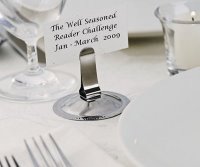
Well-Seasoned Reader Challenge Roundup #8

We’re entering into the final stretch: only 31 more days. I’ll set up a finisher’s post where you can leave links within the next day or so (along with finisher’s prizes announcements).

As for the quote of the day, I think I’ve done enough from the travel part, and not enough of food. I need to rectify that. (Maybe March will be food month. Got any quotes for me? Send them to mmfbooks AT gmail DOT com.)

“He showed the words “chocolate cake” to a group of Americans and recorded their word associations. “Guilt” was the top response. If that strikes you as unexceptional, consider the response of French eaters to the same prompt: “celebration.” — Michael Pollan

As for reviews, my wish came true, and we have quite a few this week!

Katrina visited North Korea with the graphic novel, Pyongyang, by French writer Guy Delise. Unfortunately, the visit (and the book) disappointed. Katrina writes, “Now, I’m not saying that North Korea is amazing or politically correct, in fact I know so little about the place that I couldn’t make an educated comment on the country, but I can say that Delise is negative about the place from the opening to the end of the book. He never says a single positive thing about the country or the people that he meets, instead he mocks their views, behaviour and culture.”

W7 read a Graham Greene book, Doctor Fisher of Geneva or the Bomb Party. She describes the book this way, “This rather thin book describes one small part of the life of a toothpaste millionaire who lives in Geneva and who is a pretty cold and weird character. Most of all this man “entertains” himself by having parties to which he invites a small group of faithful acquaintances – he refuses to call them friends. And these parties are designed as experiments to see how far the greed of rich people will take them.” She quotes from the book about happiness and unhappiness, and comments, “It is so hard to describe happiness, and so easy to describe unhappiness.” Which I think is so true.

She also read Adrift on the Nile, by Naguib Mahfouz. She writes, “Naguib Mahfouz is a fabulous writer, or is this too obvious since he is a winner of the Nobel Prize for Literature? He writes stories which could nearly be taken to be simple. As you read his work though you cannot help but know that everything is a metaphor, everything is a parable but you cannot tell for sure what the message is, if there is one really and if what you read in it tells you more about yourself or about Naguib Mahfouz.” Obviously, I need to find a book by this man.

Mrs B. read My Life in France (many participants have visited France for this challenge, too…) by master chef Julia Child. Mrs B. comments that it’s a gem of a book — about Julia’s experiences in France and how she learned to cook the French way. She comments about the book, “. It is such an encouragement to hear about a woman beginning the most important and influential segments of life around the age of 40…makes me feel like there’s all the time in the world.”

Amira throws out one of of her favorite books: The Reindeer People: Living with Animals and Spirits in Siberia by Piers Vitebsky. She writes, “It’s too rare a combination to have a scholar like Piers Vitebsky who can write an engaging book for the general public. Not that this book is unique in that way, but it’s unusual. This really is the book to read if you’re going to read something about Siberia. Highly recommended.” She also found a Soviet-era guidebook to Bishkek (where she and her family lived for a year), Frunze, and commented, “It’s easier to imagine that the author was exaggerating than that Bishkek ever was a “City of Smiles,” at least for tourists.”

Erin read Three Cups of Tea, about Greg Mortenson’s quest to build schools in Pakistan and Afghanistan. She has a personal connection to the book, since her husband served in Afghanistan with the military, and actually saw the situation first hand. Erin writes, “[T]he idea that education of girls is the way to save the world is just fantastic. Honestly. Believe the hype, give this book a try.” (As I’ve long said, it’s not a brilliant book, but it’s a really good cause. Read the book and then give the man some money. He will do much good with it. Sorry for the soapbox.)

Becky tackled Don Quixote, and is not sorry she did. She writes, “Did it live up to my expectations? Was it everything I wanted it to be? Yes. And then some. I expected it to be a bit on the absurd side, a bit over the top. A book that explores the fine line–and not so fine lines at times–between sanity and insanity, wisdom and folly. But what I didn’t expect was the humor. I didn’t expect the book to be as entertaining as it was.”

Two people tackled Hanna’s Daughter, by Marianne Fredriksson: Corinne, who said: “I’m still reeling from the depth of this book.” (Can’t get much better than that.); and Amira, who said: “It’s probably not the sort of book I would have picked up (mother-daughter relationships), but it was worth the time to read it.”

And lastly, but definately not leastly, Kristi checked in with four reviews: Lessons from San Quentin, by Bill Dallas; The Spring of Candy Apples, by Debbie Viguie; Trail of Crumbs, by Kim Sunee; and Fruit of My Lipstick, by Shelley Adina.

I like what Kristi said about Trail of Crumbs: “Her book is doctored with tales of wonderful foods in exotic (to me) places. At the ends of many of the chapters are recipes of what sound like delicious dishes. I hope someday to have the courage to try some of them.” For me, that’s the real essence of a good food book!

Only four weeks left!

February Jacket Flap-a-Thon

I have nothing witty to stay to begin. Generally, February is better than January in my book, but for some reason, I never really got a grasp on the month. Nothing drastic or dramatic, just couldn’t shake a general funk. Thank heavens for books….

Indigo’s Star (Margaret K. McElderry Books): “IT’S BACK TO SCHOOL FOR THE START OF A NEW TERM, AND THE ECCENTRIC CASSONS ARE UP TO THEIR OLD TRICKS! Indigo, having just recovered from a bout of mononucleosis, must return to school after missing an entire semester. Only his younger sister and loyal sidekick, Rose, knows why he’s dreading it so much. As it turns out, the school bullies are eagerly awaiting Indigo’s return so that they can pick up where they left off — flushing his head in the toilet. But Indigo hasn’t counted on meeting Tom, an American student who is staying with his grandmother in England for the year. With his couldn’t-care-less attitude and rock-and-roll lifestyle, Tom becomes Indigo’s ally, and together they work to take back the school. Meanwhile, eight-year-old Rose is desperately trying to avoid wearing horrible glasses, nineteen-year-old Caddy is agonizing over her many suitors, Saffy is working overtime with her best friend, Sarah, to protect Indigo from the gang, and with their father, Bill, in London at his art studio, their mother, Eve, is just trying to stay on top of it all!”

Actually, this is a good bad one. M read the blurb and had no interest in reading the book. (Her exact words: “I have no desire to read about heads being flushed in toilets.”) It was only after I read it, gushed, cajoled and reminded that she actually read the book. And loved it.

Princess of the Midnight Ball (Bloomsbury): “A tale of twelve princesses doomed to dance until dawn… Galen is a young soldier returning from war; Rose is one of twelve princesses condemned to dance each night for the King Under Stone. Together Galen and Rose will search for a way to break the curse that forces the princesses to dance at the midnight balls. All they need is one invisibility cloak, a black wool chain knit with enchanted silver needles, and that most critical ingredient of all—true love—to conquer their foes in the dark halls below. But malevolent forces are working against them above ground as well, and as cruel as the King Under Stone has seemed, his wrath is mere irritation compared to the evil that awaits Galen and Rose in the brighter world above. Captivating from start to finish, Jessica Day George’s take on the Grimms’ tale The Twelve Dancing Princesses demonstrates yet again her mastery at spinning something entirely fresh out of a story you thought you knew.”

Perhaps I notice this because I read a lot of Bloomsbury books, but the folks there really know how to pique a reader’s interest without giving too much away.

Matrimony (Vintage Contemporaries): “It’s the fall of 1986, and Julian Wainwright, an aspiring writer, arrives at Graymont College in New England. Here he meets Carter Heinz, with whom he develops a strong but ambivalent friendship, and beautiful Mia Mendelsohn, with whom he falls in love. Spurred on by a family tragedy, Julian and Mia’s love affair will carry them to graduation and beyond, taking them through several college towns, over the next fifteen years. Starting at the height of the Reagan era and ending in the new millennium, Matrimony is a stunning novel of love and friendship, money and ambition, desire and tensions of faith. It is a richly detailed portrait of what it means to share a life with someone — to do it when you’re young, and to try to do it afresh on the brink of middle age.”

I like this because the book is about such normal, everyday things which are hard to summarize. But, the copy does a good job with this.

The Trouble Begins at 8 (Greenwillow Books): “Mark Twain was born fully grown, with a cheap cigar clamped between his teeth.” So begins Sid Fleischman’s ramble-scramble biography of the great American author and wit, who started life in a Missouri village as a barefoot boy named Samuel Clemens. Abandoning a career as a young steamboat pilot on the Mississippi River, Sam took a bumpy stagecoach to the Far West. In the gold and silver fields, he expected to get rich quick. Instead, he got poor fast, digging in the wrong places. His stint as a sagebrush newspaperman led to a duel with pistols. Had he not survived, the world would never have heard of Tom Sawyer or Huckleberry Finn—or red-headed Mark Twain. Samuel Clemens adopted his pen name in a hotel room in San Francisco and promptly made a jumping frog (and himself) famous. His celebrated novels followed at a leisurely pace; his quips at jet speed. “Don’t let schooling interfere with your education,” he wrote. Here, in high style, is the story of a wisecracking adventurer who came of age in the untamed West; an ink-stained rebel who surprised himself by becoming the most famous American of his time. Bountifully illustrated.”

My only quibble is the “Bountifully illustrated.” Huh? (They weren’t even really illustrations, more a combination of photographs and reprinted cartoons.) But the rest is a good teaser inviting readers to learn more about Mark Twain.

Other books read this month:
Everything Beautiful
Beside a Burning Sea
Maus I and Maus II
Skeleton Creek
The Dragonfly Pool
Madame Pamplemousse and Her Incredible Edibles
Becoming Jane Austen
The Adventures of Boone Barnaby
The Four Agreements
The Graveyard Book
The Bermudez Triangle
A View from Jerusalem
Dear Julia
Chocolat

The Trouble Begins at 8

by Sid Fleischman
ages: 9-12
First sentence: “So often had Mark Twain suffered through bumbling introduction before he rose to speak that he sometimes chose to introduce himself.”

When I was in 7th grade, I had an abiding love for Mark Twain. We had read Connecticut Yankee in King Arthur’s Court (I had read Tom Sawyer the summer before), and I was totally and completely smitten. In short, I would have adored this biography, had it existed when I was in 7th grade.

Even now, I adored this book. Not just for the wealth of information about Sam Clemens aka Mark Twain, or for the illustrations/photographs that grace it’s pages, or even for the beautiful layout and font that it was written in (it was one of those rare times that I kept flipping pages because it was just so satisfying to flip the pages and gaze at the text). No, I adored this book because Fleischman was so, well, amusing.

He had me with this passage:

When I was the young writer of a novel, The New York Times reviewed my comedy with the news that I was no Mark Twain. I was astonished. I had already had myself fitted for a white suit, like the celebrated author of Tom Sawyer and Huckleberry Finn. I had been trying to track down the brand of cigars he smoked by the handful. His wit may have come from the noxious weed. Who knew?

I was gone. Hook, line, and sinker.

Fleishman spends the book recounting the origins of Mark Twain — from Clemens birth through his rough and wild days in Nevada and San Fransisco, through until he became famous. He’s not all that interested in what Twain did with the rest of his life — the later books (aside from Huck Finn) only get a passing glance, as do the last 50 years of Twain’s life. But, then, that’s not what’s important (or humorous) to the book. No, it’s the young Twain, the wild Twain, the one that’s observing, exaggerating, writing, figuring that’s the interesting Twain.

It isn’t a detailed book, though: there’s facts but Fleischman is more interesting, it would seem, in the story that is Twain’s life. It’s not as dry as a typical biography, but then it’s also not as detailed. Thankfully, Fleishman has a book list (in order of importance and relavance) in the back that will point anyone curious to know more about Twain in the right direction.

Most of all, though, Fleishman treats Twain probably excatly the way that Twain himself would want to be treated: with equal parts grace, humor and skepticism. Which makes it an absolutely wonderful read.

(It also made me want to go and re-read the works I’ve read in the past, as well as crack open Roughing It and Innocents Abroad, neither of which I’ve ever read. That says a lot about the book in and of itself, doesn’t it?)

Chocolat

by Jeanne Harris
ages: adult
First sentence: “We came on the wind of the carnival.”

I finished this a couple of days ago, but put off writing a review because I wanted to watch the movie again, mostly so I could compare the two. But, alas, the planets/stars/karma aligned against me, and I wasn’t able to get a copy. Not willing to wait another week until I could get one (that whole bad memory thing), I’ll just have to write my impressions of the book, and save the whole comparison thing for later.

Vianne Rocher and her daughter Anouk move into tiny, drab, sober, religious Lansquenet on Mardi Gras. Vianne decides that her services are needed in this village, and sets up a chocolate shop, La Praline. Because the world that Harris has set up is a magical one, Vianne is possessed with the ability to know each of the villiagers Favorites, and fairly quickly wins not only customers, but loyal friends. This rankles the villiage priest, Pere Reynaud, who is hell-bent on keeping his flock in what he determines is a straight line.

It sounds like a greater conflict than it really is. The chapters alternate between Vianne and Reynaud narrating, and by the end of the book, I didn’t trust either as a narrator. Reynaud is despicable as a priest, more set on his right way rather than actually being a Christian. Vianne, on the other hand, is more set on finding the path of happiness through indulgence and freedom of desire. The book sets the Church up as wrong and oppressive, and Vianne as right and the way to True Happiness. Which isn’t entirely bad, since Vianne does some admirable things — things that a priest should have — while in town. However, I got to the point where I felt that because she was actively working against Reynaud, fool that he was, she provoked him in ways that were unnecessary. I felt like the “true” story, as well as the moral center, was somewhere in between the two narrators. (Then there’s the whole deal with Roux, the riverboat gypsy, but since I think I need to see the movie to fully formulate my thoughts on him, I think I’ll have to give him a pass.)

While the writing was captivating at times, I suffered from the same problem I did in Dear Julia: too many French names, not enough lush description. Please, please, describe the smells, the textures, the tastes of the chocolate, not just the names. Harris is better at this, for she does delve into that at times, but not enough for my taste. I do have to admit that at times I was reminded of Isak Dineson’s story” Babette’s Feast”, but there are quite a few stories about a woman’s ability to work magic, and therefore change, through food.

That’s not to say that the book is bad; I did enjoy it, for the most part. A friend of mine, when I told her I was reading this one, said that while she liked the book, she thought the movie was better. Perhaps this is just really one of “those” books.

Dear Julia

by Amy Bronwen Zemser
ages: 12+
First sentence: “When Elaine Hamilton was six years old, she told her mother she wanted to be a cook when she grew up.”

Elaine Hamilton has been cooking since she was small. Her favorite person is Julia Child, and she decided very early on that she wanted to be exactly like her. Elaine’s father bought her a boxed set of Mastering the Art of French Cooking (volumes one and two) when she was eight, and she has spent the last nine years memorizing and mastering the recipes. All but the lowly omlette; that she can not make.

Every time Elaine hits a snag in her cooking, she writes a letter to Julia Child. Except that she doesn’t mail them. They sit in a trunk in her room, testimonies to her passion, her desire to be a chef, and… to her inability to make friends.

That is, until Lucida Sans (yes, she’s named after the computer font) comes into Elaine’s life. With a bang. Literally. They form an unusual friendship, that leads (because of Lucida’s weakness for a certain handsome cad) to an attempt at a cable show and, ultimately, to the Young Chef’s American Culinary Competition.

In some ways, the book is absolutely delightful. It has a fairy-tale quality (including what I thought was a hokey ending, that M pointed out it completly fit the fairy-tale-ness of the book) that was entertaining and charming. Both Elaine and Lucida were fun, sweet, enjoyable characters. Even the cad was amusing with all his preening and begging.

But, with all the sweetness, there was an underlying brashness. Elaine’s mother, an old-school feminist and a Congresswoman, dislikes her daughter’s love of cooking. In fact, the rest of the first page underscores this quite well:

“Oh, Elaine,” she had said, hurriedly stuffing papers into her briefcase, “Can’t you aspire to something higher? Twenty years since liberation and you want to stay home and slave over a burner?”

I wanted to throttle the woman. She spent the whole book underappreciating her daughter’s ability (I can’t even pronounce half of what Elaine can cook, let alone prepare it!), and trying to force her daughter to be exactly like her. (While Elaine’s brothers are free to do what they will.) The nerve of the woman. (Can you tell this really bothered me?)

And then there’s the tone of the book. The narrator bothered me at first, and while the annoyance went away, I was never fully able to lose myself in the book. (Perhaps this same critique can be said of The Disreputiable History of Frankie Landau-Banks?) I kept being bothered by the way the story was being told. And then there was the hokey ending. After finishing, I thought it was overly corny, but I can see M’s point: there is a bit of the unreal, the fairy tale perfect about it. Which, while it rubbed me the wrong way, really does suit the book.

All that aside, what I really wished was that Zemser would spend time being more sensuous about Elaine’s cooking. She dropped a lot of French words and terms, but never really described anything except the processes that Elaine used to make. I’d like to know more about the dishes (besides that they were delicious), about the smells, the sounds, the tastes. In the end, it left me not filled and satiated, as I was hoping, but empty, wishing for more.

Which is too bad. Because it was a cute little story.

Library Loot #8

I’m still putting a moratorium on books for me, since all the books I checked out nearly a month ago are due next week. *sheepish grin* What I did get:

For A/K:
Naked Mole Rat Gets Dressed, Mo Willems**
Jumpy Jack and Googily, Meg Rosoff/Sophie Blackall
The Littlest Owl, Caroline Pitcher/Tina Macnaughton
The Day We Danced in Underpants, Sarah Wilson/illus. by Catherine Stock**
Do Knights Take Naps?, Kathy Tucker/illus. by Nick Sharratt
I am a Dancer, Pat Lowery Collins/illus. by Mark Graham
The Egg, M. P. Robertson**
Beauty and the Beast, Max Eilenberg/illus. by Angela Barrett
The Halloween Cat
Say “Ahhhh!” Dora Goes to the Doctor

For C:
The Road to Oz: Twists, Turns, Bumps and Triumphs in the life of L. Frank Baum, Kathleen Krull/Illus. by Kevin Hawkes
Ranger’s Apprentice: The Ruins of Gorlan, John Flanagan (it’s what we’re going to read out loud next)

For M:
The Lady and the Squire, Terry Jones/Illus, by Michael Foreman
Catalyst, Laurie Halse Anderson (I looked for Speak, but it wasn’t in)
The Darkangel, Meredith Ann Pierce (figured a vampire book couldn’t hurt)*
The Explosionist, Jenny Davidson (I’ll probably read this one when she’s done with it)*
Chosen, Ted Dekker (someone tell me if this is Christian fiction or regular fantasy… I couldn’t quite figure it out…)*
Infidel, Ted Dekker*
Renegade, Ted Dekker

For me:
To Catch a Mermaid, Susan Selfors/illus. by Catia Chien

The roundup is at A Striped Armchair.

*Ones that M eventually read.
**Picture books we really liked.

I Need to Read More Classics

I’ve seen people joining this challenge right and left, and it got me thinking. After the Weekly Geeks Classics week, I realized that there were a lot of classics that I had read, ages ago, and now can remember little to nothing about. That, and there’s still a huge pile out there that I haven’t read at all. So… sign me up.

I’m going to do the Classics Snack plus Bonus. My list:

1. My Antonia, Willa Cather
2. The Woman in White, Wilkie Collins
3. Tess of the d’Ubervilles, Thomas Hardy
4. Anecdotes of Destiny and Ehrengard, Isak Dineson

Snack: Atonement, Ian McEwan

Teaser Tuesday, February 24

  • Grab your current read.
  • Let the book fall open to a random page.
  • Share with us two (2) “teaser” sentences from that page, somewhere between lines 7 and 12.
  • You also need to share the title of the book that you’re getting your “teaser” from … that way people can have some great book recommendations if they like the teaser you’ve given!
  • Please avoid spoilers!
  • From Chocolat, by Jeanne Harris, p. 107:

    The magic mountain opens to reveal a bewildering array, half-glimpsed, of riches; multicolored piles of sugar crystals, glace fruits, and sweets that glitter like gems. Behind this, and shielded from the light by the concealed shelving, lie the saleable wares.

    The roundup is as Should Be Reading.

    The Book of Nonsense

    by David Michael Slater
    ages: 10+
    First sentence: “It was downright embarrassing to get treated so shabbily, especially after the way she’d gone on about how great the place was.”

    There are some books that grab you and won’t let you go. Ones that you’re dying to get to night after night, the ones that your kids beg you to keep reading. This one started out that way. It’s an interesting premise: a book of “nonsense” that a couple of twins — Daphna and Dexter — discover is actually a key to an ancient language of magic. There’s an evil, twisted villain, who’s hypnotized the twins’ dad, and is trying to kidnap Dapha so she’ll work for him. There’s Emmett, a creepy red-eyed bully. And, at the beginning, it’s all very exciting and interesting.

    But.

    Yes, our circumstances didn’t lend for reading every day: we were often sick or busy. But days would go by and C wasn’t asking me to read. And the times when she did, and we couldn’t, she wasn’t horribly disappointed. And I wasn’t terribly thrilled while reading it, either. The chapters were long, and we could never remember what had just happened from one to the next. So, we’re abandoning it, and moving on to something else. Sure, we take the chance that we’re leaving just at the best part, that something spectacular will happen to make the book absolutely fabulous, and we’d be hooked and can’t wait for the sequel.

    The problem is: neither one of us is terribly interested in finding out whether or not that’s true.