French Milk

by Lucy Knisley
ages: 16+
First sentence: “My last night in Chicago for six weeks, and unseasonably warm for December.”
Support your local independent bookstore: buy it there!

This slim travel memoir/graphic novel is about Lucy’s trip to Paris with her mother the semester before she graduates from college. It’s very much a young adult book; Lucy’s trying to figure out her future, dealing with rejections and insecurities about what path to take, and so it, at times, becomes highly angst-ridden. The book is best the times when Lucy lets her ego go, and she sits back and enjoys what Paris has to offer. The food! The art! The architecture! The history! The people!

The trip is in January, and so the book has a very winter feel. But even with that, it’s a joyful experience. Told through drawings and pictures, Lucy captures Paris in a way I’ve never read before. The only thing it lacked, I think, was a sense of smell. I saw what she saw, I felt what she felt, but I wanted to smell it all as well. It was a touristy book, but she also went off the beaten path, discovering shops and markets and museums that your average tourist wouldn’t have the time. (In other words: I’d love to have the opportunity to be this kind of tourist!)

Mostly, though, what this book made me do is long to be in Europe again. The pace of life, the sensibilities, the food… I’m just a European at heart, I guess. And this book tapped into that for me. And I really enjoyed that.

Extremely Loud and Incredibly Close

by Jonathan Safran Foer
ages: adult
First sentence: “What about a teakettle?”
Support your local independent bookstore: buy it there!

Huh. I heard so much good about this book, the people over at the Nook (that’s my online book group) are basically raving about it, and all I can come up with is… huh.

For those of you who don’t know (all five of you), the story revolves around nine-year-old Oskar Schnell whose father, two years before, died in the World Trade Center Bombings. Oskar has become increasingly fearful: of heights, elevators, people that look Arab and more and more neurotic, wearing only white, writing letters obsessively to famous people (mostly asking to be their protégé). Then, in his father’s closet, he finds a key in an envelope marked “Black”, and begins searching New York City for the owner. Somehow, he feels, this will help him learn more about his father and give him some kind of closure. Interspersed with Oskar’s story are letters from his grandparents: ones from his grandfather to his father explaining why he left and wasn’t there while his son was growing up. And ones from his grandmother to Oskar, explaining what happened with her husband and why she is leaving now.

It’s the combination of Oskar’s pretentiousness (and “wise innocence”) and the use of graphics — pictures or red markings or — that give this novel it’s unique feel. Sometimes, that’s a good thing. Sometimes, I thought, all of the novel ideas in this novel actually worked. I enjoyed the photographs; they gave an interesting perspective into Oskar’s world and his journey. It’s a depressing subject, 9/11, and I thought there were moments when Foer got grief, got incompleteness, got searching for closure just right. There were chapters that hit me powerfully — the letter from the grandmother about her reaction when she realized her son had died in the towers, for instance — and the ending is, ultimately, hopeful. Which is a good thing considering the scope of the tragedies in the book. It could have been a horribly depressing book, and it wasn’t.

But, there were also moments when the pretentiousness — of both the novel and of Oskar — drove me absolutely batty. I spent too much time trying to figure out the red editing marks on one of the grandfather’s letters, trying to figure out what it all “meant”. And the letter from the grandfather that began with numbers — he was trying to communicate on the phone without speaking — and ended in pages of black ink drove me batty. (Yes, I did try to figure out what he was saying. Argh.) Perhaps, for once in my life, I was over thinking a book instead of letting it wash over me. But perhaps, also, all the uniqueness and all the pretentiousness negated each other: there was too much of a good thing in this book, and in the end I was left with an empty void of Huh.

Library Loot 2010-18

I barely got to the library these past two weeks; they’re still under construction, and there’s not much to do except go, pick up the numerous holds I have, take all the paper off and rubber bands off of them, and check out. Sigh. Hopefully, we’ll be back to normal next week!

What came in these past two weeks:

Adult Fiction:

Extremely Loud and Incredibly Close: A Novel, by Jonathan Safran Foer
The School of Essential Ingredients, by Erica Bauermeister
A Song for Summer, by Eva Ibbotson
Sabine’s Notebook: In Which the Extraordinary Correspondence of Griffin & Sabine Continues, by Nick Bantock
The Golden Mean: In Which the Extraordinary Correspondence of Griffin & Sabine Concludes, by Nick Bantock
The Gryphon: In Which the Extraordinary Correspondence of Griffin & Sabine Is Rediscovered, by Nick Bantock
The Morning Star: In Which the Extraordinary Correspondence of Griffin & Sabine Is Illuminated, by Nick Bantock
The Beekeeper’s Apprentice: Or On the Segregation of the Queen, by Laurie R. King

Middle Grade Fiction:
Running Out of Time, by Margaret Peterson Haddix
Cosmic, by Frank Cottrell Boyce
Where the Red Fern Grows, by Wilson Rawls

YA Fiction:
North of Beautiful, Justina Chen Headley
Blue is for Nightmares, by Laurie Faria Stolarz
Enchanted Glass, by Diana Wynne Jones

The roundup is either at Adventures of an Intrepid Reader or A Striped Armchair. Obligatory FTC note: the links are provided through my Amazon Associates account. If you click through and actually purchase one of these books, I’ll get a teeny, tiny payment. But, since no one ever does, and it’s SO much easier using the associates account to put up these links, I’m going to keep doing it.

Letter to My Daughter

by George Bishop
ages: adult
First sentence: “Dear Elizabeth, How to begin this?”
Support your local independent bookstore: buy it there!
Review copy provided by TLC Book Tours.

Elizabeth, 15 years old, has taken the car and run away after a heated argument with her mother, Laura, which ended with Laura slapping Elizabeth. All Laura can do, now, is wait and hope and reminisce about her own adolescence. In a letter to her daughter, Laura lays her past out before her, hoping that somehow it’ll help the two connect.

And, thankfully, while it’s not a happy, pretty past, it’s also not something that’s truly horrifying. It’s honest in it’s reflections of the teenage years from an adult perspective. Nothing is sugar-coated, but there’s a reflectiveness to the prose, a weightiness that makes the actions of Laura’s youth — from her first, and only it seems, love affair to the loss of that love in Vietnam to her impulsive decision making to her strained relationships with her parents — seem less angsty.

It also helped that the book was one long letter from mother to daughter. It would seem, with something like this, that there would be a self-help feel to it: Bishop, after all, is exploring the relationships between mothers and daughters and (as I well know being on both sides of that equation) that is a tricky one. There is a need to be a parent, to set boundaries, to make sure that your daughter is safe. And yet, there’s is a desire to connect as women, as people who have gone through (or will go through) many of the same experiences. It’s this tension that Bishop is exploring, I think, and the letter format pushed that tension more into the background and less of a central theme. It’s still there, it’s still present, but the book reads less like a “what to do when you’re girl goes astray” and more like a memoir, which helped.

And Bishop writes quite elegantly, as well. It’s a slim novel, and never did a feel that there was more — or less — than should have been told. As a reader, you only find out about Elizabeth through incidental comments Laura makes, and that’s as it should be. It’s Laura’s story, Laura’s memories, and Bishop doesn’t do anything to take away from that. He also quite skillfully handles the passage of time, both flipping back from the present to the past as well as Laura’s traveling through high school. It didn’t feel choppy or jumpy at all.

It was a surprisingly good novel, one that I can see myself dipping into and out of as my girls get older (and perhaps passing on to them).

Fantastic Mr. Fox

by Roald Dahl
ages: 8 to 11
First sentence: “Down in the valley there were three farms.”
Support your local independent bookstore: buy it there!

I’m not quite sure what I expected when I started this. It’s Dahl, so something weird, obviously. And Hubby’s been raving about it for years: it was his favorite Dahl as a kid. So, something… fantastic, hopefully.

And so I was surprised at how little I liked it.

It’s not that it was bad or poorly written. It was fine; it’s Dahl after all. But… perhaps that’s the problem. It’s very Dahl. On the one side of the ring are three horrible farmers, Boggis, Bunce and Bean. They’re disgusting, they’re mean, they’re… well, horrible. And on the other is Mr. Fox and his family — wife and three kids. They have to eat, of course, and what better catch is there than the ducks, geese, chickens and turkeys from the horrible farmers. So, Mr. Fox (being a fox), steals them for his family. The farmers get wise, and eventually try to catch Mr. Fox. They shoot his tail off, and then stake out his house. Mr. Fox (being a fox), is much to wily to catch, and he and his family dig ever deeper into the hill. There ensues a huge siege by the farmers; eventually the foxes will starve and come out, right?

And this is where the weirdness starts. Mr. Fox gets his friends — Badger, Rabbit, Mole — and they start digging. Amazingly, they hit right in the middle of each of the three farmer’s storehouses, creating a grand feast for all of the now-trapped underground animals, and so they never, ever have to go outside again. And… that’s it. That’s the story. It’s short, it’s for younger kids, but I’m not satisfied.

Really. That’s it. Huh.

I like Dahl’s weirdness, the fact that the horrible people get their comeuppance. But, there just wasn’t enough to this story. It wasn’t developed enough, even for a middle grade book, and it just ended, which was highly unsatisfying.

Sigh. Some books were just meant to be read as kids, I guess.

Will Grayson, Will Grayson

by John Green and David Leviathan
ages: 14+
First sentence: “When I was little, my dad used to tell me, ‘Will, you can pick your friends, and you can pick your nose, but you can’t pick your friend’s nose.'”
Support your local independent bookstore: buy it there!

So, to be easy about this, I’m just going to agree with what everyone else said.

(Basic plot, if you’re the 10 people who haven’t read this: Will Grayson — WG1 — is a nodescript loser who’s friends with Tiny Cooper. He accidentally meets Will Grayson — WG2 — a troubled gay teen, at a porn store in Chicago. Don’t ask. Somehow their lives intertwine. There is humor, angst, and lots and lots of singing.)

1. “Tiny Cooper. Best. Character. EVAH. Just saying. Normally I don’t like people who act like stereotypes, especially GLBT stereotypes because it’s, as one character says multiple times, “bad for the team.” But Tiny – he’s MORE than a stereotype. He’s himself, and I absolutely fell in love with him. Not sure I’d want to be his best friend, but I’d love to give him a big hug.” – Amanda, The Zen Leaf

2. “The book’s compulsively readable and both Will Graysons undergo a great deal of character development. In fact, each Will Grayson is getting to know himself, something that most teens can identify with. And now that I think about it, I think both Will Graysons are learning some of the same things – learning to stand up for himself, learning to take risks, learning to define himself in the context of friendships, and learning not to blame the world for not meeting his own expectations. They’re both learning all of these things, but in different ways, on different paths.” — Abby (the) Librarian

3. “It took me a bit to get used to the sections where the Will Grayson writing them didn’t use capitalization, or really any sentence structure at all. That writing method always bothers me, but you get used to it eventually.” – Kelly, The Written World

4. “I love that cover. It’s so pretty. I see it as an abstract representation of the color and excitement of the ending scenes (Tiny’s play). Also, I loved the name of the band the characters are obsessed with: Neutral Milk Hotel. It’s just odd enough to work. ” — Nancy, Bookfoolery and Babble

5. “Will Grayson, Will Grayson has a lot going for it. The concept of the two guys with the same name with stories running in parallel, until they converge briefly only to diverge again, is great. The two writers have different writing styles which are evident by the obviously different voices making the characters sound nothing alike.” — The Book Smugglers

6. “I love finding books that are savvy, smart, silly, funny, intelligent, irreverent, and honest. This is one of those books. Put it in the hands of teens, let them see themselves in it because we are all of us there in this book. Gay and straight, we are there, and we can hear the truth and love being spoken in this novel.” – Kids Lit

I think that about covers it.

Sunday Salon: Linky Goodness

I thought, today, that I’d share a few links for things that have caught my eye around the blogs/Twitter this past week…. (Granted, you all may have seen all of these already, but hey: this is about the speed I’m driving this week.)

First off, since BEA is just around the corner, and I’m suffering from intense BEA jealousy (want to go, but can’t) since it seems that it’s just about all anyone can talk about. Sigh. Thankfully, Danielle at There’s a Book (along with a few others) came up with Armchair BEA for those of us who are left at home, wishing we could join in the fun. A week’s worth of posts, discussions, longing… and, yes, there’s a hashtag: #armchairBEA.

Second — an event I’ve been thinking about for a couple of months now, musing over what books to go on my reading pile — it’s Mother Reader’s FIFTH (!) annual 48 Hour Book Challenge. Basic rules… it’s June 4-6th; what you do is pick 48 hours in which to read as much as you possibly can.Sign up for the challenge in the comments. I’ve got a trip up to Salina for a doctor’s appointment for M, and Hubby and M will be gone on the 5th, but I’m not going to let that deter me. Let the reading commence!

And for other odds and ends…

One more reason why you shouldn’t trust Wikipedia… Neil Gaiman confesses to making stuff up about American Gods… it’s an interesting ethical dilemma, though.

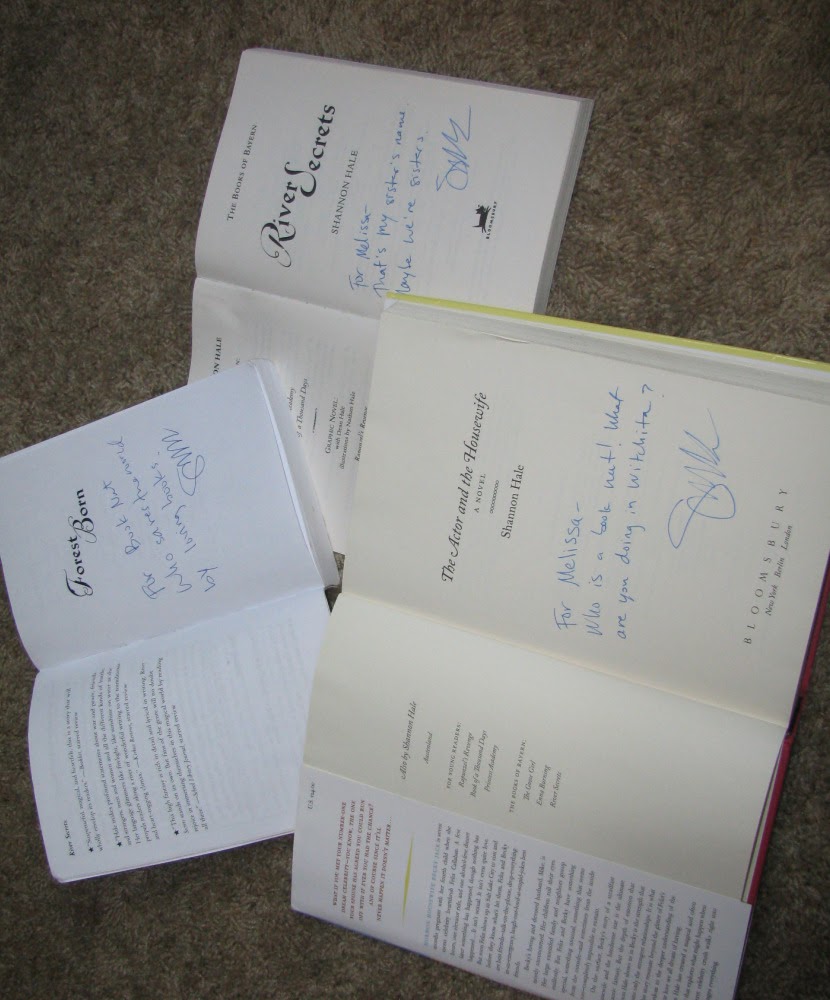
Shannon Hale has an interesting post over at squeetus on the monetary side of becoming an author (which reminded me of John Green’s posts on advances and economics of publishing from a while back). I was interested in it, mostly because C has determined that she’s either going to be an actress or an author, and when she gets “rich and famous” she’s going to buy me a mini. I hate to be the one to burst her bubble….

A few lists of Top 10 Children’s/YA books (via 100 scope notes. Thanks!) for historical fiction, graphic novels, sf/fantasy from Booklist. I’ve heard of, but haven’t read, most of them. Interesting what they picked, though.

And, finally, just because it’s hilarious… 10 words you need to stop misspelling.

The Picture of Dorian Gray

by Oscar Wilde
ages: adult
First sentence: “The studio was filled with the rich odour of roses, and when the light summer wind stirred amidst the trees of the garden, there came through the open door the heavy scent of the lilac, or the more delicate perfume of the pink-flowering thorn.”
Support your local independent bookstore: buy it there!

If I’m being completely honest, I wanted to read this book because of the movie Dorian Gray that should be coming out sometime this year (at least in the US). It caught my fancy, and I realized that while I’ve seen several adaptations of The Importance of Being Earnest, I’ve never actually read any Oscar Wilde. Shame on me.

And, after finishing this, really shame on me. Wilde is a superb writer. Terribly funny — that wonderful British dry wit you have to love, self-deprecating and dismissive — and, at the same time, incredibly thought-provoking. I found that I couldn’t stop thinking about this book.

For the three of you that don’t know the plot, I may just have to spare you. I’ve tried writing a plot summary of the book, but it’s not working. It’s about the characters — Dorian, the young innocent, who wants to stay young and beautiful, and, in the end, is willing to sell his soul to do so; Basil, the painter who paints the portrait, who pins all of his artistic hopes on Dorian; and Lord Henry, the worldly, snide, philosophic man who leads Dorian — whether intentionally or unintentionally — into a hedonistic lifestyle that ends up corrupting Dorian.

It’s also about the ideas: the place of beauty and art in our lives, the purpose of beauty in our lives, in addition to the moral weight of art, as well as whether or not we should be asking art to carry our morality or for artists to express our morality. It’s heady stuff, ideas that begged to be discussed long and thoroughly over a good dinner. (Hmm… food’s still on my mind.)

That’s not to say Dorain Gray is an easy read; it’s not. It can be funny — Lord Henry, with his posturing and glib opinions often made me laugh — but it’s also incredibly creepy and highly disturbing. Which, honestly, is as is should be. If it were just glib and funny, then I think much of the impact of what Wilde wanted to get across. I can see how this would not have gone over well in Victorian England; Wilde is putting forth ideas that are challenging to our expectations of art and morality, and challenges of that sort never go over well.

Still, it’s an incredible book, a fascinating book. And I can only hope the movie can begin to do it some justice. (*fingers crossed*)

God Went to Beauty School

by Cynthia Rylant
ages: 12+
First sentence: um… it’s a book of poetry. This doesn’t really fit.
Support your local independent bookstore: buy it there!

I picked this up because the title, of all things, cracked me up. Sure, God went to beauty school. What’s with that? I needed to know.

It turns out that it’s a collection of poems about things — human things — that God experiences. It’s simply written, thoughtful, and at times both hilarious and moving. I like Rylant’s version of God: an interesting combination of human and divine; wondering at all the little things that we often take for granted. It’s a delightful collection, spiritual in nature, yet not overly religious. And, above all, thoroughly enjoyable (And I say that I don’t like poetry!)

One of my favorites:

GOD BOUGHT A COUCH
He ordered it from Pottery Barn
and He had a little trouble
because His credit card
billing address didn’t match
the delivery address.
They weren’t totally convinced
He was God.
Because for one thing
He got His credit card
bills in Hell
(just His quirky
sense of humor)
and He wanted the
couch shipped to Heaven
(the old one was too hard),
but they didn’t buy it
until He told them
how He made the first
rhinoceros.
He had it all down,
the DNA, the chromosomes,
and especially the
Holy Spirit.
Nobody is as convincing
about the Holy Spirit
as God.
They asked Him did
He want corduroy or leather.
He said, “What do
you think?”

One of the best ways to spend 30 minutes, I promise.