A Mango Shaped Space

by Wendy Mass
ages: 10+
First sentence: “Freak.
Support your local independent bookstore: buy it there!

Mia doesn’t quite know how to deal with her world. She seems normal from the outside, possibly the most normal in her family. She likes to paint, she has been best friends with Jenna since forever, and she does okay at school. Except she has a secret: sounds, numbers and letters have a color for her. You wouldn’t think this was a big deal, but back in third grade, when she tried to tell people, everyone — adults and kids alike — thought she was making things up. So, she stopped telling people, quietly bearing the burden of being a… freak.

Then she hits eighth grade and things start to fall apart for her. She finally admits the color “thing” to her parents, they take her to a series of doctors, finally diagnosing her with synesthesia. On the one hand, this is good: Mia is no longer a freak, or alone in dealing with the challenges that synesthesia brings. On the other hand, Mia delves into an intense regimen of self-discovery, inadvertently shutting out her family, her friends, her schoolwork, and (perhaps most of all) her cat, Mango.

It’s an interesting growing up story; Mia has so much to deal with on her plate — from the usual teenage stuff, to sibling stuff, not to mention all the colors which color her life — that there’s just so much to juggle. On the one hand, it’s a very teenagery book, and because of that, Mia was a bit much to handle. There were some issues that never got resolved for me (as a parent, admittedly), and the story just didn’t quite gel as well as I wanted or hoped. On the other hand, the descriptions of what Mia sees was so vivid, so amazing that it almost made me jealous I can’t see the world that way. My “normal” world seems so boring in comparison.

Which is one of the reasons I like Wendy Mass so much: she takes something not-quite-mainstream — like synesthesia or astronomy — and weaves a story around it in such a way that makes you want to have a similar experience, even if the story isn’t all that great.

Which is why I keep reading her books.

Sunday Salon: Savoring

I’ve been rereading Under the Tuscan Sun, enjoying it as much as I did the first time around. I am finding myself savoring the language, and feeling myself being pulled to Italy, to slow down, stay a while and enjoy the language, the landscape and the food. (I am also finding myself wishing there was more than one sense employed when reading; I want to touch, smell, and hear this book as well!). I don’t normally consider myself an Italy person (preferring France and England and China in my literary pursuits), but this book is written well enough that it pulls me there.

When they arrive it will be the soft, slow Tuscan twilight, fading after drinks from transparent to golden to evening blue, then, by the end of the first course, into night. Night happens uickly, as though the sun were pulled in one motion under the hill. We light candles in hurricane shades all along the stone wall and on the table. For background music, a hilarious chorus of frogs tunes up. Molte anni fa, many years ago, our friends began. Their stories weave an Italy around us that we know only through books an films.

This book demands you slow down, you enjoy the prose, you savor each moment as it unfolds.

Which has got me thinking about savoring. Too often, and sometimes with good cause, I find myself propelling through books, either because I’m clamoring for the next development in the story or because I just want to finish it. I vary rarely slow down and enjoy the scenery, so to speak.

I’m not sure I’d want to do it all the time, but I find that right now, in these lazy late summer afternoons, this is what I really need. You could say that I’m savoring it.

Is there a particular book (or books or genre or author) that just demands you savor?

Bookish Madlibs

Ooooh, a meme! It’s been forever since I’ve done one. But this one, seen yesterday at Melody’s Reading Corner, was just too much fun to pass up. The point is to answer the questions using book titles you’ve read in the past year.

In school I was: The Girl Who Chased the Moon

People might be surprised I’m: (Confections of) a Closet Master Baker

I will never be: Front and Center

My fantasy job is: Heist Society

At the end of a long day I need: Eat, Pray, Love

I hate it when: (there’s) Much Ado About Nothing

Wish I had: French Milk

My family reunions are: Extremely Loud and Incredibly Close

At a party you’d find me with: Charles and Emma

I’ve never been to: The Street of a Thousand Blossoms

A happy day includes: A Song for Summer

Motto I live by: Running out of Time

On my bucket list: Turtle in Paradise

In my next life, I want to be: The English American

Library Loot 2010-29

One the one hand: I really like that my TBR pile is shrinking rather than growing. On the other hand: I want, I want, I want, I want….

There are too many books and not enough time!!

(Week 3 of my ban on checking out books…)

Picture Books:
I Want Two Birthdays, by Tony Ross
Little By Little, by Amber Stewart and Layn Marlow
The Legend of Ninja Cowboy Bear, by David Bruins and Hilary Leung
An Octopus Followed Me Home, by Dan Yaccarino
Sheep in a Jeep , by Nancy Shaw
Happy Birthday, Good Knight, by Shelley Moore Thomas/Illus. by Jennifer Plecas
Penguin, by Polly Dunbar

Middle Grade:
The Owl Keeper, by Christine Brodien-Jones
Noonie’s Masterpiece, by Lisa Railsback

The roundup is either at Adventures of an Intrepid Reader or The Captive Reader. Obligatory FTC note: the links are provided through my Amazon Associates account. If you click through and actually purchase one of these books, I’ll get a teeny, tiny payment. But, since no one ever does, and it’s SO much easier using the associates account to put up these links, I’m going to keep doing it.

The Cardturner

A Novel About a King, a Queen, and a Joker
by Louis Sachar
ages: 12+
First sentence: “Ever since I was a little kid, I’ve had it drilled into me that my uncle Lester was my favorite uncle.”
Support your local independent bookstore: buy it there!

This book is about bridge. The game. I know squat about bridge (except for that it’s a card game), and yet I found myself fascinated by this book. Sure, it helps that it’s written by Louis Sachar, and it helps that our main character, Alton, is quite likable, and it helps that there’s more to it than bridge, but really: the book is about bridge. There’s no getting around it. There’s bridge terms, and lots and lots of descriptions about bridge games, and at first you won’t get it, but by the end you’ll want to play a hand or to, just to see what everyone is talking about.

Seventeen-year-old Alton is not exactly what you’d call an overachiever. He was going to get a summer job — really — but then an opportunity fell in his lap: his great-uncle Lester Trapp is a bridge player, but he’s blind. He needs someone to sit with him and let him know what the cards are and then play the cards he tells him to. It’s an easy job; not fun, but easy. Except, after a while hanging around Trapp and the game, Alton begins to realize something: it interesting. It’s intriguing. And what if — 40 years after he last tried — Trapp could win a national championship? Of course, there’s some bumps along the way (not to mention a breakdown, death, a romance, and a little bit of underhandedness), but it all manages to work out in the end, for the best. Call it fate, or call it synchronicity, but it works.

It works, primarily, because of the narration. For starters, because Alton’s about as clueless at bridge as we are (I’m assuming you’re as clueless as I am), it helps that he stops and explains it as we go. Amazingly, it doesn’t halt the plot, but it’s woven into it almost pretty seamlessly. (It does stop it a little, but I was interested in it; Sachar does provide an out: you can skip the explanation sections and just read the summary box if you want.) It helps that Alton is a pretty genial kid; funny and self-deprecating, and yet somehow determined to win his great-uncle’s respect. You can’t help but root for a kid like that. It’s actually filled with likable characters (the only people I really didn’t like were Alton’s parents who were a bit too money-digging for my taste, but thankfully got marginalized as the book went on), which is one of the reasons it was a delight to read.

I enjoyed the book, and yet I wonder about its success: really, who’s going to want to read a book about bridge? Especially in the YA crowd. I’d recommend it, saying, “Trust me. Yes, it’s about a card game that no one really plays anymore, but it’s actually, surprisingly quite good.”

Promise.

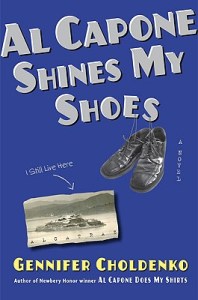
Al Capone Shines My shoes

by Gennifer Choldenko
ages: 10+
First sentence: “Nothing is the way it’s supposed to be when you live on an island with a billion birds, a ton of bird crap, a few dozen rifles, machine guns, and automatics, and 278 of America’s worst criminals — “the cream of the criminal crop” as one of our felons likes to say.”
Support your local independent bookstore: buy it there!
Review copy sent to me by the publisher

Perhaps it’s just been too long since I read Al Capone Does My Shirts, because I just didn’t find this one nearly as charming as I did that one. It’s not that I didn’t enjoy reading it; Choldenko still captures the mid-1930s very well, and the characters are still just as interesting as before. It’s just that this one is missing the novelty, the endearing charm, that made the first book so enjoyable to read.

The book picks up right where the first left off: Natalie is off to her special school; Moose is still trying to figure out inter-personal relationships, especially between his on-island friends and off-island friends, not to mention what to do with girls; there’s tension between the convicts and the guards and their families. The main source of conflict in this story isn’t with Natalie and her disability, however. It’s with Moose’s choice to get Al Capone to help Natalie getting into her school. There’s a lot of lying and covering up of the truth, not to mention sneaking around, in this book, which makes things more than slightly uncomfortable.

It is an interesting journey for Moose as he figures out that trying to handle things on his own doesn’t always work. In addition, there’s more middle school awkwardness, and a bit of a romance as well. However, the tough lesson he has to learn is that he can’t please everyone all the time, and that attempting to has dire consequences. It’s not a pretty lesson, either.

The ending was a bit overly dramatic for my tastes, however: it involved an escape attempt on the part of the convicts and Natalie using her quirkiness with her autism to save the day. It wasn’t bad, per se, just, well, more action-movie than middle grade book.

I guess you can’t win them all.

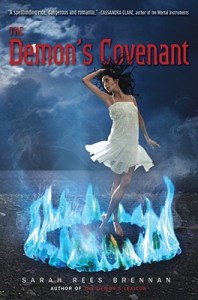
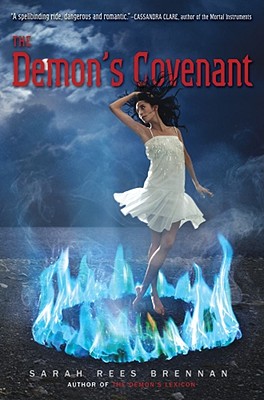
The Demon’s Covenant

by Sarah Rees Brennan
ages: 14+
First sentence: “”Any minute now,’ Rache said, ‘something terrible is going to happen to us.'”
Support your local independent bookstore: buy it there!

First step: read The Demon’s Lexicon. Second step: come back and read this. Because there isn’t any way I can write this part without spoiling the first book.

Picking up a month where we left off… Alan and Nick are back in Mae and Jamie’s life, primarily because Gerald — new leader of the magician’s Obsidian Circle — is trying to recruit Jamie to be part of the circle. This, for many reasons, completely freaks Mae out, and so she calls the Ryves brothers back to help keep Jamie safe. Except, Nick isn’t exactly the safest person in the world, being a freed demon. That creates its own problems: Alan is making bargains with magicians and demons, Mae is finding she’s falling in love with both the brothers, Jamie is actually becoming friends with Nick. And there’s a whole lot else going on that’s completely impossible to sum up.

It’s slow getting started, but picks up about a third of the way into it. At one point I was flabbergasted, wondering where on earth Brennan was going with the storyline, how it all would work out. It’s one of those instances where the right narrator makes the book; it’s from Mae’s point of view this time, and that makes all the difference. Especially when the book all comes together in the end.

Also, as Charlotte pointed out, Brennan does write some very swoon-inducing prose. Very much so. Very, very much so. But she’s not just skilled in writing swoon; the book is SO much better than that. There’s angst and surliness, yes; but, there’s also mystery, and adventure, and magic, and surprise zombies (it’s not a party until someone brings the surprise zombies), and an ending that will — I promise — leave you begging for the next installment.

Which begs the question: how long do we have to wait, and what can we do to make Sarah Rees Brennan write faster?

Sunday Salon: Books at the Top of My List

I figured since, last week, I did the bottom five, I should probably give you my top five. It’s only fair. To make it easier — since I really do have a hard time choosing what I truly, truly love (is that just me, or does your favorite list change from year to year?) — I think I’m going to pick one book from each year I’ve been blogging. (Yeah, that’ll be six, but I have to narrow down my favorites, somehow.)

America’s Women, Gail Collins (2004-2005): This was actually a book group read for my in-person book group. And I was blown away. Not only by the subject matter — Collins delves into history (or herstory?) in a very in-depth way — but by the fact that this book was so readable. Up to this point, I wasn’t that interested in history books; history was boring, history was dry. But, this showed me that history could be interesting, fun, and memorable.

The Lightning Thief, Rick Riordan (2005-2006): One of the things I’m proud of is getting on the Percy Jackson bandwagon before he got really big. I picked this up on a whim — even with the horrid hardback cover — at my library, and couldn’t put it down. It’s not deep, but it is clever and I thought, from the outset, that Riordan’s use of Greek mythology was brilliant. I’m just glad that my girls (well, M and C) love it as much as I do.

Thirteen Reasons Why, Jay Asher (2006-2007): I don’t usually write letters to authors. (Well, unless I want to interview them, anyway.) But I finished this book — I won the ARC in a giveaway — and I was blown away. Literally. It’s one of those books that changed the way I see people, affected me deeply, and I needed to share that with the author. It’s not for everyone, but I do recommend it, and loan my battered ARC out, whenever I feel it’s right. Because it’s an amazing book.

Dracula, Bram Stoker (2007-2008): I avoided Carl’s RIP challenge for years, because horror and mystery are not my “things”. For some reason, though, this year I decided to sign up for it, and I picked Dracula as one of my reads. (Possibly chalk it up to being interested in vampires due to Twilight…) I was amazed. Completely and utterly blown away. I was reminded that I did, once, love horror (I went through a Poe phase), and that it’s not the gore that I love but the mood. That spine-chilling, goose-bump inducing mood. And Dracula has that in spades, which thrilled me to no end.

My Life in France, Julia Child (2008-2009): I love food books, and so I knew going in that I would like this one. I wasn’t prepared, though, for just how awesome Julia Child was. Determined, focused, funny, amazing. I loved her joy, and how that joy — of love, of life, of food, of France — came through in her stories. It did lose a little steam near the end, but by that time I was invested: I am, unabashedly, a Julia Child fan. And I would happily read this book over and over again.

My Most Excellent Year, Steve Kluger (2009-2010): I adored this book. Hands down. As much as I adored The Casson family books by Hilary McKay. (They should be on this list; but the reasons why are similar to the reasons for this book, so I excused them.) I fell in love with the characters, and I want to move in next door to them and be their friend. I want them to take me in, and let me bask in their awesomeness, their quirkiness, their uniqueness. I was charmed the entire time I was reading about them, and I feel that, somehow, my life is better for having visited their world. It’s become a comfort read, something to pick up when I’m feeling down, because I know, without a doubt, that I will be happier when I finish reading.

So, what are some of your all-time favorites?

No and Me

by Delphine de Vigan
(Translated from the French by George Miller)
ages: 14+
First sentence: “‘Miss Bertignac, I don’t see your name on the list of presentations.'”
Support your local independent bookstore: buy it there!
Review copy sent to me by the publisher.

It started out as a school assignment. Lou, who’s the youngest in her class and who hates presentations, picked exploring why young women become homeless as her social economics class project. She decided to do some interviews, and as a result met No: 18 years old, and homeless for the past three years.

Over the course of the assignment, Lou develops a bond with No, and — mostly because of some difficulties in her own home life with her parents — takes No under her wing. She wants to help No, to make her life better, and so she invites No (with her amazingly trusting parents’ permission) to live with them. And for a while it really is better.

One of the things I liked best about this book was that it was unflinchingly honest. Without giving anything away: there isn’t a happy ending. No doesn’t “reform” and suddenly become a productive member of society. The book addresses the issue of homelessness (as well as rape, neglect, death and French welfare) without being maudlin, but also without talking down to the characters or the reader. It’s very matter-of-fact: these things happen. Sometimes we can help. Sometimes that help isn’t wanted. Sometimes it all doesn’t work out the way we want it to. But, don’t give up trying to help.

All that said, I’m not sure I quite connected with the book. While on an intellectual level, it was interesting and honest, none of the characters were terribly sympathetic. Lou is one of those precocious kids — uber smart and quirky — and while it works in this context, especially since she’s an idealist who is eventually jaded (the “growing up” process inevitably involves disappointment of some sort, because one cannot grow without it, I suppose), it’s not exactly endearing. There’s her parents: you feel sorry for them, but there’s not much else. There’s Lucas, Lou’s older friend (he’s been held back a couple of years, so they’re in the same class), and while he has the potential to be interesting, he’s never really given the chance. Then there’s No: wounded, yes, but also highly petulant, which made her unsympathetic. I wanted to feel sorry for her, and I did to a certain extent. But pity isn’t enough to make a character work.

And, like always happens when I read a book in translation, I had to wonder what I missed by reading it in English. I’m sure there were some subtleties, some peculiar Frenchisms, that may have made the book that much better for me that I missed by not being a native French speaker.

It’s a good book, an interesting book, but not a breathtaking book.

Library Loot 2010-28

I’ve had an absolutely crazy week. It’s the last week before school starts, and the girls have been needy (and bored) and I’ve spent more time entertaining them (and keeping them from fighting) than reading. On the upside, I didn’t check out anything I didn’t need to… Here’s to school starting next week!

Picture Books:
Weezer Changes the World, by David McPhail
Hattie The Bad, by Jane Devlin/Illus. by Joe Berger
Lulu the Big Little Chick, by Paulette Bogan
v, by Susan Stevens Crummer/Illus by Dorothy Donohue

Middle Grade:
100 Cupboards, by N.D. Wilson

The roundup is either at Adventures of an Intrepid Reader or The Captive Reader. Obligatory FTC note: the links are provided through my Amazon Associates account. If you click through and actually purchase one of these books, I’ll get a teeny, tiny payment. But, since no one ever does, and it’s SO much easier using the associates account to put up these links, I’m going to keep doing it.