Nerd Camp

by Elissa Brent Weissman
ages: 9+
First sentence: “It was so late that it was almost tomorrow.”
Support your local independent bookstore: buy it there!

Gabe is a nerd. Seriously. He’s smart, he loves math and poetry and reading, and he’s just been accepted into the Summer Center for Gifted Enrichment — a six-week sleepaway camp that you have to take a test to get into.

He’s okay with all this — well, in fact, it’s more than okay: he’s really, really excited — until he meets his soon-to-be stepbrother, Zach. Who is not a nerd. In fact, he is disdainful of all things nerdy. Gabe doesn’t quite know how to react to that: he really, really wants to get along with his new brother (he’s always longed for a sibling), but he doesn’t want to give up all the things he loves.

Thankfully, there’s SCGE camp to help him out: are the adventures he has over the course of the summer negated by their nerdiness, or cool in their own right?

I adored this book. Seriously. Perhaps it’s because I’m a mother of nerds, and one myself, but I thought Weissman just got the whole nerd kid culture — not  to mention that wonderful awkwardness of being 10-years-old — spot-on. Every little thing, from the awkwardness around new girls to the learning pi to the 20th digit, was adorable. (Perhaps I shouldn’t call a boy book adorable. It’d turn the boys off. But seriously, it was.) I loved Gabe from the get-go, and it didn’t take long for his camp friends Wesley and Nikhil to grow on me, either. I also really, really wanted to go to the camp. I’m not much into logic proofs, but Weissman made them seem really, really cool.

The only down side was that I felt Zach was a little shallow: all “cool” kids aren’t down on reading or horrible at spelling. (There’s also the side issue of why everything has to be either/or: do we really have to be smart OR cool? Maybe in 5th grade, yes…) But, because Zach was hardly a character, it didn’t bring the awesomeness level of this one down.

I suppose the question, in the end, is: will the boy nerds read this one? I hope so. Really.

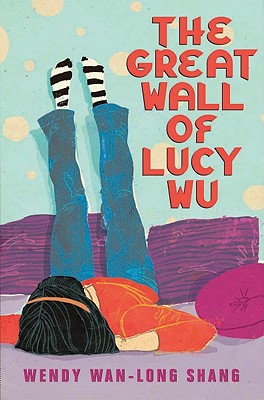
The Great Wall of Lucy Wu

by Wendy Wan-Long Shang
ages: 10+
First sentence: “There is a Chinese story that goes like this:”
Support your local independent bookstore: buy it there!

Lucy is:

  • the youngest of three children in a Chinese-American family. 
  • almost twelve years old.
  • more American than Chinese, preferring lasagna to Chinese food.
  • fanatic about basketball, and pretty good too.
  • about to share her room with Yi Po, the long-lost sister of her recently deceased grandmother.

All Lucy wants is to have the best year ever, but that seems doomed not to happen, especially since Yi Po and her strange Chinese ways have moved in everything seems to be going wrong. Somehow, though, between Chinese school, a bully at school, and having to share a room, Lucy finds that maybe the year isn’t as bad as she thought it might be.

This was a good, solid, fun read. Nothing spectacular or earth-shattering, but I really enjoyed the time spent with Lucy and her struggles to find a balance between her wants and interests and her heritage. She’s an enjoyable character, and the time which we spend with her is fun and interesting. I liked the way Shang handled the Chinese language and culture, mixing a bit of history and folklore along with the food and traditions seamlessly into the novel. It gave the book some heart, and I felt like I was learning without being preached to.

A good book.

The Friendship Doll

by Kirby Larson
ages: 9+
First sentence: “The old doll-maker Tatsuhiko poured boiling water into the teapot with trembling hands and inhaled deeply.”
Support your local independent bookstore: buy it there!

It’s the 1920s, and Miss Kanagawa is a beautiful Japanese doll, sent to America with the mission of spreading friendship and unity between the two countries. In a series of four short stories that progress through time from 1927 to 1941, we follow Miss Kanagawa as she meets, and helps, four special girls in some of the most trying times that the U.S. has seen.

I’m not usually one for short stories, but I enjoyed these. Miss Kanagawa was a good linking device, making it seem more like a novel than separate short stories. Even though I wondered about the fantasy element at first — we hear the doll’s thoughts, and she seems to connect and influence the girls in the stories — I realized that it really wasn’t a fantasy book (the doll and the girls never actually talk to each other), but just a narrative device. One that worked for me, because not only did the girls grow and change and overcome, but the doll did as well.

Out of the four stories, my personal favorite was the third one, about Willie Mae. It took place in the heart of the Great Depression, in a small Kentucky town. Willie Mae was a “holler girl”, someone who grew up in the mountains, who loves to read and write. She doesn’t feel like her life will give her anything until she’s given the opportunity to go into town for a job reading to the town crank, Mrs. Wheldon. This simple thing changes everyone’s lives for the better. It’s sweet and sad and touching all at once.

Perhaps that’s the best thing about Kirby Larson’s book: she knows how to embody the past, and bring it forward so that we can understand and relate to these kids. And the part about the doll — the exchange is an actual historical event as well — is also fascinating.

It’s wonderful when an author can make history come alive.

Why We Broke Up

by Daniel Handler/Art by Maria Kalman
ages: 15+
First sentence: “Dear Ed, In a sec you’ll hear a thunk.”
Support your local independent bookstore: buy it there!

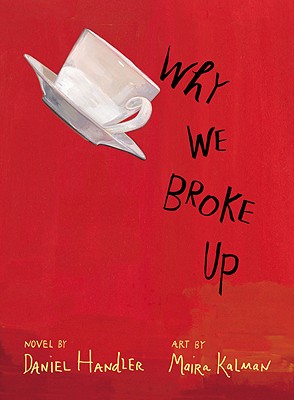
I picked it up because I liked the premise: an artsy 16-year-old girl, Min, giving all the stuff she’s collected over her brief (but passionate) romance with a jock named Ed. (Huh. Seriously?) It’s very Emma in it’s premise: the way to get over a guy is to get rid of all the collected junk. And along the way, tell exactly what he did mean to you, and why they broke up. (Spoiler: he was two-timing her. Sorry.)

I liked the idea of combining art with the story — Kalman drew pictures of all the items in the box — and thought that perhaps it would be an interesting and unique story.

What it was: depressing. Really, really depressing. It wasn’t even poignant, or thoughtful. Mostly it was a 16-year-old girl ranting, musing, crying, and venting about this boy she thought she loved, the boy she gave her virginity up to, and the boy who really, really, really let her down. Depressing.

Now, I suppose, if you had given this to me sometime when I was 16 to 18-years-old, I might have identified with Min, I might have loved the idea of getting rid of the crap (and writing a long, long letter to that boy). But now? Not so much. It was just pretentious. And stupid. And I’m sure she felt honestly, but there was just too much to wade through (354 pages worth) for me to even remotely care. I suppose if Min had a personality other than depressed and artsy, and Ed existed as more than the object of her anger, than I might have cared about the characters enough to get involved in the sordid story. But I didn’t. So, honestly? I skimmed half, read the end, and bailed.

Sometimes it works. Sometimes it doesn’t.

The Best Thing About Februray 14th

First off, I prefer Kristin Cashore’s Pan-Universal Be Who You Are Day to Valentines Day. I hate this “holiday.”

That said, the absolute best thing about February 14th is that the Cybils winners are announced! Seriously: these are some good books. I’m quite proud of the one that my panel (the Middle Grade fiction) picked, as well. I really enjoyed being part of the second round, too. While I did miss the hustle and frantic pace of being on a Round 1 panel, I enjoyed the deep discussion of the Round 2. It was like being in a very cool, very exclusive book club. With some pretty awesome women as well.

And because I’m thorough (and I’m allowed to after the judging), I’m going to put up the reviews for our finalists (well, the ones I haven’t read) over the course of the rest of the month. There’s some very good books in the bunch.

Anyway, go check out our pick for best kid-friendly book. And see what all the rest of the panels picked. There’s bound to be some excellent books (and apps!) waiting.

Midnight in Austenland

by Shannon Hale
ages: adult
First sentence: “No one who knew Charlotte Constance Kinder since her youth would suppose her born to be a heroine.”
Support your local independent bookstore: buy it there!

 Since her husband cheated on her then left her and married his mistress, Charlotte Kinder has been completely numb. Sure, she still runs her very successful web business and takes care of her two kids, but in her personal life, she has no hope. No matter how many dates her friends set her up on, she figures she will never love again.

Then, she discovers an old bucket list of hers, which has “read Jane Austen” on it. She does, falls in love (just with the idea of falling in love, of course), and as a present to herself, goes on vacation to Pembrook Park. For a good, old-fashioned Regency Romance.

The best way I can think of to describe it is thus: if Austenland (which you don’t need to read before reading this one, but why wouldn’t you?) is Pride and Prejudice, Midnight in Austenland is Northanger Abbey. There are a couple of mysteries — both real and made-up — to solve; there’s a lot of running around at night; but most of all, there’s a Gothic feel. That, and the book just isn’t as light as Austenland is. It’s not only Charlotte’s hurt from her husband’s infidelity and betrayal, and the mysteries, there’s just a lot more brooding going on. The romantic interest, Mr. Mallery, is Heathcliff — okay, I know: not Austen, but it’s the best description — reincarnated. He attempts to do the Regency thing, but mostly he just skulks in the corner. Thank goodness there’s Charlotte’s “brother” (for the two weeks, not in real life) Eddie Grey, who lightens and mixes things up. Some of the minor players from Austeland are back: the formidable hostess, Mrs. Wattlesbrook (who is not quite as formidable), and the goofy-yet-vulnerable Miss Charming. There are new characters as well, including a starlet that’s using Pembrook Park as a place to escape not just from the press, but from real life.

The only complaint I have is that it’s not as funny as Austenland was (or that I’d hoped it would be). That’s not to say it isn’t good. Admittedly, I adore Shannon Hale, but I do think this one is worth reading (if only for this sentence: “But in life, rarely do we encounter an onslaught of beauty, enter a hive of handsomeness, find ourselves awash in an ocean of attractiveness, drowning ina miasma of hotness.”). It’s sweet and it’s tender; it’s light enough to be fluffy, but has enough weight so that it’s not a waste of time. (I need to say it: there was a moment when I needed to shout “GO CHARLOTTE!” Hooray for heroines who can save themselves!)

In other words: it’s another delight from a delightful writer.

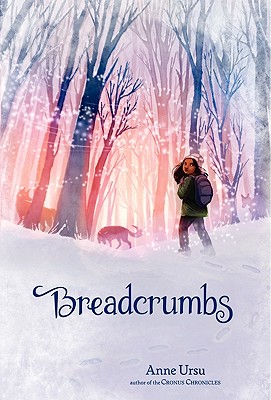
Breadcrumbs

by Anne Ursu
ages: 9+
First sentence: “It snowed right before Jack stopped talking to Hazel, fluffy white flakes big enough to show their crystal architecture, like perfect geometric poems.”
Support your local independent bookstore: buy it there!

Jack and Hazel fit together. Not like romantic-fit — they are in fifth grade, after all — but with Jack, Hazel — who is often the odd child, the imaginative child, the one who doesn’t quite fit in anywhere — belongs. Really belongs.

So, when Jack suddenly stops talking to her, she’s beyond hurt. She’s devastated. She wants to stop living. And yet, she’s the only one who can help Jack: his heart has been turned to ice by the Snow Queen (“Like in Narnia?” “No. Narnia is like her.”) and Hazel is the only one with enough imagination (and courage) who can go save him.

Hazel sets off, somewhat prepared, into the woods and the fairy tale. It’s a cross between Stephen Sondheim’s Into the Woods, and Neil Gaiman’s Instructions: Hazel finds herself not only in the tale in which she needs to confront and rescue her friend from the Snow Queen, but in various other tales as well. There’s an element of Wrinkle in Time, in that Hazel doesn’t quite fit in and yet she’s the only one who can Do what needs to be Done.

For some reason — it may just be where I was — I found this book beautiful, truly, honestly, and simply beautiful, and yet impossibly sad. I didn’t so much want to read an adventure about Hazel as hold her and help make her deeply-felt insecurity go away. There was hope in the end — there always is, in this kind of the story — but I still finished it feeling quite sad for Hazel.

Even so, it’s a wonderfully told fairy tale.

Ready Player One

by Ernest Cline
ages: adult
First sentence: “Everyone my age remembers where they were and what they were doing when they first heard about the contest.”
Support your local independent bookstore: buy it there!

It’s 2044, and as a result of the energy crisis, the world has basically gone to pot. That’s okay, though, because most people spend their lives in OASIS, a virtual utopia where you can be whomever and whatever you want. Five years ago, the creator of OASIS died, and as his dying act, set up a contest: be the first one to find the Halliday “Easter Egg” and you will inherit Halliday’s fortune of billions of dollars. Wade is one of those obsessed with the contest, and with Halliday, which means he’s into all of Halliday’s interests: everything 80s. As Wade delves deeper into the contest, he finds friends and allies and makes enemies who will go so far as to kill him in real life in order to get to the prize.

This was a last-minute impromptu buddy read with Kelly from A Written World. We traded questions for our review; click through to her blog to see her answers to my questions.

1. This book has had a lot of hype surrounding it around the blogosphere. Did it live up to the expectations you were expecting as a result?
Actually, I missed the hype surrounding this one (one of the side benefits of working, I guess) — I did pick it up as a result of a review on a friend’s blog, though — and so I went in with a fairly clean slate.  I suppose, if I had read a lot of hype, if it had been one of those books I’d been seeing everywhere, I would have had a worse attitude. I think going in with no expectations was the best way to go here.
2. What did you think of Wade, the main character? Was he he someone you could enjoy enough to read the book from his perspective, or did he bother you?
Oh, I liked Wade. He wasn’t perfect, but I’m enough of a geek (and I had two geeky brothers as well) to relate to the social awkwardness, the obsessive side of his personality, and the way his mind worked. He was a fine narrator for me. (Though I think I’d like to see the world from Aech’s point of view.)

3. What were some of your favourite (geeky) references?
Ah, I ate up the 80s stuff.  Seriously. War Games! (Loved the movie.) Ladyhawk! (Ditto) All the little ones (Back to the Future, Hitchhiker’s Guide, Knight Rider, John Hughes movies, Pac Man) that were sprinkled throughout just gave me little bursts of glee. The only things I didn’t get were the gaming references — I wasn’t, and am not now, a gamer — but Cline explained things enough that it didn’t bother me that I didn’t get the in-jokes.

4. What did you think of the secondary characters? Did any stick out for you?

I loved Ath3na. Seriously, she rocked. She’s smart, she’s determined, and she was awesome enough to get to the top on her own accord. (I kept wanting to say, “In your face, gamer boys.” But maybe that’s a bit harsh.)


5. What did you think of the whole idea of the book? Did the game and the Dystopian aspect work for you?

I’m not sure the dystopian aspect worked. As I was talking to my husband about the book, and he kept asking questions about the world: how do they survive? Where do they get food?  Money? Everyone in the world can’t all always live inside the virtual one? But, I’m not sure I really cared. Because I got sucked inside the virtual world as well, wrapped up in the game. The parts when Wade wasn’t playing — like after Art3mis dumped him — were the sluggish ones for me. But, when Wade was fully immersed in OASIS and the game, the book was hard to put down.

Sunday Salon: The State of the TBR Pile 4

What’s sitting on my reading pile (not as much as usual…) this Superbowl Sunday:

A Discovery of Witches, by Deborah Harkness (Because everyone’s raving about it at work. M has absconded it, however, and I don’t know if I’ll get it read before it’s due. Hopefully, I can renew it.)
Highland Fling, by Katie Fforde (The author was recommended by a friend. Also, because the local library is doing their winter adult reading program, and I need a romance to finish it.)
Why We Broke Up, by Daniel Handler and Maria Kalman (Because it won a Printz honor. Though, to be fair, I had it on my pile before it won.)
Notes from an Accidental Band Geek, by Erin Dionne (Left over from last month.)
Before I Fall, by Lauren Oliver (Because I was curious about Oliver after reading Leisl and Po.)
Putting Makeup on the Fat Boy, by Bil Wright (Because it won a Stonewall award.)
Midnight’s Children, Salman Rushdie (Actually, I’m not sure about this one. I want to read some Rushdie, but I’m not sure if this is a good place to start. Suggestions??)

What’s on your TBR pile this week?

Outcasts United

by Warren St. John
ages: adult
First sentence: “On a cool spring afternoon at a soccer field in northern Georgia, two teams of teenage boys were going through their pregame warm-ups when the heavens began to shake.”
Support your local independent bookstore: buy it there!

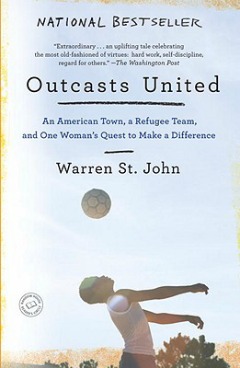
The thing I like best about St. John’s writing is that, no matter the subject, he really makes you care about it. Seriously. Granted, this one has a subject — a woman who creates soccer teams, and an outlet, for refugees in Clarkston, Georgia — that is easy to care about. But, St. John doesn’t do the predictable thing and make the bok Inspirational and Heart-Warming. No, he does the good thing, and makes the book interesting.

The focus is on Luma Mufleh, who grew up in Jordan loving soccer. St. John touches on, but doesn’t delve into Luma’s trouble with growing up in such a restrictive environment for girls. She comes to the U.S. for college, and much to her father’s disappointment, decides to stay. She tries a few things, coaching soccer on the side, before literally falling into creating teams for the boys of Clarkston.

Clarkston, Georgia was once a sleepy little southern town. However, over the last decade or so, it has become a place for refugees — from all over the world, but mostly Africa — to begin their lives in the U. S. You can imagine (and, unfortunately, the town lives up to that stereotype) how that goes over in the all-white, good-boy South. The problem is that because there isn’t much infrastructure for them, the kids were getting lost in the cracks, turning to gangs, drugs and violence.

Enter Luma’s soccer program. She’s not an easy coach — to his credit, St. John never glorifies her: she is harsh, she is unforgiving, she is tough, she is demanding. But above all, she is dedicated and she cares. Amazingly, this combination of toughness and caring works, especially for the younger kids. Not only does Luma give them a purpose, family and a place, she teaches them to win games.

As I mentioned before, it’s not an Inspirational book, and yet there is a message: one person can make a difference. It’s just not one that St. John beats you over the head with, thankfully. Instead, he found a good story, spent a while researching it, and told it in a compelling way. Which makes this one excellent book.