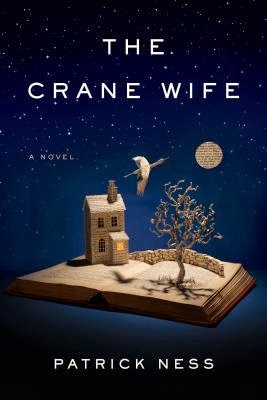
The Crane Wife

by Patrick Ness
First sentence: “
Support your local independent bookstore: buy it there!
Review copy given me by the Penguin rep.
Content: Multiple f-bombs and other language, some off-screen sex. Rightly sits with the adult fiction at the bookstore.

George is your very typical kind-of-loser guy. He’s divorced (nine years) with a child (who’s in her 20s) and can’t seem to keep a relationship (he’s too nice; they always break it off, but he’s always friends with them after). Even though he’s the owner of a print shop, he’s a bit of a pushover, letting his one employee, Mehmet, push him around. But, because he’s nice, because he’s George, when a crane with an arrow piercing its wing unexpectedly lands in his suburban London backyard in the middle of the night, he helps it out.

The next day, a woman named Kumiko shows up in George’s print shop. And suddenly, George’s life — and the life of his daughter, Amanda — are irrevocably changed.

Yes, this is a fairy tale. A very charming, sweet, wonderful fairy tale. Ness divides its time between George, Amanda, and Kumiko’s tales, but does so in a way that doesn’t feel awkward or forced. But it’s not just a fairy tale — or at least not just a one-dimensional fairy tale — art (in this case, paper cuttings) and a slight Japanese-inspired tale within a tale play major roles, which gives the book depth and substance.

But what I enjoyed most with this one was Ness’s use of the language. The fact that one of his characters, Rachel (who is very confused and not at all nice), speaks entirely in questions. Or the way he uses “…” to represent silence. Or the way George and Amanda think of themselves. And descriptive sentences like “He loved physical books with the same avidity other people loved horses or wine or prog rock.” (60) or “Stories do not explain. They seem to, but all they provide is a starting point. A story never ends at the end.” (141-142) or “She stopped, her face scrunching up in some really, really unattractive crying.” (161) There were others, but those are the ones that I marked.

It did all the things I want a book to do: it gave me characters to care about, and transported me away from the dreary winter months. It delighted me, and made me wish I was even a tiny bit artistic.

Delightful.

Jinx’s Magic

by Sage Blackwood
First sentence: “It wasn’t that Jinx didn’t like people.”
Support your local independent bookstore: buy it there!
Review copy snagged from the ARC shelves at my place of employment.
Content: There are some tense moments that might scare a more sensitive child. But, even though there are deaths, it’s all very abstract and kind of distanced from the reader. It’s in the middle grade (grades 3-5) in the bookstore.
Others in the series: Jinx

Jinx’s life has gotten more complicated. Not that he expected any different, really. He’s been told he’s the Listener, but no one has bothered to explain what that means. The trees he talks to are becoming increasingly more panicked because someone — well, the neighboring kingdom — is chopping them down. And Simon — the wizard Jinx is apprenticed to — is trying to stop the Bonemaster (Evil Villain) without much success or help from the other clearings in the Urwald. It’s all a big mess, really.

Jinx has two missions in this book: get Reven out of the Urwald and to that neighboring kingdom, where he is (presumably) the long-lost rightful heir. And then get to Samara to learn how to use Knowledge is Power (or KnIP). Neither is what he wants to do. (He just wants to make sure Simon doesn’t kill himself when he goes up against the Bonemaster, really.) But, do them he must, and so he does. Sort of.

This is very much a middle book in a series. It takes the elements of magic and setting that Blackwood laid out in the first book, and builds on them, but nothing really is resolved. Jinx does grow in his magic usage, though not really in his understanding, and he makes a couple more friends. But nothing is really clearer than at the end of the first book. Additionally, new elements are introduced: an impending invasion from Reven and his newfound power, the existence of an underground society for the use and freedom of KnIP in Samara (of which at least two of the characters are members), and Jinx’s role as the Listener is expanded (at least a little bit). So, the ending really is quite unsatisfying, but that’s just because it’s not, well, done yet.

It works well as a middle book, I think. But I’m reserving final judgement for the whole series until the third book comes out.

What the Heart Knows

Chants, Charms, & Blessings
by Joyce Sidman, Illustrated by Pamela Zagarenski
First sentence: “
Support your local independent bookstore: buy it there!
Content: None. The book would go in the children’s poetry section at the bookstore.

I picked this one up because it made the list for the SLJ’s Battle of the Books and I was curious. I didn’t know it was poetry.

Let me just say, up front, that the artwork is gorgeous (you can check some of it out on this video here). I almost want to buy this book because of the gorgeous artwork. And maybe buy some notecards with it as well.

I liked the idea of the book: a series of chants, songs, incantations, and blessings. But, I just. don’t. get. poetry. So I don’t know if they were any good or not. I enjoyed some of them, and didn’t enjoy others. And maybe that’s all I need to know about poetry. I guess, sometimes, that I feel I need to have a deep connection with poetry, and I just… don’t.

I don’t know if the answer is to stop trying, or keep on hoping that someday it’ll make sense.

First Sunday Daughter Reviews: February 2014

Whew, January is done. That means — in spite of the snow that’s threatening to come (those up north: don’t laugh) — spring is that much closer. It also means things get busier and there are holidays (even the dreaded Valentine’s Day, ugh) to distract me from the Cold and Snow. Which is something.

What did the girls read this month?

Hubby and K read this:

Which K picked out (she has a very elaborate picking scheme when she doesn’t have her  mind already made up), and thoroughly enjoyed. She said she liked Elionwy the best, because she’s “good and awesome and a good fighter. She’s very funny and talks a lot, and even though she has a bauble, she stands up for herself.” But she also liked how Taran admitted to making mistakes at the end. She’s very thoughtful, my daughter.

A had a book report on Joan of Arc due, but she still found time to read

She really loved the first one, and so requested I pick up the second. She’s liking it — there’s more conflicts than there were in the first book, which she’s liking, and bonus: Seth is a LOT less annoying — but she’s reserving final judgement until she finishes.

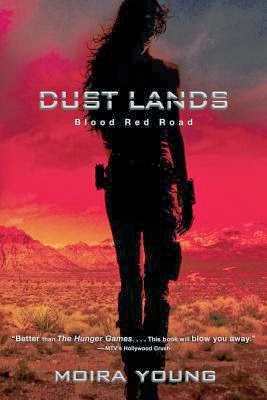
And C, having seen this flow chart on Tumblr (and because Days of Blood & Starlight wasn’t as interesting as she wanted it to be)decided she wanted to go on a dystopian/post-apocalyptic bender. We requested a bunch from the library, but the one she picked up was

which she’s enjoying, though she has to constantly remind herself that it doesn’t quite fit in with the Uglies universe. She misses Tally and all the rest. Also, she’s decided that Westerfeld’s novels need to be illustrated: “He describes things that are hard to imagine.”

I think I’m going to start including by 3-5th Grade Book Group choices here, just so I have a record of them. The kids — probably predictably — really liked Fablehaven last month. We had a great discussion about choices and annoying boys and whether or not magic creatures are real. I also appreciated that Brandon Mull had a lot of cool things on his website (the kids love it when there are extras). This month, we’re reading one of my favorites as a kid:

Here’s hoping the kids like it.

I’m off today for our Book Club Sunday at work before the SuperBowl, and have gotten roped into talking about good Middle Grade/YA books for adults. I think I’ve worked up a good list of already published and soon-to come out books. I’l be sure to stick them up on the third Sunday as my list this month.

Happy reading!

January 2014 Round Up

Happy January! (ugh) I have found myself in the middle of a reading slump. I’m still reading, but in many ways, it feels like I’m doing it because I have to, not because I want to. I’ve always found that it’s better for me to push through these slumps (too many books to read to completely give up!), but that means everything I’ve read is all kind of… meh.

Except for this one, though it was an audiobook, so I don’t know if it counts:

One Summer: America, 1927 

As for the rest:

YA:

Allegiant (DNF)
Dangerous
The Impossible Knife of Memory

Graphic novels:

Bluffton

Middle Grade:

Fablehaven
The Last Present
Better Nate than Ever

Adult:

S.
The Importance of Being Ernest

That one was my favorite review this month, though.

The Rosie Project

What was your favorite this month?

S.

by J. J. Abrams and Doug Dorst
First sentence: “If found, please return to the workroom B19, Main Library, Pollard State University.”
Support your local independent bookstore: buy it there!
Content: Language, including lots of f-bombs. And some violence. It’s in the adult section of the bookstore.

The thing that piqued my interest about this book was the buzz about the form. We had a sample copy and I perused through it. The format — a book published in 1948, stolen from a high school library, with notes scribbled in the margins — was intriguing. Enough so, that I bought myself a copy for Christmas, and eagerly dove in. It IS an intriguing concept, reading someone else’s notes, figuring out the story as you go.

It’s an incredibly layered book: the “book” is one Ship of Theseus, written by the mysterious V. M. Straka. A book where the main character, S., has amnesia, and goes on a journey to figure out who he really is. In doing so, he finds out that he was involved with some shady figures. The second layer is the work that a disenfranchised grad student, Eric, is doing to figure out the real identity of V. M. Straka. All that’s really known about him is that he was involved in this mysterious organization, the S. Eric gets help on this quest from a struggling undergrad, Jen, who finds Ship of Theseus laying in the stacks and begins a conversation. Which brings me to layer three: Jen and Eric’s story. They work together, and over the course of the book, develop their own relationship.

I realized fairly early on that the layers were too dense for me. I couldn’t hold everything in my mind, for starters. I ended up giving up the main Ship of Theseus story, partially because it was boring, but also because I just couldn’t keep multiple storylines in my head. Call it being out of practice, or lack of interest, but I just couldn’t do it. But there was also the fact that the story’s told  inside out and backward. I did think that maybe if I had read it in shifts — read Ship of Theseus first, then the inked-comments, then maybe it would have made sense.

So, in the end, this was all form and no substance. In the end, all the thrills, chills, and mystery They were promising weren’t there. It was a simple story, one that tries to give grad school a mystique and make it cool (it doesn’t succeed). It did succeed in being a homage to paper books — there’s no way this would make a decent e-book. But it wasn’t much else.

And in the end, I found that disappointing.

Better Nate Than Ever

by Tim Federle
First sentence: “I’d rather not start with any backstory.”
Support your local independent bookstore: buy it there!
Content: There is some bullying, a bit of swearing, and some frank talk about sexuality and alcoholism. I probably wouldn’t give it to a third grader (it just feels more mature than an 8-year-old, but you know your kid), but a 4th or 5th grader would be fine with it. It’s in the middle grade (3-5th grade) section of the bookstore, though the library has it in the teen section (which surprised me).

Nate Foster is a 13-year-old kid living in the blue collar town of Jankburg, PA (just outside of Pittsburg). His dad is a “maintenance engineer” and his mom runs a slowly dying flower shop. They have put all their hopes, dreams, and expectations on Nate’s older brother, Alex, the sports star. Which leaves Nate as the… well… outcast. It doesn’t help that he’s a Broadway musical fanatic, knowing them all, singing away, quoting incessantly. Which leaves his family (and the town) baffled.

Of course, Federle is playing off of stereotypes here: people in blue-collar towns are (obviously) backward and don’t understand Culture. People — boys especially — who like musicals are (obviously) gay. (There is much too much discussion about Nate’s sexuality here. And while his position is “I’m 13, how would I know if I were gay?” it bothered me that musicals are, necessarily, lumped in with being gay. Can we just get over that, now, please?) Boys who are short, overweight, and awkward are (obviously) bullied at school (and by his — jerk is not a strong enough word — older brother).

When Nate finds out about open auditions for a new musical based on the movie E. T. he jumps at the chance. And because he knows his backward parents would never let him, he takes the opportunity (with the help of his friend Libby) to run away to the auditions. He was supposed to go there and back again in a day, but (of course) things don’t quite work out. Which brings us to another cliche here — the kid from the backward blue-collar town has NO IDEA how to make it in New York City. (Which may be true, having never run away to the big city when I was 13.)

Even with all the cliches and stereotypes, this wasn’t a terrible book. And I think what saved it, for me at least, was Nate himself. Federle caught the voice of an awkward, insecure, hopeful kid someone who has been beaten down his whole life, and yet still remains optimistic about everything. He’s adorable, and heart-warming, and just plain fun. It was this that kept me reading, and when I finished, it was this that made the book a good one for me.

Additionally, it’s one of those books that’s good to have out there, if only because it addresses stereotypes. There aren’t that many books out there where the male main character gets to be something other than stereotypically male. Hopefully, boys will pick this up and give it a shot. If only to increase their empathy.

There’s a sequel — Five, Six, Seven, Nate — which just came out. I may even like Nate enough to give that one a shot.

The Last Present

by Wendy Mass
First sentence: “When you’ve drawn breath for nearly a hundred years, not much surprises you.”
Support your local independent bookstore: buy it there!
Others in the series: 11 Birthdays, Finally, 13 Gifts
Content: There some kissing (a first kiss) and a bit of fudging the truth, but other than that, nothing objectionable. Sits quite happily with the rest of the series in the middle grade (3-5th grade) section of the bookstore.

Amanda and Leo have gone without talking for a year. Again. This time, though, it wasn’t a fight that did it: Angelina — the mysterious, magical woman in the town of Willow Falls — asked them to. Because when Amanda and Leo don’t talk, they have the power travel through time.

This time, they’re tasked with going back in time to fix their friend’s sister’s birthday party. See, Angelina bestows a “benediction” of protection on all the children of Willow Falls, something that will keep them safe. But she didn’t make it in time to help Grace (that’s the friend’s sister), and every attempt she made in the intermittent 10 years didn’t work either. And she’s tasked Amanda and Leo with going back and making sure that Grace’s benediction happens. Three times.

It sounds simple, and in many ways it is: Amanda and Leo head back to a different year each day over the course of a week, and all they have to do is fix one little thing at each birthday party. But as they find out, it’s not as easy as it sounds. And then there’s the problem that all this might be more about Angelina than it is about Grace.

While it’s nothing earth-shattering or ground-breaking, it’s a very sweet little book. I liked how Mass brought in all the elements of the whole series, and though this is Amanda and Leo’s follow-up story (they were always my favorite, anyway), Rory and Tara do have parts to play. It’s very much one of those “on the cusp of adulthood” books: Amanda and Leo have their first kiss, and they are beginning to make decisions that will effect their future. But even with that, it’s a simple, sweet (I know: I keep saying that. There really is no better word.) story about moving on and making things right.

And a fitting end to this series.

Audiobook: One Summer: American 1927

by Bill Bryson
Read by the author
Support your local independent bookstore: buy it there!
Content: It’s popular history. And because of that, there is talk of sex and some swearing (maybe 4 or 5 f-bombs). It’s adult-oriented, but I’m sure an inquisitive high schooler could read it.

I adore Bill Bryson. Sure, he’s a former journalist and a popular historian, but he comes at history in such unique ways that I can’t help but love him. Rather than Another Dry Biography of any of the people he talks about in this book — Charles Lindberg, Babe Ruth, Jack Dempsey, Al Capone, Calvin Coolidge, Ruth Snyder, Niccola Sacco and Bartolomeo Vanzetti, among others — he realized that talking about a summer, the summer where everything seemed to gel, would be so much more interesting.

And he was right.

He had me enthralled from the prologue when he talked about the failed attempts at flying across the Atlantic in the early 1920s. And he kept me enthralled (for the most part; I did tune out the banking parts) for the whole of the entire book. (Granted, that may be because I listened to it, and I love listening to Bill Bryson read his books. Kind of like Neil Gaiman.) It was chock full of trivia (the one thing I remember is that the summer of 1927, Memphis had the highest murder rate in the country, not Chicago), sure, but also of insightful passages. (I would quote them, but again: audio book.) That’s one of the things I love about Bryson; the way he throws in asides and commentary about his subject, but you never quite feel he’s being didactic. Snarky, yes. But didactic or preachy? No.

One of the things that I kept thinking as listened is just how much history repeats himself. And how much we ARE. Racism and trying to block immigrants? Check. (Except it’s south of the border and Middle East rather than Ireland, Italy, and Jews.) Banking bubble because politicians won’t regulate it? Check. I’m sure there are others, but (audio book, dangit!) I can’t think of them right now. I’d say everyone needs to read this for that reason — so we can grow and change and become better — but really? Read it because it’s Bill Bryson and it’s fascinating and a lot of fun.

You won’t regret it. Promise.

Allegiant

by Veronica Roth
First sentence: “I pace our cell in Erudite headquarters, her words echoing in my mind: My name is Edith Prior, and there is much I am happy to forget.
Others in the series: Divergent, Insurgent
Content: There’s violence, some swearing, and a whole lot of kissing. In the first half, anyway. It’s in the Teen (grades 9-12) section of the bookstore, but I wouldn’t have an issue giving it to someone younger.

I’m going to get hate for this.

This is how my opinion on the series has gone (without looking at my reviews): Divergent is a unique dystopian idea, with some cool action scenes. The movie might be good. Insugent I don’t remember a thing about. Not a thing. Except that I don’t remember liking it all that much. And I had no interest in reading Allegiant. I only picked it up because I succumbed to the hype and stuck my name on the hold list at the library.

So, if I gathered right, after the events of Insurgent, Four’s mom has taken over things, deciding that the factions are to be done away with. Except that’s not working. And she’s executing people right and left. So, there’s an underground movement to fight against the Man (still) and to get people out to explore the world outside the fence. Tris and Four are part of that group. And when they get out they discover that 1) their life is an elaborate experiment by a government bureau in order to make people’s genes “normal” again after a gene war (or something like that) and 2) I was so over it.

I was. I didn’t care that Four was angsting about not being a true Divergent. I didn’t care Tris stressing about Who She Was. Their hallway snogging did nothing for me. I found the world to be trite and simplistic. I was over caring about government conspiracies or parental abuse or revolutions.

So I bailed. I admit I’m a little curious to know why the whole fandom was up in arms about the book, but I have so many other books to read, that I honestly don’t care if I don’t finish this one. Ever.

There’s just not enough time to waste it on things that I’m so over.