Circe

by Madeline Miller
First sentence: “When I was born, the name for what I was did not exist.”
Support your local independent bookstore: buy it there!
Content: There is a lot of violence, a rape scene, and some references to sex. It’s in the adult fiction section of the bookstore, but I’d give it to an interested high schooler.

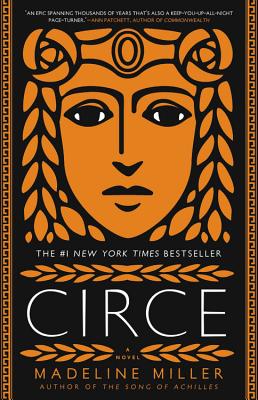
I am not overly familiar with Circe’s myth. As one of our customers said, when I mentioned that I was reading this book, “she’s the one who turned men into pigs, right?” That’s pretty much all I knew.

So, I was taken with Miller’s re-imagining of this myth. (And since I didn’t have anything to compare it to, I was a blank slate.) Circe was an interesting character (if a bit annoying at times), and I really loved her slow growth arc, how she went from being a clueless daughter of the god Helios to a witch to a woman with a confidence in her own abilities. I liked the details that Miller put in; you could tell she’s a scholar of the mythology, and she handled the huge cast of characters extremely well. It was a bit slow in the middle, when Circe was exiled to her island, but nothing much else was going on, but once Odysseus showed up, it picked back up again.

All of this to say: I really enjoyed this one a lot!

First Sunday Daughter Reviews: April 2019

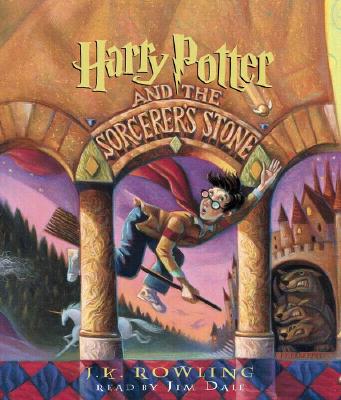
K, having plowed through Lord of the Rings and then Watership Down (she really liked it and thought it was a really good story!), has decided that she needed to revisit this:

Actually, she’s plowed through the first five in the past week (she says three and four are her favorites, though she really liked the fight scene at the ministry of magic in number five (even if angsty Harry is her least favorite).)

She inspired A, who (finally!) finished Salem’s Lot and was wondering what to read next, and so she’s begun the descent into Hogwarts. She’s not reading as fast, partially because she doesn’t but also partially because she’s up to her eyeballs helping build a set for Dracula, which is next weekend.

What are your kids reading?

Internment

by Samira Ahmed
First sentence: “I strain to listen for boots on the pavement.”
Support your local independent bookstore: buy it there!
Review copy provided by the publisher.
Content: There are instances of mild swearing, plus a handful of f-bombs. It’s in the Teen section (grades 9+) of the bookstore, but just because of language. The themes are good for anyone, really.

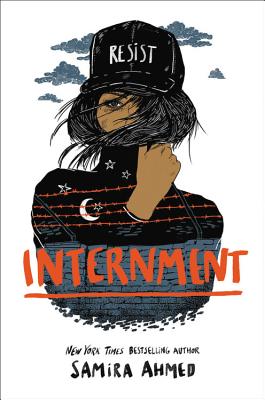
It’s in the near future, and the U. S. government has decided that Muslims are a threat to the country. It started with a registry, with everyone declaring their religion. And then Muslims began to be discriminated against (well, they probably were already), and now they’re being rounded up and taken to internment camps. To keep the rest of America safe from them.

Layla and her parents are among those rounded up and sent to camp Mobius in the California desert. It’s a harrowing experience: being arrested at home and then shipped on a train to an isolated “camp” (read: prison; there aren’t cells, but they’re kept in with an electric fence) where they were expected to comply to rules and are constantly watched over by drones and guards.

Layla, however, is not okay with all this. (Fair.) In spite of her parents’ pleas to just get along, Layla decides that she needs to Do Something. So, she smuggles out articles she’s written about conditions in the camp — the Director using intimidation and force and the disappearances of other internees — to be put on blogs. She organizes protests. She makes friends with sympathetic guards on the inside who help her along with her boyfriend on the outside. They stand up for what they believe in, and resist.

I think that was the thing that was most striking to me: that resistance to authority comes from the teenagers. It probably always has. Adults get complacent, and are conditioned to not make waves. But teenagers? They’re often idealistic and want a better world. And have the courage to make it happen. And Ahmed captured that perfectly.

Yes, this book is heavy-handed: Ahmed hammers the idea that This. Is. Wrong. home in so many ways, but I think this book is meant for White People. Seriously. I am sure that so many of the themes of racism and exclusion and mistrust of the Other are already known to Muslim (and Black and Asian and Native) people. The people who need to see this are White. And probably middle class. And comfortable in their lives. (Like me.) We need to remember that inaction is the same as action. And that just because we don’t see or experience the problems doesn’t mean they’re not there.

In the end, the question I thought this book was asking was: What kind of White Person will you be? (Granted, I’m coming at it with this perspective. I’m sure others will get something different out of it.) And that’s a good question to be asking right now.

Animus

by Antoine Revoy
Support your local independent bookstore: buy it there!
Content: There are some unsettling images. It’s in the graphic novel section of the bookstore, but I’d give it to a 5th/6th grader who wants something weird and unsettling.

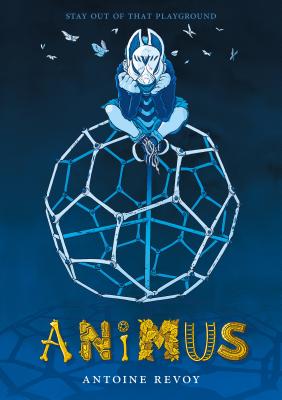
Tucked away in Kyoto, Japan is a small, unassuming playground. No one things about it, not parents, not kids who play there. Except, one day, friends Hisao and Sayuri see a masked ghost. That tells them the playground is alive: the swings can transport you into people’s dreams, the statues can hear everything, and the slide… well, the slide ages you super fast.

Which might explain all the missing children.

So, Hisao and Sayuri embark to figure out what makes the playground tick, and to perhaps find some of the missing children, and maybe put things back to rights.

I think I expected this to be creepier than it was. It was odd more than unsettling, Weird more than disturbing. The mystery wasn’t terribly mysterious. And I kept thinking that maybe Japanese kids being drawn by a Frenchman was a bit, well, problematic. That said, the art was gorgeous, and I appreciated that Revoy kept the traditional manga black and white instead of coloring it.

Maybe I just went in with too high of expectations.

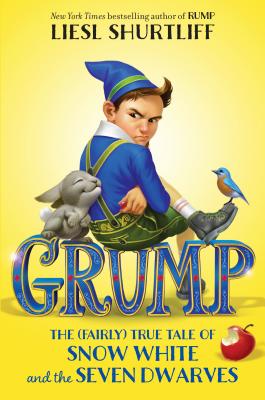
Grump

by Leisl Shurtliff
First sentence: “I was born just feet from the surface o the earth, completely unheard o for a dwarf, but it couldn’t be helped.”
Support your local independent bookstore: buy it there!
Content: It’s got a longer chapters, and some challenging words, but nothing too outrageous. It’s in the Middle Grade (grades 3-5) section of the library.

Borlen is a very unusual dwarf: he was born near the surface and is more curious about the human world than digging for gems. He carries around a pet bat, and spends his time reading about the human world and trying to go above and see it. His Fate Stone — the stone that all dwarves get when they come of age — is a mirror, which is unheard of. And so, when he’s placed as a Seventh (the worst position) on a mining team and there’s a chance for him to see what the humans are like, he takes it. 

Once above ground, Borlen stumbles into the clutches of Snow White’s power-hungry stepmother, the Queen Elfrieda Vronika Ingrid Lenore (let’s see if you get it), who unfortunately mis-interprets the word “fairest” to mean most beautiful instead of most fair. That creates a problem for Borlen, when he’s tasked with seeing Snow White killed.

The rest of the plot follows the fairy tale pretty closely, and I enjoyed it. I’m not entirely sure why giving Borlen — Grump of the seven dwarves (I recognized Sneezy, Bashful, and a couple others in the mix) — a backstory was necessary to retell Snow White, but it did make for an entertaining little book.