

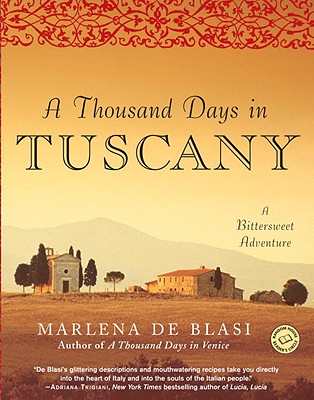
 A Bittersweet Adventure
by Marlena de Blasi
Ages: adult
First sentence: “Ce l’abbiamo fatta, Chou-Chou, we did it,” he says, using the name he gave to me, clutching the steering wheel of the old BMW with both hands, elbows out straight like wings, shoulders hunched in glee, wheezing up a conspiratorial laugh.”
Support your local independent bookstore: buy it there!
A friend of mine loaned this to me last October, when I was effusing about my reread of Under the Tuscan Sun. I let it sit on the shelf for months, figuring I’ll get to it when the time is right.
When I started it yesterday, I despaired: perhaps I was destined to like only one book about Tuscany. But, where Frances Mayes book is about a love of a house and finding a place, de Blasi’s book is about a love of the people and the food of that place. It took me a while to understand what de Blasi was trying to tell me, but by the end I was hooked, luxuriating in the descriptions of the food, and submersing myself in the stories of the people.
She and her Venetian husband, Fernando, uproot their somewhat comfortable Venetian lives and head for Tuscany, somewhat on a whim: they need something new, something different to feel alive again. It’s scary and intimidating and exhilarating all at once. And once they got to their rented house in Tuscany, they find so much more than they bargained for: a friend in Barlozzo, an old curmudgeon who has opinions about everything, and yet is generous with his time and knowledge about the countryside and its charms (especially food-related!). They find a community in the town they’re living in, friends, kindred spirits, family. They find solace in simplicity and rusticness. (Okay, not a word, but you get what I mean.)
One quote that I thoroughly liked (she’s talking about her former profession as a food writer), and think is a good example of the goodness of simplicity:
Enticed neither by swirls of kiwi puree forced from a plastic bottle nor by teetering constructions built from a puff of pastry upon which rested a grilled lamb chop upon which was piled a roasted pear, the pillar secured by spears of asparagus, which leaned fetchingly against it, a few hard-cooked lentils strewn casually about with petals of a zinnia, I’ve always wanted food that sent a current straight to my loins. I’d find it exhausting, having to break down a still life before getting to my supper… And so it was that as chefs began to decompose the very molecular structure of food, recasting it into ever more bizarre forms and substances, it became harder and harder to stay excited about my job…. And now I’m wishing could I scoop up all those men and women who began their chef lives as purists and bring them here to wander these markets, to stand in front of the burners with some of these chefs who change their menus every night so as to reflect that morning’s market, and who are not quietly amazed by this fact as a proof of their own genius.
While the book is slow to show it’s charms (at least for me), it’s like an old friend, sitting down over a glass of wine (for those who drink wine, anyway), talking about everything and nothing all at once. It speaks to your soul (well, at least mine), and invites you to look at what you have and need, to reflect upon what is truly important.
And what better kind of book is that?
 The Book Nut
Sounds like a nice book to relax with!
LikeLike
This is one of my favorite books of all time. The only thing on my bucket list is do exactly what she did. And the recipes are the best!
LikeLike
My library has this one! I hope I like it too.
LikeLike
I do, too, Amira. 🙂
LikeLike