

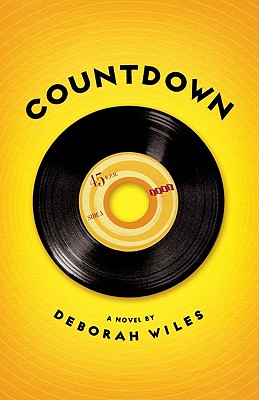
 by Deborah Wiles
ages: 10+
First sentence: “I am eleven years old and I am invisible.”
Support your local independent bookstore: buy it there!
It’s the fall of 1962, and there’s tension in the air. Fifth-grader Franny Chapman is not quite sure what’s going on with her best friend; her Uncle Otts seems to be not quite there anymore, instead spending more and more time fighting an old war in his head. Her mother is distracted, her father is gone, her older sister is choosing to spend time with her college friends and leaving Franny behind. Even her teacher has skipped her every single time when it’s her turn to read aloud in school.
On top of all that, the president — John F. Kennedy, for those of us who didn’t do well in history — has just informed the country that the Soviet Union is sending missiles to Cuba that have the potential to blow the entire country up. Franny only wants to be worried about going to her first boy-girl party, not whether or not she’s going to live to see tomorrow.
This book is billed as a “documentary novel”; the narrative is interspersed with pictures and quotes and clippings (there’s a Fallout Shelter Instruction Manual!), presumably to give the reader (who, we assume, didn’t do well in history either) some frame of reference. And taken separately, both the non-fiction parts and the fiction parts were interesting. I kind of liked Franny, and her struggles. I wanted to smack her mom, and I kind of felt that Wiles was playing up an early-60s mom stereotype: the bridge-playing, cigarette-smoking, mostly absent mom who was a very strict disciplinarian when she was around, and yet somehow had a soft heart for her children, though her son saw it more. (We’ve come a long way, baby.) And I liked the non-fiction parts as well. The quotes, the bios of notable people, the pictures were all fascinating to look at.
I just think this book tried to do too much in combining both. The narrative felt interrupted to me, and I didn’t get the sense of foreboding about the Cuban Missile Crisis that I think the author wanted us to get. In some ways, I think this would have worked better as a straight-up non-fiction book, like Marching for Freedom or Claudette Colvin. Combined with quotes and interviews, this could have been a compelling book. (I’d love to see one done from a Cuban perspective, personally.) But as it is, the book fell short in many ways for me. It tried to do too much (there’s even a faint subplot about the race issues in the country at the time, but it was never developed enough to do much with), and because of that, it didn’t do enough.
Which is just too bad.
(Just for the record: because this is a Cybils nominee, I’ve been asked to make sure y’all know this is my opinion only, and not that of the panel.)
 The Book Nut
I'm sorry this one didn't work for you 😦
I really enjoyed it for the different way it taught the historical elements. But agree that it was a bit choppy in spots.
LikeLike