

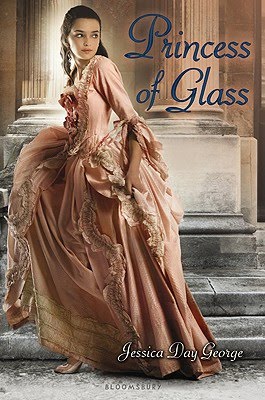
 by Jessica Day George
ages: 11+
First sentence: “‘Perfect,’, the Corley said, lips stretched wide in a smile.”
Support your local independent bookstore: buy it there!
Review copy sent to me by the publisher.
Ah, fairy tale adaptations. Round whatever. In one corner: Cinderella. In the other corner: Jessica Day George’s newest. And how does the new book hold up against the original? Surprisingly, quite well.
It helps, I think, that this is a sequel, of sorts, to Princess of the Midnight Ball. Our main character is Princess Poppy, one of the sisters forced to dance through the night for the evil King Under Stone. In the aftermath of that, the various countries relations are falling apart, and Poppy’s father and King Rupert of Briton devise an exchange program. Poppy is sent to Breton, but not to stay in the castle. Instead Rupert invites Prince Christian of Danelaw to stay in the castle. And, then becomes obsessed about getting him married off, preferably to a Breton.
Poppy is a delightful character: not your typical princess (it’s best when they’re not, you know): she prefers to play cards and talk rather than dance, for obvious reasons. It makes going to balls uncomfortable, so she doesn’t have much opportunity to meet people. But meet Christian she does, and they fall into a nice, happy, casual relationship.
Enter Ellen. She was once nobility, but then her father got in over his head with gambling debts, her mother died, and then her father sold off everything and died himself. Left alone, she was force into being a maid in the house Poppy’s staying at. Which she was absolutely horrible at. Then The Corley contacted her, told her she was Ellen’s godmother, and offered to make her wishes come true. This is where the story takes some interesting twists; instead of wicked stepsisters, the readers dislike the Cinderella figure, especially as Ellen goes to the balls, upstaging both Poppy and her cousin Marianne. The only problem, I think, is that as Ellen goes in, under enchantment, to steal and get Christian to marry her, there isn’t much reason to not let her. Sure, Poppy and Christian are friends, but there’s not enough of an attachment to make the reader terribly worried.
On the other hand, one of the more interesting parts is watching Poppy — with the aid of some family friends — unravel The Corley’s enchantment, while finally coming to terms with the after-affects of her own. She’s singularly determined to make it work, and while the ending is a bit rushed, it does work.
Which is to say, this is one fairy tale adaptation that does its job quite well.
 The Book Nut
I would really like to read this one immediately. It is not at the top of my TBR pile, but maybe if I do a bit of shuffling…
LikeLike
I have this one from the library on top of my fridge RIGHT NOW 🙂 Hopefully it will be enjoyed while I am at the BEACH in ONE WEEK!! YAY!!
LikeLike